

Do not silently change a released pivot-bolt drawing from DIN 912 to ISO 4762. DIN 912 is withdrawn, but that status does not itself authorize changing the supplied component or its mating interfaces. Establish the legacy edition, explicit drawing requirements and proposed replacement before comparing them. The useful review concerns thread pitch, head clearance, bearing contact, custom shoulders and final supplied condition, not just two names for a socket-head screw. For spare parts, retaining the defined baseline may be the relevant request; for a revised design, a new reference needs an explicit definition. PremFixer can review the manufacturing request without declaring every legacy part interchangeable.
Hero: concept illustration of example hardware and its application. It is not a factory photograph, tested component or approved production geometry.
Separate a withdrawn reference from an unusable part
DIN Media's DIN 912 record marks the 1983-12 edition as withdrawn and lists DIN EN ISO 4762 replacements. It also identifies DIN 912 as a modified ISO 4762 adoption. A replacement listing does not establish that every particular drawing or size has identical requirements.
DIN Media's guidance on withdrawn standards recommends current editions, while recognizing agreed use of historical standards subject to legal limits. That is not a blanket permission for every application. Establish the contractual requirement and any applicable restriction separately.
For a drawing-controlled spare, determine what the existing designation actually specifies. For a redesign, identify the intended new basis. Neither decision should be disguised as an administrative spelling correction to an unchanged purchase order.
Read the exceptions before choosing a catalog substitute
A pivot drawing may borrow a socket-head form while separately defining a locating shoulder, shortened thread, special pitch or reduced head. Those details can carry the joint's function. The general product designation should not erase them merely because a catalog screw looks similar.
Separate features governed by the cited product standard from explicit drawing dimensions and supplementary notes. If their relationship is ambiguous, resolve the specific conflict. Do not let quotation software choose which instruction controls a shoulder that locates a bearing.
The socket-head, hex-head and flange-head comparison addresses choosing a head form. This review instead concerns continuity of a legacy definition: what must survive when a replacement reference is proposed for the same controlled item.
| Feature | Legacy requirement to retain | Replacement risk | Useful verification |
|---|---|---|---|
| Thread | Explicit diameter, pitch and engagement | Same diameter but incompatible pitch | Compare thread callout and receiver |
| Head envelope | Clearance and tool access | Head or drive collides in recess | Compare dimensional limits and access |
| Under-head region | Contact face and transition clearance | Recess contact differs from visible fit | Review receiving face and actual transition |
| Locating shoulder | Diameter and useful contact length | Standard shank loses locating function | Compare finished features with mating bore |
| Material and surface | Required final condition | Unstated material or finish substitution | Reconcile separate drawing requirements |
| Reference and exceptions | Edition and explicit custom definition | Cross-reference erases drawing exceptions | Define retained features and accepted changes |
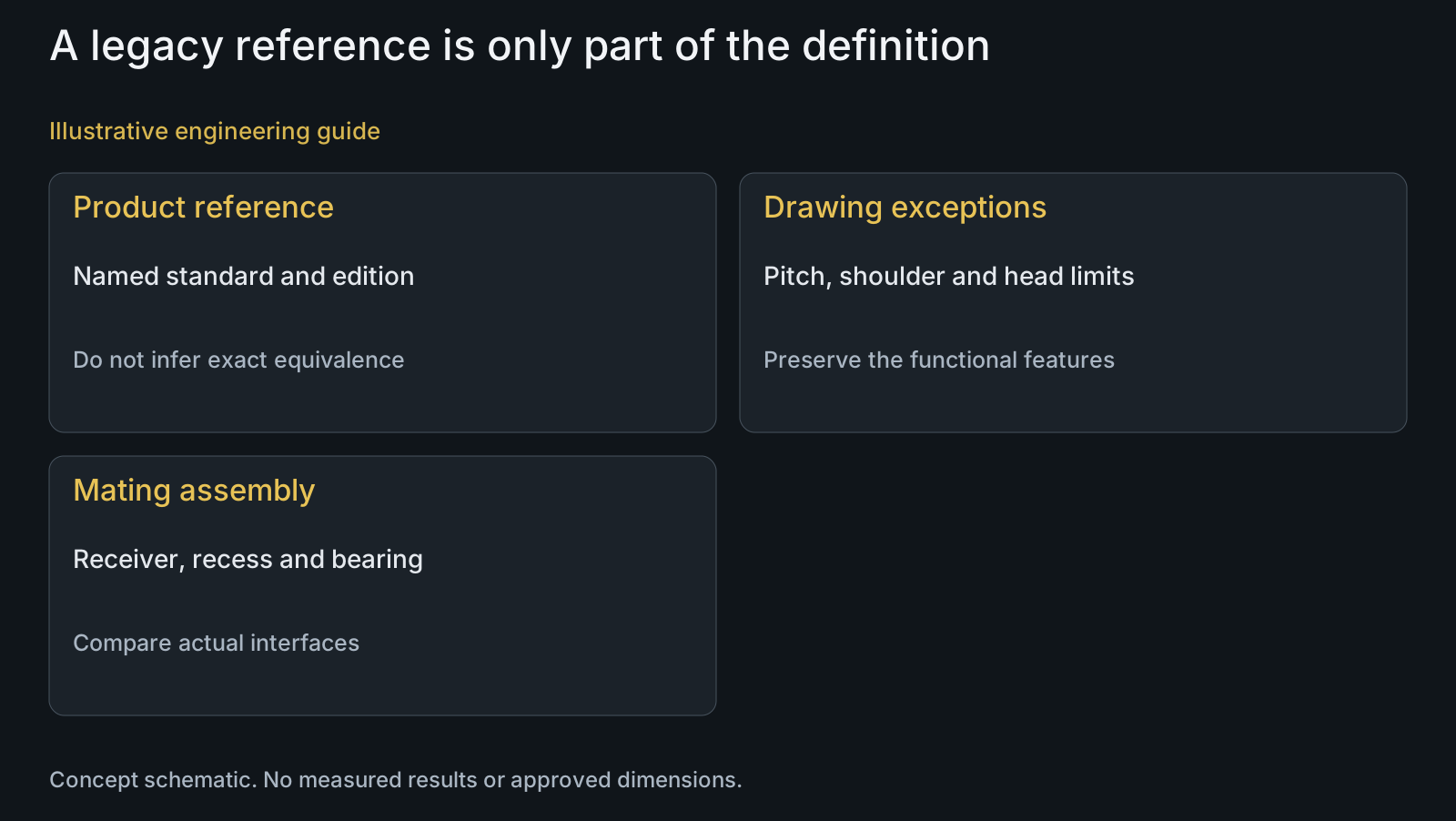
Check thread pitch before calling the candidate equivalent
ISO 4762:2004's public scope covers coarse-pitch hexagon socket head cap screws of product grade A, from M1.6 to M64. A legacy drawing's explicit fine-pitch requirement cannot therefore be silently replaced by a coarse-pitch catalog description.
Compare the required diameter, pitch, engagement region and receiver definition. A shared nominal diameter is not enough: a different pitch changes the mating thread relationship. Do not use apparent initial engagement or forced assembly as a compatibility test.
Also compare thread runout with the location of the clamp and locating regions. A candidate can have a suitable thread designation yet place the transition in the wrong interface. Use the drawing and fit guide to define the actual controlled features.
Compare head and shoulder interfaces in their final state
For the head, compare the envelope with recess clearance and access for the intended tool. Then examine the under-head contact and transition against the receiving face. A fit in the visible recess does not establish suitable contact below the head.
For a shoulder, identify the locating diameter, useful contact length and transition clearance. Replacing a custom locating section with a standard threaded shank can change how the bearing or sleeve is supported even if the head remains familiar.
Use actual dimensional requirements and tolerance limits from the specified editions and drawing. The full dimensional tables were not available for this discussion, so no universal head-diameter tolerance change is asserted. Inspect the proposed finished condition, including relevant coating dimensions, rather than assume a name change proves interchangeability.
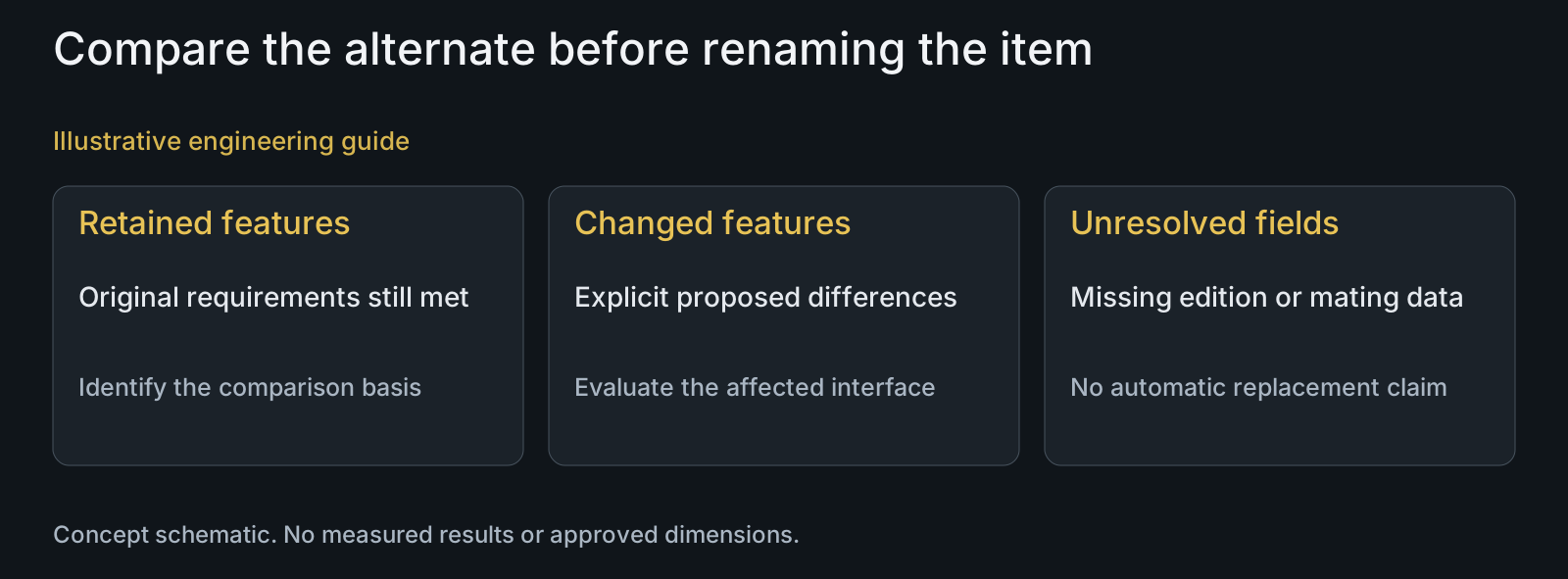
Describe the replacement offer as retained features and changes
A meaningful offer identifies what is retained, what changes and what remains unresolved. Distinguish an exact legacy drawing request, a proposed alternate with exceptions and a newly defined drawing. Calling all three 'ISO equivalent' hides different purchasing decisions.
Keep the material, required finished properties and surface condition in the comparison. A dimensional substitution review does not authorize a material change. The property-specification guide explains why a familiar designation is not a complete application rating.
Discuss manufacturing against the defined part, not an assumed universal stock item. PremFixer manufactures drawing-controlled fasteners and can identify relevant feasibility questions; this article does not promise every historical standard, custom exception or replacement will be available without review.
Resolve a legacy fine-pitch spare without changing its receiver
Illustrative engineering example: assume a released spare-part drawing cites DIN 912 but explicitly defines a fine-pitch thread and a bearing-locating shoulder. A buyer receives a proposed ISO 4762 catalog screw with the same nominal diameter. No actual project, dimensions or test result is assumed.
The buyer does not start by accepting the new reference. The thread requirement and custom shoulder are compared first. A coarse-pitch candidate does not preserve the stated thread interface, and an ordinary shank does not establish the required locating function. The alternatives are to request the defined custom part or evaluate an explicitly changed assembly, not force the candidate into the existing receiver.
Supply the legacy drawing and applicable edition with the mating definition and proposed alternate. Consistent drawing and BOM files let the review concern the actual differences. Any new definition must state the accepted features rather than leave the old exceptions implicit.
Questions buyers need to confirm
Does withdrawal of DIN 912 automatically make a spare unusable?
No such conclusion follows from withdrawal alone. Establish the exact legacy requirement, contractual context and applicable restrictions. A proposed purchasing substitution remains a separate decision.
Can ISO 4762 be entered in the order without telling engineering?
Not when it changes the controlled definition. Identify the proposed reference and compare relevant features and exceptions. A cross-reference is not authority to alter a released part.
Does the same nominal thread diameter prove compatibility?
No. Compare pitch, engagement and the receiving thread as well. A changed pitch cannot be resolved by forcing assembly, and the thread transition may affect a nearby locating or contact region.
Are all head dimensions and tolerances identical?
Do not assume that. Compare the actual size and editions with the drawing's head envelope, tool-access and under-head requirements. No complete dimensional tables or universal tolerance-change claim are supplied here.
Does a standard replacement preserve my special shoulder?
Only if the proposed definition actually retains the required diameter, length and transition. A socket-head product name does not independently specify a custom bearing-locating section.
What should I send for a legacy replacement quotation?
Send the controlled legacy drawing, named edition and exceptions, with receiver or mating geometry, material and finish requirements. Include the proposed alternative so the offer can distinguish an exact request from a changed definition.
Technical references and scope
DIN Media DIN 912:1983-12 catalog record. Withdrawn status, modified ISO adoption and listed replacement editions, not complete dimensional equivalence.
ISO 4762:2004 public scope. Coarse-pitch socket-head cap screw range and product grade only; no unavailable dimensional tables inferred.
DIN Media guidance on withdrawn standards. Current-edition recommendation and qualified historical-use explanation, not application-specific legal authorization.
Explore related component, material and sourcing decisions in the customer decision knowledge center. For a drawing review, use the Drawing/BOM RFQ path.
Keep the legacy interfaces visible in your RFQ
Send the legacy drawing, STEP or sample reference, BOM and applicable edition, together with the receiver, recess and locating requirements. Include any proposed alternate so PremFixer can review retained custom features, manufacturing feasibility and the differences requiring a decision.
Discuss the drawing and BOM