
Do not replace an 8.8 pivot fastener with A2-70 simply because both labels are associated with strong bolts. They belong to different specification systems, and the actual component still needs applicable finished-property and geometry requirements. ISO 898-1 concerns carbon and alloy steel fasteners; ISO 3506-1 concerns corrosion-resistant stainless steel fasteners. Compare the proposed part against the required joint function, including its head, shoulder, receiver and supplied surface condition. A class label is not a complete fatigue, corrosion or torque/clamp-force specification. PremFixer can discuss the defined manufacturing request, but substitution approval must address the actual component and application, not the apparent similarity of two numbers.
Hero: concept illustration of example hardware and its application. It is not a factory photograph, tested component or approved production geometry.
Select the relevant specification system before comparing labels
ISO 898-1's public scope identifies carbon/alloy-steel bolts, screws and studs. ISO 3506-1's public scope identifies stainless counterparts with specified grades and property classes. Confirm the part, edition and product coverage instead of citing either entire series without a defined subject.
Treat 8.8 and A2-70 as requirements to interpret within their applicable systems, not interchangeable material names. Do not rank them by comparing the printed numbers or assume one suffix provides every property needed by an oscillating pivot assembly.
The A2-70 and 304 receiving guide addresses delivered evidence and material identity. This article addresses specification and substitution: what the drawing must request before a supplier can offer a meaningful alternative.
Keep the actual custom shape in the property discussion
Both public scopes flag geometry-related limitations on loadability. A custom head or reduced section therefore needs review alongside the claimed property requirement. Do not assume the conventional shape used in a familiar class table represents every low head, hollow shank or special shoulder.
Compare the complete proposed geometry with the required function. A larger shoulder can locate a bearing without changing the critical head or threaded region in the same way. One visually substantial feature does not prove that every section is adequate for the requested conclusion.
Identify any relevant limitation explicitly rather than ask the manufacturer to apply an unrestricted label to an unsuitable shape. The exact applicable provision and evidence need the full specification and actual drawing. No universal head thickness, reduction factor or allowable pivot load is assigned here.
| Requirement field | 8.8/carbon-alloy proposal | A2-70/stainless proposal | Buyer decision |
|---|---|---|---|
| Specification system | Identify applicable steel fastener basis | Identify applicable stainless basis | Correct part/edition and product coverage |
| Material definition | Required stock and condition | Required grade and condition | Do not infer one exact alloy from a label |
| Custom geometry | Actual head, shank and thread | Actual candidate head, shank and thread | Review limitations on the supplied shape |
| Finished-property evidence | Applicable requirement and specimen | Applicable requirement and specimen | Comparable requested conclusions |
| Locating/contact interfaces | Baseline mates and final state | Changed or retained mates and final state | Functional relationship remains acceptable |
| Assembly/application behavior | Approved basis and relevant evidence | Alternative's unresolved questions | No automatic torque or fatigue equivalence |
Write material and finished-property requirements coherently
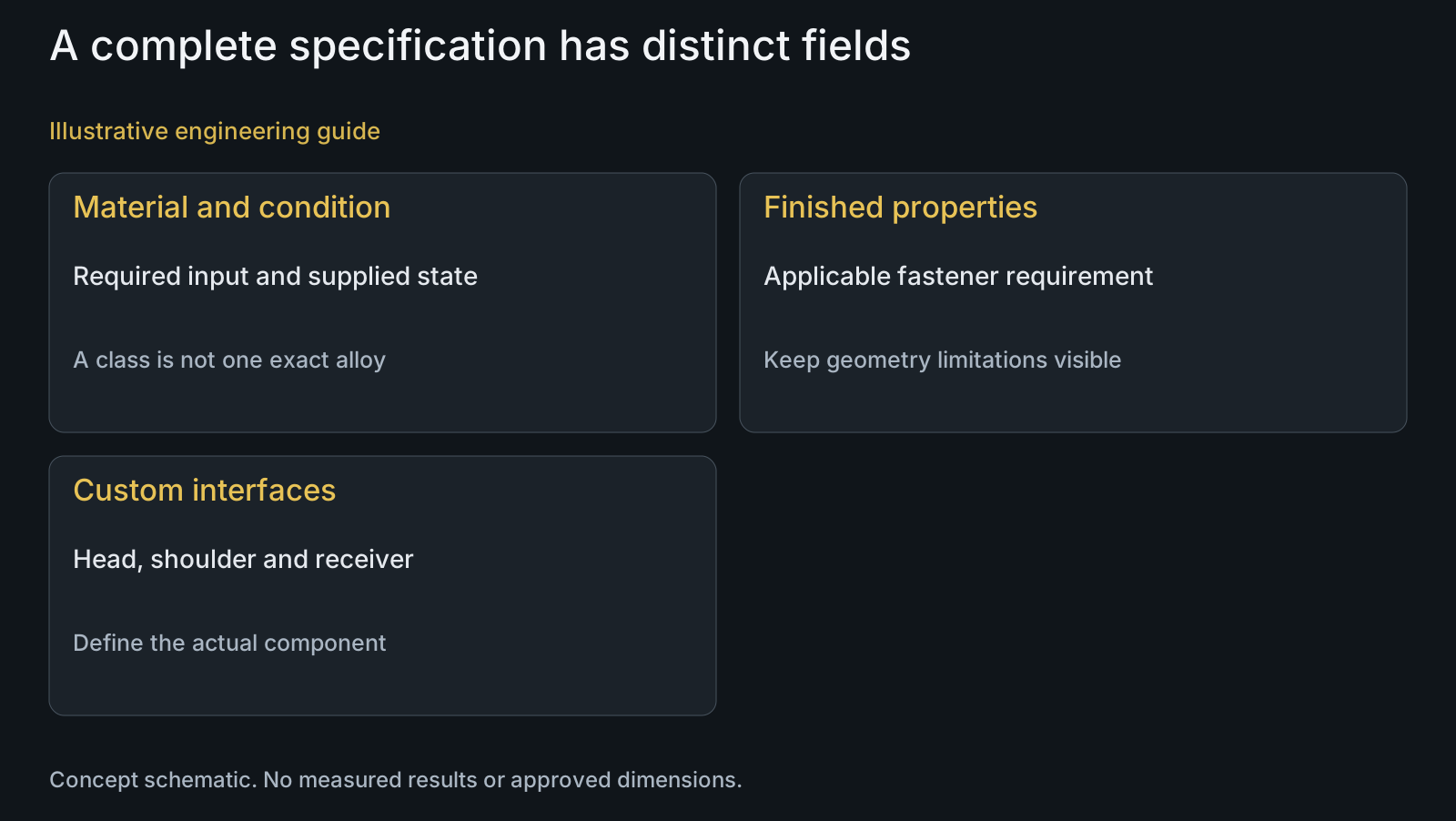
A raw-stock designation, product condition and finished-fastener property requirement can address different fields. State the necessary combination without creating contradictory notes. If a particular material is required, do not let a property-class label silently authorize every stock alternative that might fit a broader family.
Ask the supplier to identify a conflict between the requested material condition, geometry and finished requirement before quotation. The useful response names the conflicting fields and any proposed alternative. It should not simply return a familiar head mark as proof that the drawing can be fulfilled.
Use the material-selection guide for the design decision and the manufacturing overview for the defined route discussion. A changed alloy, forming route or heat condition may alter the relevant questions; no universal processing recipe follows from the designation alone.
Specify the joint questions the class does not answer
The examined public scopes do not establish requirements for fatigue resistance or torque/clamp-force behavior. A property designation therefore cannot substitute for a relevant assembled-joint assessment or a validated installation instruction.
For a proposed substitution, compare the actual receiver, effective engagement, contact path and supplied finish. If a new part changes those conditions, preserving the old wrench setting without an appropriate basis can obscure a different assembly result. The assembly-torque guide addresses that separate decision.
Likewise, decide the required corrosion or surface behavior for the actual exposure rather than infer it from a class number. A material alternative can address one concern while leaving another unresolved. Keep the application's interface context visible instead of collapse all needs into 'higher strength.'
Choose evidence by the requirement it must substantiate
A material record supports its represented stock. Finished-component property evidence supports its identified specimen and condition. Feature inspection addresses the named geometry. These outputs can complement one another, but no single title should expand one into all three conclusions.
For custom geometry, identify how the proposed assessment applies to the supplied shape and what conclusion is requested. A convenient stock specimen may not address a low-head limitation, and a shoulder diameter report does not establish a finished property class. Do not invent a specimen plan or acceptance value without the governing basis.
The test-report guide helps define document scope. PremFixer coordinates relevant manufacturing and partner work within the agreed request; no universal mechanical test entitlement or owned laboratory is claimed by a general property-specification discussion.
Review a stainless alternative with a different head
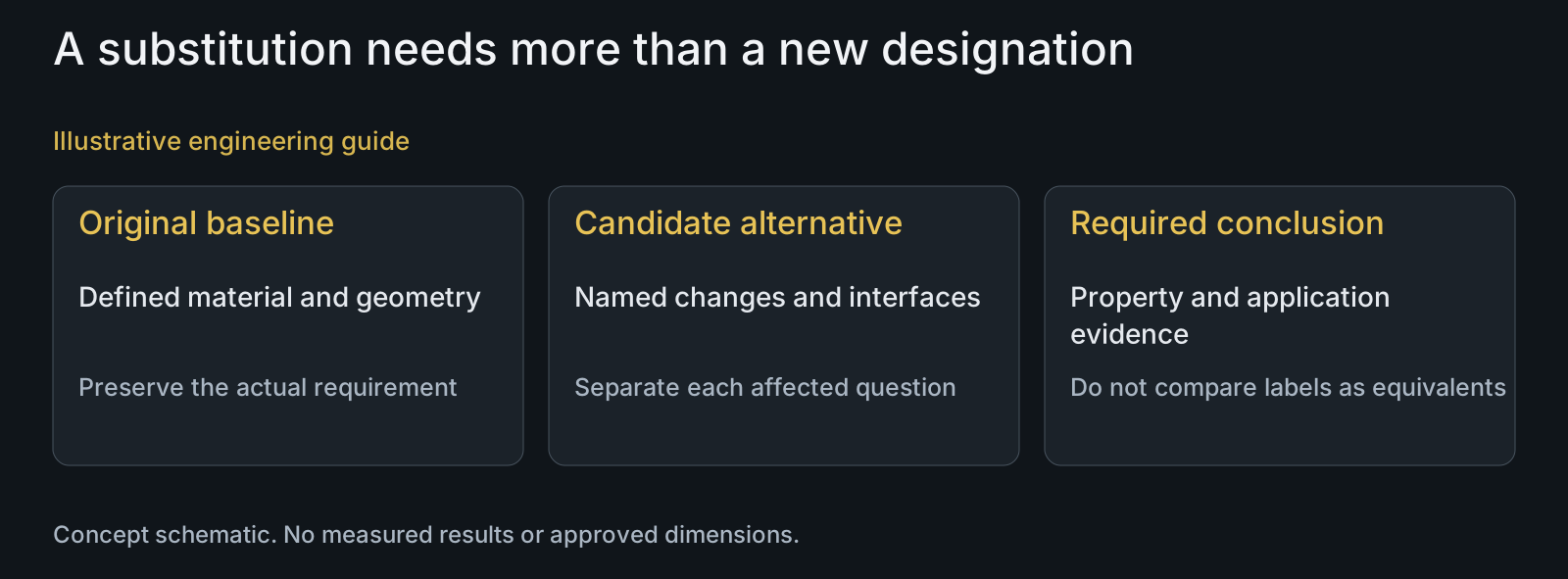
Illustrative engineering example: assume an OEM considers replacing a defined carbon/alloy-steel pivot bolt with a stainless candidate using a lower head for tool-access reasons. The proposal changes both material specification and geometry. No actual class result, load, customer project or accepted substitute is assumed.
The team separates the questions. It identifies the requested finished properties under the relevant system, checks the low-head geometry's implications and compares the actual joint interfaces and supplied state. A favorable corrosion discussion does not settle the head question, and an unchanged nominal thread does not prove equivalence.
Only a defined alternative can be meaningfully offered and assessed. Provide consistent RFQ files, material requirements and the original baseline beside the proposal. Keep any outstanding property or assembly decision visible rather than rename the candidate as an automatic replacement.
Questions buyers need to confirm
Are 8.8 and A2-70 interchangeable specifications?
No automatic equivalence follows. Interpret each within its applicable system and compare the actual finished requirements, geometry and joint needs. A substitution needs a defined alternative and the responsible review, not similar-looking numbers.
Does a property label identify one exact raw-stock alloy?
Do not use it that way. State any specifically required material designation and condition separately, and reconcile them with the finished-fastener requirement. A broader classification should not silently override the drawing's material field.
Can a low custom head carry an unrestricted familiar class claim?
Check its geometry and the applicable provisions. The public scopes identify possible loadability limitations. Do not apply a conventional-shape assumption or invent a reduction factor; define the actual shape and requested conclusion.
Does property-class conformity prove pivot fatigue life?
No such conclusion follows here. The relevant assembly and repeated-use question needs its own basis. A property designation and static component evidence cannot be expanded into an untested service-life claim.
Can the old tightening instruction be retained after substitution?
Only with an appropriate basis for the actual changed joint. Compare receiver, engagement, contact and supplied surface conditions. An unchanged thread size does not independently establish the same clamp behavior or installation result.
What information helps price a proposed alternative?
Provide the baseline and candidate drawings, material/condition requirements, applicable fastener specification, mating context and supplied finish. Identify which geometry or evidence changes so the offer concerns a defined alternative rather than an automatic equivalent.
Technical references and scope
ISO 898-1:2013 public scope. Carbon/alloy-steel product scope, geometry-related limitations and noncoverage of fatigue/torque-clamp properties; no unavailable property table or component value inferred.
ISO 3506-1:2020 public scope. Stainless grade/property-class product scope, geometry loadability and noncoverage of fatigue/torque-clamp properties; no exact material equivalence or unverified test value.
Explore related component, material and sourcing decisions in the customer decision knowledge center. For a drawing review, use the Drawing/BOM RFQ path.
Define the candidate before comparing its designation
Send the baseline and proposed drawing or STEP, BOM and material/condition requirement, with the relevant property specification and finished interfaces. Name the changed head, shoulder, thread or finish so PremFixer can discuss manufacturing feasibility and the required evidence scope.
Discuss the drawing and BOM