
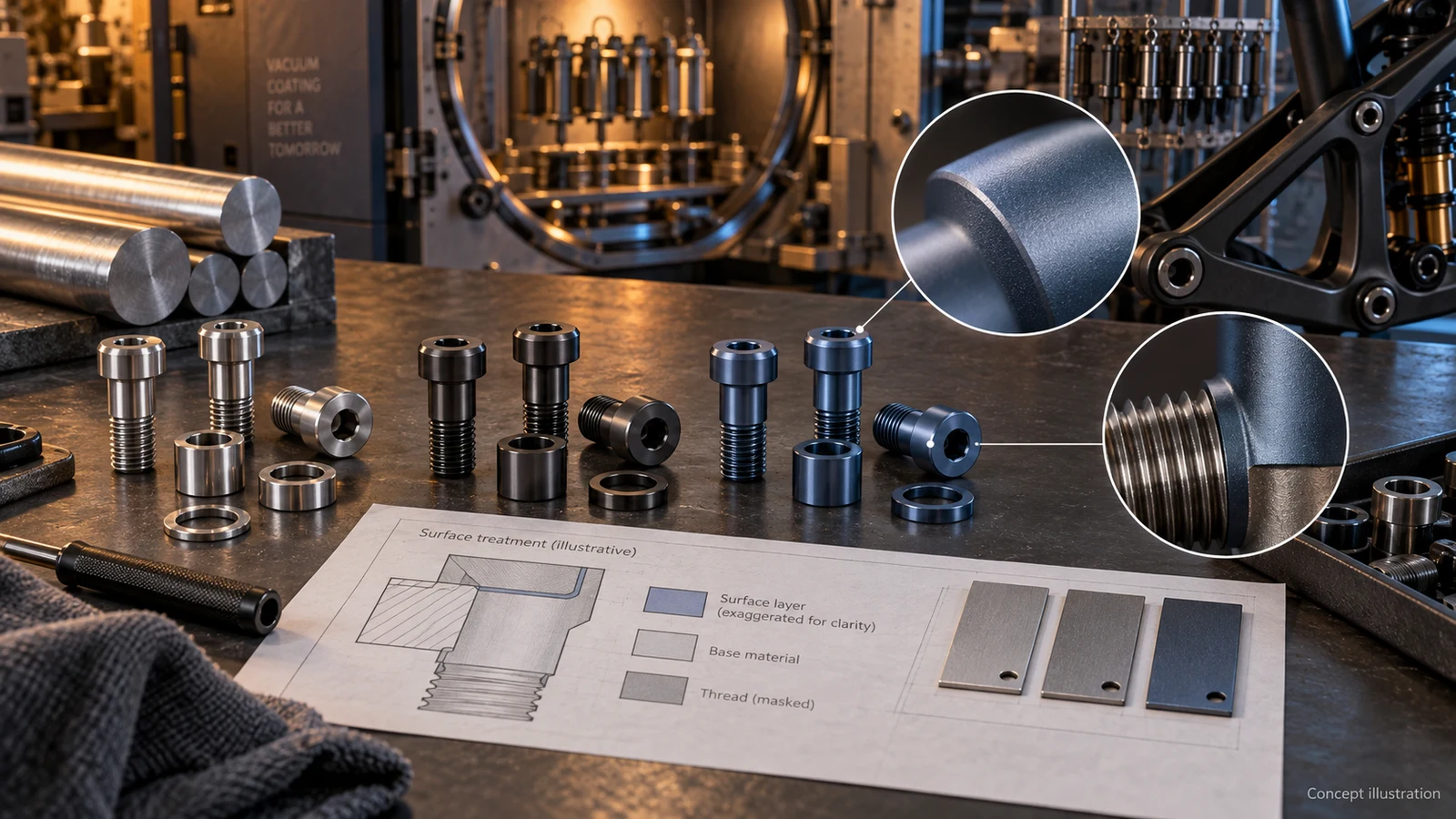
A 7075 pivot bolt can be considered for a surface treatment only after the buyer defines the substrate condition, contact and finished interface. DLC, PVD and anodizing are not three equivalent, mutually exclusive choices: DLC names a film family, PVD names a deposition route, and anodizing forms an anodic oxide finish on aluminum. A dark appearance does not identify any of them. For an OEM choosing a wear surface or corrosion strategy, the direct answer is to compare specified systems, including pretreatment, thermal exposure, coverage and mating-part effects. A coating data sheet without those application conditions is not approval for a 7075 pivot assembly.
Hero: concept illustration of example hardware and its application. It is not a factory photograph, tested component or approved production geometry.
Resolve the film name and deposition route first
A quotation headed PVD should name the deposited material and relevant process. A quotation headed DLC should identify the film system and how it is deposited. Treating those headings as competing chemistries can make two offers appear different when their classification levels, rather than their functions, differ.
Oerlikon's precision-component coating article discusses PVD coating families and a specific PACVD DLC system. Ionbond's Ionbond 40 product information identifies a particular DLC system with a PVD route. These examples explain terminology, not approval of either vendor system on this pivot or evidence that every DLC process suits aluminum.
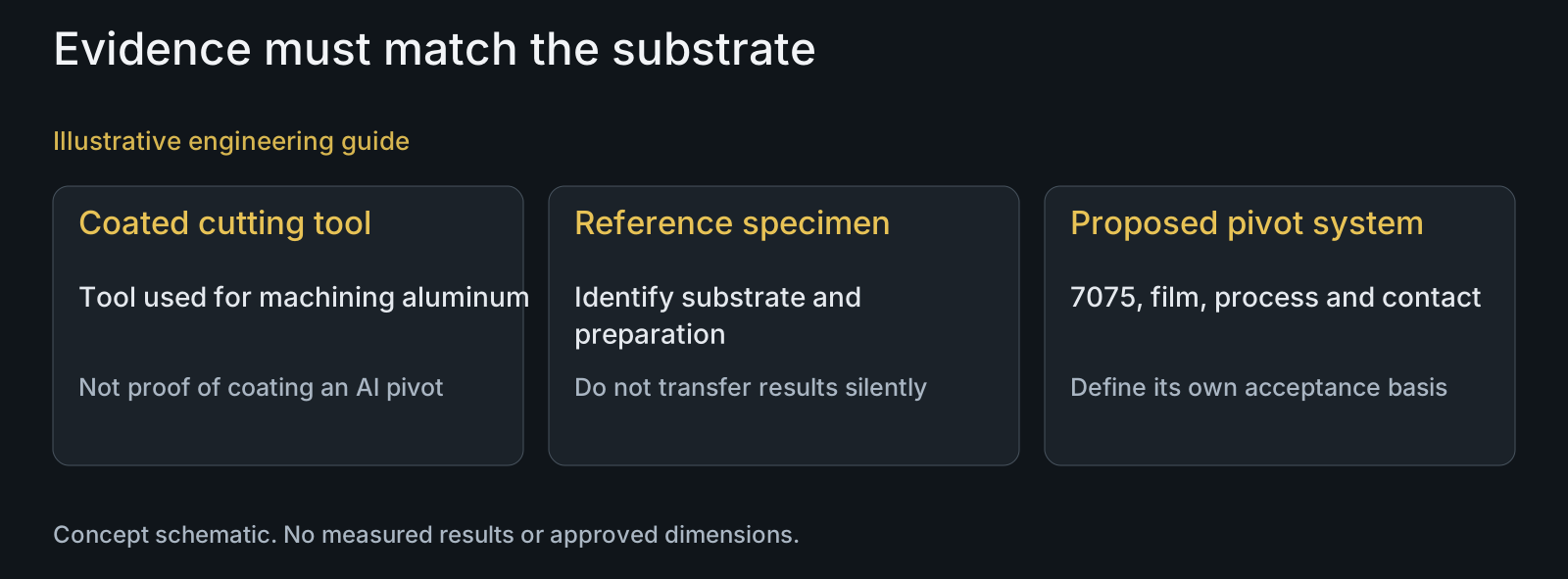
Ask the supplier to identify the exact coating, process and substrate scope. A cutting tool coated to machine aluminum is a coated tool, not necessarily a coating deposited on aluminum hardware. Keep that distinction in the evidence request. Compare with the broader pivot finish guide when the alternatives involve different base materials.
Review process heat against the specified 7075 condition
A coating's rated service temperature concerns the coated system's stated operating conditions. It does not describe the complete deposition and pretreatment thermal history. Obtain the proposed exposure sequence, including relevant heating steps, and have its effect on the specified alloy condition assessed. A short process label is not enough to approve the route.
Do not declare all DLC impossible on 7075 or all PVD safe for it. Systems and routes differ. The coating provider must address the actual substrate and process, and the product authority must accept the resulting material basis. This guide supplies no universal safe deposition temperature, time limit or post-coating strength allowance.
Keep the starting temper and any condition requirement explicit in the drawing and purchase information. The T6 versus T73 discussion explains why those conditions are not interchangeable labels. A permitted finish cannot silently replace that material requirement or make a finished-part mechanical acceptance claim unsupported by the supply records.
| Candidate definition | Condition to resolve | Unresolved risk | Evidence or check to request |
|---|---|---|---|
| Anodic oxide finish on specified 7075 | Alloy condition, preparation and final feature size | Color or nominal thickness hides an unsuitable final fit | Coverage drawing and represented finished-feature inspection |
| Named film deposited by PVD | Film chemistry, actual substrate and heat sequence | PVD label alone says little about aluminum suitability | Provider process definition and substrate-specific acceptance basis |
| Named DLC system and deposition route | Adhesion preparation, supporting substrate and mating contact | DLC performance on another substrate is transferred without evidence | Relevant system evidence and contact-specific comparison |
| Masked thread or seat within any route | Boundary position and separately protected surfaces | Unaddressed interface or coating boundary at a contact | Zone drawing and final-state feature assessment |
| Appearance sample only | What material and process the sample represents | A dark color is accepted as proof of wear or corrosion performance | Separate appearance approval from functional qualification |
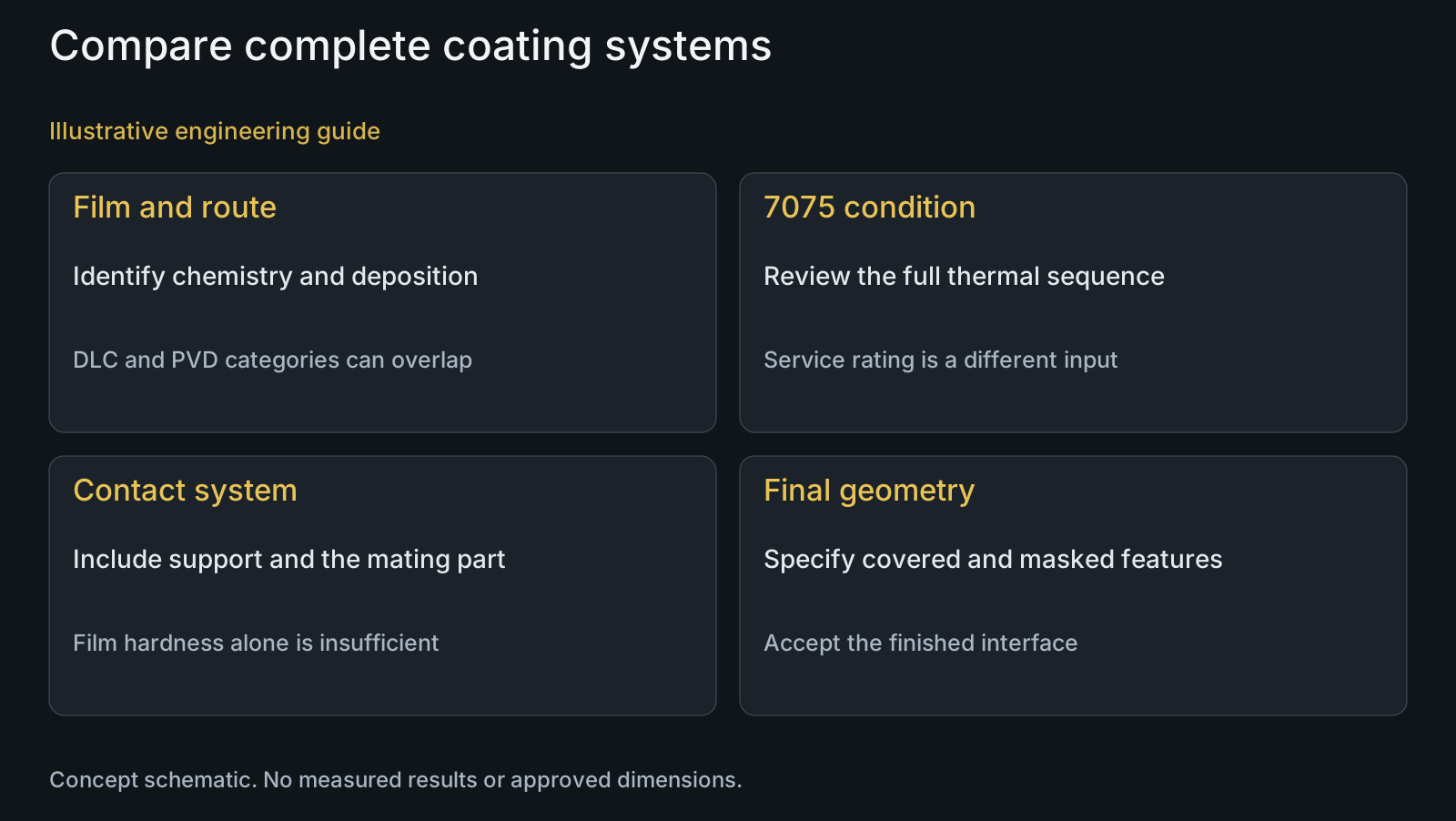
Define the contact and supporting surface, not hardness alone
Identify whether the surface is a sliding shoulder, washer contact, bearing-seat feature or exposed head. These contacts present different questions about movement, support and the mating material. Ask the provider to explain the pretreatment and adhesion system proposed for the actual aluminum surface, rather than transferring a result from an unspecified steel specimen.
A high film hardness does not establish wear behavior of the complete contact. The Aluminum Anodizers Council's hardcoat guideline distinguishes wear evaluation from relying on hardness. For another film system, require evidence appropriate to that system and contact; do not borrow an anodizing test result as DLC validation.
Consider the mating part in the selection. A bolt finish chosen in isolation may leave the receiver, sleeve or washer as the unresolved interface. Specify the motion and intended support arrangement, then define what observation or test would discriminate the candidate systems. No advertised friction value or coating life is adopted here as assembly performance.
Specify final geometry and coverage zones
Separate the machined condition from the accepted finished condition. Identify diameters, threads and shoulder lengths that must conform after treatment. The anodizing guideline highlights dimensional and pretreatment considerations; a nominal oxide thickness is not a universal correction for every final bore or shaft dimension.
A thin deposited film still needs a dimensional assessment where the fit is sensitive to added material or the preparation route. Do not approve a tight shoulder or thread merely because a brochure calls a film thin. State the required final feature and ask how the proposed process will preserve and verify it.
Draw the covered, masked and transition zones. A masked thread may need a separate corrosion approach, while a transition near a contact can introduce a boundary that deserves review. Color continuity does not establish coverage quality. The hard-anodized pivot guide covers the narrower anodic wear-and-fit decision.
Illustrative review: a dark shoulder is not a coating specification
Illustrative engineering example: assume a team requests a dark 7075 shoulder bolt with a sliding sleeve contact and a masked receiver thread. One offer says DLC and supplies data for a steel component; another says anodized aluminum but does not define the finished shoulder. No actual coating qualification or measured wear is assumed.
Neither offer yet answers the drawing. The first needs a defined process and a substrate-specific basis, including relevant heat exposure and adhesion preparation. The second needs alloy-specific finishing information, coverage and final fit. Both need consideration of the sleeve and the masked-thread boundary, not just a color sample.
The review can narrow the candidates without inventing a winner. Once the providers address those differences, the team can select an appropriate comparison and acceptance basis. A visual sample settles appearance only within its agreed scope; it does not establish material condition, mating wear or environmental protection.
Questions buyers need to confirm
Are DLC and PVD mutually exclusive alternatives?
No. DLC identifies a film family and PVD a deposition route; some particular DLC systems use PVD, while other systems use other routes. Ask for the exact film and process rather than comparing those two labels alone.
Can DLC be specified for 7075 aluminum hardware?
It can be considered, but the label alone is not an approval. Obtain the specific substrate scope, preparation, thermal sequence, adhesion basis and contact conditions. Do not assume a result on steel demonstrates suitability on this 7075 component.
Does a high service-temperature rating make deposition safe for the temper?
No. Service capability and processing exposure answer different questions. Review the actual heating sequence and its effect on the specified material condition; no general temperature limit supplied here approves every coating route.
Is a tool coating advertised for aluminum machining evidence for coating an aluminum bolt?
Not by itself. That description may concern a coating on a cutting tool that machines aluminum. Identify the coated substrate and the tested system before using the document to support the bolt proposal.
Can a thin film be ignored in the fit calculation?
Not automatically. Its thickness and preparation effects must be evaluated against the required finished shoulder, bore or thread. State the final feature and verification method instead of accepting a generic thin-film dimensional guarantee.
What information should a coating RFQ include?
Provide the 7075 condition, drawing and mating BOM, contact motion, relevant environment, coverage and masked zones, appearance requirement and final tolerances. Ask the provider to identify the system, thermal route and evidence represented by its proposed inspection or qualification.
Technical references and scope
Oerlikon: PVD coatings for precision components. Deposition and film terminology, including a particular PACVD DLC system. No vendor life improvement, dimensional guarantee, fatigue gain or 7075 qualification adopted.
Ionbond: Ionbond 40 product information. Public indexed product information identifies a particular DLC/PVD system; direct page access was rate-limited. Used only to demonstrate overlapping categories, not to approve its tool coating on aluminum or transfer process/service temperatures.
Aluminum Anodizers Council: Hardcoat anodizing guideline. Anodic finish, dimensional/preparation considerations and distinction between wear and hardness. No universal thickness allowance or dated standard edition adopted.
Explore related component, material and sourcing decisions in the customer decision knowledge center. For a drawing review, use the Drawing/BOM RFQ path.
Review a defined coating system for the actual pivot contact
Send the drawing, STEP model, specified 7075 condition, sleeve and receiver BOM, contact description, environment and finish-zone requirements. PremFixer can coordinate a drawing-led manufacturing and surface-treatment review with qualified partners, separating appearance, final fit and application-specific coating acceptance.
Discuss the drawing and BOM