
Choose GB and GB/T references for a bicycle pivot by its actual material, component type and supplied condition, not by the series number alone. A steel property-class requirement cannot simply follow the same geometry into stainless steel, titanium or aluminum. First separate the applicable bicycle-level safety requirements from stock specifications, finished-fastener properties and drawing-specific interfaces. Then identify the exact standard part, edition and acceptance scope for each requirement. The practical risk is a drawing that names the new material but still carries an incompatible old property label, leaving engineering, purchasing and inspection to judge different meanings of the same order.
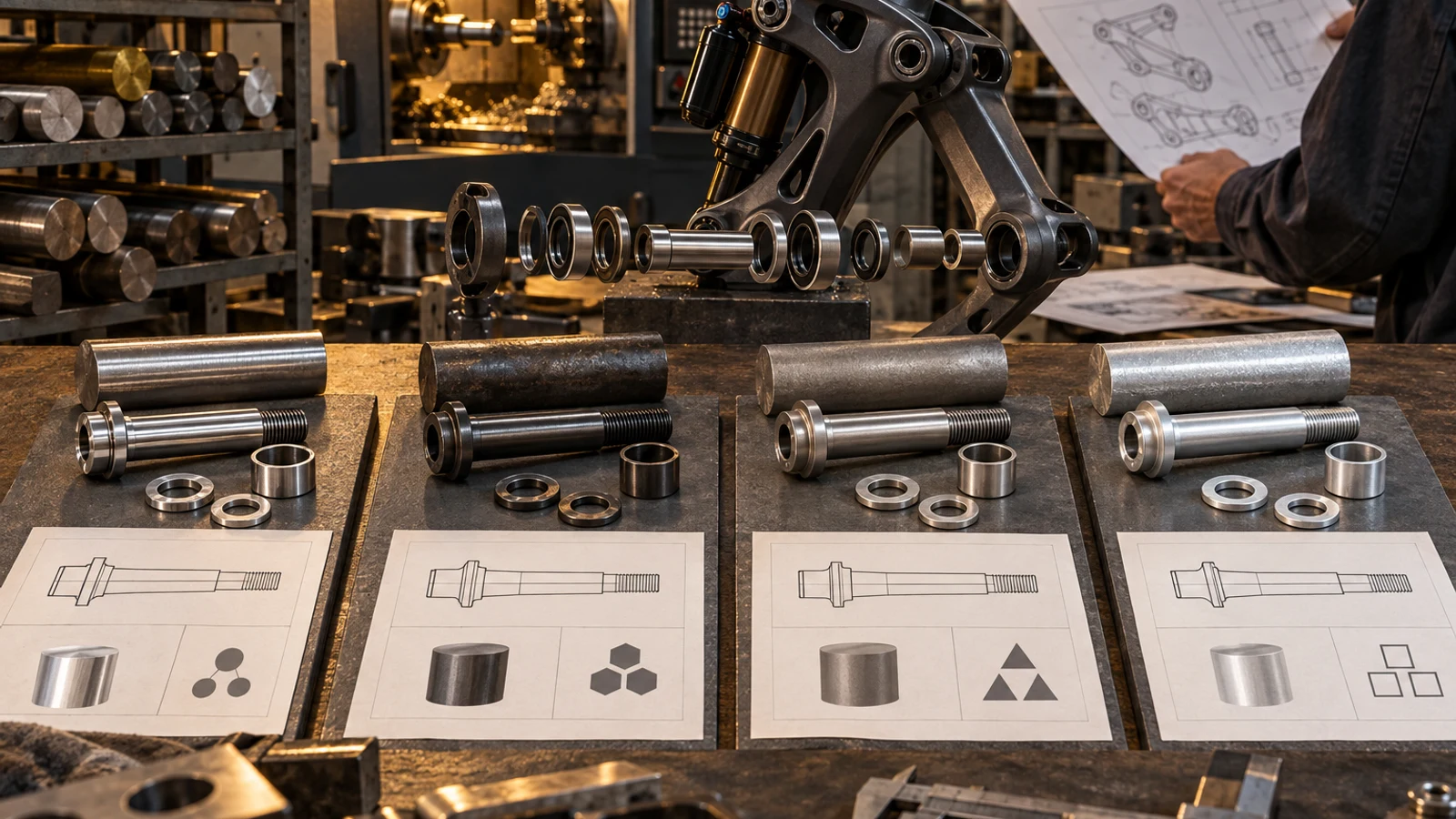
Hero: concept illustration of example hardware and its application. It is not a factory photograph, tested component or approved production geometry.
Distinguish a mandatory product requirement from a selected specification
China's Standardization Law distinguishes mandatory and recommended national standards: mandatory standards must be implemented, while adoption of recommended standards is encouraged. That legal distinction does not make a selected purchase specification irrelevant once the parties use it to define their order.
The official catalogue lists GB 3565.2-2022 as the current bicycle safety requirements part for the named bicycle categories, implemented in October 2023. Determine its applicability to the actual bicycle with the responsible team. It is not a universal stock-material specification for every pivot component.
Keep the product requirement, chosen component specification and custom drawing requirements on separate lines. The standards-change guide covers edition transitions; this review concentrates on whether a reference still fits the material route and supplied part.
Select the property reference by material rather than appearance
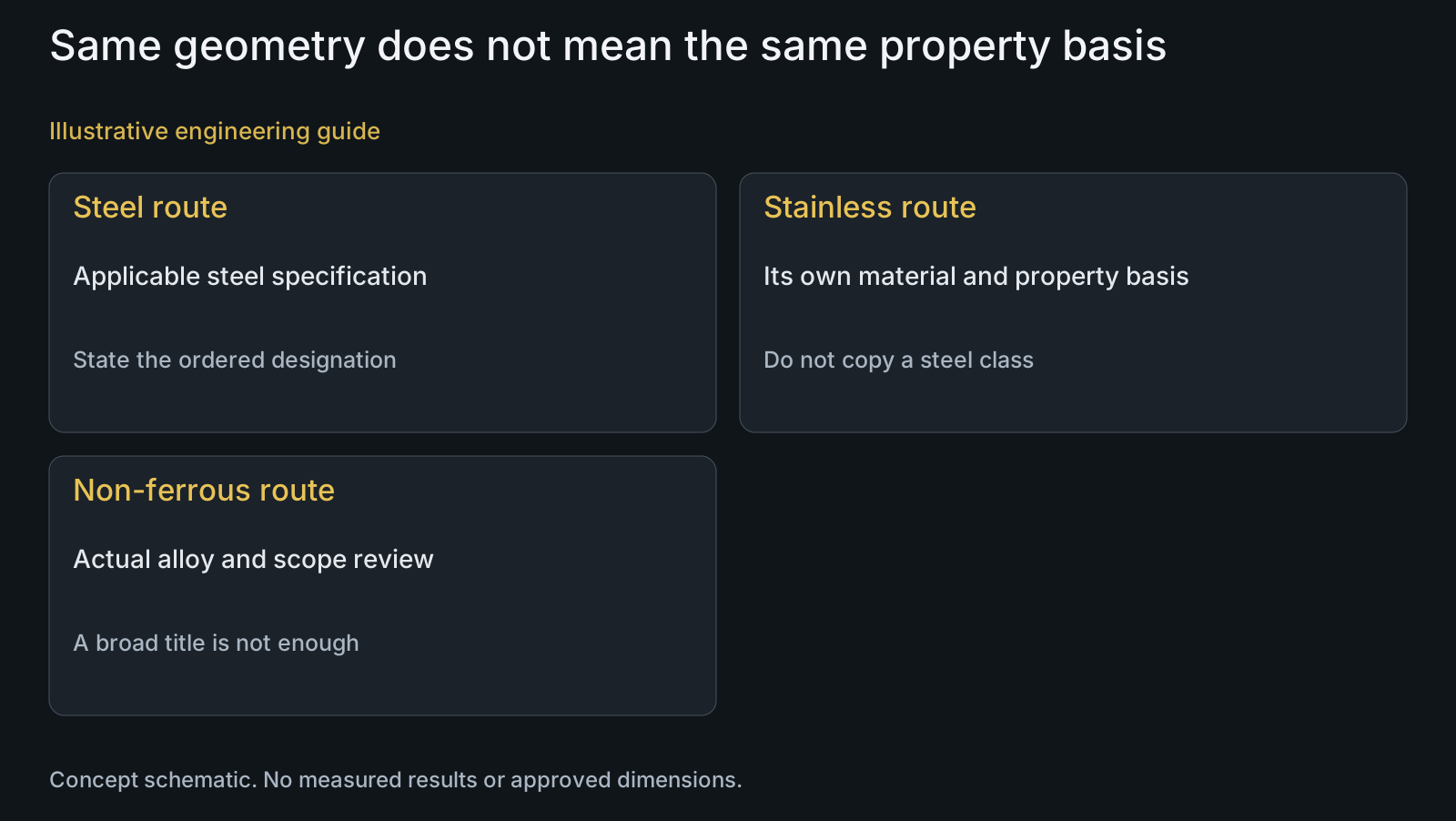
The official GB/T 3098.1-2010 record identifies modified adoption of ISO 898-1:2009, whose named subject is carbon and alloy steel fasteners. The GB/T 3098.6-2023 record instead names stainless steel bolts, screws and studs and modified adoption of ISO 3506-1:2020. These are different reference scopes, not two interchangeable labels for any threaded metal.
For a proposed material change, ask which property designation the new specification uses and what evidence the actual finished part can support. Do not translate a carbon-steel class into a stainless designation by comparing only one strength number. Material family, condition and ordered requirements need their own agreement.
Use the materials overview to discuss candidate routes, then check the full relevant standard for the selected configuration. A polished surface cannot establish an alloy, property class or accepted manufacturing condition.
| Requirement situation | Reference selection issue | Risk | Useful verification |
|---|---|---|---|
| Carbon or alloy steel pivot | Check applicable GB/T 3098.1 scope and edition | Series name replaces a complete property requirement | Confirm material, designation and finished-part assessment |
| Stainless steel pivot | Check the stainless-specific part and condition | Steel class is copied into a different material system | Review the selected stainless designation and evidence |
| Titanium or aluminum alternative | Check actual alloy and detailed non-ferrous scope | A broad title is treated as coverage of every alloy | Establish stock and component requirements separately |
| Custom shoulder or reduced section | Check assessment object and geometry applicability | Stock properties are treated as complete pivot acceptance | Define what the proposed specimen or result represents |
| Changed surface treatment | Check finished state and interface definition | An earlier bare-part result is reused without scope review | Identify affected properties and finished dimensions |
| GB and ISO references both named | Compare adopted editions and requirement differences | Multiple labels are treated as automatic dual conformity | Resolve conflicts without overriding mandatory duties |
Do not turn a non-ferrous heading into automatic titanium coverage
The official catalogue lists GB/T 3098.10-1993 for fasteners made of non-ferrous metals. Its title alone does not establish which alloy, designation, geometry and acceptance provisions apply to a particular titanium or aluminum pivot. Verify that detailed scope before placing the number beside an unexamined material substitution.
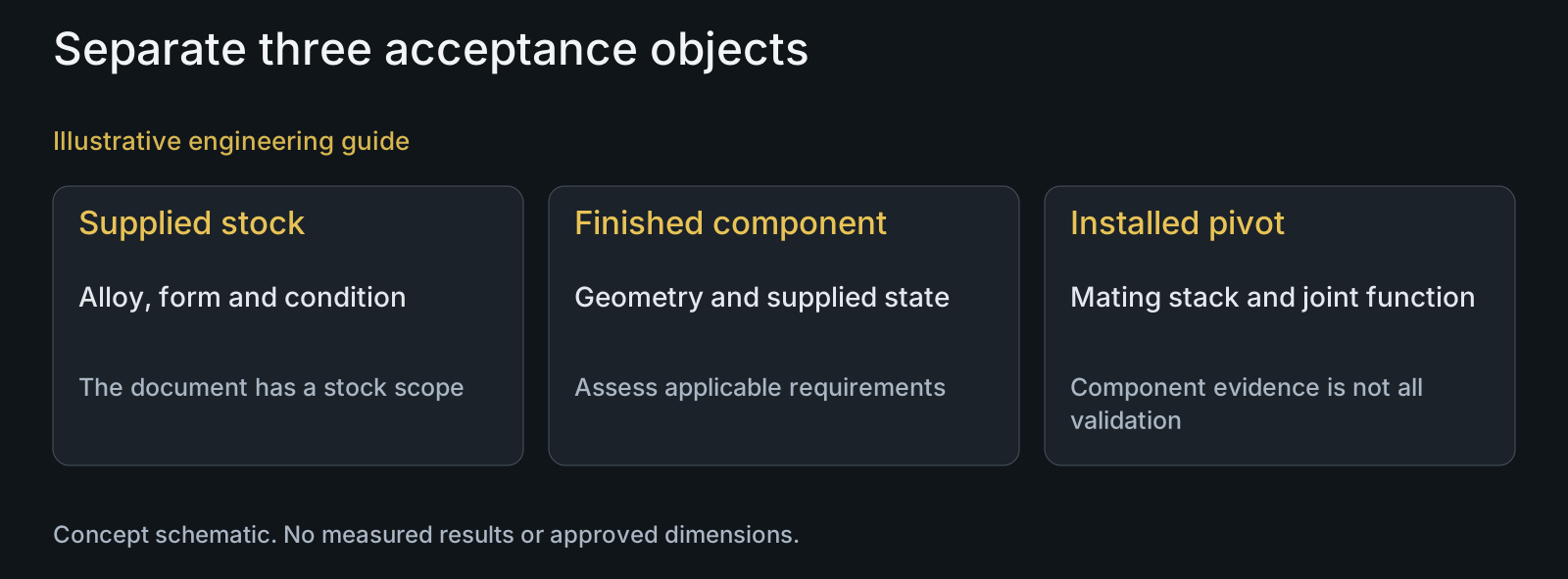
Specify the stock requirement separately from the finished-part property requirement. A titanium bar document can describe its represented alloy, form and condition without establishing every property of a manufactured shoulder pivot. The titanium stock-specification guide explains that stock-to-finished-part boundary.
If no reviewed standard fully defines the custom component, identify the project-specific requirements and validation basis with engineering. Do not borrow a steel property class to hide the gap, or declare the titanium part equivalent solely because its nominal thread and silhouette match.
Keep custom geometry and finished state visible in acceptance
A property specification does not define all locating and clamping features of a bicycle pivot. Establish the shoulder, bearing and receiver interfaces, the required finished dimensions and the assembly assumptions. A component can have adequate material properties yet create an unsuitable stack through its geometry.
Determine whether the custom geometry permits the specified assessment and what any proposed evidence represents. A stock specimen, a representative finished fastener and the installed joint are different objects. Do not treat a test on one as automatic verification of every requirement on the others.
The pivot drawing guide addresses dimensional definition. Use the selected material route and finished surface alongside those fields; do not add numerical loads, torques or universal test frequencies from an unread standard.
Illustrative engineering example: a titanium change leaves a steel label
Illustrative engineering example: assume a buyer changes a custom pivot drawing from alloy steel to titanium while leaving the earlier steel property-class note unchanged. The thread and visible head shape stay the same. No real drawing, manufactured specimen or strength result is represented.
The reviewer does not approve the change from the new material name or reject titanium categorically. It identifies the incompatible requirement basis, confirms the intended stock specification and asks engineering to define the relevant finished-part and assembly acceptance. The supplier then responds to that explicit scope rather than inventing a steel-class certification for titanium.
A resolved material requirement still leaves interface and joint questions to review. If a GB and an ISO reference are both retained, the team compares their relevant editions and requirements before agreeing how differences are handled. The example demonstrates specification reasoning, not a proven substitution or successful validation.
Resolve reference conflicts instead of hiding them behind precedence
Write the exact standard part and edition, selected material and condition, property designation where applicable, custom exceptions and acceptance method. If two references disagree, identify the affected requirement. An order-of-precedence note can organize agreed specifications but does not authorize ignoring an applicable mandatory requirement.
PremFixer manufactures against the agreed drawing, sample, interface and BOM scope. Discuss manufacturing and surface-treatment choices with the required finished state. No default complete-standard conformity, test package or Chinese-market product approval is promised.
Send marked material changes and unresolved reference conflicts with the RFQ. The customer decision knowledge center helps connect material selection, component acceptance and application review without treating one certificate as the answer to all three.
Questions buyers need to confirm
Can one GB/T 3098 number cover every pivot material?
No complete requirement follows from the series name alone. Select the relevant part and edition for the actual material and component, then define custom interfaces and acceptance separately.
Can a steel property-class note remain when the drawing changes to titanium?
Do not carry it over automatically. Reopen the material and property basis, define the relevant stock and finished-part requirements and obtain engineering agreement. Matching geometry does not establish the old designation's applicability.
Does recommended GB/T status mean the supplier can ignore an ordered requirement?
No. Keep legal status separate from the agreed purchase basis. A selected specification still defines the requested scope; it must not be silently removed or used to override an applicable mandatory requirement.
Does the title of GB/T 3098.10 establish coverage of every titanium alloy?
No. Its public non-ferrous title is not a substitute for detailed scope review. Check the actual alloy, designation, geometry and acceptance provisions before claiming conformity for a custom titanium part.
Can a stock certificate establish complete pivot acceptance?
No. It represents the identified stock scope. Finished dimensions, processing and the installed joint require their own defined review. Specify the evidence object rather than relabel stock results as finished-pivot validation.
What should a GB or GB/T pivot RFQ include?
Provide the drawing or STEP and BOM, actual material and condition, exact standard parts and editions, proposed property designations and custom exceptions. Include finished interfaces and acceptance purposes, especially where materials or references have changed.
Technical references and scope
SAMR: Standardization Law. Public mandatory and recommended national-standard distinction and relevant mandatory requirement boundary. Not an individual product or contract legal determination.
SAMR: GB 3565.2-2022 catalogue. Public bicycle safety part title, current status and implementation date. Full incorporated requirements unavailable in this public record.
SAMR: GB/T 3098.1-2010 catalogue. Public title, current recommended status and modified ISO 898-1:2009 adoption identity. No numerical property limits or full geometry applicability asserted.
SAMR: GB/T 3098.6-2023 catalogue. Public stainless-fastener title, current edition and modified ISO 3506-1:2020 adoption. Not automatic steel-to-stainless equivalence.
SAMR: GB/T 3098.10-1993 catalogue. Public current non-ferrous fastener title. Title alone not used to establish detailed coverage of a particular titanium alloy or custom pivot.
Explore related component, material and sourcing decisions in the customer decision knowledge center. For a drawing review, use the Drawing/BOM RFQ path.
Match the GB and GB/T requirements to your pivot
Share the drawing or STEP and BOM, material and finished condition, named standard parts and editions, and any proposed material change. PremFixer can discuss manufacturing scope and identify requirement conflicts or acceptance gaps before quotation.
Discuss the drawing and BOM