

A GPSR review of bicycle hardware should connect the identifiable product to the configuration and safety information it represents. Begin with the actual item, supply route and responsible parties; do not invent a standalone GPSR certificate for every pivot bolt. A kit reference, internal lot code and complete-bicycle identity may describe different objects. If a receiver, spacer or finish changes, the information relationship needs to remain clear even when the commercial name stays the same. The practical question is whether the responsible reviewer can identify the supplied variant and relevant evidence, and whether a safety concern can reach the right team without relying on appearance alone.
Hero: concept illustration of example hardware and its application. It is not a factory photograph, tested component or approved production geometry.
Establish the product and responsible roles first
GPSR is Regulation (EU) 2023/988, not a bicycle-specific directive. The European Commission's factsheet identifies its application from 13 December 2024 and describes a safety net for non-food products and risks not otherwise covered. Do not infer an individual pivot's entire legal position from that overview.
Describe how the item reaches its users: an OEM production component, a separately supplied replacement kit or hardware within a complete bicycle. Have the responsible product team determine the applicable scope and economic-operator roles. A manufacturing contract alone does not settle every market responsibility.
The export-document guide separates destination obligations from component evidence. Here the focus is the identity-to-information relationship within the selected product route, including what changes after the first configuration is supplied.
Connect the usable identifier to the represented configuration
Article 9's public text addresses manufacturer risk analysis, technical documentation and product identification. It allows specified identification information on packaging or an accompanying document where product size or nature does not allow it. That is not permission to omit identification just because a pivot is small.
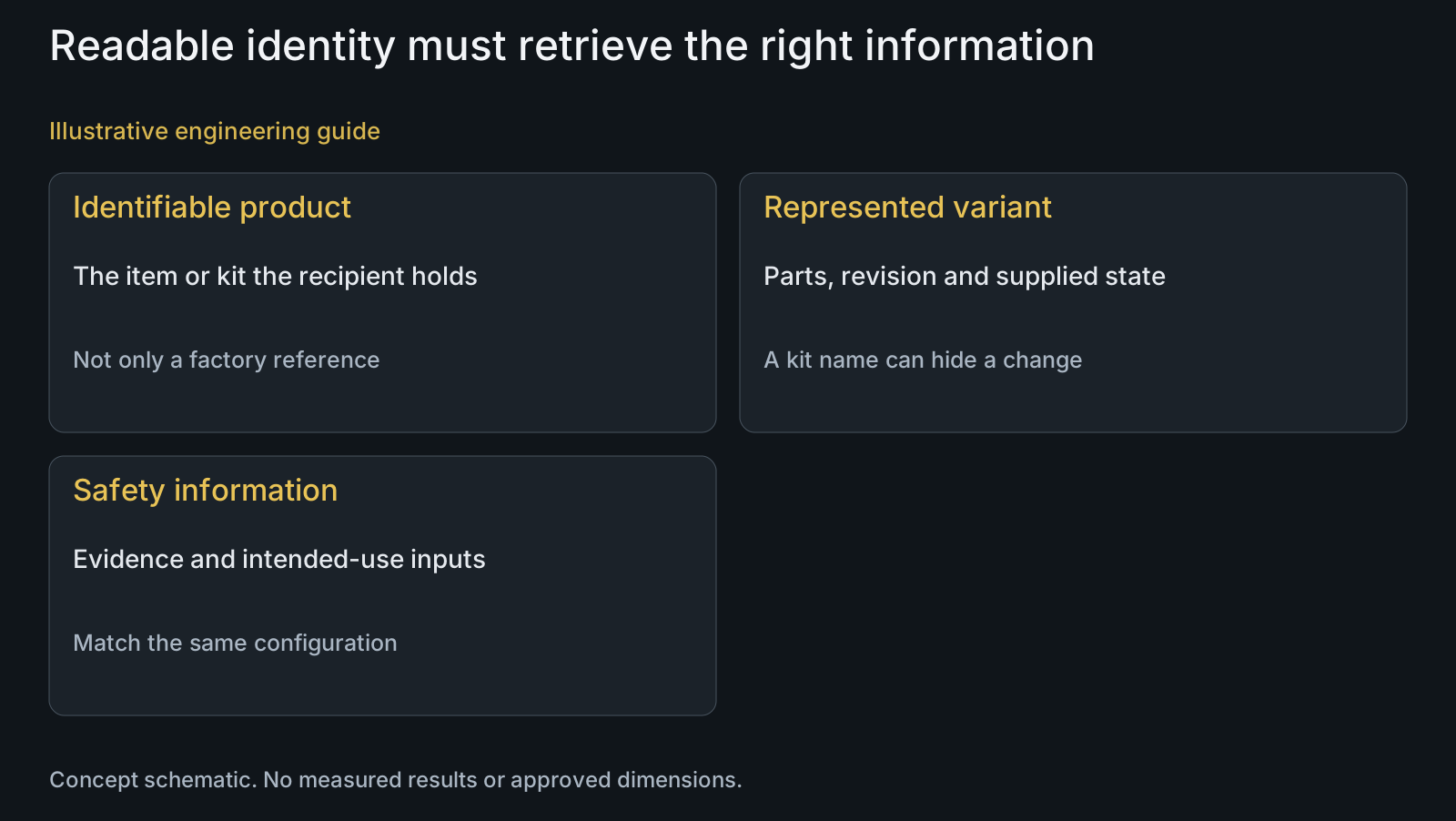
For engineering purposes, map the identifier to the exact item or kit revision, constituent parts and supplied condition. A commercial kit name may persist while its spacer changes. If the associated information only describes the earlier arrangement, a readable label has not solved the configuration question.
Keep identifier purposes distinct. A customer-facing product identity helps identify what is held or used; a production-lot reference connects to manufacturing evidence. The digital lot-traceability guide explains internal genealogy. Do not assume that genealogy automatically supplies usable safety information to the recipient.
| Review situation | Risk of the shortcut | Information relationship to check | Useful decision |
|---|---|---|---|
| A kit has a readable label | Readability is mistaken for complete traceability | Identifier to actual kit configuration | Confirm what variant can be identified |
| Only an internal lot is known | Factory genealogy is mistaken for usable product identity | Recipient's item to relevant product information | Agree an identification relationship that survives supply |
| A spacer arrangement changes | The old assembly sheet follows the new kit | Revised interface to instructions and technical evidence | Assess affected information before claiming coverage |
| A small part cannot carry the planned details | Identification is simply omitted | Applicable product, packaging or accompanying information route | Responsible reviewer determines the arrangement |
| A safety observation arrives | The lot code is treated as proof of cause | Available identity to configuration and investigation owner | Preserve uncertainty and route the concern |
| A new current file replaces the old one | Earlier supplied variants disappear from history | Earlier product identity to represented revision | Retain the ability to distinguish configurations |
Make technical evidence and user information describe the same item
Identify the hardware functions and the conditions under which it is intended to be assembled and used. For a replacement pivot kit, relevant engineering inputs can include the mating interface, component orientation and intended installation conditions. This discussion does not establish universal installation instructions for any bicycle model.
Where instructions or warnings are required, connect them to the same represented configuration as the product identity and technical evidence. Do not let an axle drawing describe one receiver while the accompanying assembly information depicts another. A generic instruction sheet cannot repair a missing compatibility definition.
PremFixer manufactures against the agreed drawing, sample, interface and BOM scope. Its manufacturing page is not a safety assessment for an unidentified consumer product. Agree which component facts and records support the responsible manufacturer's work, without relabeling every supplier file as the complete technical documentation.
Treat a revision as an information change as well as a part change
Article 9's public text requires technical documentation to remain up to date. It also gives a ten-year manufacturer documentation duty from market placement. That stated duty is not a universal retention rule for every supplier worksheet, every actor or every kind of production record.
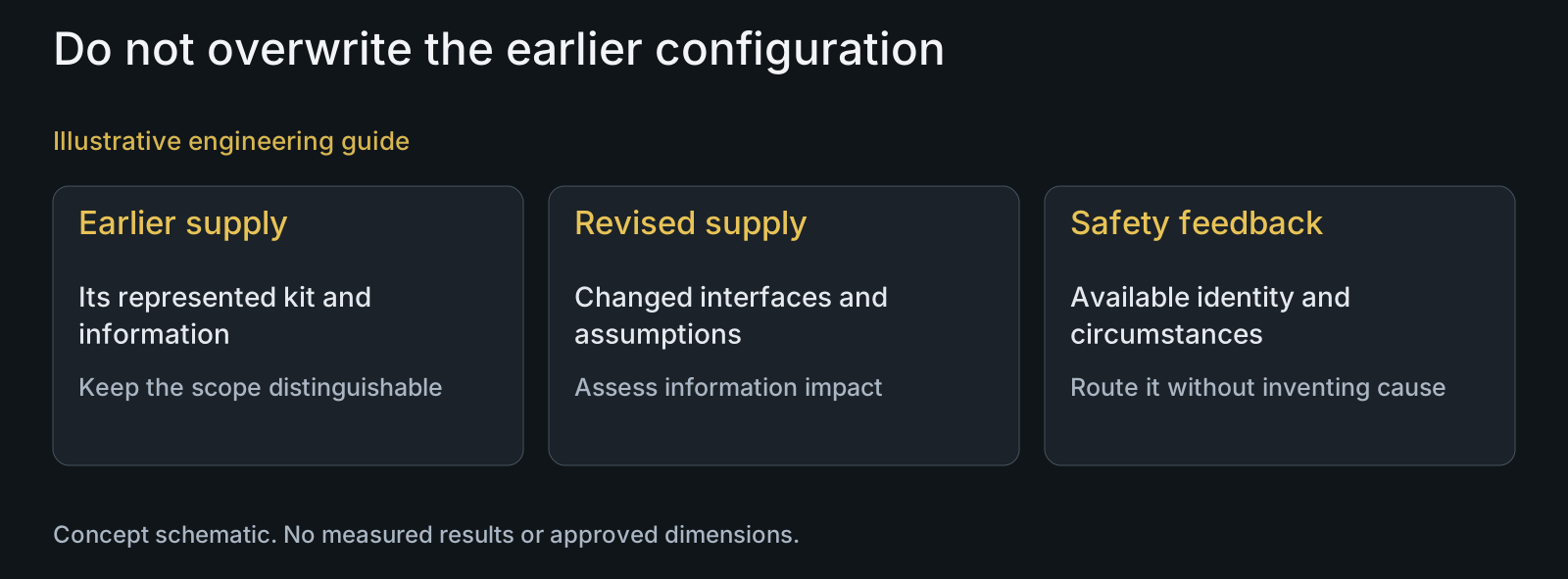
Compare the revision's affected interfaces, assembly assumptions and supplied materials with the information already associated with the product. Determine whether the previous instructions and evidence still represent the new variant. Document the conclusion rather than silently attaching an old folder to a new drawing.
Keep the relationship to earlier delivered configurations available at the agreed granularity. Replacing the current file should not make an earlier supplied arrangement impossible to identify. This is change-control analysis, not a claim that every physical component must carry an individual serial number.
Illustrative engineering example: one kit name, two spacer arrangements
Illustrative engineering example: assume a replacement pivot kit retains its commercial name after the intended spacer arrangement changes. The packing identity can identify the kit, but the linked assembly sheet still represents the earlier configuration. No actual safety incident, dangerous-product determination or recall is assumed.
The reviewer first distinguishes which configuration the supplied kit contains. It then compares the affected mating and installation information, identifies the responsible owner of the product assessment and decides which documents need revision. The presence of a supplier material report does not close that information mismatch.
Earlier kits remain a separate represented population; the team does not overwrite their configuration history with the new sheet. The scenario shows how identity, technical information and change scope must work together, without asserting a real failure, compliant marking arrangement or successful corrective action.
Give safety feedback a usable route to the responsible team
Agree how the component supplier receives relevant observations from the product team. Useful initial information includes the available product identity, configuration, location of the observation and associated assembly circumstances. Do not require the reporter to prove a manufacturing root cause before the team can examine the concern.
Record the difference between an observation, an investigation and a concluded risk decision. Traceability can help identify represented groups, but it does not itself establish the cause or justify a predetermined remedy. The returned-item traceability guide addresses limits in narrowing the affected population.
The Commission describes safety communication and corrective-action channels within the GPSR framework. Legal notification, consumer communication and product dispositions belong to the responsible parties' applicable process; a supplier email is not automatically a regulatory notification. Use the customer decision knowledge center to connect the component questions without collapsing those roles.
Questions buyers need to confirm
Is GPSR a bicycle-specific directive or universal bolt certificate?
No. It is Regulation (EU) 2023/988 on general product safety. Determine the actual product scope and responsible roles rather than order an undefined GPSR certificate for every loose component.
Does an internal production code complete product identification?
Not necessarily. Establish how the recipient's product identity connects to the actual variant and relevant information. An internal lot can support genealogy while leaving the external item-to-information relationship unresolved.
Can identification be omitted because the pivot is small?
Do not assume that. Article 9's public text addresses packaging or accompanying information when size or nature prevents the stated on-product identification. The responsible reviewer must establish the applicable arrangement, not simply remove the requirement.
Can an old technical folder represent a revised spacer stack?
Only where the represented scope remains justified. Compare the changed interfaces, assembly assumptions and associated instructions. Update affected information while keeping earlier delivered variants distinguishable.
Does GPSR mean every supplier record has one identical retention period?
No universal supplier-record period is stated here. Article 9 gives a specific manufacturer technical-documentation duty, including its market-placement reference. Determine each actual role and record purpose rather than apply that duty to every worksheet.
What should we send for an identity and information review?
Provide kit and component identities, drawings or STEP and BOM, old and revised configurations, intended use, supply route and responsible product contacts. Include associated instructions and the requested component evidence so missing relationships can be identified.
Technical references and scope
European Commission: GPSR factsheet. Public regulation identity, application date, safety-net purpose and safety communication overview. No individual product applicability or notification performed.
EUR-Lex: Regulation (EU) 2023/988 consolidated public text. Public indexed Article 9 text on manufacturer technical documentation, updating and product identification. No complete article-by-article legal assessment or individual marking approval.
UK OPSS: EU Regulation on General Product Safety overview for Northern Ireland. Government guidance on roles, scope and responsibilities, explicitly written for Northern Ireland. Not used to invent a universal EU supplier-record requirement or substitute for the applicable legal text.
Explore related component, material and sourcing decisions in the customer decision knowledge center. For a drawing review, use the Drawing/BOM RFQ path.
Connect the supplied hardware to its represented information
Share the product and kit identifiers, drawings or STEP and BOM, intended use and supply route, plus relevant revision changes and assembly information. PremFixer can discuss component records and the configuration links needed by the responsible product-safety team.
Discuss the drawing and BOM