

The label answers one narrow question
When a quotation says Grade 5 titanium, the team has received a material callout. It has not yet received a component-release evidence package. The same caution applies to a broad 7075 label when the actual requirement is 7075-T6 or 7075-T651.
The practical distinction is simple: a material label describes an intended identity; a release decision belongs to a specific part, revision, interface, process route, inspection record, validation plan and authorized disposition. [INFERENCE][C01][C02][C17]
For Ti-6Al-4V Grade 5, keep the alloy identity, ordered condition, product form, material specification, revision and heat/lot evidence connected to the part. For 7075, preserve the exact temper and form in the same way. A generic datasheet can orient a review, but it does not turn a machined pivot into a released component. [SOURCE + INFERENCE][C02][C03][C15]
Start with the joint role, not the architecture name
VPP, Horst Link, single-pivot and flex-pivot are useful architecture descriptions. They help a team route questions to the right member and interface. They do not select an alloy by themselves. The release decision begins with the actual joint role and load path: what is clamped, what supports a bearing, what transfers bending or shear, what carries end-face load, and what provides the threaded reaction. [INFERENCE][C13][C14]
Bolt / axle
Start with the bolt or axle as more than a line through a bearing. Review the smooth bearing-support region, shoulders, head, fillets, thread transition, receiver and the way installation and removal are controlled. If it rotates relative to a bearing inner race, the fit and surface condition need their own evidence; if it is a clamp-loaded shoulder fastener, the stack and mating parts still need to be identified. [INFERENCE][C01][C04][C14]
Spacer
The spacer changes the question from “which alloy is stronger?” to “which faces close the intended clamp path?” Its length, end-face condition, parallelism and position relative to the bearing inner races and frame-tab stack must be visible in the configuration review. A spacer that is present in a parts list but not tied to the actual mating stack leaves the interface logic open. [INFERENCE][C01][C04][C14]
Linkage plate / rocker / frame ear
For a linkage plate, rocker or frame ear, the material discussion belongs with the section, bore location, edge distances, fillets and load-transfer surfaces shown on the actual drawing. A fastener datasheet cannot close the question for a plate that sees a different combination of bending, shear, contact and service loads. [INFERENCE][C01][C14]
Bearing seat / bore
At the bearing seat or bore, ring support, location, fit concept, shoulder geometry, roundness and replacement access become the center of the review. A bolt that passes through the bearing ID does not by itself prove that the outer ring is supported, that creep is controlled or that the service route is acceptable. Those are assembly-interface questions. [SOURCE + INFERENCE][C04][C12]
Threaded receiver / nut / insert
At the receiver, nut or insert, make the mating pair, engagement, runout, bottoming, locking or lubrication method, repeated service and inspection route explicit. NASA threaded-fastening guidance can provide a disciplined review structure; it does not supply a universal bicycle torque, preload or engagement value. [SOURCE + INFERENCE][C04][C12]
The evidence chain a supplier review should follow
The useful sequence is:
quotation → configuration → material / lot → process → inspection → traceability → first article → component / assembly validation → authorized release
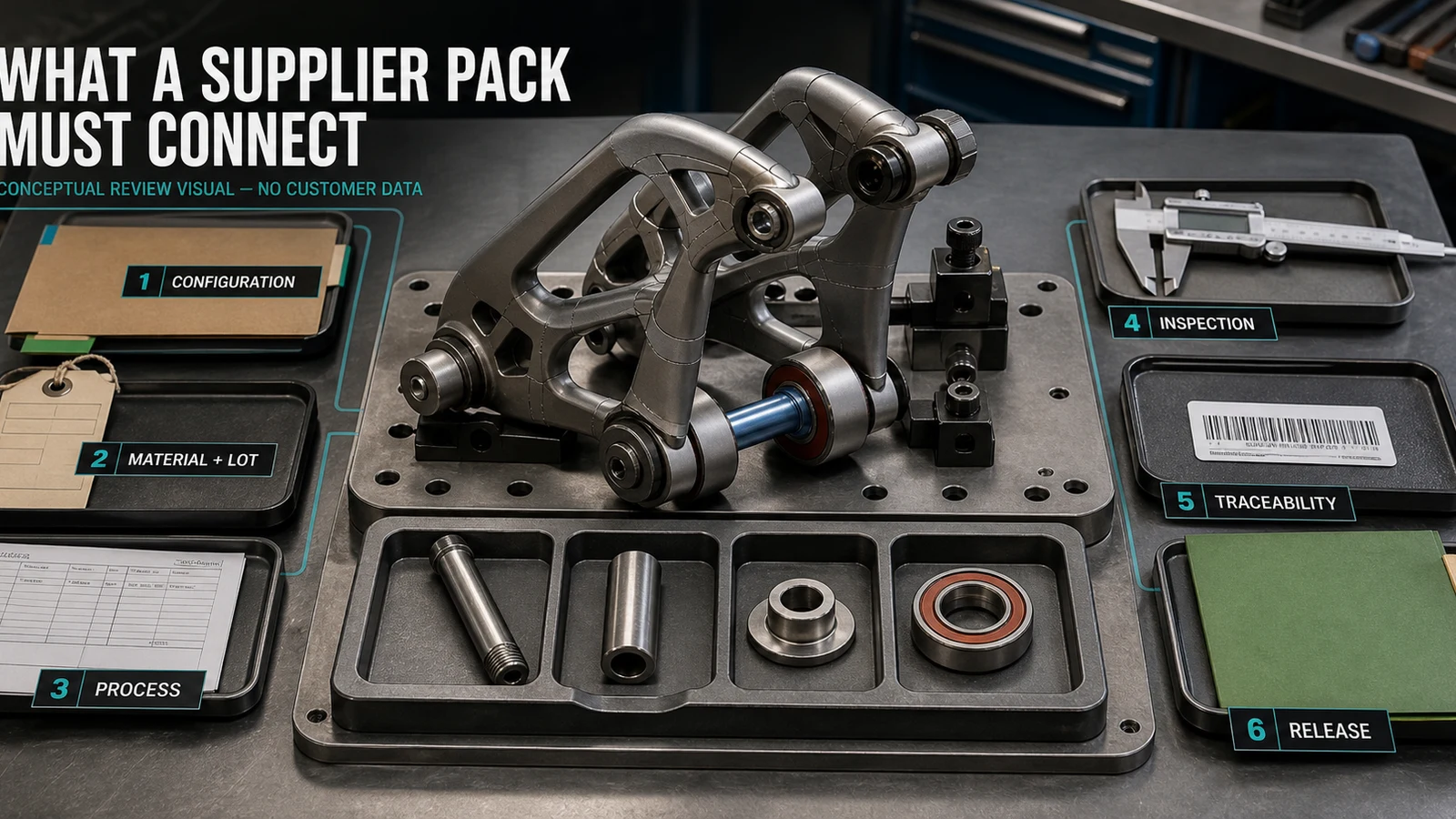
This is a review route, not a claim that every step is complete. Start by fixing the current drawing, BOM or assembly revision, part role, bearing part number, spacer stack, thread/receiver, surface or coating condition, service route and acceptance clauses. Then connect the exact material condition and lot to the finished part, record the manufacturing route, and inspect the characteristics that control the interface. [SOURCE + INFERENCE][C03][C04][C10][C11]
An inspection result should be characteristic-by-characteristic: nominal, tolerance, actual value, datum, method, instrument, calibration or measurement-system evidence, sampling or coverage, part lot/serial, inspector/date and NCR disposition. Measurement traceability supports confidence in a result; it is not a substitute for defining the characteristic or deciding whether the component is validated. [SOURCE][C07]
FAI or FAIR has a different boundary. AS9102/IAQG material is a structured first-article evidence framework when a project adopts it. It does not automatically become production approval, fatigue validation, assembly validation or release authority. Verification and validation also remain distinct: verification checks whether specified characteristics or requirements were met; validation asks whether the product works for the intended use under the planned conditions. [SOURCE + INFERENCE][C08][C09][C12]
That is why a CoC, MTR, process certificate, inspection report, FAI, laboratory accreditation and component validation report should not be stacked into one vague word such as “certified.” Each answers a different question. ISO 9001 describes a quality-management-system framework; ISO/IEC 17025 addresses laboratory competence. Neither one is a part-specific material-lot or release approval. [SOURCE + INFERENCE][C04][C05][C06]
What the architecture changes — and what it does not
The architecture routes the review; the part number and load path close it.
- VPP: Santa Cruz describes a system using two opposite-rotating links and a moving virtual pivot or instant center. Use that page for topology context, then trace the actual links, seats, axles, spacers and receivers in the project configuration. [SOURCE][C14]
- Horst Link / four-bar: Specialized describes FSR as a four-bar relationship involving the linkage, pivots and rear axle. That description does not establish a universal hardware alloy or load split for another frame. [SOURCE][C14]
- Single-pivot / linkage-driven: Classify the actual axes, plates, seats and receivers from the current drawing. Do not import a material rule from the platform name. [INFERENCE][C13][C14]
- Flex-pivot / flex-stay: Cannondale describes a carbon flexing section in its FlexPivot technology. Metal pivot-hardware evidence must remain separate from evidence for the composite flexure; one cannot validate the other. [SOURCE + INFERENCE][C14]
ISO 4210-1 provides bicycle vocabulary and design/testing scope context. It does not turn a supplier’s material label, quality-system certificate or FAI form into a pedigree and release record for a particular pivot component. [SOURCE][C13]
The minimum questions before a release decision
Use the following questions as a review gate, not as a generic supplier scorecard:
- Which part number and revision are being reviewed, and who is the release authority?
- Is the item a bolt/axle, spacer, linkage plate or frame ear, bearing seat/bore, receiver/nut/insert, or a structural flex member?
- What exact alloy, temper/condition, product form, specification and heat/lot are connected to that part?
- Which processes are controlled: machining, heat treatment, coating/anodizing/passivation, thread or fit processing, special processes and preservation?
- Which interface characteristics have actual inspection results, and can the result be traced to the part lot or serial?
- Is the requested evidence sample approval, FAI, lot acceptance, design qualification, component validation, assembly validation or authorized production release?
If the answer to these questions is still “the quotation says Grade 5,” the evidence gate is not closed. That is not a criticism of the material; it is a statement about the level of proof currently available. [INFERENCE][C01][C02][C10][C12][C17]
Sunday Review conclusion
The productive question is not “Which alloy wins?” It is “Which material, in which condition and form, for which joint role, with which mating interfaces and which evidence?”
Architecture is a map. The joint role and load path tell the team what to inspect. The evidence chain tells the team what can be released. Until the project’s H0 drawing/BOM, lot, process, inspection, validation and authorization records are reviewed, the responsible status is OPEN rather than approved. [INFERENCE][C01][C03][C10][C12][C17]
The canonical PremFixer website is included only as project and contact context. It is not evidence of material properties, certification, customer performance or a particular component release. [PROJECT CONTEXT][C16]
Author & Contact
Kang Wang
Senior Product & Technical Lead | Bicycle & Motorcycle Division
PremFixer (Guangdong Pinshang Hardware Co., Ltd.)
Website: https://premfixercnc.com/
WhatsApp: +86 15766506531
References
- S1 — ISO 9001:2015, Quality management systems: https://www.iso.org/standard/62085.html
- S2 — ISO/IEC 17025, Testing and calibration laboratories: https://www.iso.org/standard/66912.html
- S3 — ISO 10005, Quality management guidelines: https://www.iso.org/standard/70398.html
- S4 — ISO 10012, Measurement management systems: https://www.iso.org/standard/10012
- S5 — NIST, Metrological Traceability: https://www.nist.gov/metrology/metrological-traceability
- S6 — SAE AS9102C, First Article Inspection Requirements: https://saemobilus.sae.org/standards/as9102c-aerospace-series-first-article-inspection-requirements
- S7 — IAQG 9102 First Article Inspection Requirement: https://iaqg.org/standard/9102-first-article-inspection-requirement/
- S8 — IAQG Supply Chain Management Handbook: https://scmh.iaqg.org/scmh-buy/
- S9 — NASA-HDBK-6025 with Change 1: https://standards.nasa.gov/sites/default/files/standards/NASA/Baseline-w/CHANGE-1/1/nasa-hdbk-6025_w_change_1.pdf
- S10 — NASA-STD-8739.14: https://standards.nasa.gov/sites/default/files/standards/NASA/Baseline/0/nasa-std-873914.pdf
- S11 — NASA Product Verification: https://www.nasa.gov/reference/5-3-product-verification/
- S12 — NASA Product Validation: https://www.nasa.gov/reference/5-4-product-validation/
- S13 — ISO 4210-1, Cycles vocabulary and design/testing scope: https://www.iso.org/standard/78075.html
- S14 — Kaiser Aluminum, 7075 Rod and Bar data: https://online.kaiseraluminum.com/depot/PublicProductInformation/Document/1028/Kaiser_Aluminum_7075_Rod_and_Bar.pdf
- S15 — ATI, Ti-6Al-4V Grade 5 data sheet: https://www.atimaterials.com/Products/Documents/datasheets/titanium/alloyed/ati_6-4_tds_en_v1.pdf
- S16 — Enduro Bearings help center: https://cycling.endurobearings.com/en-ca/apps/help-center
- S17 — Santa Cruz Suspension: https://www.santacruzbicycles.com/pages/suspension
- S18 — Specialized FSR Suspension: https://www.specialized.com/th/en/fsr-suspension
- S19 — Cannondale FlexPivot: https://www.cannondale.com/en-eu/technology/flexpivot
- S20 — PremFixer canonical website: https://premfixercnc.com/
Claim-to-Source Map
| Claim ID | Label | Claim used in this article | Source / evidence | Qualifier |
|---|---|---|---|---|
| C01 | INFERENCE | A quotation material callout is an input to review, not a component-release package. | S9, S10, S11, S12; Research handoff H0/H1 boundary | No project H0 release records are present in this package. |
| C02 | SOURCE + INFERENCE | Datasheet/reference data does not prove the delivered lot or machined pivot conforms. | S14, S15 | General material data; not a finished-part approval. |
| C03 | SOURCE + INFERENCE | Exact alloy, condition/temper, product form, specification and lot must stay connected to the part record. | S9, S10, S14, S15 | Datasheets establish alloy/form qualifiers; traceability evidence establishes the part-to-lot connection. Do not collapse 7075 variants. |
| C04 | SOURCE | Bearing support, spacer stack, thread/receiver, process and inspection are different interface/evidence questions. | S9, S10, S16 | Review framework; no universal bicycle dimension or setting is supplied. |
| C05 | SOURCE + INFERENCE | ISO 9001 is a QMS framework, not a part/material-lot approval. | S1 | Scope depends on the certified organization and applicable requirements. |
| C06 | SOURCE + INFERENCE | ISO/IEC 17025 concerns laboratory competence, not product approval. | S2 | Laboratory competence does not replace project release authority. |
| C07 | SOURCE | Measurement validity and traceability belong to a documented result and calibration chain. | S4, S5 | Does not define the characteristic or acceptance decision by itself. |
| C08 | SOURCE | AS9102/IAQG 9102 structures first-article inspection when the project adopts it. | S6, S7 | Aerospace-led framework; applicability is project-controlled. |
| C09 | SOURCE + INFERENCE | FAI does not automatically equal production approval, fatigue validation or assembly validation. | S6, S7, S11, S12 | Verification, validation and release remain distinct decisions. |
| C10 | SOURCE | Supplier-quality review should flow down requirements, verify purchased product and monitor supplier processes. | S8 | Handbook guidance, not evidence that a specific supplier passed. |
| C11 | SOURCE | A project quality plan should be established, reviewed, accepted, applied and revised for the intended output. | S3 | Plan guidance, not a finished inspection result. |
| C12 | SOURCE | Verification, validation, acceptance and qualification answer different questions. | S11, S12 | Project plan determines the required evidence and authority. |
| C13 | SOURCE | ISO 4210-1 supplies bicycle vocabulary and design/testing scope context, not supplier pedigree or release. | S13 | Scope context only. |
| C14 | SOURCE + INFERENCE | Architecture names route the review but do not replace part-specific role, interface and load-path evidence. | S17, S18, S19; Research handoff architecture routing | Manufacturer topology pages are not universal material rules. |
| C15 | SOURCE + INFERENCE | Grade 5 Ti-6Al-4V / UNS R56400 and 7075-T6/T651 must not be silently collapsed into generic labels. | S14, S15 | Exact ordered condition/form/spec remains project-controlled. |
| C16 | PROJECT CONTEXT | https://premfixercnc.com/ is the canonical PremFixer contact/context URL. | S20; local website registry | Website context is not material, certification or performance evidence. |
| C17 | OPEN | Specific component release remains OPEN until the H0 evidence package and authority records are reviewed. | Research handoff 2026-08-09; H0 definition in project rules | No customer drawing, BOM, lot, inspection, validation or authorization record was supplied here. |
This article is a supplier-review framework based on the cited standards and reference sources. No customer drawing, BOM, lot record, inspection report, validation report, or authorization record was supplied; final geometry, material condition, tolerances, and release decisions remain project-controlled.
Explore Related PremFixer Resources
Review a Component Release Package
Send the drawing, BOM or assembly revision, material and lot evidence, process route, inspection plan, validation boundary, and intended release authority for a focused engineering review.
Send Drawing, Sample, or BOM