

Direct Answer: Why Can a Stainless Pivot Bolt Seize?
A stainless MTB pivot bolt can seize because corrosion resistance and galling resistance answer different engineering questions. Corrosion concerns chemical or electrochemical attack. Galling concerns friction, adhesion, and material transfer when loaded metal surfaces slide against each other.
The threads may look clean before assembly and still bind as the external and internal thread flanks move under contact pressure. Once adhesion and surface transfer begin, installation torque can rise rapidly and the joint may become difficult to tighten, remove, or service.
This article is a design and release-review guide. It does not provide a universal torque, lubricant, installation speed, or service interval. Those values depend on the drawing, materials, surface condition, friction-control method, tool, and bicycle application.
Corrosion Resistance Is Not Galling Resistance
| Question | Corrosion | Galling |
|---|---|---|
| Primary mechanism | Chemical or electrochemical surface attack | Friction, adhesion, and material transfer during sliding contact |
| Typical evidence | Discoloration, pitting, deposits, or material loss | Thread pickup, scoring, transferred material, rising drive resistance, or seizure |
| Main review question | Can the material and finish tolerate the service environment? | Can the mating surfaces assemble and service without unstable adhesive wear? |
| Release implication | Define environment, material, finish, and corrosion validation | Define the complete thread pair, friction route, installation method, and joint-specific validation |
The Nickel Institute review of stainless-steel wear and galling treats sliding-contact assemblies as a system-selection problem. Its guidance also warns that literature wear data should not be transferred directly into a specific design without competent review and application-relevant testing.
Where Galling Risk Sits in an MTB Pivot Joint
A typical pivot fastener may combine two different functional regions:
- Smooth shoulder or axle region: supports bearing inner races, bushings, or a central spacer and controls the supported stack geometry.
- Threaded engagement: connects the external thread to a nut, receiver, or internally threaded frame component and creates the sliding thread interface during installation or removal.
These regions should not be reduced to one generic “stainless part” note. The drawing should show where the bearing-support surface ends, where the thread begins, what receives the thread, and which faces seat or react clamp load.
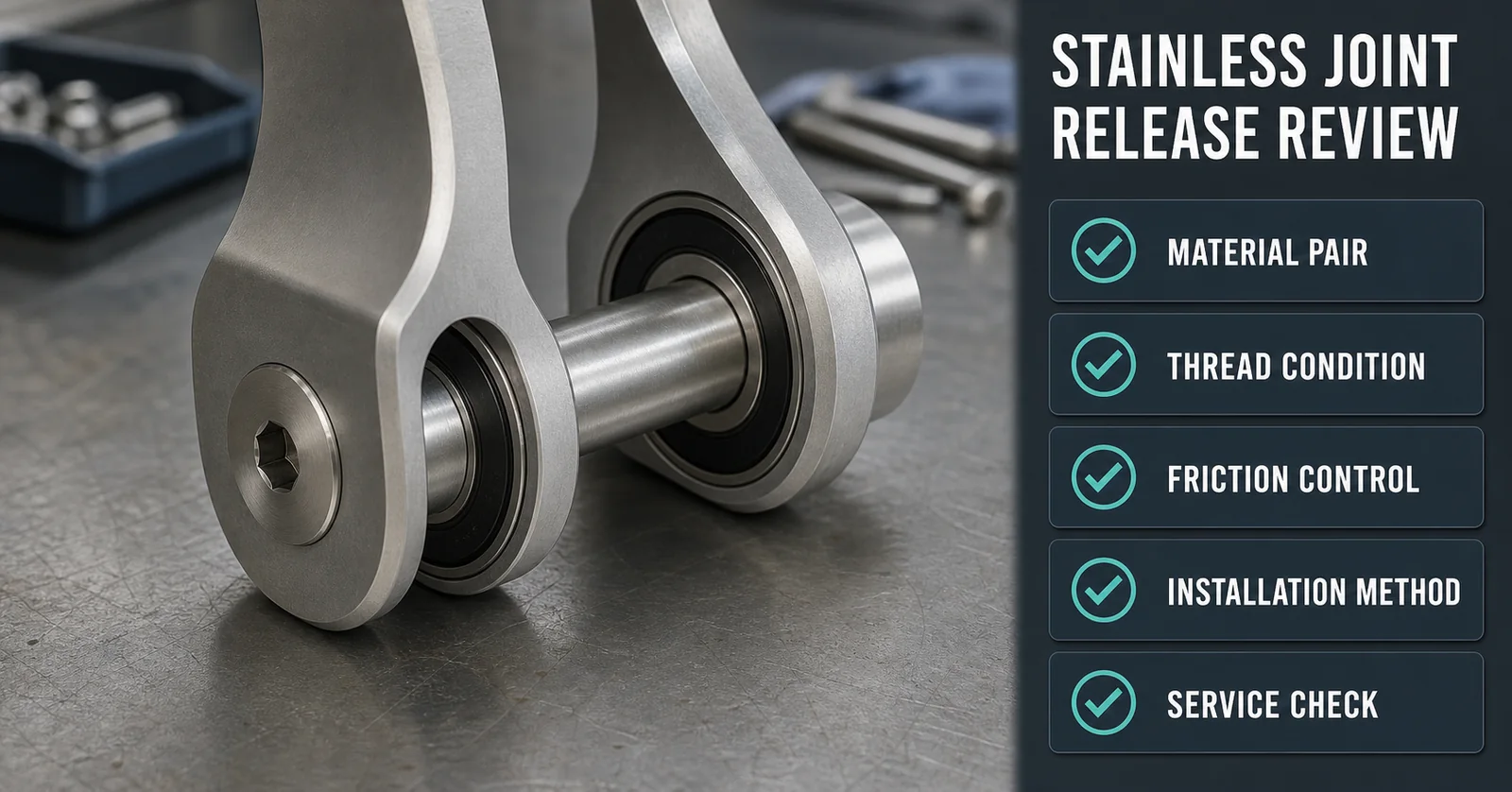
Image boundary: the hero image is a conceptual engineering illustration. It explains interface logic but is not a customer design, validated production stack, or dimensioned manufacturing drawing.
What ISO 3506-1 Does—and Does Not—Define
ISO 3506-1:2020 specifies mechanical and physical properties for corrosion-resistant stainless-steel bolts, screws, and studs with specified grades and property classes. The official scope explicitly states that it does not specify functional requirements for torque/clamp-force properties, shear strength, fatigue resistance, or weldability.
That boundary matters. A correct grade and property class are necessary material inputs, but they do not release the complete bicycle joint. They do not define the mating internal thread, surface finish, lubrication or locking condition, assembly tool, reuse policy, or galling validation.
Five-Point Stainless Joint Release Review
| Review item | Questions to resolve | Expected project evidence |
|---|---|---|
| 1. Material pair | What are the external and internal thread materials? Are both conditions and grades controlled? | Released drawing, material specification, and approved substitution rule |
| 2. Thread condition | Are thread form, pitch, tolerance, engaged length, cleanliness, burrs, and damage criteria defined? | Drawing, gauges or inspection method, and acceptance record |
| 3. Friction control | Is the joint dry, lubricated, coated, passivated, or used with a locking compound? How was that exact condition validated? | Approved process specification and joint-specific validation plan |
| 4. Installation method | Which tool, sequence, speed, and project-controlled target apply? What happens if drive resistance rises unexpectedly? | Assembly instruction and controlled acceptance criteria |
| 5. Service check | How will removal, inspection, reuse, replacement, and contamination control be handled? | Application-specific service instruction and inspection boundary |
Why Friction Control Cannot Be a Generic Prescription
Lubricants, coatings, passivation, and thread-locking products can change the friction route between the mating threads. That can change the relationship between applied torque, thread friction, under-head friction, and resulting clamp behavior.
The NASA Fastener Design Manual treats materials, platings, lubricants, locking methods, threads, and torque as connected fastener-design inputs. For a bicycle project, the safe conclusion is not “always use one product.” It is “define the exact friction-control condition and validate the joint in that condition.”
Changing from dry assembly to lubrication—or from one locking product to another—should therefore trigger a review of the approved assembly target and validation evidence. A material or coating change should not be released as a cosmetic substitution when it changes thread behavior.
What the Drawing and RFQ Should Define
For a custom pivot bolt or receiver, the RFQ should provide enough joint context to prevent the supplier from guessing at the threaded interface.
- external and internal thread materials;
- thread designation, pitch, tolerance, and effective engagement;
- smooth shoulder, bearing, bushing, spacer, seating-face, and receiver relationships;
- surface finish, coating, passivation, lubrication, or locking condition;
- assembly tool and method controlled by the project;
- operating environment, maintenance access, and expected service route;
- inspection, functional validation, and change-control requirements.
If the mating receiver or assembly condition is unknown, the supplier can manufacture the external bolt to its drawing but cannot confirm the behavior of the complete joint.
Service and Application Boundaries
Bicycle suspension hardware is application-specific. The FOX eyelet hardware documentation, for example, distinguishes multiple reducer, pin-and-sleeve, bushing, bearing, spacer, and crush-washer arrangements. It also directs service work to qualified technicians and product-specific procedures.
That does not make a shock-eyelet instruction a universal pivot-bolt specification. It demonstrates why the hardware architecture, frame compatibility, service tooling, and maintenance route must be identified before a joint is released or serviced.
Pre-Release Checklist
- Confirm the current drawing and both sides of the mating thread.
- Confirm the material and surface condition actually used in the sample.
- Record the friction-control condition rather than assuming “dry” or “lubricated.”
- Validate the approved installation method on the representative joint.
- Define what inspection evidence blocks release if pickup, scoring, or abnormal drive resistance appears.
- Keep material, process, assembly, and service changes under revision control.
Engineering Conclusion
A stainless pivot bolt can resist corrosion and still suffer thread galling. The risk is not resolved by the alloy name alone because the failure develops at a loaded mating interface whose behavior depends on both materials, both surfaces, the friction-control condition, and the installation route.
For MTB frame hardware, release the joint—not only the bolt. Start with the drawing, receiver or nut definition, bearing and spacer stack, material/finish requirements, and assembly method. Then validate the complete condition that will be supplied and serviced.
Explore Related PremFixer Resources
Review a Stainless Pivot Joint Before Release
Send the bolt drawing, mating-thread information, bearing or spacer stack, material and finish requirements, and intended assembly condition for an engineering and quotation review.
Send Drawing, Sample, or BOM