
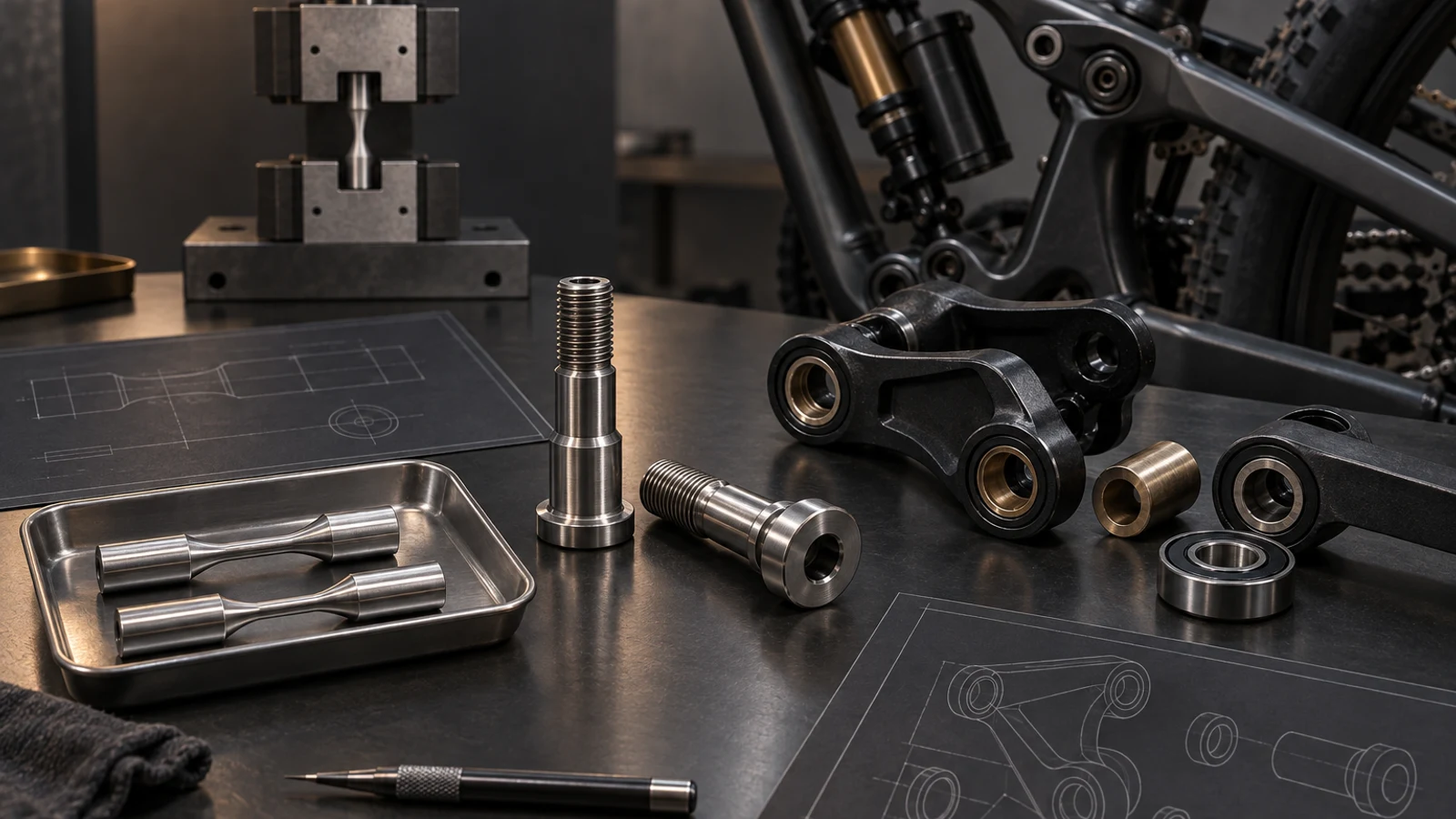
Select a fatigue test for a bicycle pivot by the object and question it represents, not by a preferred standard number or cycle total. ISO 3800 concerns axial fatigue of threaded fasteners, while ASTM E466 concerns defined metallic specimens within its stated limits. Neither designation alone qualifies the complete bearing, spacer and receiver assembly. For an OEM request, identify the retained geometry and surface, loading definition, environment and stopping criterion. Require these fields alongside the observation so the engineering team can judge what the report supports. A material-specimen result cannot silently become a finished-joint life guarantee.
Hero: concept illustration of example hardware and its application. It is not a factory photograph, tested component or approved production geometry.
Identify the evidence object before selecting the method
A material comparison, threaded-fastener comparison and assembled-joint validation are different tasks. A smooth coupon can deliberately remove component geometry to investigate material behavior. A fastener specimen can retain the thread but omit the receiving structure. An assembly can represent interfaces but introduces additional contacts and load paths.
For the RFQ, state which task the report is intended to support. Identify a thread-root concern separately from a shoulder contact or bearing-supported section. The object definition prevents purchasing from accepting an available report that measures a different subject.
Use the axial-versus-bending comparison for load-mode selection. This article's focus is the standard-to-object boundary and a useful reporting structure, rather than repeating every fatigue mechanism.
Read ISO 3800's threaded-fastener and assembly boundaries
The official ISO 3800:1993 abstract identifies threaded-fastener axial fatigue and, unless otherwise agreed, fluctuating tension at room temperature. It specifically notes that the influence of clamped-part compliance on fastener strain is not taken into account. That boundary is important when the requested conclusion concerns the complete pivot.
A bearing, sleeve and receiver stack changes the application's contacts and support. It is therefore not enough to attach an isolated axial report and call the assembly validated. Identify which joint behavior requires separate interpretation or additional evaluation.
Clarify thread engagement, fixture contact and the represented production condition with the testing provider. No bespoke stepped or hollow specimen is declared compliant merely from an article title. Full method details and any agreed adaptations belong in the actual test plan, not in an invented generic laboratory recipe.
| Report field | Useful content | Risk if omitted | Review action |
|---|---|---|---|
| Object and revision | Material specimen, fastener or joint | Wrong subject accepted | Match evidence to the question |
| Retained condition | Geometry, surface and material history | Production features assumed present | Identify specimen preparation |
| Method and edition | Applicable procedure and adaptations | Generic title suggests compliance | Confirm actual agreed scope |
| Loading definition | Maximum/minimum and reference basis | Unlike stresses compared | Reconstruct the reported force basis |
| Environment and frequency | Actual test conditions | Context-free transfer to service | State relevant boundaries |
| Stop and failure definition | Endpoint and observed status | Non-failure treated as unlimited life | Keep statuses distinct |
| Location and interpretation | Observed region and represented claim | Fixture event mistaken for design answer | Separate observation from conclusion |
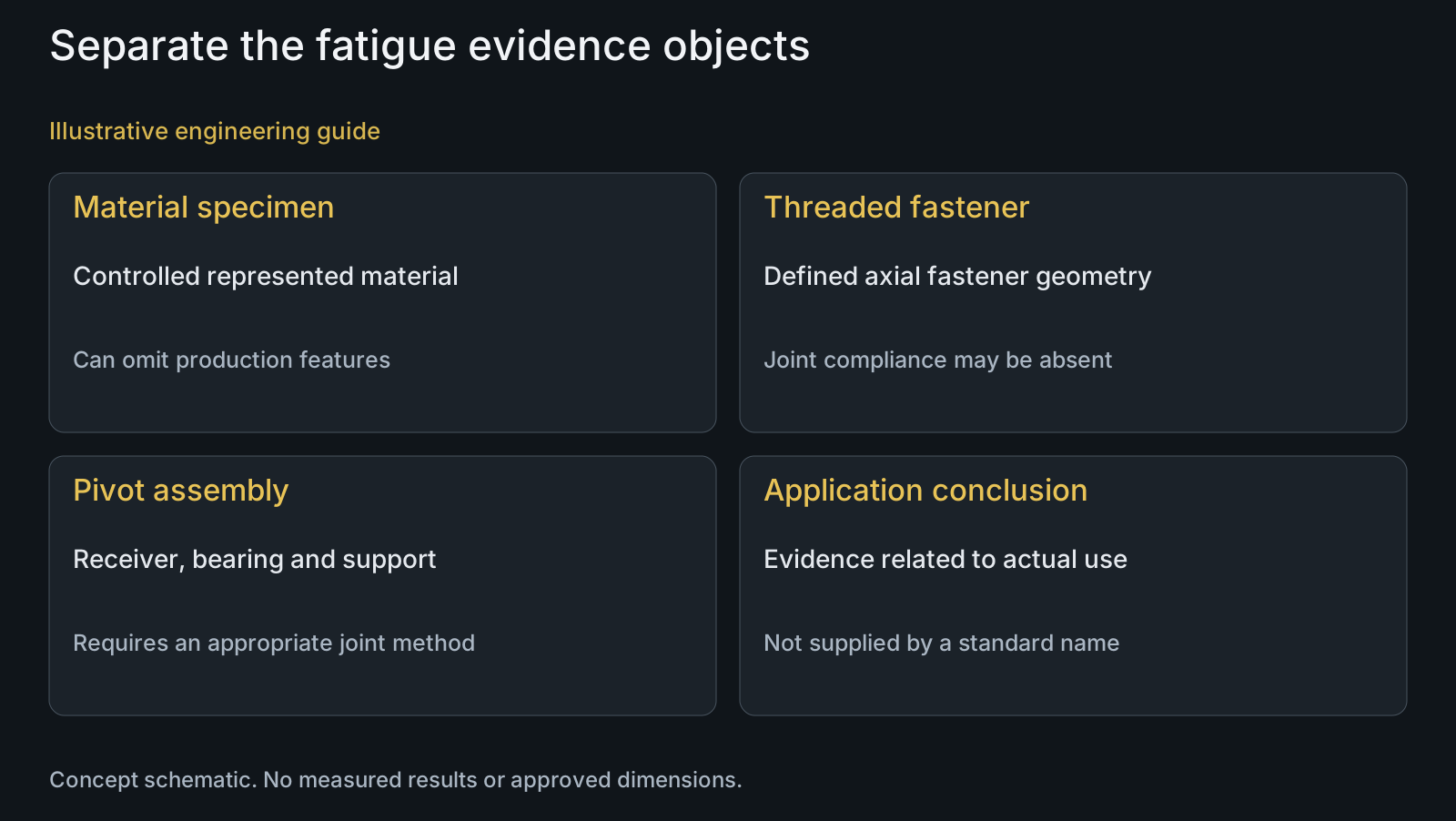
Do not describe E466 as a full bicycle component test
ASTM's E466-21 scope covers force-controlled, constant-amplitude axial fatigue of defined metallic specimens, with predominantly elastic strains, in air at room temperature. It excludes full-scale components, structures and consumer products. Keep that exclusion visible when interpreting a report submitted for a custom pivot program.
If the objective is to compare represented material conditions, an appropriate specimen method can be useful. It does not preserve every thread, bore, coating or contact on the production drawing. Identify specimen preparation so the engineering team understands which features were changed or removed.
A complete linkage evaluation should be described by its actual method and configuration. Do not label it E466 solely because a machine applies repeated force. The system failure map separates crack failure from joint movement, wear and retention questions that one specimen result cannot answer.
Report the loading definition, not just a fatigue number
Identify maximum and minimum force or stress, mean and alternating components where used, and the stated ratio convention. Also identify whether stress refers to a nominal section or another explicitly defined basis. A change in the reference area can make similar stress labels represent different actual forces.
Include frequency and environmental conditions where relevant to interpretation. These are report inputs, not default values supplied by this article. Do not assume two programs become equivalent merely because both quote constant amplitude or the same completed cycle count.
ASTM E468/E468M's public guidance emphasizes communicating material, specimen and testing context with fatigue results. Use that principle to review report completeness, without describing the following buyer checklist as a copied normative report template.
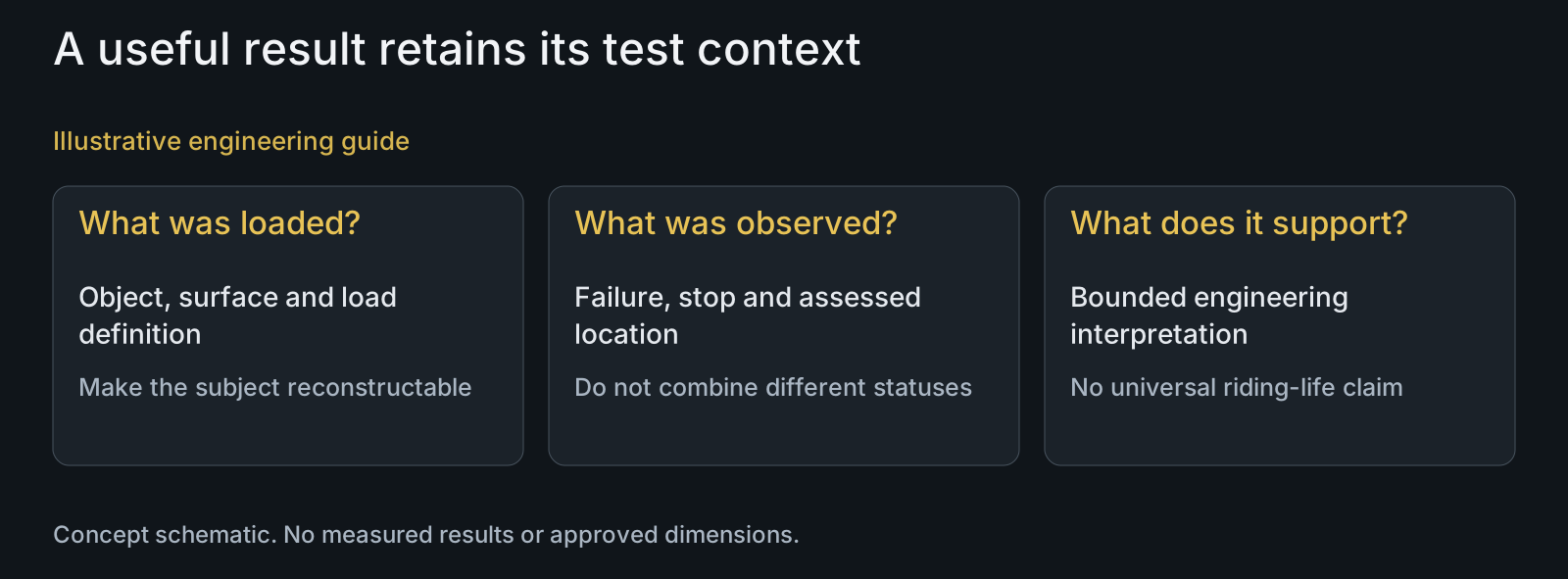
Keep outcome status separate from a design conclusion
Record whether a specimen failed, reached its stated stopping point without the defined failure, or was stopped for another reason. Keep those statuses distinct. A stopped test is not automatically a measured failure, and a non-failure observation does not establish unlimited life.
Specify the failure definition and observed location. A fixture-related break or a crack outside the intended assessed region may answer a different question from the requested feature evaluation. Do not automatically discard the observation, but explain its relevance before using it to compare manufacturing options.
Any design interpretation should identify what is represented and what remains outside the evidence. The full joint's service loads, contacts and assembly condition need their own justified relationship to the test. No direct conversion to riding years or universal fatigue strength is claimed.
Illustrative review of two apparently comparable reports
Illustrative engineering example: assume an OEM compares an E466 material-specimen proposal with an ISO 3800 threaded-fastener proposal for a hollow shoulder pivot. Both summaries emphasize a desired cycle count. No loads, test outcomes or actual customer history are assumed.
The reviewer first identifies the retained object. The material specimen may remove the production thread and hollow shoulder. The axial fastener proposal may retain the thread yet omit the bearing support and receiver compliance. The same headline target cannot make those subjects interchangeable.
The OEM requests the missing report fields and selects evidence for the intended question, with separate application interpretation where needed. Send the drawing, specimen proposals and reporting scope through the RFQ-input guide. PremFixer can discuss specimen manufacturing and qualified-partner arrangements; an owned fatigue laboratory or completed test is not asserted.
Questions buyers need to confirm
Does ISO 3800 evaluate every effect in an assembled pivot?
No. Its stated scope concerns axial threaded-fastener fatigue and excludes clamped-part compliance influence on strain. Identify the bearing, receiver and support questions separately. Do not represent an isolated fastener report as complete joint validation.
Can an E466 report be presented as a full bicycle test?
No. The stated scope excludes full-scale components, structures and consumer products. Identify the metallic specimen and what it retains. Any application interpretation needs a justified relationship rather than a changed report title.
Why are maximum and minimum loads needed?
They identify the actual load range and its mean, not just a headline peak. Specify the force or stress basis and ratio convention. Similar stress labels can be misleading when the represented geometry or reference section differs.
Does reaching a chosen stop count prove unlimited life?
No. It records an observation up to the specified stop under the reported conditions. Keep non-failure, defined failure and other stoppages separate. Do not treat a runout as a riding-life guarantee or an observed failure.
Is the comparison table an official report template?
No. It is a buyer review aid for keeping evidence interpretable. The applicable full method and order must establish required reporting. Add the actual specimen-level information and agreed evaluation; do not turn this checklist into a fabricated laboratory report.
What should an OEM provide for a fatigue-evidence quotation?
Send the drawing and critical features, material and surface condition, proposed object and method, loading definition and stop criterion. Include the required report and receiving authority. Distinguish specimen supply from testing and complete-joint validation so each scope can be agreed.
Technical references and scope
ISO 3800:1993 public abstract. Threaded-fastener axial fatigue, default fluctuating-tension context and clamped-part-compliance exclusion; full procedure not reproduced.
ASTM E466-21 public scope. Defined force-controlled constant-amplitude metallic specimens and exclusions; no custom fixture compliance or full-product qualification asserted.
ASTM E468/E468M public scope. Material, specimen and test context in fatigue-result presentation; buyer checklist is original engineering analysis, not a normative report template.
Explore related component, material and sourcing decisions in the customer decision knowledge center. For a drawing review, use the Drawing/BOM RFQ path.
Define the fatigue specimen and report before commissioning it
Share the drawing or STEP, critical location, material and surface condition, proposed method and loading definition. Include the required observation and stopping criterion. PremFixer can discuss manufacturing represented specimens and the requested partner-testing scope while keeping joint validation and service-life conclusions separate.
Discuss the drawing and BOM