
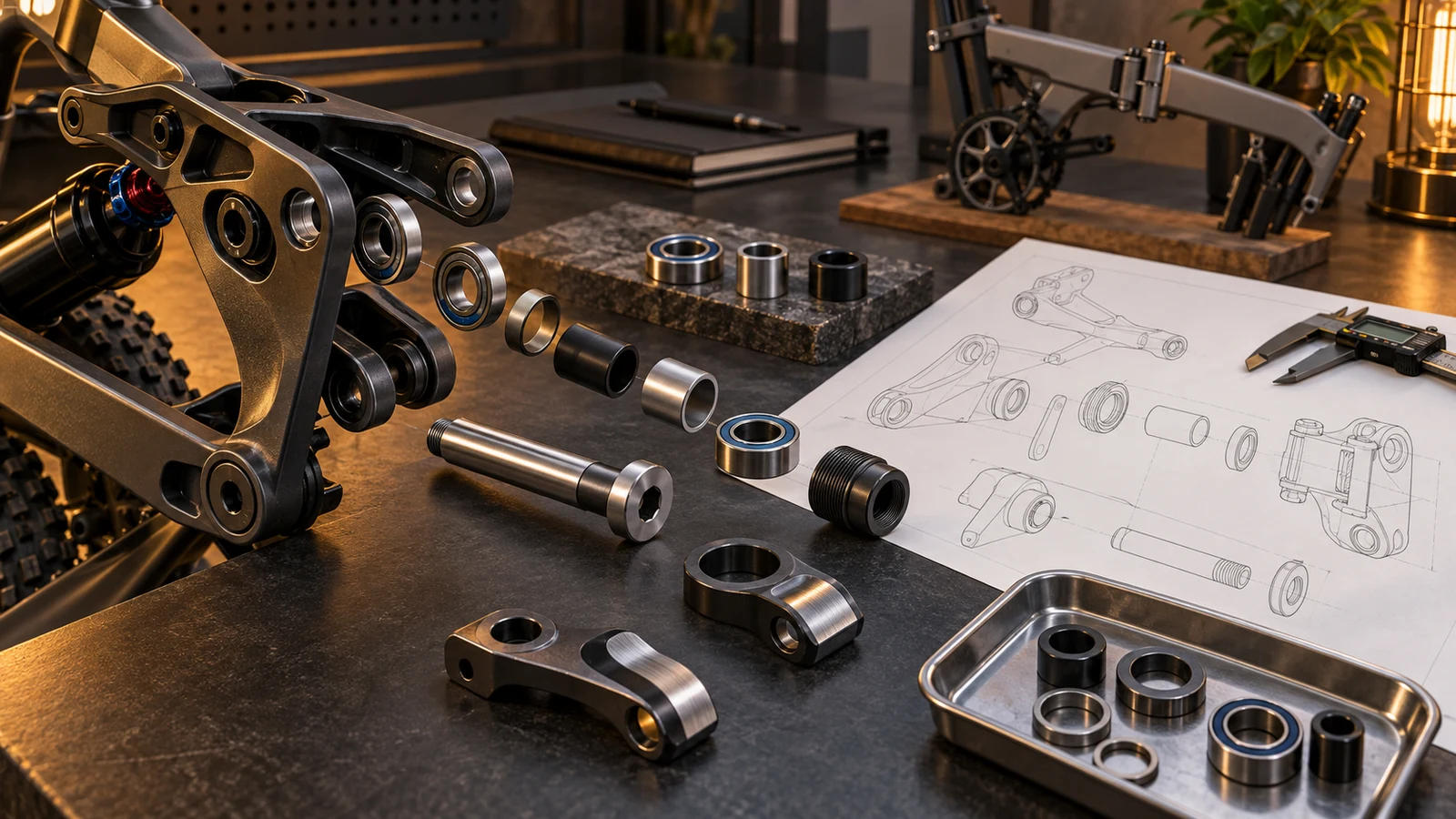
Turn a bicycle safety-fastener requirement into a supplier task by first identifying the applicable clause and actual connection. Then name the features, mating information and supplied conditions that the drawing must control. ISO 4210-2:2023's public contents place safety-related fasteners under section 4.3; a clause number copied without checking its subject can misdirect the request. A pivot bolt may contribute threaded retention, radial location and axial contact through different surfaces. Manufacturing conformity, installation instructions and complete-product validation remain separate conclusions. PremFixer can discuss the defined component and evidence scope, not approve an entire bicycle from a generic fastener note.
Hero: concept illustration of example hardware and its application. It is not a factory photograph, tested component or approved production geometry.
Check the clause subject before assigning a supplier task
The official ISO public contents identify the safety-related-fastener section. The public BSI preview places clause 4.6.3 under brake assembly attachment and cable requirements, not the general fastener heading.
Correct an inconsistent reference before it becomes a test request or purchase note. Keep the intended engineering question visible while the responsible reviewer identifies the applicable full requirement. A table of contents locates the subject; it cannot supply every normative condition or acceptance criterion.
A folding mechanism and a suspension pivot can both contain bolts without being the same assessment subject. Do not transfer a mechanism-specific procedure to another connection merely because its parts look alike. This article provides a feature-mapping analysis, not an unavailable clause-by-clause reproduction.
Describe what each interface actually does
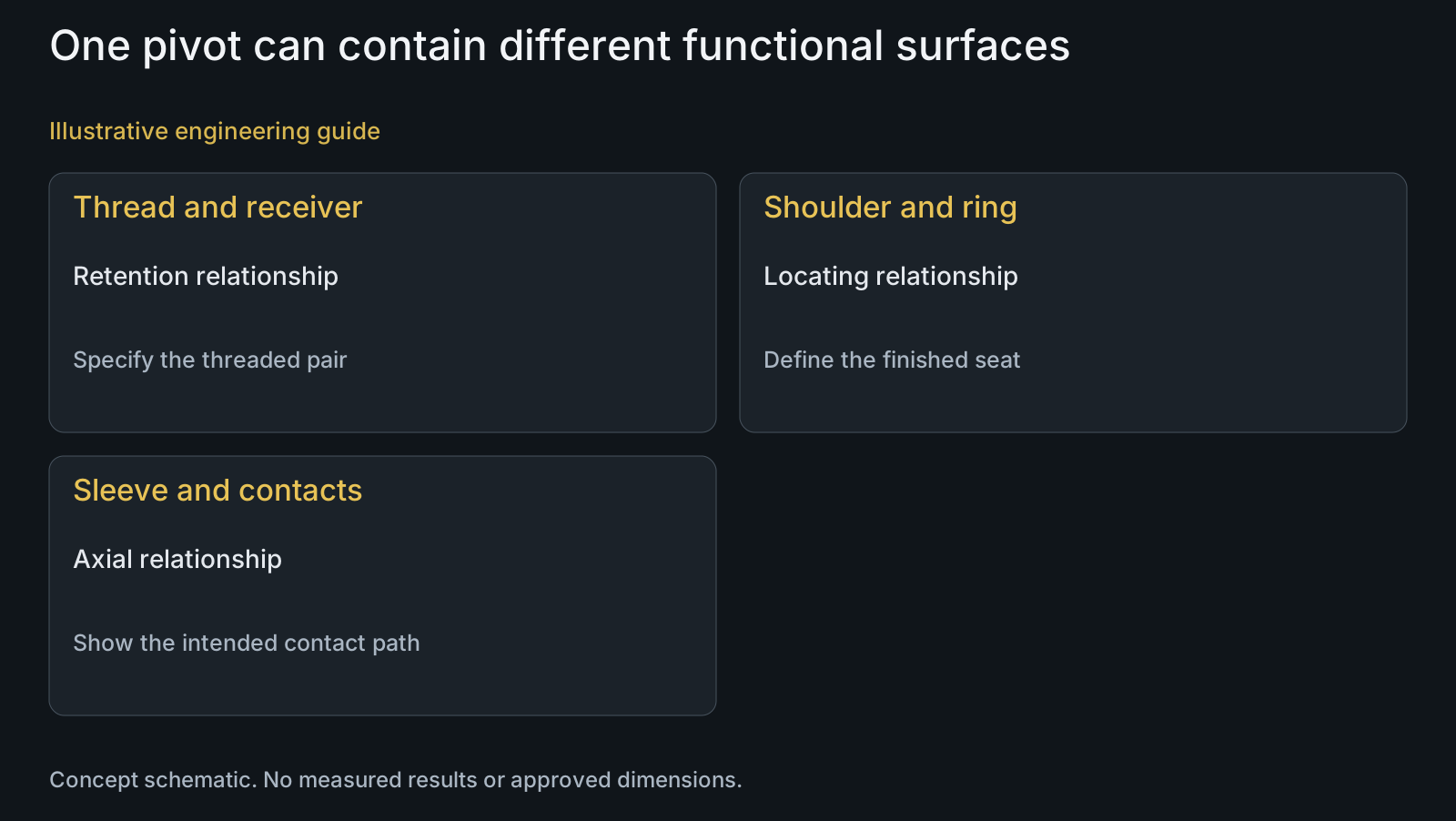
Identify which features retain the connection, locate a component and allow the intended movement. An external thread and receiver form one relationship; a shoulder and bearing ring form another. The head or shoulder contact can also contribute to an axial stack distinct from the thread profile.
Describe the relevant mates rather than label every surface 'critical.' A sleeve intended to support a contact path needs its associated ring or face information. A receiving thread needs its actual engagement context. The supplier cannot infer those relationships reliably from a bare bolt image.
The drawing-fit guide addresses how size, geometry and finished condition are defined. Here those controls are selected because of their contribution to the named connection, not presented as requirements automatically imposed by a standards heading.
| Function or subject | Useful drawing input | Manufacturing/evidence task | What it does not establish |
|---|---|---|---|
| Threaded retention | Thread definition and receiver context | Specified thread and relevant acceptance | Bearing-seat alignment or bicycle approval |
| Radial location | Seat, mate and intended restraint | Finished size and named geometry | Correct axial contact by itself |
| Axial contact path | Shoulder, sleeve and face relationship | Defined stack-related features | Clamp behavior from appearance alone |
| Supplied surface state | Material/finish and controlled features | Relevant final-condition acceptance | Universal friction or service life |
| Installation arrangement | Approved joint and locking condition | Explicit supplied versus OEM responsibility | Tightening value from failure headline |
| Assembly assessment | Represented mates and conditions | Applicable requirement and evidence scope | Complete conclusion from an isolated bolt |
Turn the function into a manufactured deliverable
For threaded retention, provide the specified thread and relevant receiving definition. For location, identify the seat and mating limits with the required geometry. For axial contact, show the shoulder, sleeve or spacer relationship. These are different drawing tasks even when one machining operation produces several features.
State the material condition and final surface requirements that belong to the supplied component. A pre-treatment reading can support process control without establishing a finished interface whose condition changes later. The finishing-acceptance guide keeps that acceptance subject explicit.
Define the required inspection output by feature and purpose. Thread gauging does not inspect seat alignment, and a diameter reading does not establish every contact relationship. Do not turn a request for 'ISO compliance' into a universal inspection method or invent tolerance values from the standard's name.
Keep installation and retention arrangements explicit
If the design uses a locking feature or a specified assembly product, identify its applicable configuration and supply responsibility. A finish change or alternative fastener can affect the represented condition; do not silently retain the old instruction merely because the nominal thread size remains unchanged.
The assembly-torque development guide addresses the installation decision. A destructive endpoint or a standard clause title is not a usable tightening instruction. Use the OEM's approved instruction for the exact joint rather than calculate a universal conversion from failure torque.
Component manufacturing tasks can support retention without encompassing the whole assembly procedure. Specify whether a requested deliverable is finished hardware, an identified locking condition or evidence for a defined question. Keep the customer's design and installation responsibility distinguishable from the supplier's offered work.
Match the evidence subject to the conclusion being requested
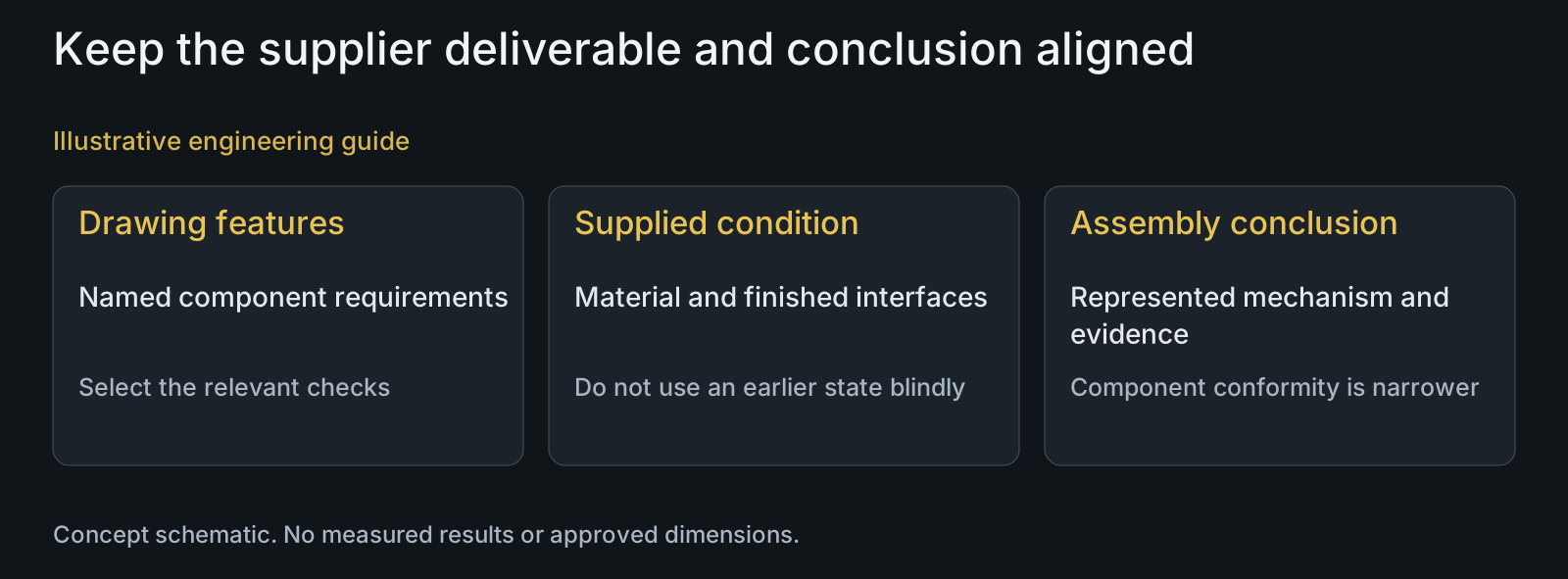
Identify whether the evidence concerns stock material, a finished component, a threaded pair or an assembled mechanism. Those subjects answer different questions. A conforming bolt drawing does not independently establish the receiver's behavior or the linkage's intended movement under use.
Supply the relevant configuration when an assembly question is being discussed. Include the bolt, receiver, mating contacts, supplied state and intended purpose of the assessment. The test-report scope guide explains why a report's title cannot enlarge its represented subject.
No universal test fixture, sample count, torque threshold or complete bicycle-validation service is specified here. Those details need the applicable full requirement and a competent project assessment. PremFixer's manufacturing overview supports scoping relevant work, including partner operations where appropriate.
Review a generic compliance note on a shoulder-bolt drawing
Illustrative engineering example: assume an OEM drawing names a safety standard but shows only a shoulder bolt, without the receiving thread or sleeve contact context. The supplier can discuss its visible geometry, but the requested 'joint approval' has no identified assembly subject. No real drawing, dimension or test result is assumed.
The team first clarifies the reference and connection. It then supplies the missing mates and assigns the shoulder's locating requirement separately from threaded retention. A component inspection can address those defined features, while any assembly conclusion needs the relevant configuration and assessment basis.
The result sought is a useful division of tasks, not a declaration that adding notes makes the bicycle safe. Send consistent RFQ files, material requirements and bicycle interface information. Keep unconfirmed requirements open rather than replace them with a generic approval claim.
Questions buyers need to confirm
Where do the public contents locate safety-related fasteners?
Under section 4.3. Check the applicable full requirement before assigning work; a heading alone is not a complete acceptance basis.
What if the drawing cites an inconsistent clause number?
Clarify the intended subject before issuing the corresponding test or purchasing instruction. Do not silently assume which requirement the designer meant. Preserve the engineering question while the responsible reviewer resolves the reference.
Can one passing thread check establish the whole pivot interface?
No. The shoulder, contact faces and mating arrangement can have separate requirements. Identify what the check represents and specify the additional feature tasks needed for the actual function. Thread conformity is not seat alignment or assembly validation.
Does a failure-torque requirement define the tightening setting?
No. The installation decision concerns the exact usable joint and its approved assembly condition. Do not derive a universal instruction from a destructive endpoint or heading; retain the OEM's appropriate engineering basis.
Can a folding-mechanism requirement be copied onto a suspension pivot?
Not by similarity of hardware. Identify the applicable connection and requirement first. The represented mechanism, use and assessment can differ even when both contain bolts; the full applicable text is needed for a normative conclusion.
What should the supplier receive for a safety-related pivot discussion?
Provide the part and mating definitions, relevant clause/edition, material and finished condition, and the evidence conclusion needed. Separate manufactured features from assembly instructions and product validation so the requested deliverable has a clear subject.
Technical references and scope
ISO 4210-2:2023 official public contents. Public heading locates safety-related fasteners; no complete normative clause or universal test values obtained.
BSI public preview: BS EN ISO 4210-2:2023. Contents locate the source's disputed clause under the brake subject; not a clause-by-clause interpretation or reproduced normative procedure.
Explore related component, material and sourcing decisions in the customer decision knowledge center. For a drawing review, use the Drawing/BOM RFQ path.
Connect the requirement to the actual pivot interfaces
Share the bolt and receiver drawings or STEP, bearing/sleeve context and BOM, with the applicable clause/edition and supplied material/finish. Identify the component checks and assembly question separately so PremFixer can discuss a relevant manufacturing and evidence scope.
Discuss the drawing and BOM