
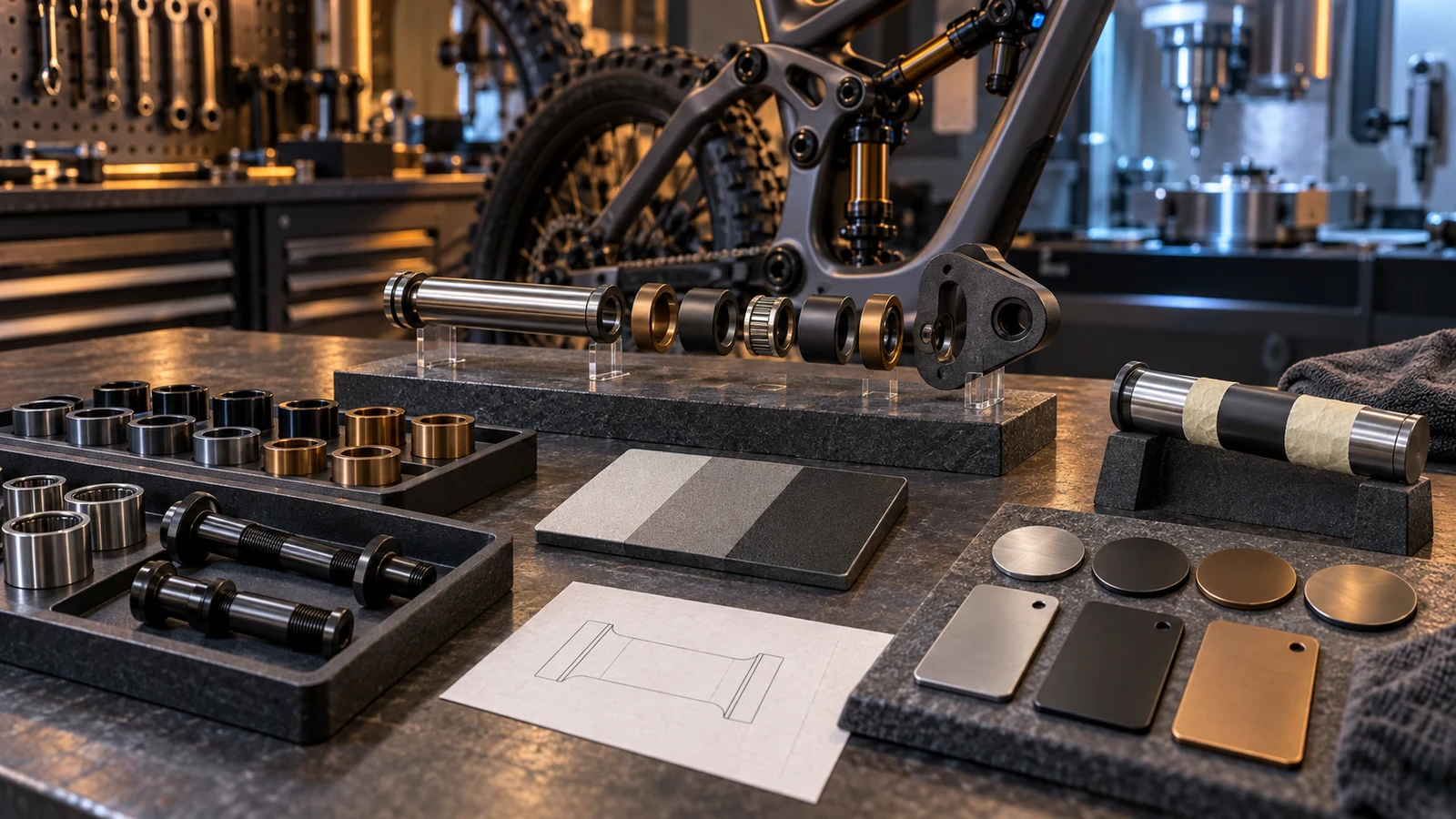
PremFixer's integrated finishing scope does not mean that every surface treatment is performed on an owned line. The confirmed model combines relevant in-house manufacturing with qualified-partner surface treatment under an accountable project team. For custom pivot hardware, ask what the delivered evidence establishes: treatment completion, an applicable verification, final geometry or appearance. These are separate questions. A processor record alone need not answer all of them, and an attractive part does not establish its locating fit. Define the acceptance subjects in the order so coordinated supply remains clear without implying universal quality results or a fixed delivery-time reduction.
Hero: concept illustration of example hardware and its application. It is not a factory photograph, tested component or approved production geometry.
Start with the supplied scope, not the ownership slogan
PremFixer's confirmed manufacturing boundary includes in-house cold heading, CNC machining, thread rolling and tool/die work, with qualified partners for specialist testing, heat treatment and surface treatment. The proposed route must still be related to the actual material, geometry and requested finish.
A single customer contact can coordinate those operations without describing partner equipment as owned. Ask which treatment and delivered condition the quotation covers. A broad finishing menu is not a released offer for every material, part shape or acceptance requirement.
The integrated manufacturing-scope guide addresses responsibility across the route. This article focuses on interpreting the evidence returned with the finished part, not counting internal versus external process steps.
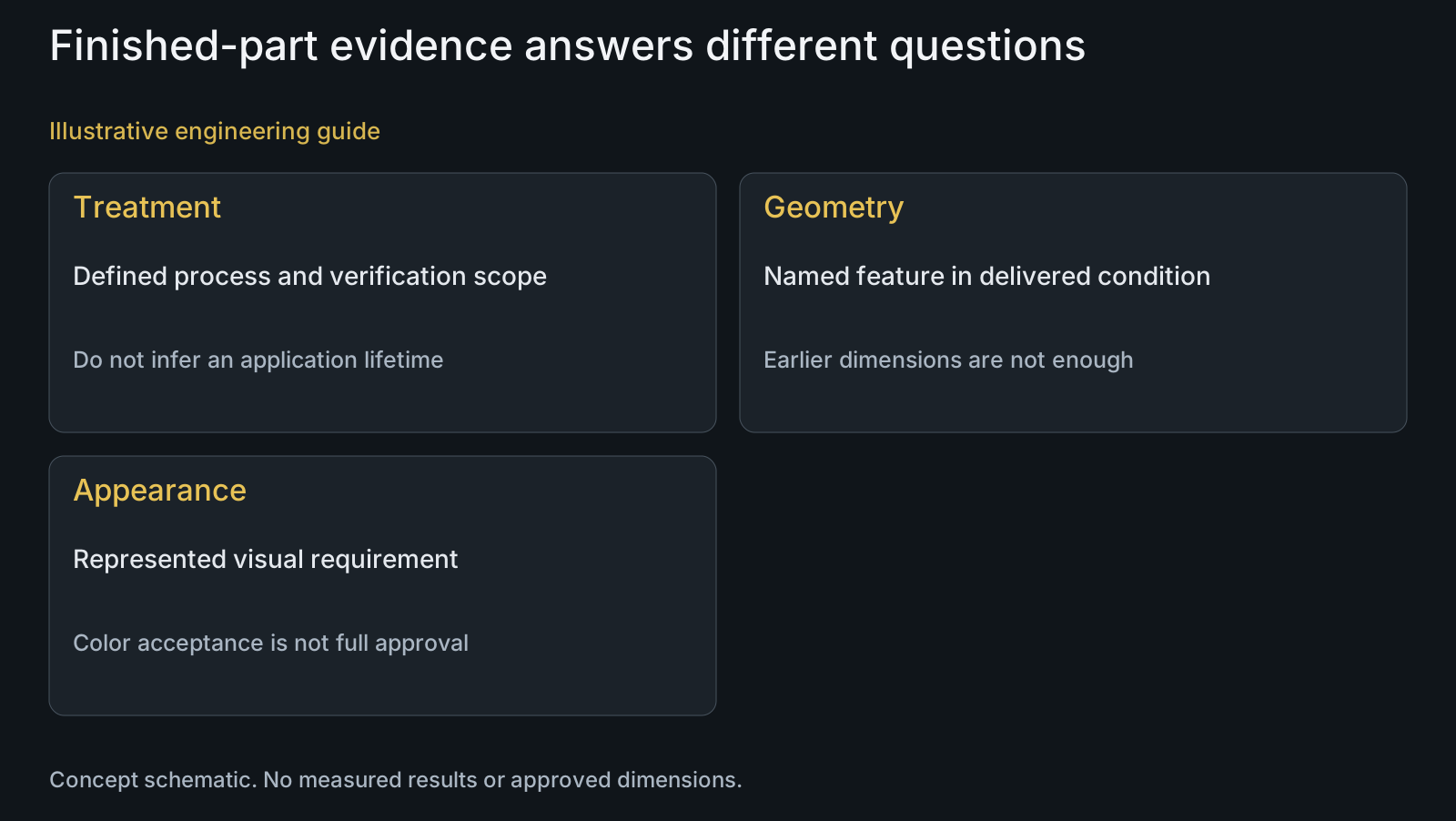
Separate process completion from treatment verification
A record that identifies a performed treatment may support the route history. Ask whether it also evaluates the particular requirement you specified. A named operation, a completed work record and a reported verification are not interchangeable statements.
The public ASTM A967/A967M scope describes alternative qualitative tests for passivation effectiveness and states that it does not recommend application-specific suitability. The scope is not permission to assume every test applies or that a passivation statement validates a complete bicycle joint.
If your order names a governing specification, identify its agreed edition and applicable treatment or verification requirement. Define the represented parts and acceptance subject. Do not infer a corrosion lifetime, universal test schedule or another treatment's performance from that document reference.
| Evidence or observation | Can address | Does not automatically establish | Useful review input |
|---|---|---|---|
| Treatment completion record | Named operation and represented work | Every finished feature accepted | Part identity and treatment scope |
| Applicable passivation verification | Specified qualitative treatment question | Bicycle corrosion lifetime | Agreed specification and test subject |
| Pre-treatment dimension | Feature in its represented earlier state | Finished locating fit | Final-state drawing requirement |
| Finished dimension result | Represented supplied feature | Appearance or treatment performance | Feature, condition and method |
| Appearance acceptance | Defined visual subject/reference | All functional interfaces | Pairing and viewing basis |
| Assembly observation | Named interface under stated conditions | Every route or future configuration | Relevant parts and evaluation scope |
Keep the finished-interface question independently answerable
A locating shoulder, sleeve bore or contact face needs its own delivered requirement. State which dimensions apply after the specified treatment and any permitted final operation. A record of pre-treatment machining is not automatically evidence for the final supplied surface.
If a report contains dimensional results, identify the represented feature and condition. A measurement of the head does not answer the sleeve-seat question merely because it appears on the same page. Connect the feature to the drawing and its mating relationship.
Use the finished-state discussion for an anodized interface and the relevant manufacturing scope for the proposed route. Avoid supplying a universal machining allowance where the actual treatment and geometry have not been defined.
Treat appearance as a separate acceptance subject
If caps or spacers must appear consistent together, identify the represented pairing and viewing basis. A finish name alone does not define an acceptable cosmetic difference. An approved appearance reference should state what it covers rather than imply all functional requirements are accepted.
Conversely, dimensional conformity does not necessarily resolve a customer-visible finish concern. Keep the reported observation and the applicable appearance requirement distinct from a locating-fit result. The next action depends on which subject remains open.
For a mixed-material kit, define the intended appearance per item and the combination being evaluated. The item-level material guide preserves the separate material requirements. A common appearance goal does not make their finishing evidence interchangeable.
Read a returned package without borrowing its conclusions
Illustrative engineering example: assume a stainless axle and anodized spacer return with a treatment record, while the kit drawing names a finished locating interface and a visible spacer appearance requirement. No actual batch, processor report, inspection value or successful result is assumed.
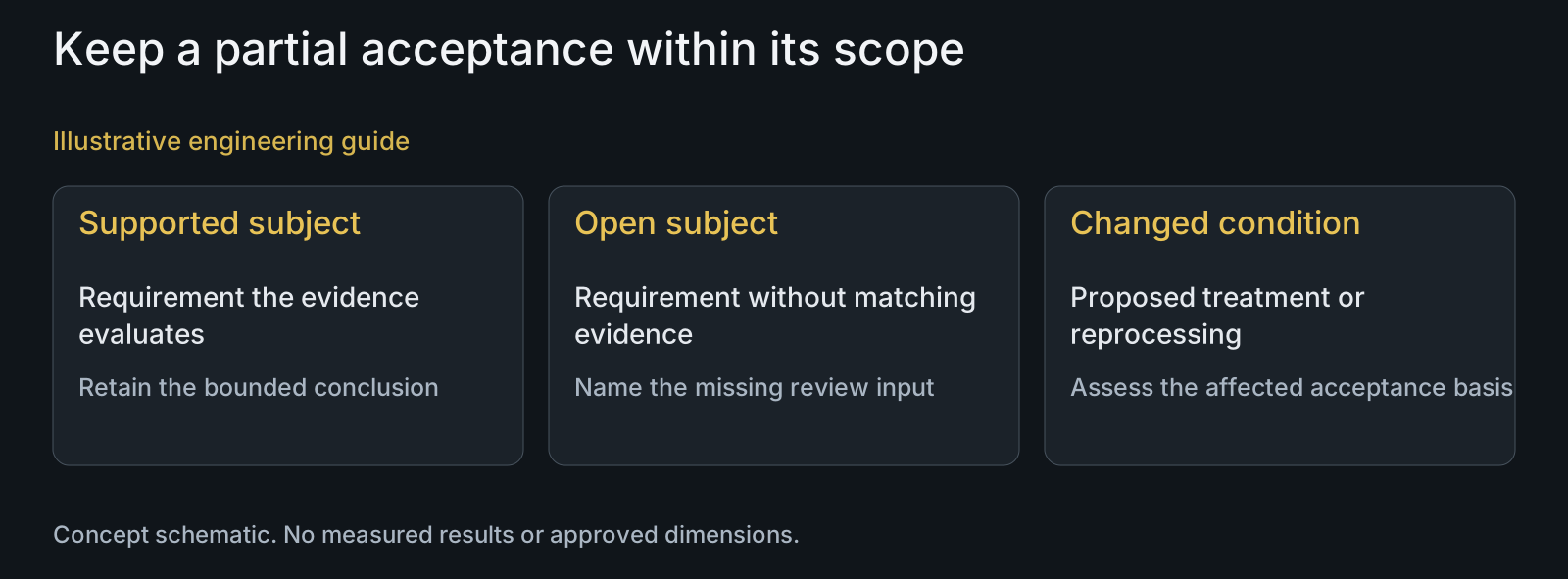
The treatment record can be assessed for the process subject it represents. It does not, without relevant content, answer whether the spacer's finished locating dimension meets the drawing or whether its appearance matches the intended reference. List those as distinct questions rather than reject or approve the entire package from one label.
If appearance is accepted but the interface evidence remains incomplete, that acceptance should retain its scope. Likewise, a dimensional result does not convert an unspecified passivation record into a broader corrosion finding. The example ends with evidence matched to requirements, not an invented pass outcome.
Define the open subject before changing or reprocessing
When an issue is reported, name whether it concerns treatment identity, coverage, geometry, appearance or a separate application observation. These can require different review inputs. Do not substitute a generic instruction to refinish for a defined diagnosis.
If a different treatment or reprocessing route is proposed, identify which requirements would be affected and what evidence would represent the new supplied condition. Earlier appearance or dimensional conclusions may not apply unchanged. Keep the customer design decision visible for altered functional requirements.
For quotation comparison, align the surface-treatment scope, acceptance evidence and delivery milestone. Neither ownership of an operation nor integration alone proves a fixed time saving. The value to evaluate is the coherent offered package and responsibility for its unresolved subjects.
Questions buyers need to confirm
Are all PremFixer surface treatments performed in-house?
No. The confirmed model coordinates relevant in-house manufacturing with qualified-partner surface treatment. Clarify the route for the quoted items and requested finish. A one-stop contact does not turn specialist partner lines into owned equipment.
Does a treatment record prove the finished pivot fit?
Not automatically. Check whether it evaluates the named locating feature in its delivered condition. A performed-treatment statement or pre-treatment dimension may support a different subject without answering the final mating requirement.
Does a passivation test predict bicycle corrosion life?
No universal life conclusion follows here. The cited public ASTM scope describes qualitative passivation-effectiveness tests, not application-specific suitability. State the applicable requirement and evaluate the represented assembly exposure separately.
Can appearance approval release every other requirement?
No. It addresses the represented visual subject and reference. Keep final dimensions, treatment requirements and application evaluation independently visible. An attractive finish is not evidence for every functional interface.
Can parts simply be reprocessed if the finish is questioned?
Assess the proposed action against the defined issue and supplied requirements. Identify affected surfaces, geometry and evidence before treating the new condition as equivalent. A cosmetic concern alone does not authorize an unspecified route change.
Will integrated finishing always shorten delivery by several days?
No fixed saving is established. Compare the actual offered route, processor availability, evidence and kit-ready milestone. Integration can clarify coordination, but a universal reduction cannot be inferred from the service label.
Technical references and scope
ASTM: A967/A967M-25 Public Scope. Public scope of qualitative passivation-effectiveness tests and application-suitability limitation; not a full-standard clause interpretation, universal test list or PremFixer result.
Explore related component, material and sourcing decisions in the customer decision knowledge center. For a drawing review, use the Drawing/BOM RFQ path.
Specify the finished requirement and the evidence it needs
Send item drawings or STEP and the BOM, material conditions, finish requirements, protected surfaces, final-interface dimensions and appearance reference where relevant. State requested evidence and the delivery milestone so PremFixer can discuss a coordinated finishing scope with each acceptance subject visible.
Discuss the drawing and BOM