
Do not change every children's bicycle pivot bolt solely because ISO 8098 has a revised edition. First confirm the actual product scope and the relevant connection requirement, then determine what the drawing, supplied condition or evidence needs to address. The public 2023 revision notice identifies a minimum-failure-torque change, but it does not establish a universal pivot tightening value. A shared bolt across a children's product family also does not make every model the same assessment subject. PremFixer can discuss drawing-led manufacturing inputs; the responsible OEM team must identify the applicable product requirements and the evidence needed for its actual assembled bicycle.
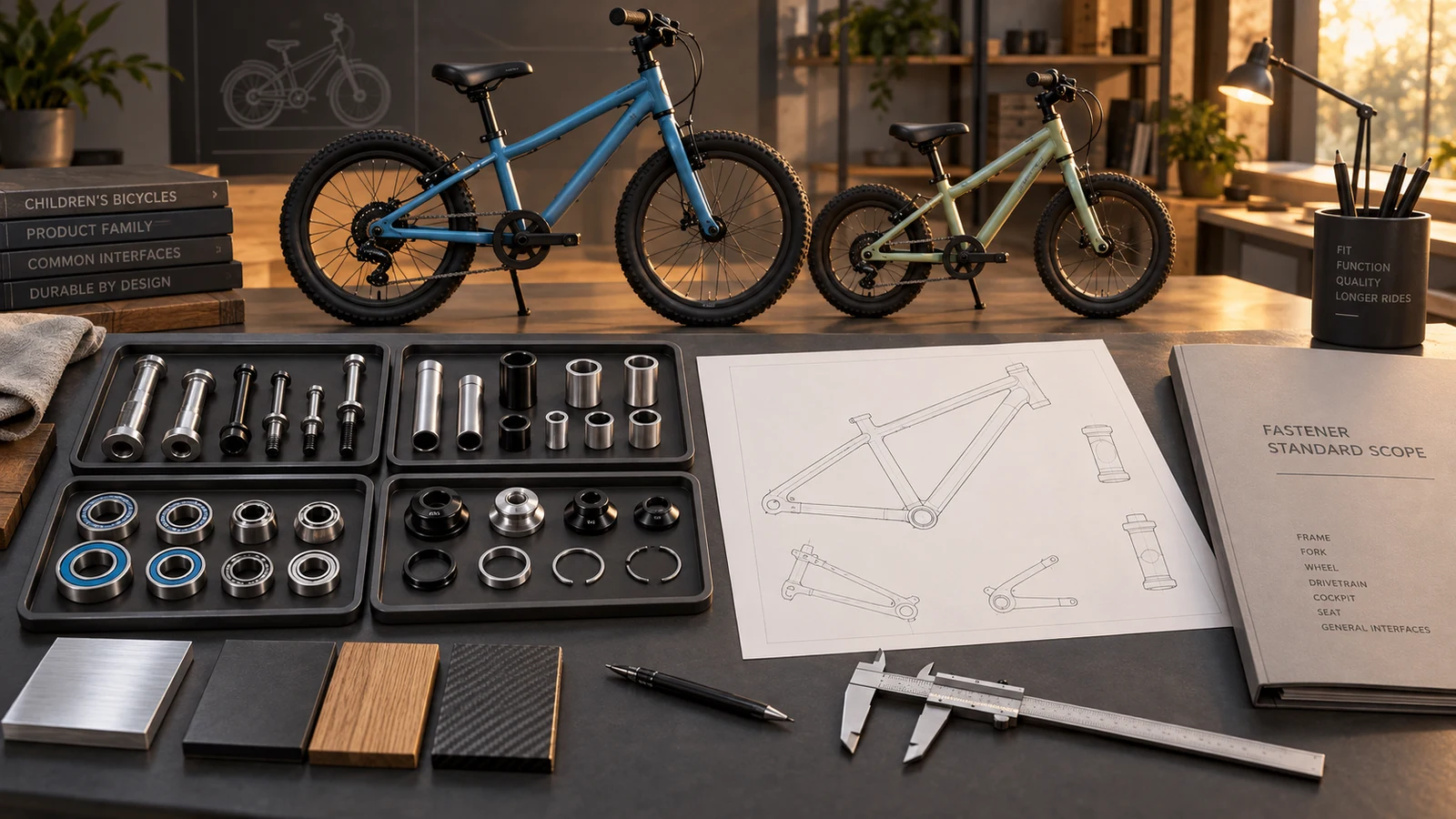
Hero: concept illustration of example hardware and its application. It is not a factory photograph, tested component or approved production geometry.
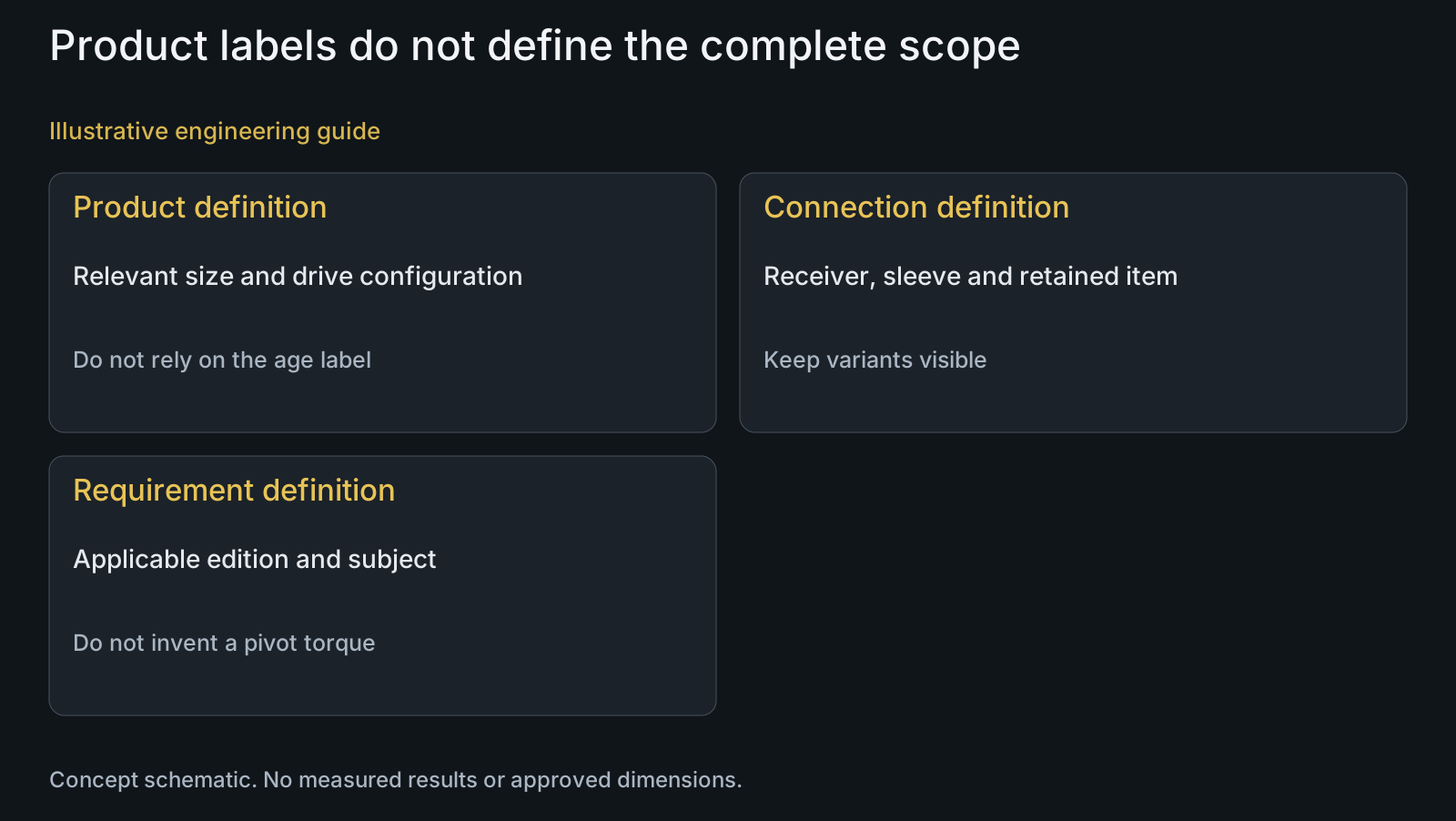
Use the actual bicycle configuration instead of an age label
ISO's public scope covers bicycles with maximum saddle height greater than 435 mm and less than 635 mm, propelled by a transmitted drive to the rear wheel. It excludes special stunt bicycles such as BMX. These are product-scope conditions, not a bolt-size or alloy rule.
A marketing label such as 'kids' or 'junior' does not provide those inputs. Obtain the product's relevant maximum saddle-height definition and drive configuration from the responsible team. Do not substitute the current seat adjustment, wheel-size label or suggested rider age for the required scope information.
If a balance-style or another configuration does not match the described scope, identify its applicable basis separately. Being outside this one document does not mean no safety requirements apply. This article does not classify a particular product as a toy or settle destination regulations.
Locate the revised subject without inventing its consequence
The official ISO preview hosted by ANSI identifies a technical revision from the 2014 edition, including a minimum-failure-torque change and a parallel-brake-lever addition. These are separate revision subjects, not proof that every pivot requires a different part.
Read the relevant full requirement to determine the named connection, method and acceptance basis. A revision list can identify where a comparison is needed but cannot establish a percentage change, universal test fixture or new installation setting from its heading.
Keep a brake-related change assigned to its actual subject rather than expand it into a pivot manufacturing claim. The clause-to-feature guide explains the general mapping task for a different standard; do not transfer its clause numbers into ISO 8098.
| Finding or difference | What it changes | Wrong purchasing shortcut | Useful next input |
|---|---|---|---|
| Only an age/marketing label is known | Product scope remains unclear | Assign one children's standard to every model | Actual scope-defining product information |
| Drive configuration differs | Applicability needs separate review | Treat all small cycles identically | Responsible product basis |
| Same bolt, different receiver or sleeve | Assembly evidence subject differs | Reuse one report as family approval | Mating definitions and represented scope |
| Same component and changed requirement | Evidence question may change | Assume every bolt needs redesign | Relevant full requirement comparison |
| Material report is available | Represented material can be reviewed | Treat it as complete bicycle approval | Defined component and product evidence |
| Sample is for a mating review | Purpose is bounded to that configuration | Infer durability or every model's safety | Revision, supplied state and assessment question |
Keep product variants visible even when a hardware item is shared
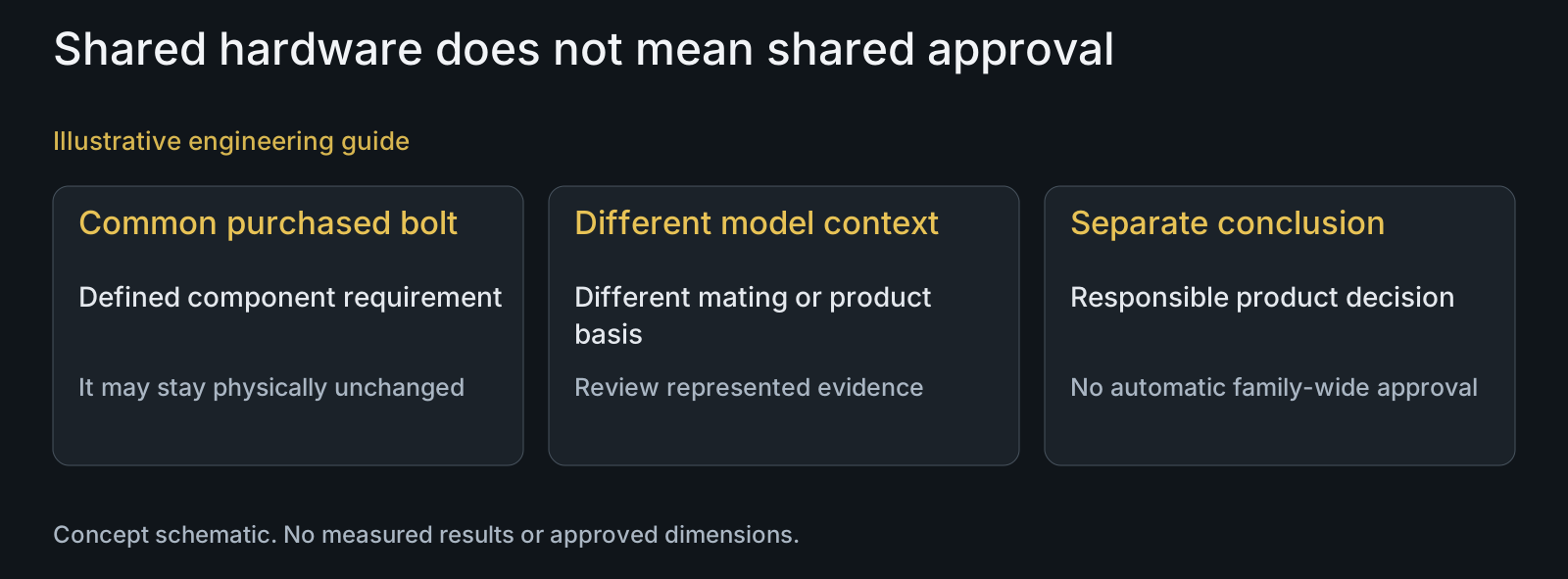
An OEM may buy one bolt for several models, but each model can place it in a different receiver, contact stack or product configuration. Common purchasing identity does not establish that one assembly assessment represents all of those uses.
Distinguish the unchanged supplied component from the changed application. If the geometry, material and finish remain the same, there may be no component redesign to price. The product team still needs to determine whether its requirement and evidence cover the proposed additional model.
For a variant with a different sleeve, bearing arrangement or receiving thread, keep those differences in the interface definition. The mixed-material kit guide helps retain item visibility; it is not a product-family certification rule.
Define the requested component and the sample's question
Specify the part geometry, material condition, finish and relevant mates rather than ask for a generic 'children's compliant bolt.' A material record concerns the represented material; it does not approve the full bicycle's interfaces, use and applicable requirements.
State whether a sample supports a dimensional check, a mating review or input to a defined assessment. Identify the part revision and supplied condition. A sample used with one receiver cannot silently demonstrate the behavior of another receiver or every product in a family.
The children's hardware design article separately addresses accessible geometry and material substitution. This scope review decides which product and requirement the hardware discussion concerns, not a universal edge shape or alloy selection.
Review common hardware across two child-oriented models
Illustrative engineering example: assume an OEM wants to share a shoulder bolt between two small pedal-bicycle models. Their relevant maximum saddle-height definitions and sleeve arrangements have not yet been compared. No actual dimensions, test results, customer project or accepted commonality decision is assumed.
The team first identifies each model's product scope rather than apply the same standard from the age label. It then compares the represented interfaces and asks which evidence addresses each actual configuration. Sharing the purchased bolt may remain possible without claiming that a report for one model approves the other.
If the second model needs a different sleeve, the change should be visible in its BOM and request. If the bolt definition remains unchanged, that distinction can prevent an unnecessary bolt redesign while preserving the unresolved product question. The example demonstrates a review logic, not a validated safe design.
State the edition and supplier evidence without assigning product approval
The ISO catalog identifies the English corrected version dated August 2023. State the required edition and correction status in the project information rather than treat a filename date as sufficient identification. An in-development amendment is not automatically an implemented purchasing requirement.
Keep the relevant requirement and supplied configuration together in the RFQ package. Identify the requested evidence subject through the report-scope guide, and keep complete-product decisions with their responsible reviewer.
PremFixer's manufacturing, materials and application discussions can support the defined component request. No children's bicycle certification, universal alloy approval, legal deadline or complete test package is promised here. Do not request a supplier declaration broader than the offered work and available evidence.
Questions buyers need to confirm
Does the children's age label establish ISO 8098 applicability?
No. Use the actual scope-defining product information. The described size and drive conditions matter; an age recommendation alone does not classify the bicycle or define the component requirement.
Did the 2023 revision identify a failure-torque change?
Yes, the public revision notice identifies that subject. The applicable complete requirement still needs review; the notice alone does not assign a tightening value to every children's pivot.
Can one bolt be purchased for several children's models?
It can be proposed if the component requirements are suitable, but shared purchase identity does not establish shared assembly evidence. Compare the receivers, sleeves, supplied conditions and relevant product basis before making the commonality decision.
Does a material report approve a children's bicycle?
No. It addresses its represented material, not all interfaces and product requirements. Request the appropriate component evidence and retain the separate complete-product assessment with the responsible team.
Does the standard require stainless or titanium for every pivot?
No such universal alloy conclusion is supported here. Define the actual part and connection requirements before selecting material. A category title or revision notice is not approval of a material substitution.
What should an OEM send for a children's hardware scope review?
Send the actual product-scope information, intended market, applicable standard/edition, part and mating definitions, and supplied material/finish. State the sample purpose and which model variants need a conclusion so manufacturing evidence is not confused with product-family approval.
Technical references and scope
ISO 8098:2023 public scope and catalog. Product-scope size/drive conditions, stunt exclusion and English correction status; no destination legal classification or universal alloy approval.
ISO 8098:2023 public preview hosted by ANSI. Informative foreword identifies revised minimum-failure-torque and parallel-brake-lever subjects; not full normative test methods or a universal pivot tightening value.
Explore related component, material and sourcing decisions in the customer decision knowledge center. For a drawing review, use the Drawing/BOM RFQ path.
Define the product and represented hardware before quotation
Share the drawing or STEP, item-level BOM and relevant product-scope information, with the applicable edition and connection requirement. Identify common hardware, changed mates and the sample/evidence purpose so PremFixer can discuss the defined manufacturing scope.
Discuss the drawing and BOM