

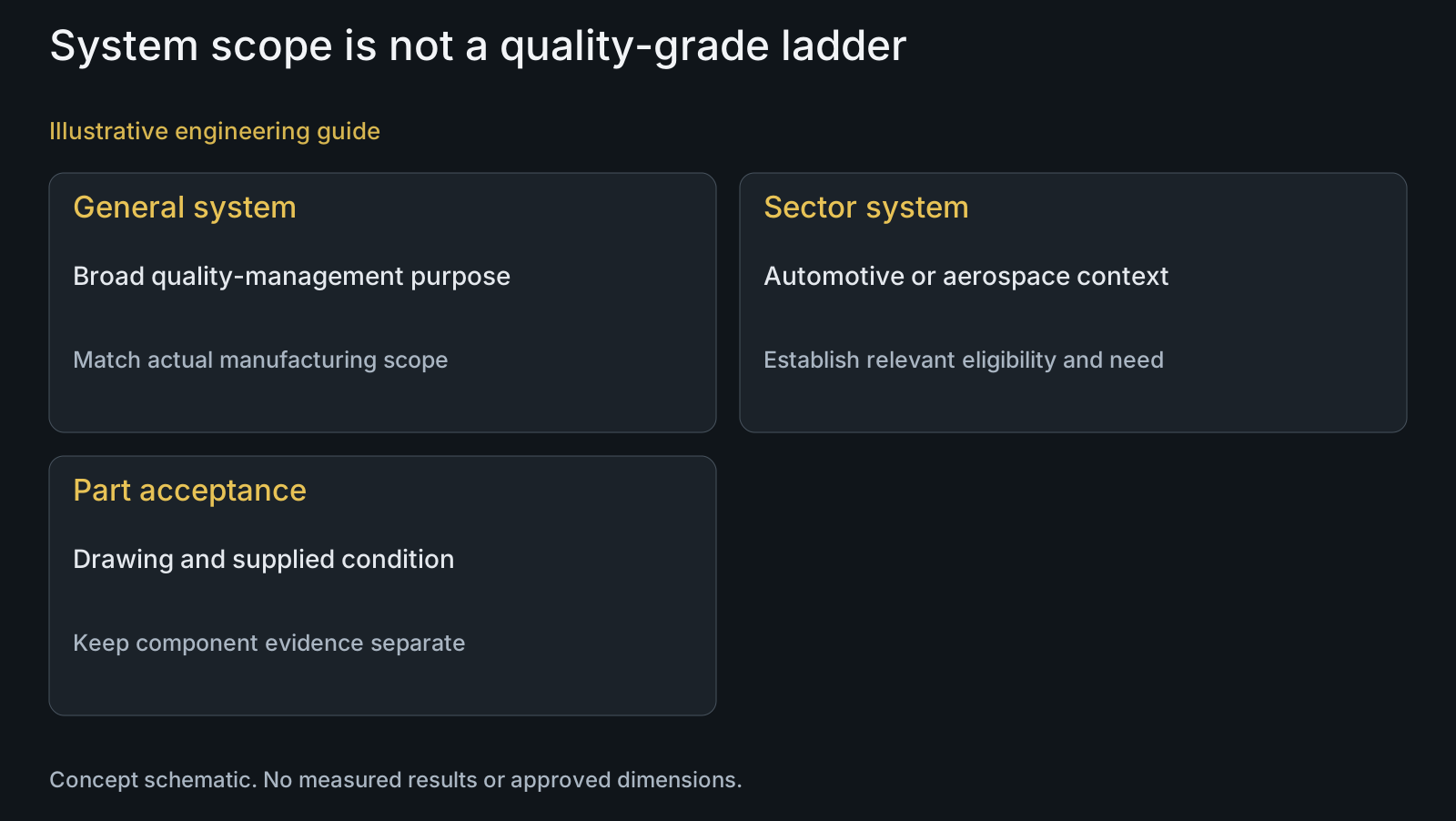
A bicycle OEM should choose a supplier quality-system requirement from its purchasing contract, sector and manufacturing scope, not assume that more certificate names mean a better pivot. ISO 9001 addresses quality management across sectors. IATF certification has automotive eligibility conditions, while AS9100 adds aviation, space and defence requirements. These are organizational systems, not proof that a shoulder, thread or treated bearing seat meets your drawing. Specify first-article inspection and design validation separately. Check the named entity, producing site, activity, edition and current certificate status before relying on the record; no universal ISO 9001-plus-AS9102 combination is established for every bicycle project.
Hero: concept illustration of example hardware and its application. It is not a factory photograph, tested component or approved production geometry.
Choose the assurance question before choosing a standard
Ask what the buyer needs from organizational assurance and which obligations the purchasing agreement names. A customer-specific program may require a particular system or evidence package. That requirement should be explicit, rather than inferred from the fact that the component is a safety-relevant fastener.
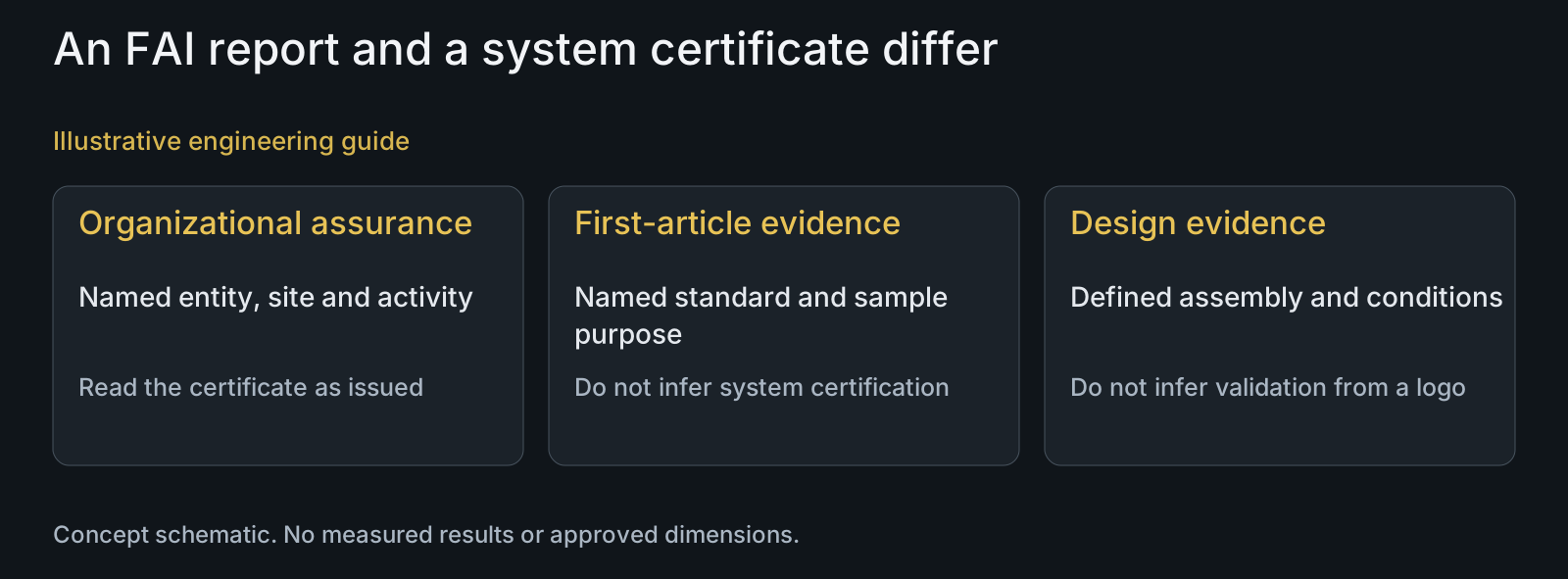
Keep three questions separate: how the organization manages quality, whether the supplied component conforms to its requirements, and whether the complete pivot design is suitable for its application. A system certificate, dimensional result and assembly-validation record answer different parts of that review.
The supplier-document guide develops identity and document applicability. This comparison focuses on choosing among quality-system purposes and keeping first-article inspection outside the certification category, not authenticating a specific certificate.
ISO 9001 supplies a general quality-management framework
ISO's public overview describes ISO 9001 as applicable across organization sizes and sectors. It currently identifies the 2026 edition and directs organizations with 2015-edition certification to their certification body for transition information. Do not invent a transition deadline or rewrite an existing certificate's edition.
For sourcing, read the actual certificate's named activity and sites. A certificate for a trading activity does not by its title alone establish the proposed manufacturing scope. A relevant production scope can support an organizational assurance decision without establishing every delivered dimension.
PremFixer's displayed certificate page provides the company-controlled record for review. Read its stated edition and scope as issued. Publication of a newer standard does not prove that the displayed record has transitioned, nor does this article perform a fresh issuer-status verification.
| Reference or record | Relevant purpose | Do not infer | Buyer review |
|---|---|---|---|
| ISO 9001 system | Quality management across sectors | Every finished pivot conforms | Entity, site, scope and status |
| IATF 16949 system | Eligible automotive manufacturing scope | Every bicycle program is eligible | Certification-body applicability |
| AS9100 system | Aviation, space and defence QMS scope | Aerospace-approved bicycle design | Customer need and covered scope |
| AS9102 FAI | Specified first-article process and record | Factory-wide system certification | Named requirement and sample scope |
| Dimensional report | Identified drawing characteristics | Design life or all future lots | Feature, datum and supplied state |
| Assembly validation | Defined design and test conditions | All variants accepted | Configuration and evidence limits |
IATF requirements need an automotive eligibility discussion
The IATF Rules sixth-edition public Q&A explains certification eligibility in relation to automotive manufacturing and defined vehicle applications. It calls for certification-body verification of applicability. Do not equate every road-going or electrically assisted bicycle with an eligible automotive program.
If a candidate serves automotive customers, ask which site and scope its IATF record covers and why that evidence is relevant to your proposed supply. Having other-sector experience may inform review; it does not automatically put the bicycle order inside the certified scope.
A bicycle buyer can specify relevant quality deliverables in its agreement without calling them IATF certification. Name the required control or report and acceptance purpose. Eligibility and certification claims should be resolved with the relevant certification body, not by interpreting a certificate logo as a universal quality rank.
AS9100 and AS9102 address different assurance subjects
SAE's AS9100D public scope identifies additional aviation, space and defence quality-management requirements alongside ISO 9001:2015 requirements. Its sector purpose is not a claim that a bicycle pivot becomes aerospace-approved when made by a supplier holding the system certificate.
SAE's AS9102C public scope addresses performing and documenting first-article inspection. IAQG's 9102 overview also describes possible use outside aerospace where a standardized FAI process is needed. That does not make it mandatory for every bicycle order.
If the customer requires a named FAI standard, agree the applicable edition and deliverable rather than rename an ordinary dimensional sheet AS9102 compliance. The first-article guide develops that inspection task. An FAI report is not a factory-wide management-system certificate.
Link the selected system to the actual producing scope
Compare the proposed contracting entity, manufacturing site and relevant operations with the certificate. Where partner finishing or testing is involved, identify the responsibility and supporting evidence needed. The lead supplier's certificate does not automatically certify every partner's system or each partner result.
The manufacturing overview distinguishes in-house work and partner scope. Use that route discussion to identify where organizational controls and product acceptance meet, without claiming that the presence of a system certificate closes the final treated-feature inspection question.
Keep status and applicability open when evidence is incomplete. A future printed expiry date is not itself a current registry check. Likewise, missing an optional sector certificate is not automatically a demonstrated product defect. The buyer should explain which agreed qualification decision the requested evidence supports.
Illustrative review: an aerospace badge does not answer the fit
Illustrative engineering example: assume a bicycle buyer compares two proposals for the same treated shoulder pivot. One offers a relevant general manufacturing-system record and drawing-specific inspection proposal. The other advertises aerospace-system certification but has not identified the finished bearing-seat acceptance method. No real suppliers or favourable test results are assumed.
The reviewer first applies the actual customer qualification requirement to both proposals. It then asks each supplier for the producing-scope relationship and the missing part-specific evidence. It does not rank the second offer higher merely because the system has an aerospace name.
If a standardized FAI is needed, it is requested as a separate deliverable with a defined purpose. The resulting decision concerns relevant organizational assurance plus the actual pivot acceptance questions, not a badge hierarchy or an invented universal bicycle certification package.
Questions buyers need to confirm
Is AS9100 always better than ISO 9001 for a bicycle bolt?
No. Compare purpose and relevant scope rather than form a quality ranking from the names. Apply the customer's actual requirement, then evaluate the manufacturing and inspection proposal for the drawing. A sector badge cannot replace missing interface evidence.
Does an e-bike application automatically require IATF certification?
No automatic requirement or eligibility follows from that label. Identify the customer's contract and the relevant vehicle and manufacturing scope, then seek certification-body clarification where needed. Do not treat every electrically assisted bicycle as an automotive certification application.
Should all pivot orders require ISO 9001 plus AS9102?
Not as a universal combination. Specify organizational assurance and first-article needs separately. If a named FAI standard is required, agree its applicable edition, sample purpose and deliverable. An ordinary inspection sheet is not automatically that standardized report.
Does the 2026 ISO 9001 publication change an existing certificate's printed edition?
No. Read the record as issued and ask the certification body about applicable status and transition information. Do not relabel an ISO 9001:2015 certificate as 2026 or invent a transition deadline. Current-standard publication and current certificate evidence are different subjects.
Can a valid system certificate accept the treated bearing seat?
No. Define the drawing characteristic, datum, supplied treatment state and relevant measurement evidence. The system supports organizational assurance within its scope; the component still needs its own acceptance basis and the assembly its own applicable validation.
What should accompany a quality-system requirement in the RFQ?
Send the drawings and BOM, proposed supply scope and customer qualification requirement. State required system evidence, first-article deliverables and part acceptance separately, including any named editions. Identify the site and partner operations that matter to the proposed program.
Technical references and scope
ISO 9001 current public overview. General cross-sector QMS purpose, current 2026 publication and direction to certification bodies for transition information; not evidence that PremFixer's displayed record has transitioned.
IATF Rules sixth-edition eligibility Q&A. Official public eligibility discussion on pages 5 through 9, read as context for automotive manufacturing and certification-body applicability review; no particular bicycle supplier eligibility decision made.
SAE AS9100D public scope. Aviation, space and defence management-system scope and its stated ISO base; public description only, not full clauses or a PremFixer certification claim.
SAE AS9102C public scope. Public first-article inspection process and documentation purpose; not a completed report or factory-wide system certification.
IAQG 9102 overview. Public description of aerospace origin and possible use in other sectors needing standardized FAI; not a universal bicycle requirement.
Explore related component, material and sourcing decisions in the customer decision knowledge center. For a drawing review, use the Drawing/BOM RFQ path.
Specify the assurance your pivot program actually needs
Send the drawings or STEP files, BOM and customer quality requirements through the Drawing/BOM RFQ path. Separate management-system evidence, first-article inspection and final part acceptance. The review will connect the proposed manufacturing scope to those deliverables and identify any specialist or certification-body clarification still needed.
Discuss the drawing and BOM