

A pivot manufacturer's certificates cannot be evaluated by counting logos or documents. Identify the subject, issuer, legal entity, covered site, scope and current applicability of each record before deciding what it supports. A quality-management-system certificate concerns an organization within its stated scope; a material document, chemical statement or dimensional report addresses a different question. None automatically accepts a custom pivot against its drawing. For supplier selection, verify the certificate and its relevance first, then identify the product-specific evidence still needed. A genuine certificate for the wrong activity or site can leave the same purchasing gap as no relevant certificate.
Hero: concept illustration of example hardware and its application. It is not a factory photograph, tested component or approved production geometry.
Ask what was assessed before asking which logo appears
Start with the decision you need to make. Are you assessing an organization's management system, identifying the supplied material, reviewing a defined compliance claim or accepting finished geometry? The relevant subject changes the required evidence. These questions should not be collapsed into a single certified-supplier label.
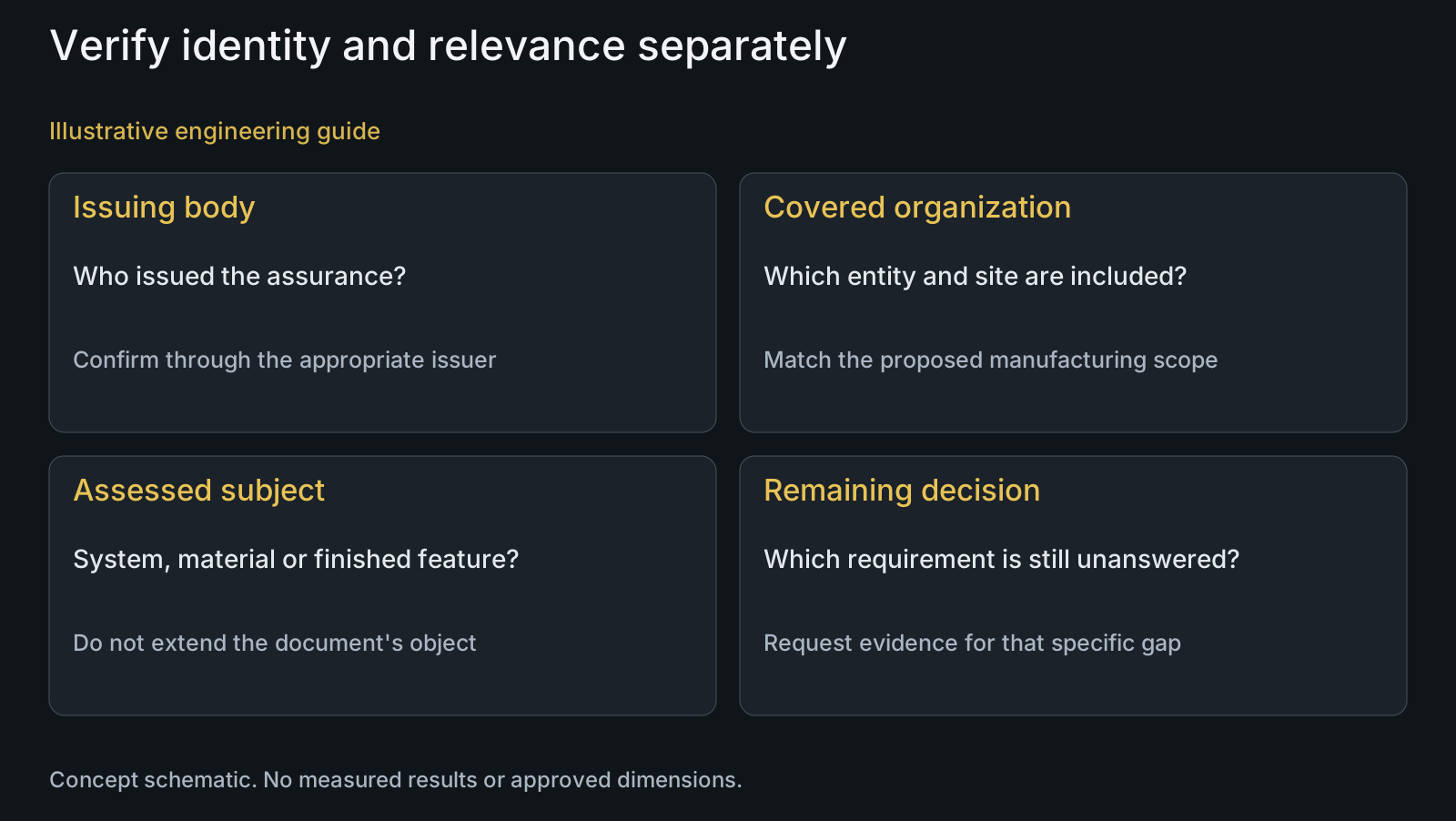
ISO's certification explanation states that certification is performed by external certification bodies, not by ISO itself. Identify the actual issuer instead of accepting a statement that the factory is certified by ISO. A standards publisher's name is not the issuing body's identity.
ISO CASCO's conformity-assessment guidance distinguishes the object and issuing party of an attestation. It also warns against implying that a certified management system means the products themselves were certified. For pivot purchasing, read the assessed object before extending the claim.
Check entity, location and activity together
Compare the certificate's legal entity with the contracting and manufacturing entities proposed for the order. A brand name can differ from a legal company name; the relationship needs to be clear. A certificate belonging to another company is not automatically evidence for the proposed manufacturer.
Read the covered site and activity, including any stated exclusions or additional sites. A certificate for a distribution activity does not, by its title alone, establish certification of a different production facility. If a group or multi-site arrangement is claimed, ask for the record identifying the covered location.
Ask how the proposed manufacturing route relates to that scope. External treatment or testing can be coordinated within an order, but the primary supplier's certificate does not automatically certify every partner or every result supplied by that partner.
| Record presented | Question it can support | Do not infer | Next verification |
|---|---|---|---|
| Management-system certificate | System certification for the named entity and scope | Every part meets its drawing | Issuer, covered site, activity and current status |
| Material inspection document | Requirements and results for represented material | Finished shoulder geometry | Specified material and connection to supplied parts |
| Supplier conformity statement | Named requirements for the identified subject | An independent certification of unstated properties | Issuer, assessment basis and declared scope |
| Chemical-related statement | Defined substance information for an article | Every coating or market obligation is covered | Configuration, assessment date and addressed requirements |
| First-article inspection report | Evaluation of identified sample characteristics | All later batches or factory-wide certification | Drawing, sample, processing state and required coverage |
Read the confirmed PremFixer certificate as written
The PremFixer certificate page provides the displayed certificate for Guangdong Pinshang Hardware Products Co., Ltd. It identifies Bureau Veritas Certification Holding SAS, UK Branch, as issuer, ISO 9001:2015 as the stated standard and production of hardware screws and nuts as the certification scope.
The displayed record gives external certificate number F02326Q00193R002, issue date 28 April 2026 and expiry date 27 April 2029. Read those details in the supplied certificate rather than replacing its stated edition or enlarging its activity to every conceivable process. The document also conditions continued validity on satisfactory system operation.
For current supplier approval, use the issuer's verification route or request current confirmation of scope and status. A future expiry date printed on a copy is not by itself a live-status check. The quality-system decision guide explains the distinction between system assurance and part acceptance.
Keep material, declarations and first-article reports in their own scope
A material document must identify the represented product and material relationship; it does not inherit finished-part coverage from the supplier's management-system certificate. Use the EN 10204 document-scope guide for document-type questions rather than treat every mill record as an independent product certification.
For a requested REACH or RoHS-related statement, identify the article, substrate, surface system, assessed requirements and date. A general logo or an undated statement does not establish which supplied configuration was assessed. Refer to the custom-order document guide to define the requested delivery package separately.
SAE's AS9102C scope addresses performing and documenting first-article inspection. IAQG describes its aerospace origins and possible use in other sectors. A bicycle sample report is not automatically an AS9102-compliant report or a factory certification; agree any named FAI requirement explicitly.
Review a supplier folder without confusing authenticity and coverage
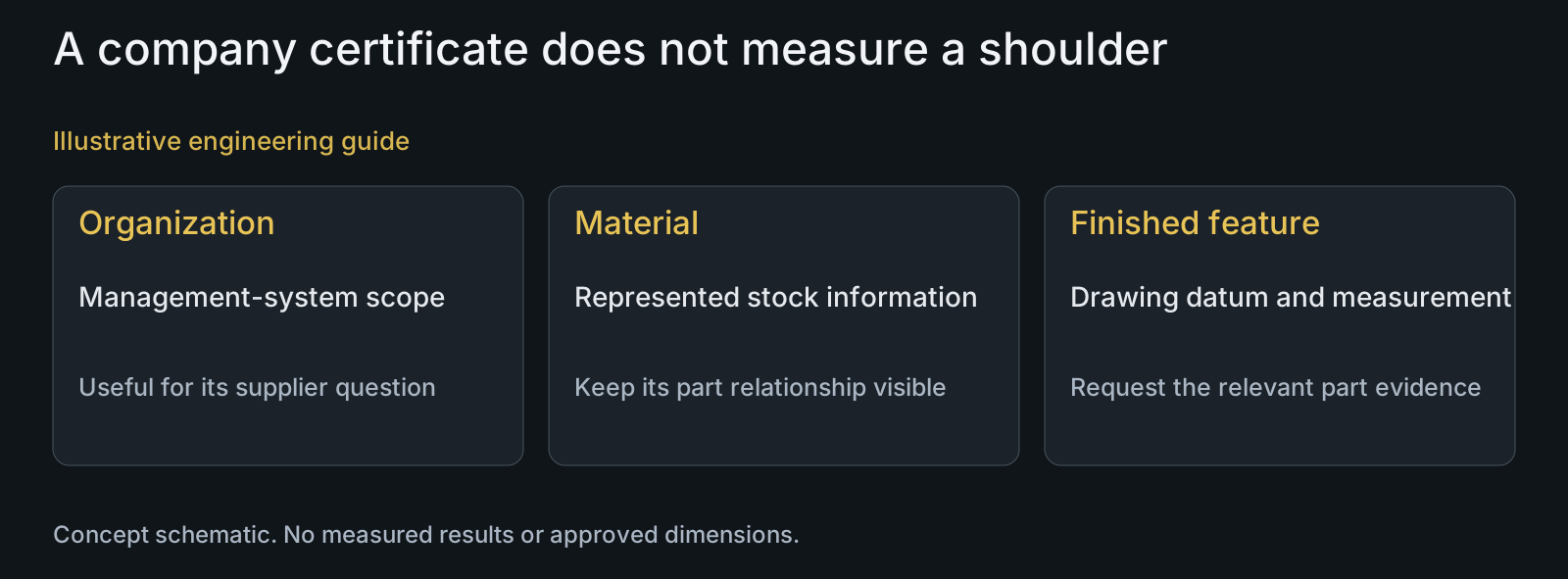
Illustrative engineering example: assume a buyer receives a management-system certificate and a material record while selecting a supplier for a custom shoulder pivot. The buyer's immediate acceptance concern is the shoulder's position relative to a drawing datum. No actual supplier failure or measurement result is assumed.
The reviewer first checks whether the company certificate applies to the proposed entity and site. The material record is then checked for its represented stock and link to the proposed supply. Even if both documents are relevant and genuine, neither supplies the finished shoulder measurement.
The remaining request is a defined dimensional evaluation against the applicable drawing and datum, not another unrelated certificate. This separates an organizational approval decision from a part-characteristic decision without dismissing the useful evidence already provided.
Escalate the specific gap instead of demanding more badges
If the issuing identity or current status cannot be established, ask the named certification body for clarification. If the entity, site or activity is unclear, request the relevant certificate or scope attachment. If finished geometry is missing, specify the characteristic and measurement basis. These gaps require different responses.
Keep supplier approval and shipment acceptance distinct. A purchasing team may approve an organizational scope while engineering or quality still needs evidence for the particular part. Make that remaining requirement visible in the quotation rather than assume approval of one subject closes every other subject.
Use the pivot supplier evaluation guide for the wider sourcing decision and Materials for specified alloy options. Requested documents, extra testing and acceptance obligations must be agreed for the actual order; no universal availability of every named report is implied.
Questions buyers need to confirm
Does ISO issue the factory's certificate?
No. External certification bodies perform certification. Read the actual issuer and certificate identity, then use the appropriate verification channel instead of assuming an ISO logo proves authenticity.
Can a different company name on the certificate be acceptable?
A brand and legal entity can have different names, but the relationship must be established. Check the named company, covered manufacturing site and contracting arrangement; do not assume a related group's certificate covers the proposed factory.
Does a printed expiry date prove the certificate is currently valid?
Not alone. Check the issuer's current status information and applicable scope. Continued validity can be subject to conditions, so an old copy with a future date should not replace current confirmation for supplier approval.
Does management-system certification accept the delivered pivot geometry?
No. Request the drawing revision, evaluated characteristics, datum basis and identified sample or lot. System assurance and finished-part inspection answer different questions, even when both come from the same supplier.
Is a first-article report automatically AS9102 certification?
No. A named FAI standard must be specified and its requirements addressed. Identify the report's actual scope and sample; neither an ordinary dimensional report nor a completed FAI is a factory-wide product certification.
What should a supplier-certification request include?
State the proposed entity and manufacturing site, required organizational scope, relevant current-status evidence and separate part-specific requirements. Include the drawing, material and finish so the supplier can identify which documents are relevant and which additional work needs agreement.
Technical references and scope
ISO certification explanation. Certification-body role; ISO does not issue organizational certificates.
ISO CASCO attestations of conformity. Assessed subject, issuing party and distinction between management-system certification and product certification.
PremFixer displayed ISO certificate. Company-controlled certificate image identifies the legal entity, issuer, stated edition, activity and printed dates; not a fresh external registry verification.
SAE AS9102C public scope. Public first-article inspection scope, not the full standard or evidence of a completed PremFixer FAI.
IAQG 9102 overview. Aerospace origin and possible other-sector use; not a universal bicycle requirement.
Explore related component, material and sourcing decisions in the customer decision knowledge center. For a drawing review, use the Drawing/BOM RFQ path.
Request evidence for the actual pivot requirement
Send the drawing revision, STEP model, BOM, specified material and surface condition, proposed acceptance requirements and required supplier-document criteria. The review will distinguish organizational scope from material and finished-part evidence, identify uncovered requirements and agree the documents needed for the quoted supply.
Discuss the drawing and BOM