

Design JIT bicycle fastener delivery around when the assembly team needs a complete accepted pivot configuration, then work backward to receiving and dispatch. A carton arriving shortly before a shift may still miss that need if receiving checks, a quality hold or internal movement remain. Set the quantity, revision, release condition and named receiving point before narrowing the time window. Locate upstream stock and unfinished work explicitly rather than call low customer-site stock a zero-inventory supply chain. JIT can support a defined replenishment arrangement, but its suitability depends on the actual route and demand; there is no universal requirement to deliver every custom pivot only a few hours before use.
Hero: concept illustration of example hardware and its application. It is not a factory photograph, tested component or approved production geometry.
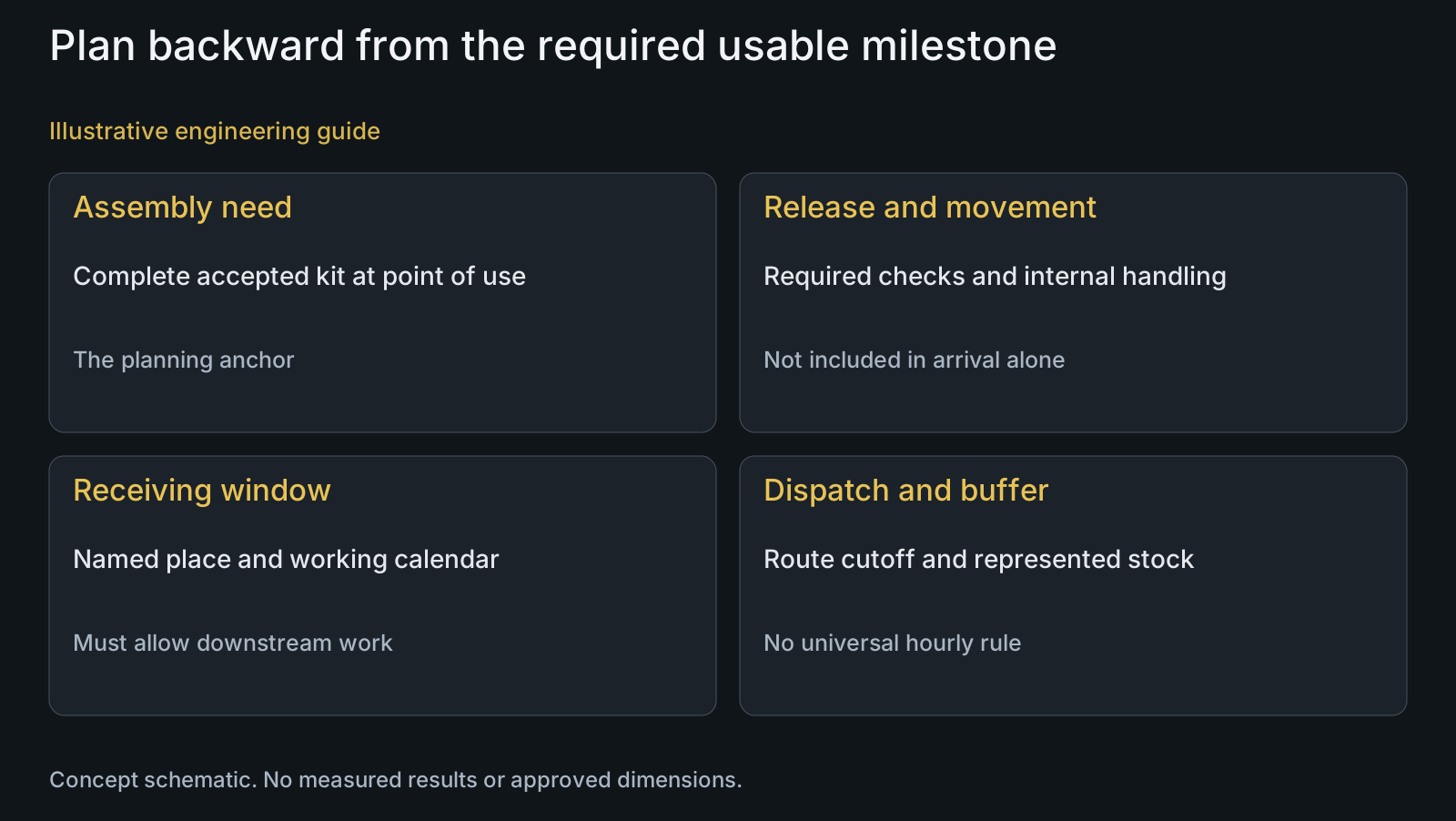
Start with assembly need and work backward
Identify the required kit configuration, quantity and point of use. Then account for the work between receipt and usable release: identity reconciliation, required receiving checks, disposition where needed, unpacking and movement to the assembly location. Do not label those activities transport time or omit them from the plan.
Set an arrival window compatible with the receiving calendar and the represented work. A shipment can arrive during a closed receiving period or meet a door timestamp without making hardware accessible to production. Define the handoff that actually matters before using an earlier milestone to claim success.
The supplier-KPI guide explains how counted delivery events affect a score. This article instead designs the timing arrangement that precedes those events. Preserve both responsibilities: an accurate dashboard cannot repair an arrival window that leaves no time for required release.
Treat JIT as synchronisation, not invisible inventory
Toyota's production-system explanation links Just-in-Time to synchronised need and also describes advance stocks in the replenishment loop. Its explanation contradicts treating every component as manufactured only after immediate demand. This is production-system context, not evidence of a Toyota relationship or a tested bicycle program.
For custom pivots, identify which material, processing and finished-state stocks support the chosen cadence. The customer may hold less at its assembly site while material or finished hardware remains elsewhere. State that location and represented readiness rather than imply that inventory has disappeared.
Use the material-buffer comparison to distinguish stock states and the VMI/JIT responsibility guide for ownership and work-release rules. This delivery design does not automatically transfer financing or obsolete-stock exposure to the supplier.
| Planning boundary | Input to establish | Risk if omitted | Decision or verification |
|---|---|---|---|
| Point-of-use need | Complete configuration and quantity | Carton presence mistaken for assembly supply | Name the required usable milestone |
| Internal release | Checks, disposition and movement | Early arrival still becomes late release | Allow the represented downstream work |
| Receiving window | Location, opening times and capacity | Arrival outside usable receiving calendar | Agree arrival and handoff conditions |
| Dispatch cutoff | Route, connection and stock readiness | Short transit estimate hides missed cutoff | Check the controlling route dependency |
| Upstream buffer | State, location and available revision | Low local stock hides unfinished work | Verify what it can release and when |
| Exception deadline | Response time and authorised options | Notice arrives too late to change output | Notify while the response is actionable |
Match delivery cadence to the remaining route
Frequent shipment releases and frequent manufacturing batches are not necessarily the same arrangement. The release cadence may draw from explicitly defined finished stock, while upstream machining or treatment follows a different schedule. Confirm that the stock and route actually support the requested release pattern.
Review the manufacturing scope, surface-treatment route and required acceptance work before promising a replenishment window. A finished-looking bolt awaiting agreed checks represents a different readiness state from an accepted item available for release.
Use the actual calendar, dispatch cutoff and receiving availability. If a missed transport connection moves receipt beyond the next usable-release point, shortening the nominal drive time may not recover the plan. Review the controlling handoff rather than apply one universal hours-before-use rule to every destination.
Give shortage notification an actionable deadline
A missing sleeve or held bolt should be reported while the buyer can still choose an effective response. Compare the time needed for another permitted shipment, release-plan adjustment or different assembly allocation. A notification after the usable-release deadline documents the problem but may no longer protect that need.
State the affected kit position, accepted revision, available quantity and current expected milestone. Do not turn a partial shipment into a complete-delivery statement. Ask whether splitting supply will enable any actual assembly or simply create another receiving task without resolving the missing component.
Keep batch identities and acceptance states distinguishable during emergency handling. Do not merge held and released hardware to make a complete-looking carton. The buyer's authorised response may change timing or allocation, but it does not silently relax component or matching requirements.
Test the plan with a receiving-release conflict
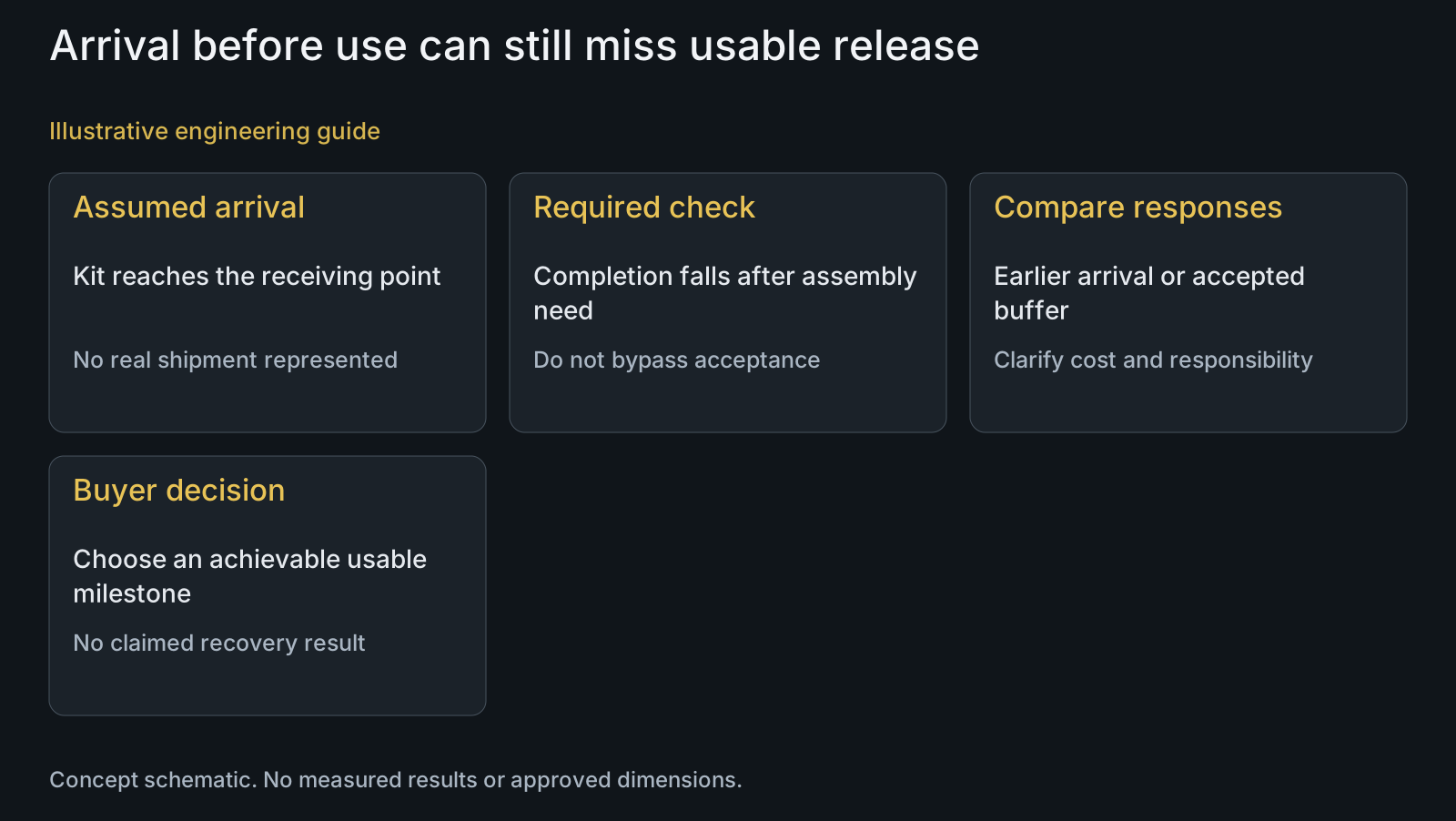
Illustrative engineering example: assume a complete pivot kit arrives before a planned assembly start, but the required receiving check cannot finish until after that start. The kit's drawings and quantity are unchanged. No actual shipment, check duration or production loss is assumed.
The arrival event meets a narrow door-window interpretation, yet the hardware is not available at the required release point. The team compares earlier arrival, a differently located accepted buffer and a revised assembly allocation. It does not resolve the conflict by declaring the required check unnecessary.
The preferred proposal must show how the represented kit becomes usable in time and who accepts any change in responsibility or cost. If none can meet the need, the limitation remains explicit. The scenario is a design test, not evidence of an approved JIT process or a recovered delivery.
Agree the timing boundary before reducing on-site stock
Record the receiving point, usable-release condition, normal cadence and exception roles in the supply discussion. Keep the actual drawing and BOM revision attached to the release. A calendar can be precise while still referring to the wrong sleeve or an incomplete configuration.
Compare the reduced on-site stock with the exposure created by the tighter window. Include extra receiving work, transport arrangements and upstream commitment where applicable. Do not declare the arrangement lower-cost merely because the customer's visible bin is smaller.
PremFixer can discuss a scoped manufacturing and delivery proposal with relevant qualified partner operations. No standing hourly-delivery, free upstream inventory or guaranteed uninterrupted assembly service is asserted. Use the materials overview for the actual item definition and the knowledge center for adjacent procurement decisions.
Questions buyers need to confirm
Does JIT require zero inventory across the pivot supply chain?
No such universal rule follows. Identify upstream stocks and their represented manufacturing state alongside the customer's on-site balance. Synchronisation may use a defined replenishment buffer; inventory ownership and change exposure still require agreed terms.
Is delivery a few hours before assembly always appropriate?
No. Work backward from usable release through required checks, movement, receiving and transport cutoffs. The necessary window depends on that actual route and calendar, not a fixed hourly definition of JIT.
Can an on-time arrival be late for assembly?
Yes, if the hardware cannot complete the required release and internal handoff by the point-of-use need. Define both milestones. A door timestamp does not prove that the complete accepted kit is accessible to production.
Should we ship the available bolts while sleeves remain missing?
Only if that partial supply serves an agreed useful purpose. State the unresolved kit position and whether any actual assembly quantity becomes available. Do not count a timely partial shipment as complete usable delivery.
When should a shortage be escalated?
While the agreed response can still affect the required release. Identify the affected item, revision, available quantity and expected milestone. Set the notification deadline against actual alternative-shipment or allocation decisions, not merely after the normal window has been missed.
What is needed to discuss a JIT delivery proposal?
Provide drawings/STEP files or samples, BOM revisions, quantities per release, consumption pattern and point-of-use need. Add receiving calendars, checks, internal movement, route cutoffs and proposed upstream stock responsibilities. These inputs expose whether a narrower window can support usable hardware.
Technical references and scope
Toyota Production System explanation. Primary Just-in-Time synchronisation and advance-stock explanation; no PremFixer relationship, bicycle-program result or universal hourly delivery rule inferred.
Explore related component, material and sourcing decisions in the customer decision knowledge center. For a drawing review, use the Drawing/BOM RFQ path.
Plan your pivot delivery from the assembly requirement
Share the drawing, STEP model or sample, released BOM, consumption pattern and required usable-release point through the Drawing/BOM RFQ path. Include receiving calendars, required checks and proposed buffer responsibilities. PremFixer can discuss the scoped manufacturing and delivery route, including the timing limitations that an arrival-only promise would miss.
Discuss the drawing and BOM