
For titanium pivot bolts, hold a buffer at the stage that addresses the threatened supply delay without prematurely fixing an unsettled configuration. Specified bar can protect a material replenishment gap, but machining, finishing and acceptance still remain. Partly finished or accepted finished hardware removes different work while tying more value to a particular drawing or delivered condition. International events can prompt a supplier enquiry, but news alone cannot establish the availability or price of your required bar. Review actual specification, replenishment assumptions, accessible stock and revision exposure. There is no verified universal six-month reserve rule or automatic permission to relax material requirements during a shortage.
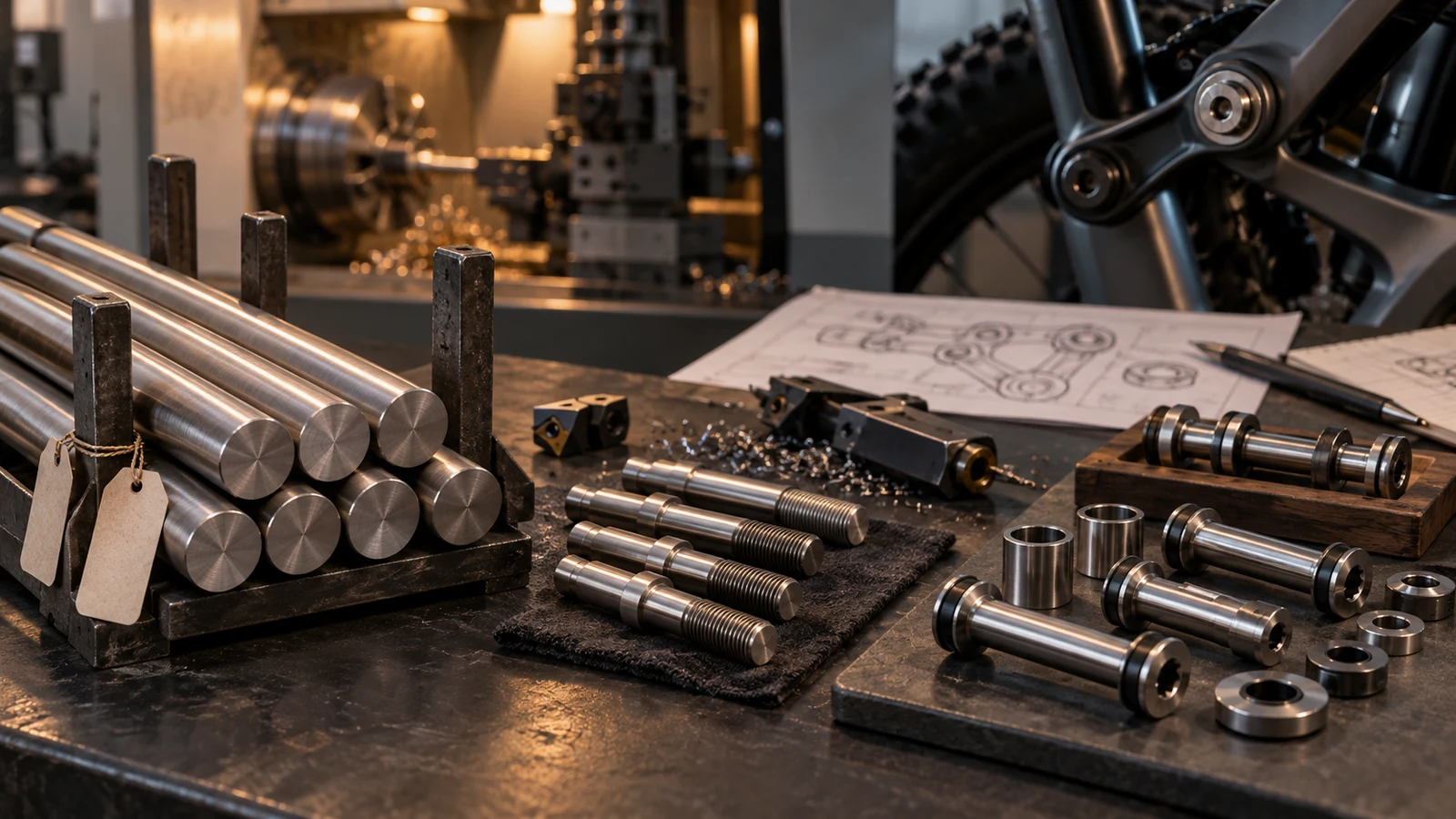
Hero: concept illustration of example hardware and its application. It is not a factory photograph, tested component or approved production geometry.
Translate commodity news into a material-specific enquiry
Ask whether the concern affects the required grade, condition, product form, stock dimensions, source or transport route. Titanium pigment, sponge, ingot and finished bar are not the same procurement object. A headline concerning one stage does not establish the quantity or delivery position of another.
USGS titanium information distinguishes titanium metal from titanium dioxide and provides separately dated commodity publications. Its 2026 summary describes aerospace as a major US titanium-metal use in the reported period. This is market context, not evidence that a bicycle buyer's specified bar price or lead time has changed.
Request an item-specific answer from the relevant source: what is available, in what represented condition, against which reference and on what delivery basis. Do not turn general geopolitical uncertainty into an invented percentage surcharge or an assumed ban on a particular transaction. Any actual trade restriction needs separate applicable review.
Check whether the offered reserve is usable input
Confirm the controlling material specification and edition, grade, product form, condition and stock dimensions. Add the required material identity and evidence scope. A reserve described only as titanium may not be usable for the current drawing or the agreed manufacturing route.
The ASTM B348/B348M public scope concerns annealed titanium bars and billets and distinguishes grades. That limited scope supports identifying the actual input rather than treating every titanium product as interchangeable. It does not establish a complete purchase requirement or certify the offered stock.
Use the titanium specification guide and stock traceability discussion for the item definition. Separate accepted accessible stock from stock awaiting verification, already allocated material or an unconfirmed supplier balance. Quantity on a list is not necessarily quantity the project can consume.
| Buffer or response | Wait it may remove | Remaining exposure | Verify before commitment |
|---|---|---|---|
| Specified bar reserve | Defined material replenishment gap | Manufacturing remains; condition may change | Grade, form, dimensions, evidence and access |
| Partly finished blanks | A defined portion of machining | Completed features may constrain revision | Remaining material and compatible geometry |
| Accepted finished hardware | Covered manufacturing operations | Higher configuration-specific exposure | Revision, finished state and acceptance |
| Alternate specified source | A stated original-source constraint | New verification or qualification work | Actual specification and evidence coverage |
| Proposed material substitution | Possibly a constrained input | Technical change may be unacceptable | Responsible approval of changed requirements |
| Revised delivery arrangement | Mismatch between supply and demand | Assembly need may remain unmet | Buyer acceptance of changed release plan |
Choose the manufacturing state of the buffer
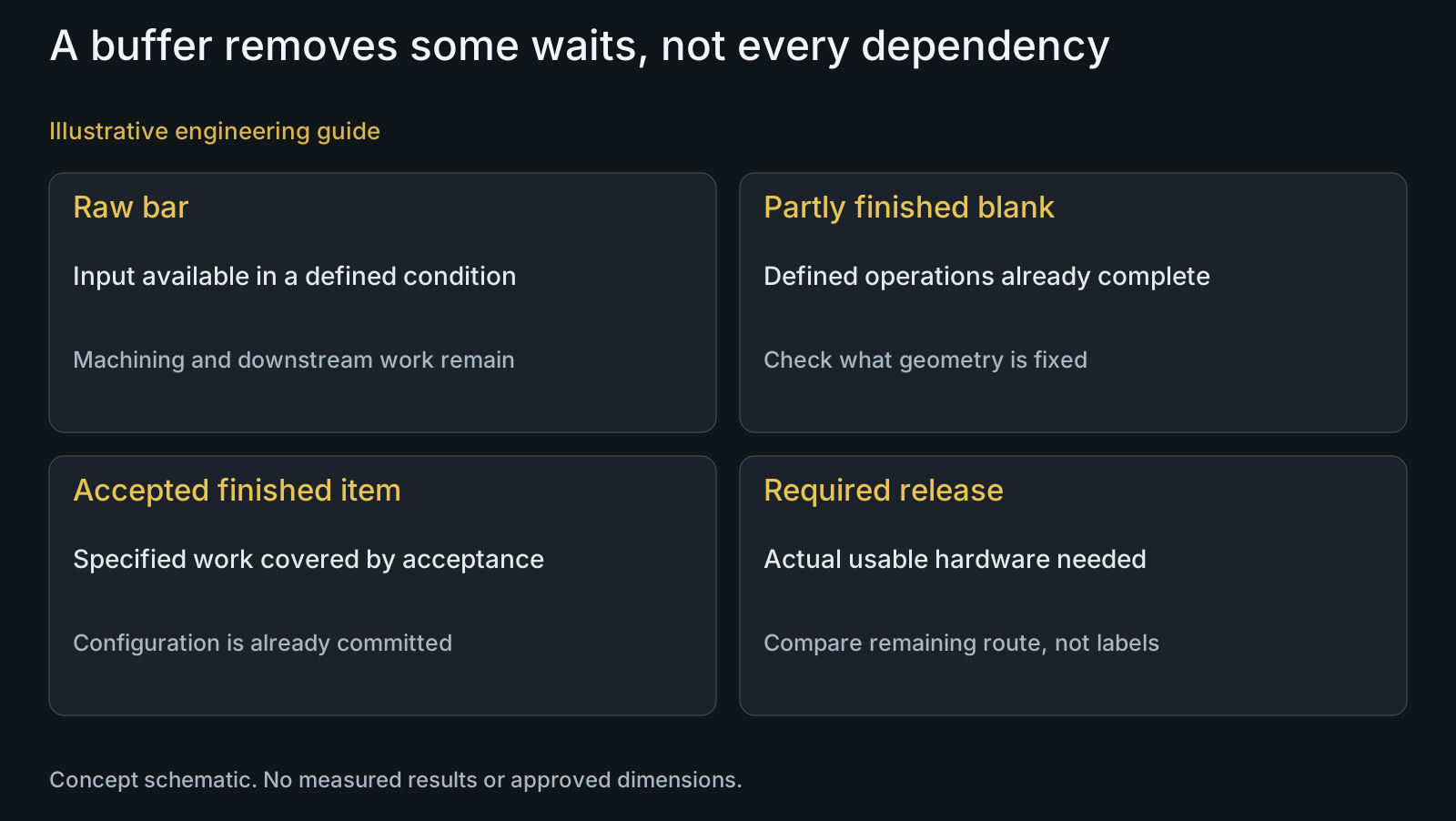
Bar retains more geometry options than a machined blank, within its grade, dimensions and condition. It can bypass a stock-purchasing wait but not all downstream work. Verify the remaining operations and capacity before using available bar to promise finished hardware.
Partly finished hardware can remove a defined portion of machining. It is only useful if the completed features remain compatible with the intended revision and the unfinished features still have the necessary material for their final definition. A blank may have left some options open while already making others irreversible.
Accepted finished parts can reduce manufacturing work before a release, but their interface, finish and identity are already committed. The manufacturing overview and surface-treatment scope help identify the remaining route. Partner work and inspection still need the agreed scope; no stock state establishes universal readiness.
Separate coverage duration from revision exposure
A stock-month figure needs a consumption basis, usable quantity and replenishment assumption. Uncertain demand, material consumption per component and incomplete processing all affect that interpretation. Do not calculate months from finished-piece demand while ignoring how the stock must become those pieces.
Ask what happens if the drawing changes before the reserve is consumed. A change in a sleeve interface may leave some bar useful but make finished bolts unsuitable; a changed material condition can affect the bar itself. Greater downstream readiness is therefore not automatically the better choice when the controlling requirement is unsettled.
The VMI/JIT responsibility guide addresses inventory ownership and release rules. Here the decision is where to commit material in manufacture, not which party manages replenishment. Agree the quantity, work stage and change responsibility before either party interprets a forecast as permission to build the reserve.
Use a changing-interface scenario to compare buffers
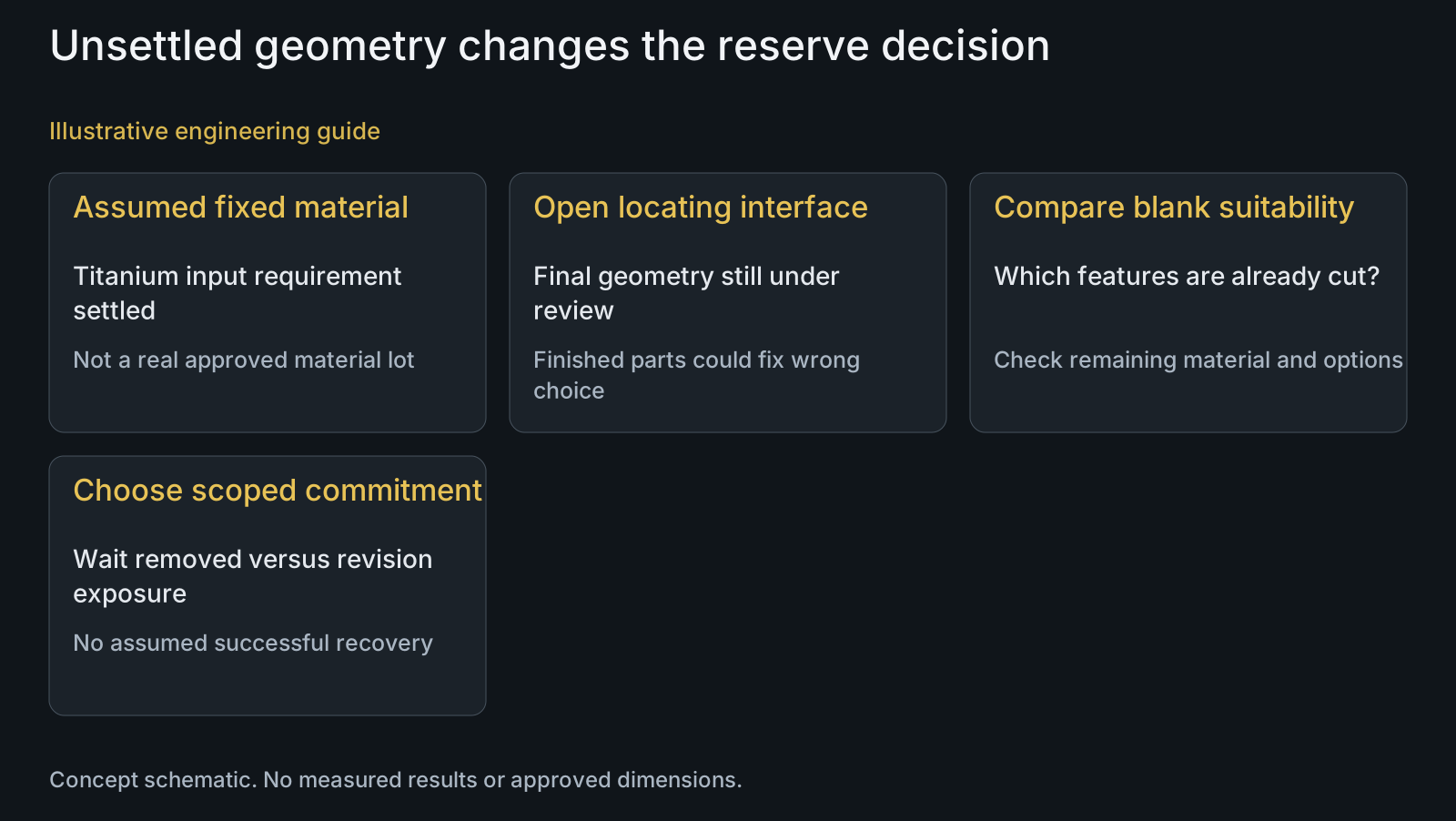
Illustrative engineering example: assume an OEM's titanium shoulder bolt has a settled material requirement but its locating interface is still under review. The bar source reports a potential replenishment delay. No actual material lot, stock quantity, shortage or delivery result is assumed.
Reserving suitable bar could preserve the unsettled geometry choice, but the plan still needs machining and the specified downstream route. Holding blanks is only a credible alternative if the existing blank features and remaining material accommodate the possible interface definition. Completing the bolt immediately could lock in the wrong geometry.
The buyer compares the waiting period removed with the revision exposure created by each state. If assembly must resume sooner than remaining manufacture allows, bar alone cannot meet that objective. The team must resolve a different continuity arrangement or the delivery plan; the hypothetical comparison does not prove any option has been approved.
Keep emergency sourcing separate from substitution authority
An alternate source of the specified material and a different material are separate proposals. Compare the offered identity, condition, dimensions and evidence with the actual requirement. If an offered change falls outside that requirement, the responsible design or purchasing authority must decide its acceptability; urgency does not create approval.
Ask which dependency the alternative bypasses and what new work it introduces. Another bar source does not remove a finishing bottleneck. A lower quote does not resolve missing identity, an unsuitable product form or a required verification step. Review supply facts and technical suitability separately.
The sourcing recovery-output guide tests whether a proposed fallback restores usable kits. PremFixer can discuss drawing-led manufacture and relevant partner coordination, but this article does not promise a standing six-month reserve, universal alternative stock or guaranteed shortage recovery. Find related decisions in the knowledge center.
Questions buyers need to confirm
Can international events affect titanium pivot supply?
They can justify reviewing a relevant sourcing dependency, but a headline does not establish the position of your specified bar. Ask about grade, condition, product form, source and delivery basis. Separate current supplier facts from general commodity context and any applicable trade review.
Should we automatically hold six months of titanium?
No universal duration is established. Define usable quantity, consumption assumptions, replenishment time and revision exposure, then compare reserve forms. This article does not assert that PremFixer maintains a standing six-month stock commitment for your program.
Is a bar reserve equivalent to finished pivot inventory?
No. It may remove a material-purchasing wait while leaving machining, finishing, inspection and packing. Confirm those remaining operations and capacity before using the reserve to support a finished-item date.
When are partly finished blanks a useful reserve?
When their completed features and remaining material fit the intended configuration and the unfinished work can meet the needed release. Identify which geometry has already been committed. A vague blank description cannot establish that it will accommodate the next revision.
Can a shortage justify switching from specified titanium to another alloy?
Not automatically. Present the changed specification, condition and application implications to the responsible authority. An alternate source of the same defined material and a different alloy are separate decisions; a quicker quote is not technical approval.
What should a material-disruption review include?
Provide the drawing/STEP model, material requirement, stock form, BOM, demand assumptions and required release. Identify usable stock, remaining operations, unsettled features, potential source constraints and ownership/change rules. These details expose the actual delay a proposed reserve can remove.
Technical references and scope
USGS titanium information. Public distinction between titanium commodity forms and dated publications; not the availability or price of a buyer's specified bar.
USGS 2026 titanium summary. Bounded published US titanium-metal use context for the reported period, not a forecast for custom pivot raw material.
ASTM B348/B348M public scope. Public identity and scope for annealed titanium bar/billet grades; full requirements and purchase conformity not inferred.
Explore related component, material and sourcing decisions in the customer decision knowledge center. For a drawing review, use the Drawing/BOM RFQ path.
Compare reserve states for your titanium pivot drawing
Send the drawing, STEP model or sample, titanium specification, BOM and demand assumptions through the Drawing/BOM RFQ path. Identify the threatened input, available stock state, remaining operations and unresolved revisions. PremFixer can discuss a scoped material and manufacturing proposal without treating a forecast or commodity headline as a stock guarantee.
Discuss the drawing and BOM