
For a Korean bicycle-hardware RFQ, connect each KS requirement to the same physical feature in the drawing and supplier response. KS B 1002 covers external hex bolts; it is not a direct reference for the ISO 4762 socket-head family. Even a correct component name leaves room for confusion between the external head, internal drive and custom shoulder. Identify the relevant edition, feature and acceptance purpose before considering an ISO alternative. Keep the component specification separate from the actual product's Korean safety route. A clear bilingual summary should expose a different interpretation early, not merely make the quotation sound familiar in two languages.
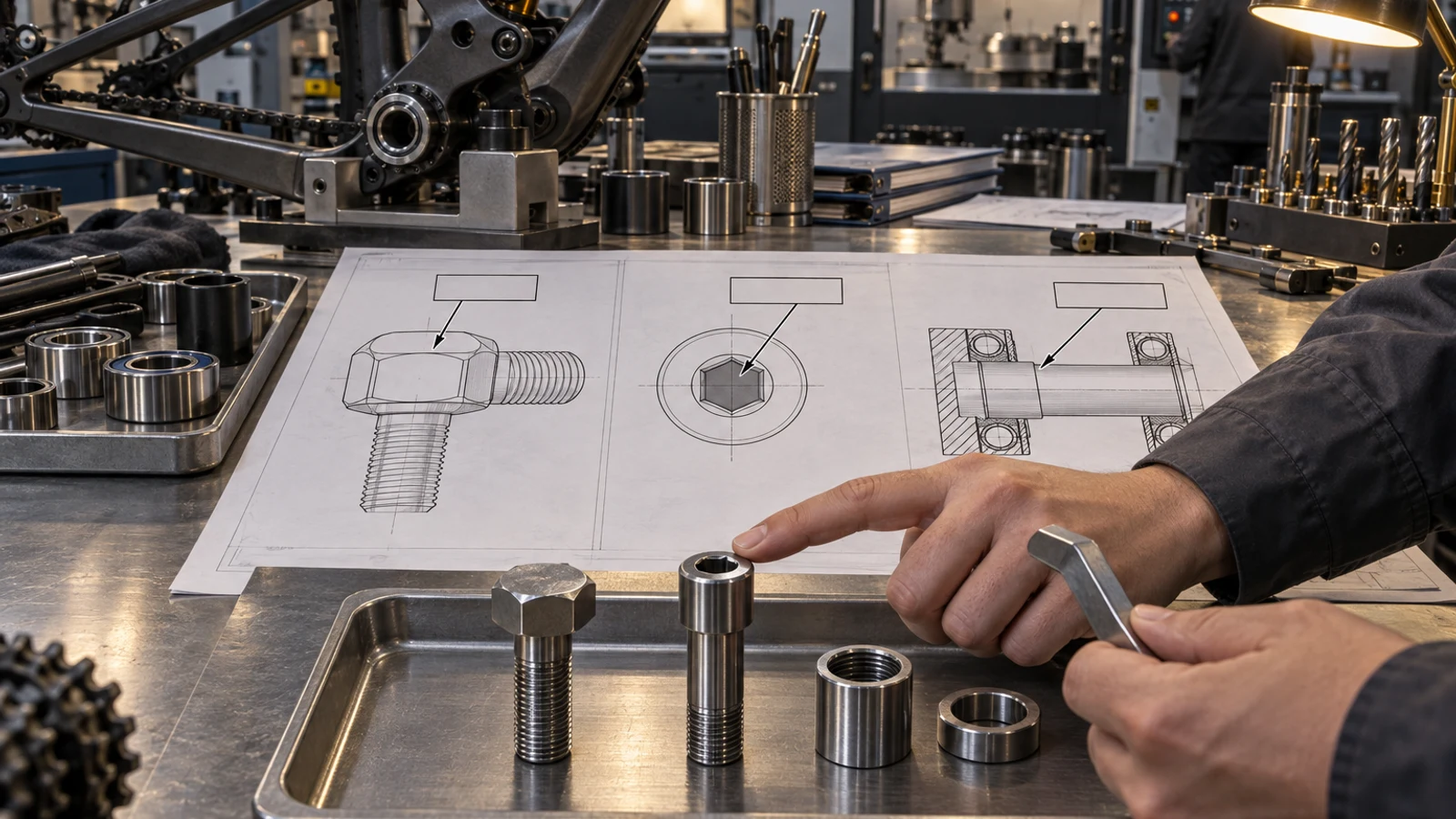
Hero: concept illustration of example hardware and its application. It is not a factory photograph, tested component or approved production geometry.
Start with the physical subject of the KS reference
The official Korean standards catalogue identifies KS B 1002 as 6각 볼트, external hexagon bolts, and lists modified correspondence to several ISO hex-bolt standards. It does not identify this reference as the ISO 4762 socket-head screw family. Verify the intended head before discussing substitution.
The catalogue separately identifies KS B 1003 as 6각 구멍붙이 볼트, the socket-head family. Its public reference information is not a full current requirement comparison. Use the exact ordered edition and complete requirements where conformity or interchangeability must be established.
The Japanese reference guide explains standard identity and purchase scope. This review focuses on the next problem: whether the Korean requirement and English response point to the same drawing feature after the number is clarified.
Separate the head, drive and shoulder in the requirement summary
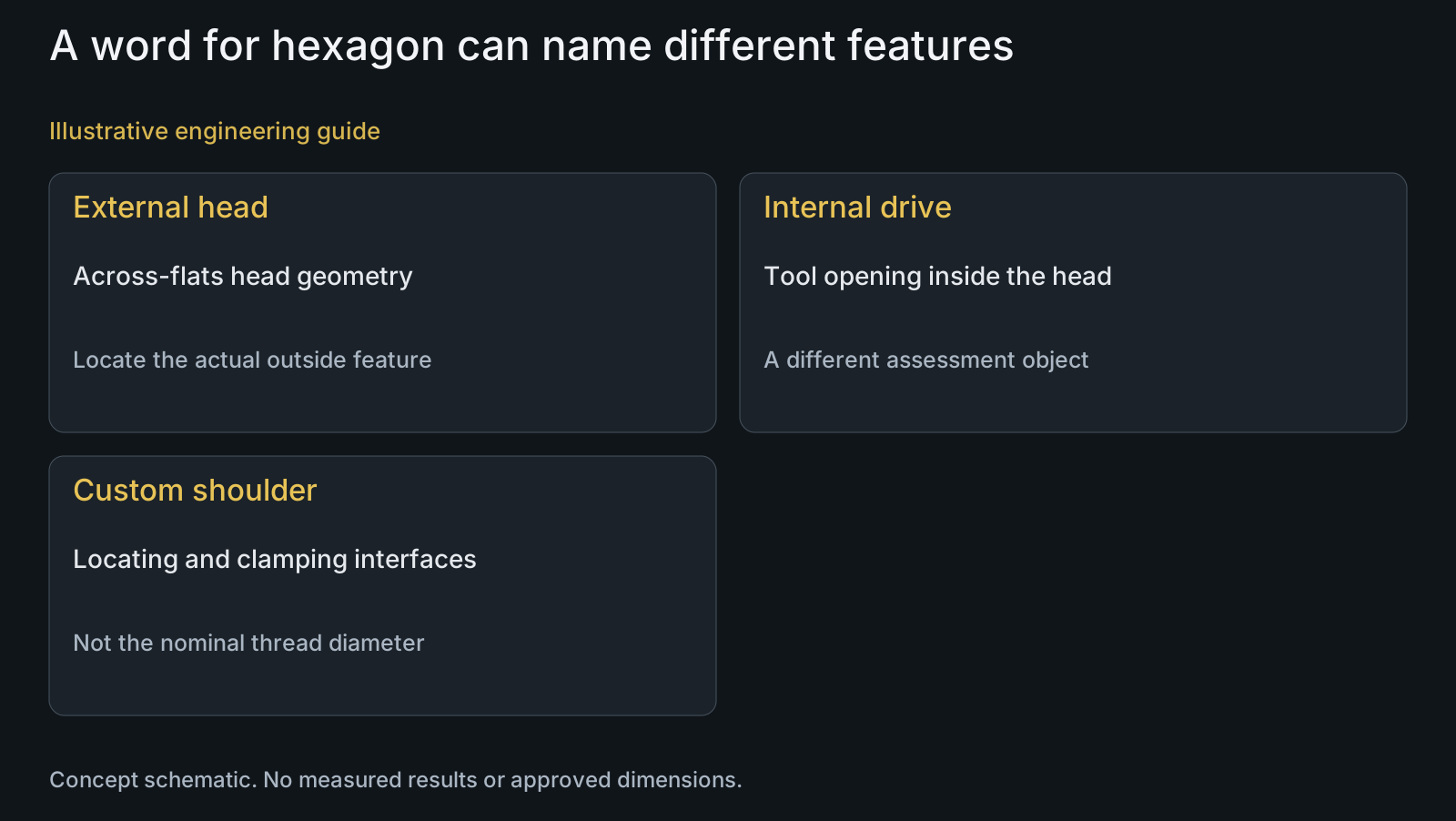
External head across-flats geometry and an internal hex drive opening are different features. A socket-head pivot can have a circular outer head while its tool recess is hexagonal. Writing hex size without identifying the feature can therefore produce two plausible but incompatible interpretations.
Link the term to a drawing view or characteristic reference and state what is controlled. For the drive, identify the specified opening and relevant geometry; for the head, identify the outside profile and contact interface. Keep the custom bearing shoulder as its own requirement rather than treating it as an informal extension of bolt diameter.
The standard-head pivot guide discusses tool access and contact tradeoffs. Here the aim is to prevent the quotation and inspection plan from using the wrong feature, not to choose the head from scratch.
| Ambiguous requirement | Possible wrong interpretation | Definition to add | Verification purpose |
|---|---|---|---|
| Hex size | External head confused with internal drive | Identify the feature and drawing view | Confirm the offered head and tool interface |
| Bolt diameter | Nominal thread confused with locating shoulder | Name the specific diameter and mating feature | Assess the intended thread or fit, not another feature |
| KS equivalent | Similar title treated as identical requirements | Name ordered edition and reviewed differences | Buyer resolves the actual alternative scope |
| Finished size | Pre-treatment value used for coated interface | State the supplied condition and controlled feature | Verify the relevant finished interface |
| Material grade | Family name substitutes for specified condition | Keep designation, source and condition distinct | Compare the offered material requirement basis |
| Korea approved | Component statement treated as product confirmation | Identify actual product and responsible route | Product team determines applicable assessment |
Use bilingual terms without replacing technical definitions
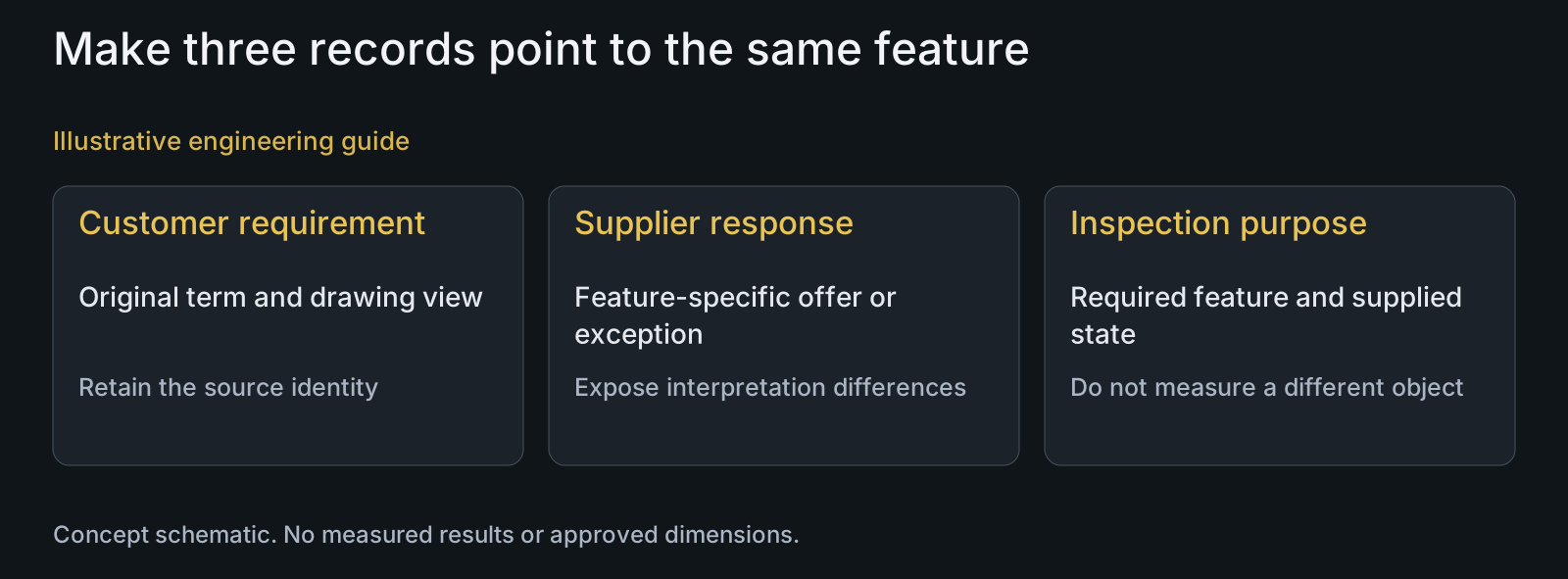
Pair the customer's original term with an agreed English meaning and the drawing characteristic it names. Preserve the original standard number and document identifier. A translation helps the conversation, but the controlled requirement still needs an explicit geometry, material or acceptance definition.
Avoid using one phrase for several diameters. A nominal thread, shoulder locating diameter and head outside diameter can each require a different interpretation and method. Identify the mating object and supplied state where they affect the feature: for example, a finished coated shoulder is not necessarily represented by a pre-treatment measurement.
Ask the supplier to respond to the same characteristic references with compliance, a defined exception or a clarification request. This makes a disagreement visible before purchasing compares price, instead of burying it inside a broadly translated KS equivalent sentence.
Keep an ISO alternative and the Korean product route separate
An alternative needs a comparison of the ordered editions and relevant requirements. Similar naming or a published correspondence entry does not prove that the proposed custom component meets the full selected specification. State which differences were reviewed and which still need the buyer's decision.
KATS separately lists two-wheel bicycles under its consumer-product safety confirmation system and describes model-specific testing and reporting by the relevant manufacturer or importer. This product route is not established by changing the standard number in a component quote.
Ask the responsible Korean team to identify the actual product category and applicable safety requirements. Do not treat an unverified KS R 1006 reference as the complete route for every bicycle or loose pivot. The export-document guide keeps such product responsibilities separate from component evidence.
Illustrative engineering example: hex size names two features
Illustrative engineering example: assume an RFQ for a socket-head custom pivot uses the short phrase hex size beside a general view. The customer intends the internal drive opening, while a supplier's translated response describes an external head across-flats feature. No real drawing, dimensional result or approved translation is represented.
The reviewer adds the relevant top view and characteristic reference, pairs the original term with the agreed English meaning and confirms the intended socket-head family. The custom shoulder and receiver interfaces remain separately defined. The correction addresses meaning; it does not invent a new size or prove compliance with an unread standard.
The supplier then identifies which ordered features its offer represents and where an ISO alternative differs or remains unverified. Purchasing compares the clarified responses only after the buyer resolves those questions. This is an illustrative communication review, not a successful production or qualification case.
Make inspection and quotation use the same feature identity
For a critical feature, align its drawing reference, requirement source, supplied condition and intended assessment. A report with the right unit but the wrong diameter does not answer the buyer's question. Likewise, a measurement of the recess cannot establish an external head contact requirement.
PremFixer works to agreed drawings, samples, interfaces and BOM requirements. Discuss the manufacturing scope and materials with the actual requirement summary, without assuming Korean certification or a universal KS-to-ISO equivalence service.
Include the Korean reference documents and marked feature questions with drawings or STEP. The customer decision knowledge center connects the remaining interface and acceptance work after the terminology is aligned.
Questions buyers need to confirm
Is KS B 1002 the socket-head counterpart of ISO 4762?
No. Its official catalogue subject is external hex bolts. Confirm the intended component and check the appropriate socket-head reference separately rather than copying an incorrect equivalence into the quote.
Why is hex size too vague for a socket-head pivot?
It can be confused with an external head dimension. Identify the internal drive or external feature explicitly and connect the requirement to a drawing view. The two features have different purposes and cannot share an undefined inspection entry.
Can a supplier replace the KS number with ISO in its offer?
Only within a reviewed and agreed alternative. Compare the relevant editions and ordered requirements, identify differences or missing evidence and retain the buyer's decision. Similar naming does not establish complete interchangeability.
Does an accurate translation prove that inspection covers the right feature?
No. The term must point to the controlled drawing characteristic and supplied state. Check whether the report measures the thread, shoulder, head or drive that the requirement actually names.
Does a KS component statement establish Korean bicycle safety confirmation?
No. KATS describes a separate model-specific product route for covered goods. The responsible Korean team must determine actual product applicability; a component specification or unverified bicycle reference does not complete that work.
What helps clarify a Korean-market pivot RFQ?
Provide the original terms and named reference editions, drawing or STEP and BOM, marked head, drive and shoulder views, material and finished condition. Identify the intended assessment and product-responsibility contact so supplier responses can use the same feature meaning.
Technical references and scope
Korean standards portal: KS B 1002. Public external-hex bolt subject and modified ISO hex-bolt correspondence. Not ISO 4762 socket-head equivalence or a full purchased requirement review.
Korean standards portal: KS B 1003 public reference record. Public socket-head family identity. This versioned public record is not used to establish the latest full edition or unrestricted ISO interchangeability.
KATS: consumer-product safety confirmation. Public listed bicycle product context and model-specific testing and reporting route. Not a classification of every pivot, completed application or approval.
Explore related component, material and sourcing decisions in the customer decision knowledge center. For a drawing review, use the Drawing/BOM RFQ path.
Align the Korean requirements with your pivot drawing
Send the drawing or STEP and BOM, original requirement terms, specified KS editions and marked feature questions, plus material and finished condition. PremFixer can discuss the manufacturing scope and identify interpretation gaps before quotation.
Discuss the drawing and BOM