
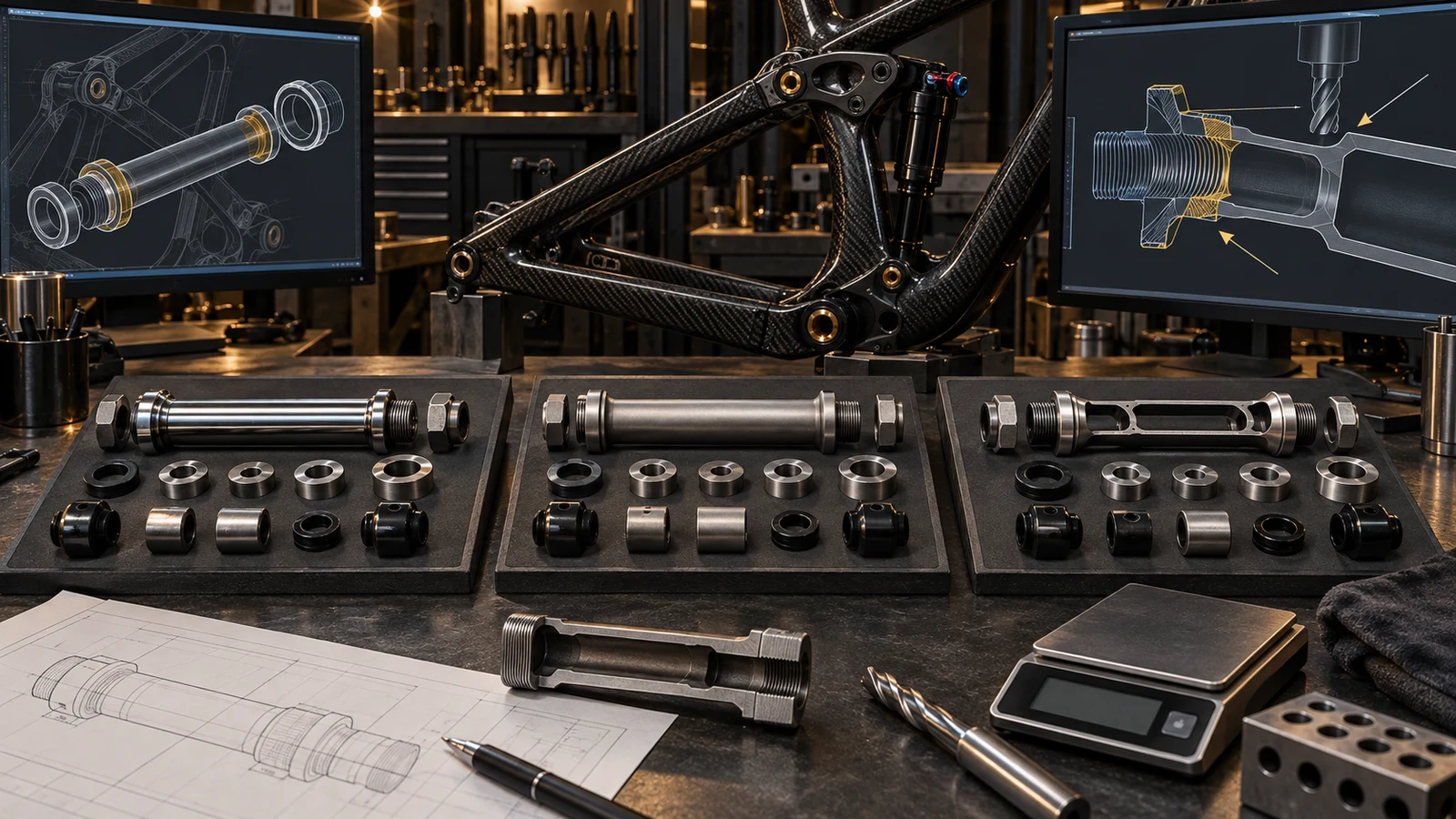
Choose a lightweight pivot-kit route by comparing complete alternatives with equivalent functional requirements. Titanium substitution, hollow geometry and a combined redesign can change different aspects of the joint; none has a universal weight saving or automatic approval. The OEM is deciding which option preserves interfaces, load capacity, assembly behavior and serviceability at an acceptable manufacturing and validation cost. Define the baseline kit and each candidate, then assess the final geometry and material condition together. Do not add a material-change percentage to an unrelated geometry-saving claim. CAD mass is an estimate for its represented configuration, not evidence that the lighter kit performs acceptably in the intended bicycle.
Hero: concept illustration of example hardware and its application. It is not a factory photograph, tested component or approved production geometry.
Choose alternatives that answer different design questions
Start with a baseline BOM and define the role of every axle, bolt, receiver, spacer and end component. State the functional requirements that must remain equivalent across candidates. This is an option-selection exercise, not permission to omit required kit members to create a lower total.
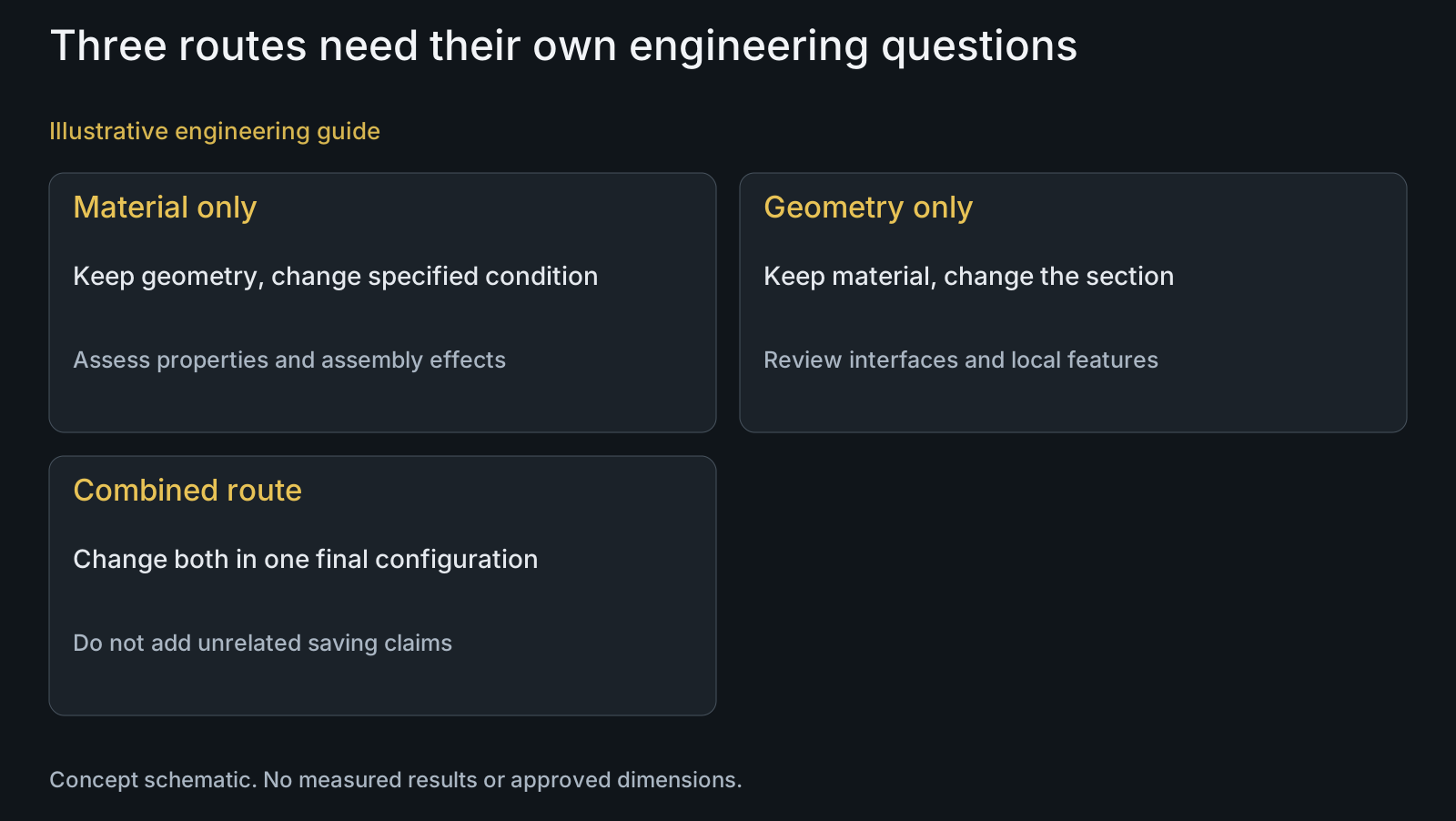
A material-only candidate asks whether the existing geometry remains suitable with a different specified material condition. A geometry-only candidate asks whether material can be removed or redistributed while retaining the original material. A combined candidate asks both questions and must be evaluated as its own configuration.
Use the kit weight-calculation guide for the mass-claim boundary and measurement basis. This article compares the engineering and purchasing consequences of the routes rather than repeating the weighing procedure.
Protect functional interfaces before removing material
Identify the bearing seats, clamp faces, effective threads, tool engagement and locating shoulders that the assembly relies on. Define what may change and what must remain controlled. Retaining an external diameter alone does not establish unchanged load transfer or contact behavior.
A hollow section changes the section geometry and can introduce manufacturing and inspection questions at its termination. Review transitions, remaining material near threads, access for cutting and how relevant internal features will be evaluated. An attractive cutaway image cannot answer those questions.
Material selection also needs the specified grade, condition and applicable properties rather than a density label. Review materials and the load-to-manufacturing discussion together, without treating stronger or lighter as complete descriptions of a revised joint.
| Candidate route | Useful starting condition | Distinct risk | Evidence before selection |
|---|---|---|---|
| Material substitution only | Existing envelope must be retained | Properties and assembly state assumed equivalent | Specified condition and joint-level assessment |
| Geometry change only | Interfaces allow defined redesign space | Removed material changes local behavior | Actual production geometry and applicable load cases |
| Combined material and geometry | Both choices are open | Separate savings treated as additive approval | Final configuration assessed as its own candidate |
| Mixed-material kit | Different members have different roles | Mating and service states overlooked | Complete BOM, interface and replacement review |
| Baseline retained | Alternative evidence remains insufficient | Mass objective mistaken for a release requirement | Explicit decision and unresolved development scope |
Evaluate the final candidate rather than adding reductions
Compare each final candidate with the same baseline. Material and geometry changes interact through the represented volume and density, and they may require different dimensions to meet the same requirements. Savings quoted against different intermediate states cannot be added as if they share one denominator.
PTC's mass-properties guidance explains that component densities enter assembly calculations and that changed models need recalculation. It also distinguishes displayed hidden components from suppressed features. These software behaviors make the represented model state an important part of the comparison.
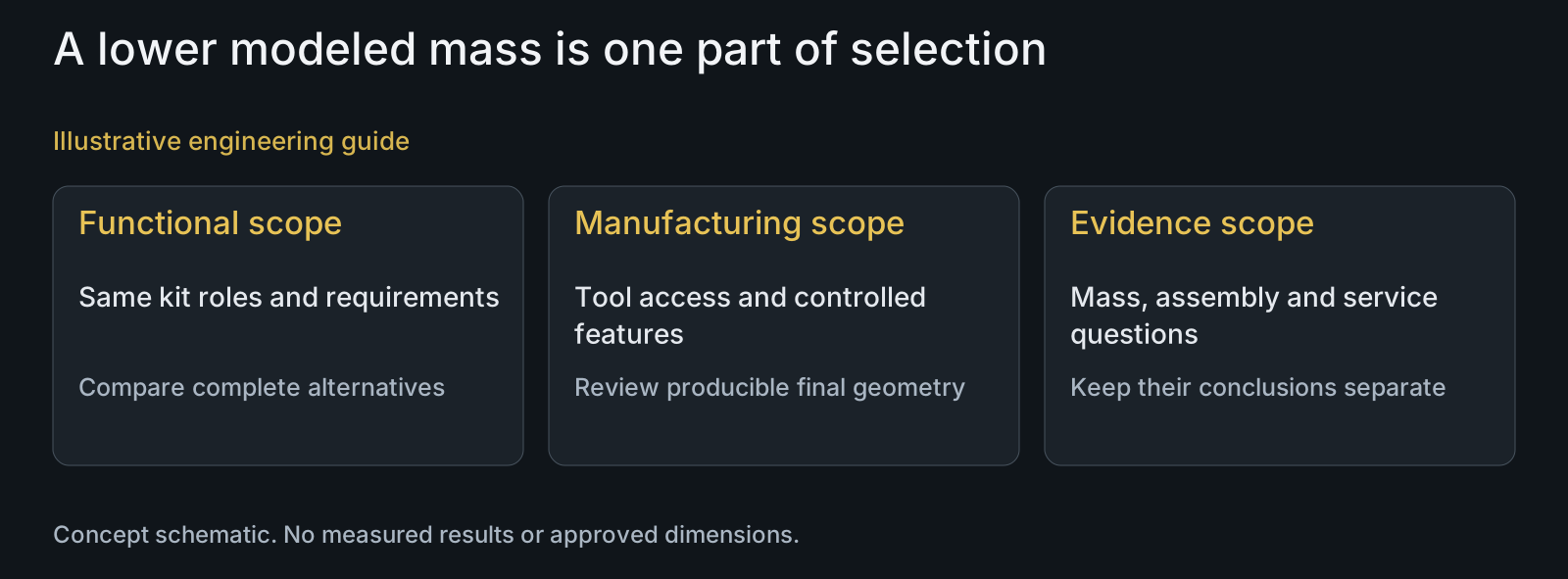
Label each result by configuration and basis: current CAD estimate, mixed entered/calculated mass or identified finished hardware. Reconcile the represented quantities before comparing candidates. A lower estimated mass should remain an estimate until the actual final kit is represented by appropriate evidence.
Do not confuse an optimized shape with a released turned part
Topology or shape optimization can explore alternatives within stated loads, constraints and allowed regions. Those inputs must represent the question being asked. A single convenient load case or a rigid idealized interface does not establish every function of a suspension pivot.
Ansys documents method-dependent manufacturing constraints, including member size and manufacturing direction or accessibility controls. Their existence is useful, but a solver option is not proof that a proposed axle can be produced by the agreed route. Inspect the actual reconstructed production geometry.
Bring the candidate to CNC turning review with protected interfaces and controlled internal features identified. Establish the manufacturing scope and inspection approach rather than claiming that PremFixer owns a particular optimization platform or guarantees an arbitrary mass reduction.
Compare manufacturing, validation and replacement consequences
Request comparable finished-kit quotations for the explicit alternatives. Include any changed stock, machining, treatments, gauges or sampling scope that actually follows from the proposal. Raw-material price alone does not describe the delivered kit or the cost of resolving new technical questions.
Identify evidence that remains relevant and evidence that the change affects. A material replacement, internal cavity or revised contact can change different assumptions. An unchanged fit check does not establish fatigue behavior, and a structural calculation does not validate a changed tightening method.
Plan replacement identification and interchangeability. If the lightweight candidate needs a different mate or assembly instruction, say so in the kit definition. The lightweight solution scope should connect to a defined project decision, not imply a universally compatible replacement SKU.
Review example: the lightest axle is not the complete choice
Illustrative engineering example: assume an OEM compares the existing solid axle with a same-envelope material substitution and a combined material-plus-hollow redesign. Both proposals retain the named bearing interfaces in their models, but the hollow candidate introduces an internal termination near a controlled threaded region. No mass, stress or test result is assumed.
The team first checks whether the represented kit contents and functional requirements match. It then identifies different evidence needs: material-condition suitability for one option, plus internal geometry, tool access and inspection questions for the combined option. The lowest CAD total does not settle those additional questions.
Either candidate may remain worth developing, but their quotations and validation plans should not be treated as equivalent. The decision compares the complete options and unresolved risks instead of presenting two independent percentage claims as a guaranteed combined benefit.
Questions buyers need to confirm
How much lighter will a titanium pivot kit be?
No universal saving is established. Define the baseline and final alternative BOMs, quantities, geometry and material conditions, then label the mass comparison as estimated or measured. A material-density difference is not a complete supplied-kit result.
Can material and topology savings be added together?
Not as unrelated percentages. Their denominators and represented geometries may differ, and material selection can affect the feasible geometry. Compare the final combined candidate directly with the same baseline instead of adding separate claims.
Is the same outside diameter enough to approve a hollow axle?
No. Identify the internal termination, remaining section, threads, shoulders and contacts, then assess the relevant requirements. The same exterior can conceal a different load path and a different manufacturing or inspection question.
Does CAD optimization prove that the kit can be manufactured?
No. Check the final geometry against the actual route, tool access, interfaces and inspection needs. Software manufacturing constraints support design exploration but do not replace a component-specific manufacturing review.
Should we select the candidate with the lowest mass estimate?
Not from mass alone. Compare equivalent function, unresolved validation questions, finished-kit cost and service compatibility. A lighter candidate that needs a different mate or more development evidence is a different purchasing option.
What is needed to compare lightweight options in an RFQ?
Provide the baseline BOM, candidate STEP models and drawings, protected interfaces, specified material conditions, required usage scope and current mass basis. Identify allowed design changes and replacement requirements so quotations reflect comparable complete options.
Technical references and scope
PTC computing mass properties. Component-density inputs, model recalculation and represented feature/component state. CAD totals are not measured hardware or structural approval.
Ansys manufacturing constraints for structural optimization. Method-dependent manufacturing constraints support design exploration. No solver setting, numerical saving or specific production capability is transferred to PremFixer.
Explore related component, material and sourcing decisions in the customer decision knowledge center. For a drawing review, use the Drawing/BOM RFQ path.
Compare complete lightweight pivot options
Send the baseline and candidate drawings or STEP, complete BOMs, material conditions, protected interfaces and intended operating scope through the Drawing/BOM RFQ path. PremFixer can review manufacturing implications and comparable supply scope while your team defines the evidence needed to choose and validate the final kit.
Discuss the drawing and BOM