
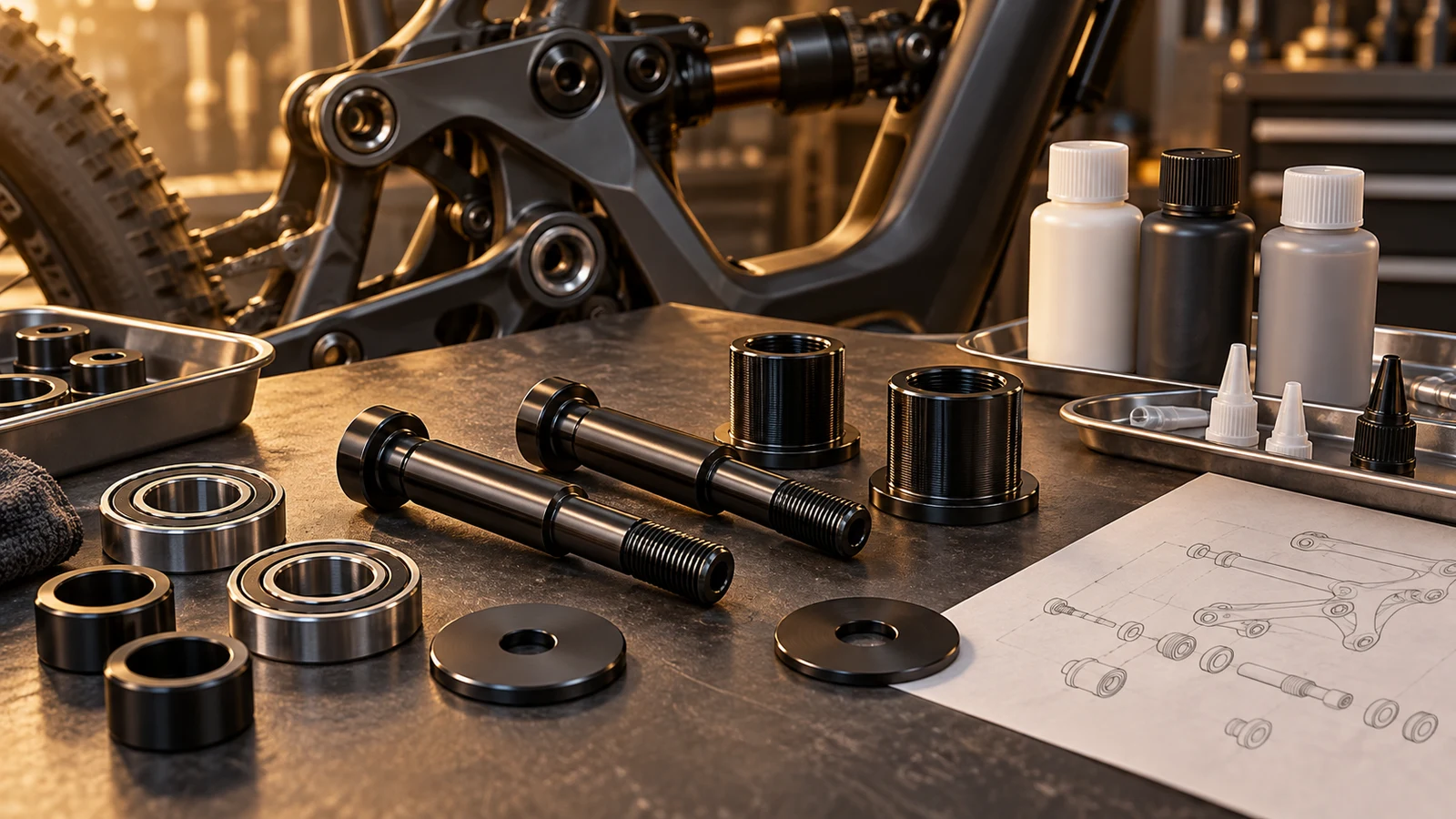
LOCTITE 242, 243 and 271 are not interchangeable instructions for every bicycle pivot. Henkel identifies 242 and 243 as medium-strength threadlockers intended for normal disassembly with hand tools; 271 is a high-strength product for permanent locking. The correct choice starts with the actual frame's specified product and preparation. For an OEM substitution review, compare thread materials and finishes, residual condition, cure basis and future removal requirements. Do not choose 243 solely because a shock is nearby, or treat 271 as an automatic upgrade. A locking product cannot accept damaged threads or restore an incorrect bearing-spacer stack.
Hero: concept illustration of example hardware and its application. It is not a factory photograph, tested component or approved production geometry.
Start with the product identity in the assembly instruction
Read the exact model, pivot position and named consumable before comparing alternatives. A request for blue threadlocker lacks the identity needed to select the technical sheet. The bottle, product designation and applicable regional supply information should agree with the specification.
Separate the liquid assembly operation from a supplied locking treatment on the fastener. Adding a liquid product over an unidentified dry patch is not the same as choosing between three liquid threadlockers. The original treatment, its function and the permitted preparation must be established first.
The locking-methods guide distinguishes chemical and mechanical features. This comparison concerns the named Henkel liquids, not a universal recommendation to replace every patch or captive feature with adhesive.
Compare 242 and 243 without assuming equivalent conditions
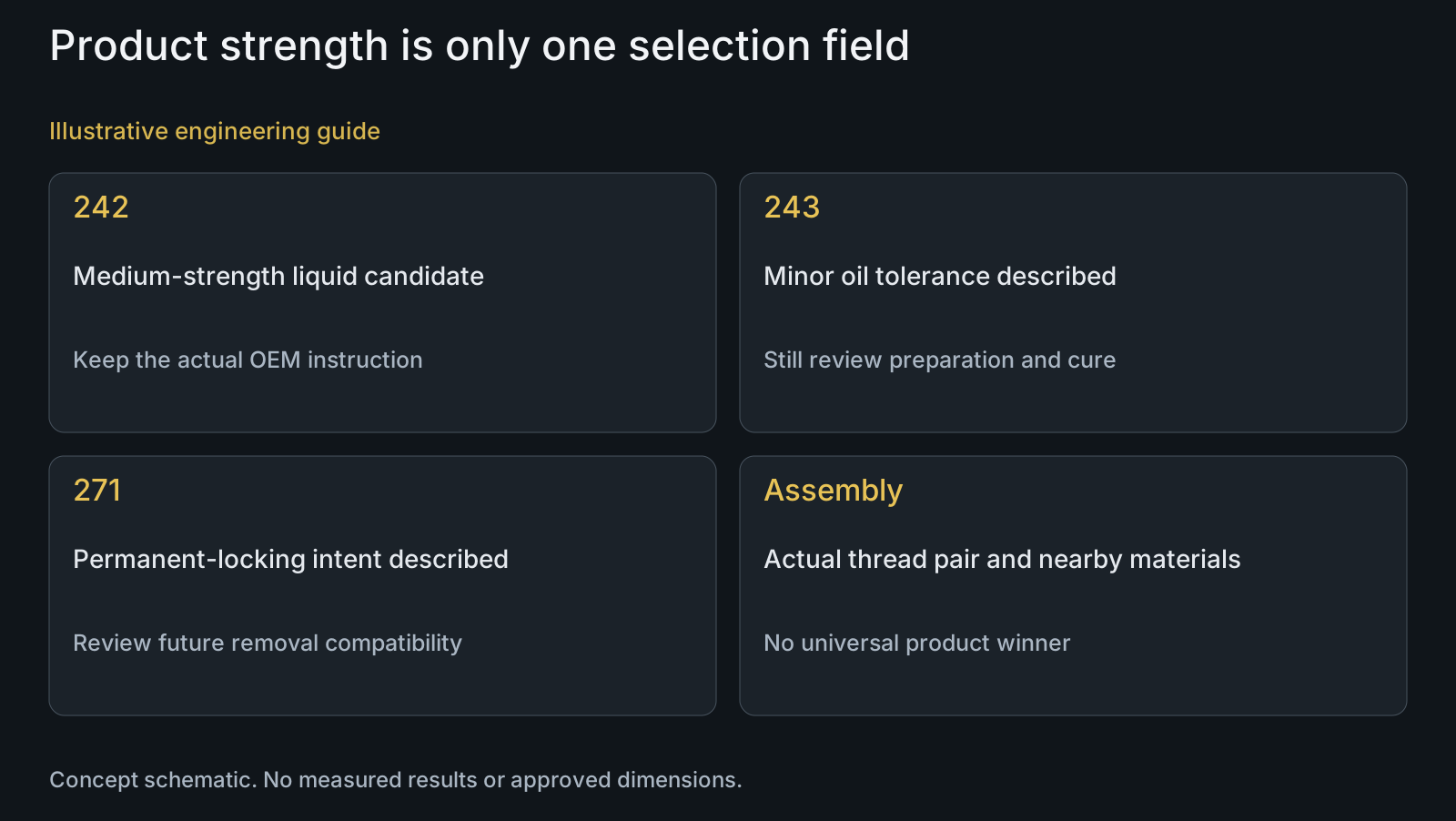
Henkel's February 2022 242 sheet identifies medium strength and normal hand-tool disassembly. Its April 2025 243 sheet also identifies medium strength and describes tolerance of minor oil contamination and curing on active and passive metal substrates. These descriptions are candidate characteristics, not complete-frame approval.
Oil tolerance is narrower than a permission to ignore preparation. The 243 sheet still gives cleaning and drying directions for best results. A deliberate grease layer or unknown cleaner residue is not automatically represented by minor oil contamination. Keep the actual residual condition with the selected product.
Near a shock is a location, not a chemical-compatibility specification. Identify what fluid can reach the threads and what surfaces the application contacts. The surface-specific cleaning guide keeps shaft preparation separate from the threaded zone; location alone cannot authorize a substitution.
| Candidate or proposal | Documented distinction | Pivot-specific risk | Confirmation needed |
|---|---|---|---|
| LOCTITE 242 | Medium strength, normal hand-tool service | Product identity replaced by color alone | Applicable OEM product and substrate state |
| LOCTITE 243 | Medium strength, minor oil tolerance | Oil tolerance interpreted as grease permission | Actual residue, preparation and cure basis |
| LOCTITE 271 | High strength, permanent-locking intent | Removal direction incompatible with assembly | Approved service route and adjacent constraints |
| Same strength category | Shared label, not identical application basis | Unreviewed substitution | Exact product, finished surfaces and conditions |
| Data-sheet breakaway value | Defined cured-specimen response | Copied into installation setting | Test specimen versus actual assembly requirement |
| Liquid over existing patch | Additional product and mechanism | Compatibility and service state unknown | Supplied treatment and approved configuration |
Include the different service consequence of 271
Henkel's March 2012 271 sheet describes high strength and permanent locking. Its disassembly direction calls for localized heat, unlike the normal hand-tool removal direction for the two medium-strength products. This is a concrete service distinction, not a ranking that makes 271 the better pivot choice.
A product's removal direction does not authorize heating an assembled bicycle. Review nearby frame materials, seals, finishes, retained compounds and access with the responsible manufacturer. No heating temperature or field removal operation is prescribed here, including for cases where a medium-strength product proves difficult to remove.
If the required removal route cannot be supported for the actual joint, resolve that issue before adopting the product. Extra bond strength does not remove the need for a serviceable component definition. Do not introduce an unapproved high-strength compound as a shortcut for repeated loosening.
Retain substrate and cure conditions with the comparison
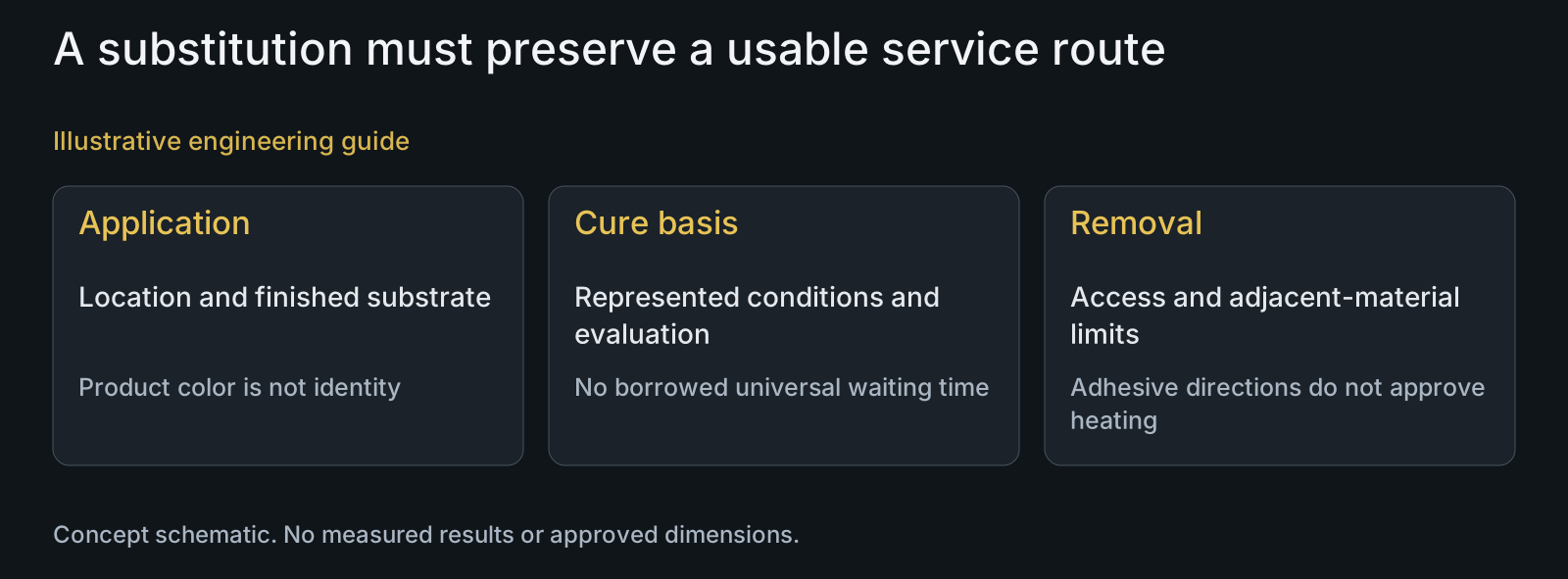
The cited sheets describe cure dependence on relevant substrate and temperature conditions; 243 additionally identifies bond-gap effects. A fixture-time label without its represented conditions is insufficient to release a changed production assembly. The finished thread surface matters, not only the alloy written on the drawing.
State the actual metal pair, finish, mating engagement, preparation and any proposed activator. Evaluate the resulting application and cure basis with the OEM and adhesive supplier where required. Do not copy a graph's value from a different specimen into a universal waiting time for the finished pivot.
The sheets also warn about plastic compatibility. Map reachable neighboring materials rather than assume metal threads isolate the entire operation. Cleaner, adhesive and activator have separate handling and compatibility questions. Their relevant safety information is not replaced by a medium-strength label.
Do not turn data-sheet torque into an installation setting
Breakaway and prevailing values in the technical sheets describe specified specimens and test conditions. They are not installation torque values for a bicycle frame. Comparing products using unmatched substrates, cure conditions or thread sizes can also disguise what the figures actually represent.
Keep the joint's tightening requirement distinct from the adhesive comparison. Review the assembly basis when changing product or preparation rather than assume the original setting remains valid or apply a generic percentage correction. The torque-reference guide retains model and operation identity.
For an OEM choice, define the evaluated outcome, such as retention, permitted service removal or another named requirement, with the actual joint configuration. Specimen evidence remains narrower than complete bicycle validation. Procurement should identify who supplies and applies the chosen treatment through the manufacturing review, without assuming every operation is in-house.
Review example: a stronger proposal changes the service question
Illustrative engineering example: assume a released pivot instruction specifies 242 and hand-tool servicing. A purchasing proposal substitutes 271 based solely on its high-strength designation. No retention test, failed bicycle or removal trial is supplied.
The reviewer finds that the proposal changes the product and its removal direction, while leaving neighboring-material and access constraints unreviewed. The higher strength label cannot resolve that mismatch. A 243 alternative would raise its own substrate, preparation and cure questions rather than inherit approval because it is also blue.
The decision is to preserve the released configuration until a supported substitution is approved, or define the necessary product/joint evaluation. This is a service-design review, not evidence that one named product always fails or succeeds on bicycle pivots.
Questions buyers need to confirm
Can 243 automatically replace a specified 242?
No automatic approval follows from their shared medium-strength label. Compare the exact product, finished thread pair, preparation, residual condition, cure basis and service requirement with the released OEM instruction. Resolve the substitution before changing the assembly.
Is 271 better because it has higher strength?
Not as a universal pivot choice. Its cited sheet describes permanent locking and a different removal direction. Review service access and surrounding-material constraints with the responsible OEM; higher bond strength does not correct geometry or damaged threads.
Does 243 suit every pivot near a rear shock?
Location alone does not establish suitability. Identify actual fluids, contamination and contacted materials. The sheet's minor oil tolerance does not authorize arbitrary grease mixing or override cleaning and preparation requirements.
Can an adhesive data sheet authorize heating a carbon-frame assembly?
No. Its removal direction concerns the product and does not approve the surrounding bicycle. The responsible manufacturer must address frame, seals, finishes, access and other treatments. No heating operation or temperature is prescribed here.
Are the data-sheet torque figures installation torque?
No. Breakaway and prevailing figures belong to identified cured specimens and conditions. Keep them separate from the model-specific tightening requirement and actual joint evaluation. A change in adhesive or preparation needs its own assembly review.
What information is needed for an OEM threadlocker substitution review?
Provide the released instruction, exact existing and proposed products, bolt/receiver drawings and finished surfaces. Include application location, residue, activator proposal, cure/evaluation basis and removal constraints. Identify any pre-applied treatment separately from liquid application.
Technical references and scope
Henkel LOCTITE 242 Technical Data Sheet, February 2022. Medium strength, service intent and product-specific preparation/cure and compatibility guidance. Specimen values are not bicycle settings.
Henkel LOCTITE 243 Technical Data Sheet, April 2025. Medium strength, minor oil tolerance, substrate/gap/cure and preparation distinctions. No unrestricted grease compatibility or universal cure time claimed.
Henkel LOCTITE 271 Technical Data Sheet, March 2012. High-strength permanent-locking intent and different disassembly direction. Product heat direction is not approval to heat a bicycle assembly.
Explore related component, material and sourcing decisions in the customer decision knowledge center. For a drawing review, use the Drawing/BOM RFQ path.
Specify the locking product and the supplied part state
Send bolt and receiver drawings or STEP, BOM, finishes, supplied patch or coating details and the released assembly/service instruction. Name the existing and proposed liquids and the conditions to be evaluated. PremFixer can review drawing-based manufacture and supplied treatment responsibilities; adhesive compatibility, substitution and complete-joint approval require the responsible technical review.
Discuss the drawing and BOM