
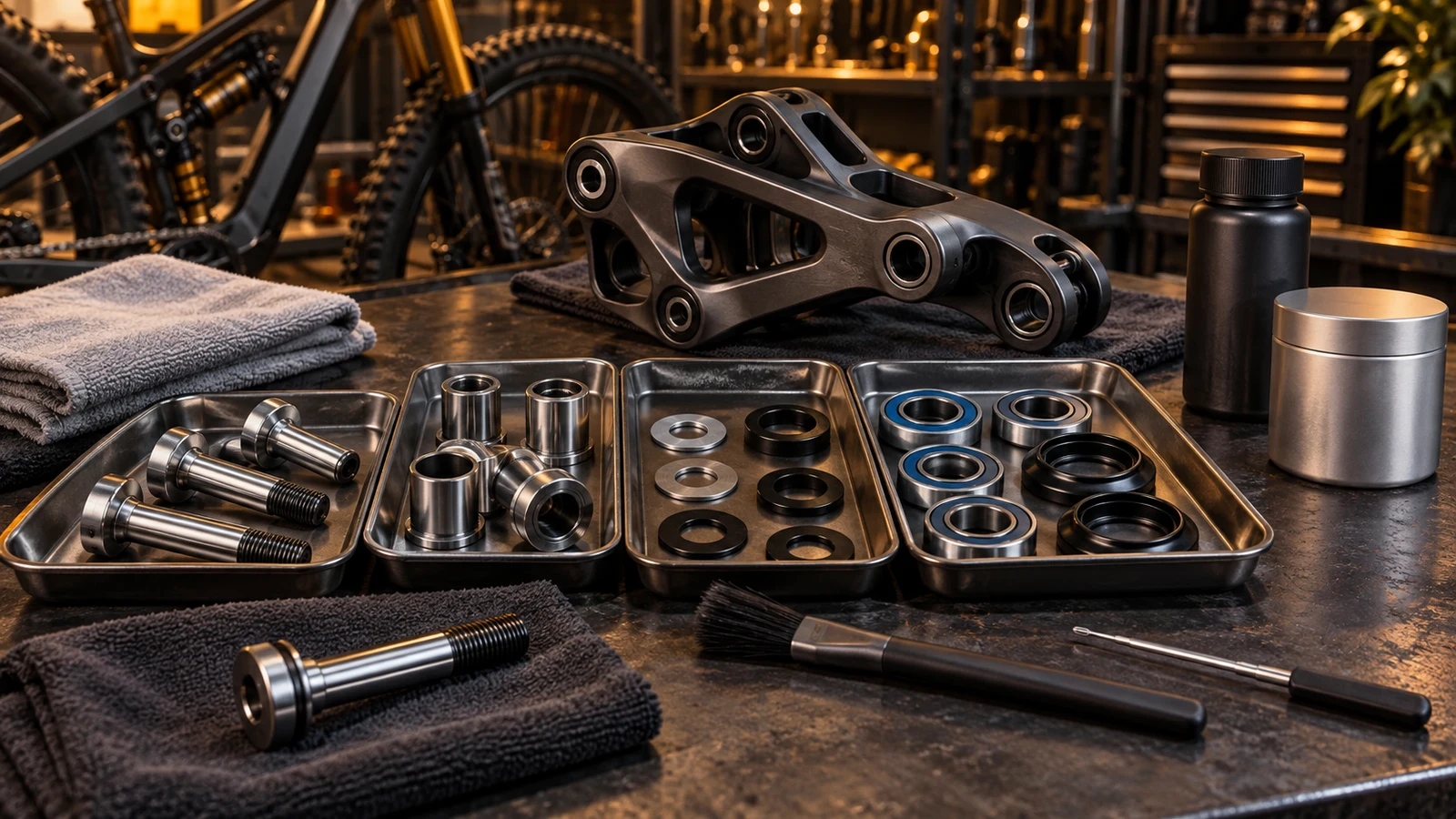
Do not grease every surface of a pivot bolt simply because it is titanium, aluminum or stainless steel. Locate the shaft, threaded end, head contact and any supplied locking or friction treatment in the applicable assembly instruction. Cleaning and lubrication should restore that defined state, not replace it with a workshop preference. An installed pivot also contains seals, frame finishes and neighboring components that a cleaner can reach. If the permitted product or surface treatment is unclear, obtain clarification before changing it. Staining, damage, play or binding requires its own service assessment rather than another application of oil.
Hero: concept illustration of example hardware and its application. It is not a factory photograph, tested component or approved production geometry.
Map each contact instead of writing grease the bolt
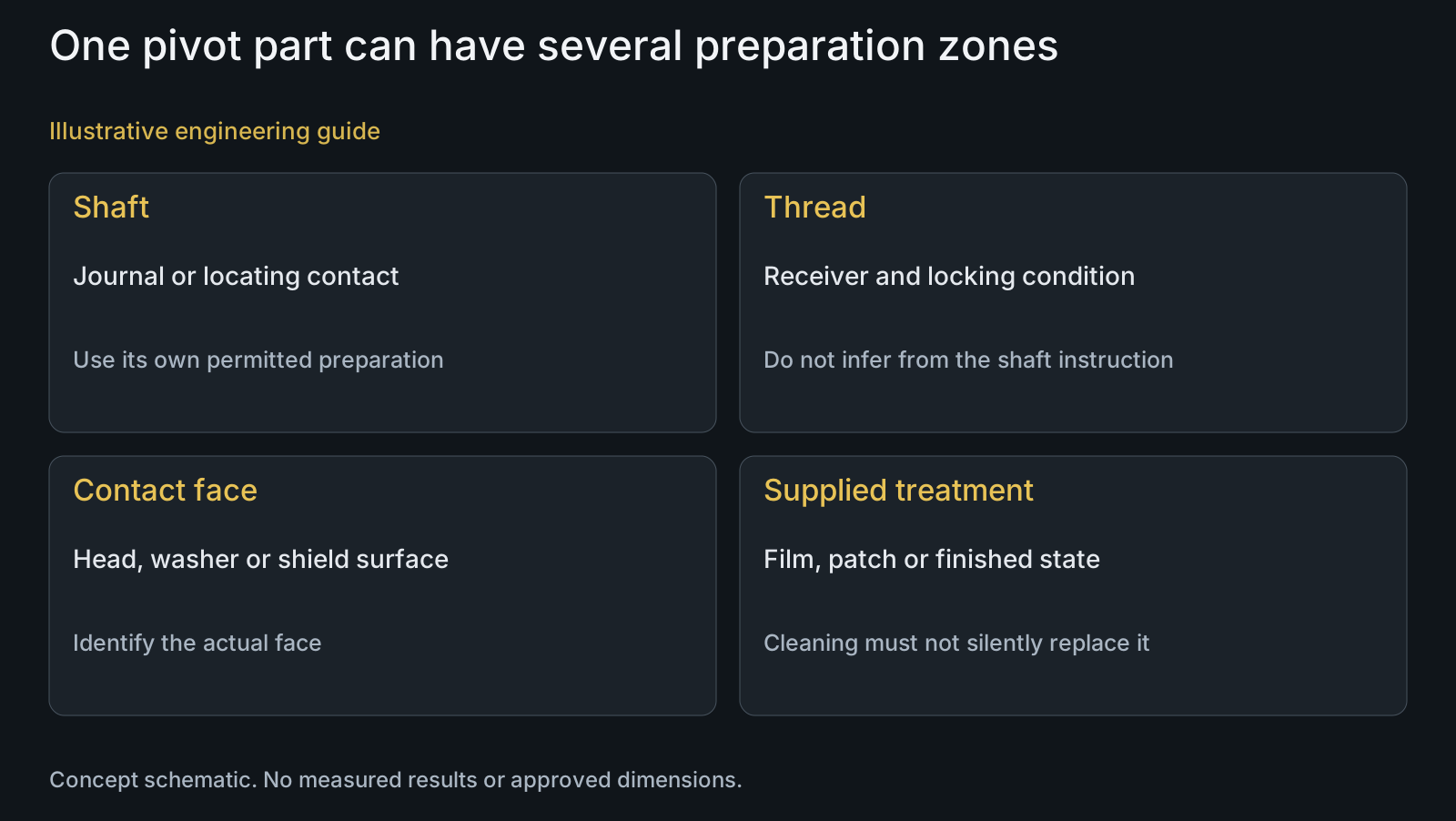
Identify the shaft or journal, male and female threads, under-head contact, washer faces and shields on the actual component view. A single part can contain surfaces with different functions. The instruction should associate each permitted product with its intended location.
Santa Cruz's V10 8 MY25 support page provides a named example: its listed pivot axles specify threadlocker on threads and grease on the shaft, while certain washer surfaces have separate notes. This demonstrates surface-specific instructions, not a rule for every pivot or every lubricant product.
Keep the installed model and hardware identity with this contact map. A familiar black axle does not establish the same preparation as another model's part. The installation-sequence guide explains when access and part placement constrain the operation.
Separate routine cleaning from disassembled-part preparation
An exterior cleaning method for an assembled bicycle and preparation of a removed threaded component are different tasks. The first must respect surrounding components and access restrictions; the second must respect the part's actual finish and supplied treatment.
Record what the cleaning product can contact, including runoff or liquid retained at a recess. Compatibility with bare metal does not establish compatibility with paint, seal material or a pre-applied patch. Use the applicable owner/service method and relevant product information rather than test an unspecified solvent on the assembly.
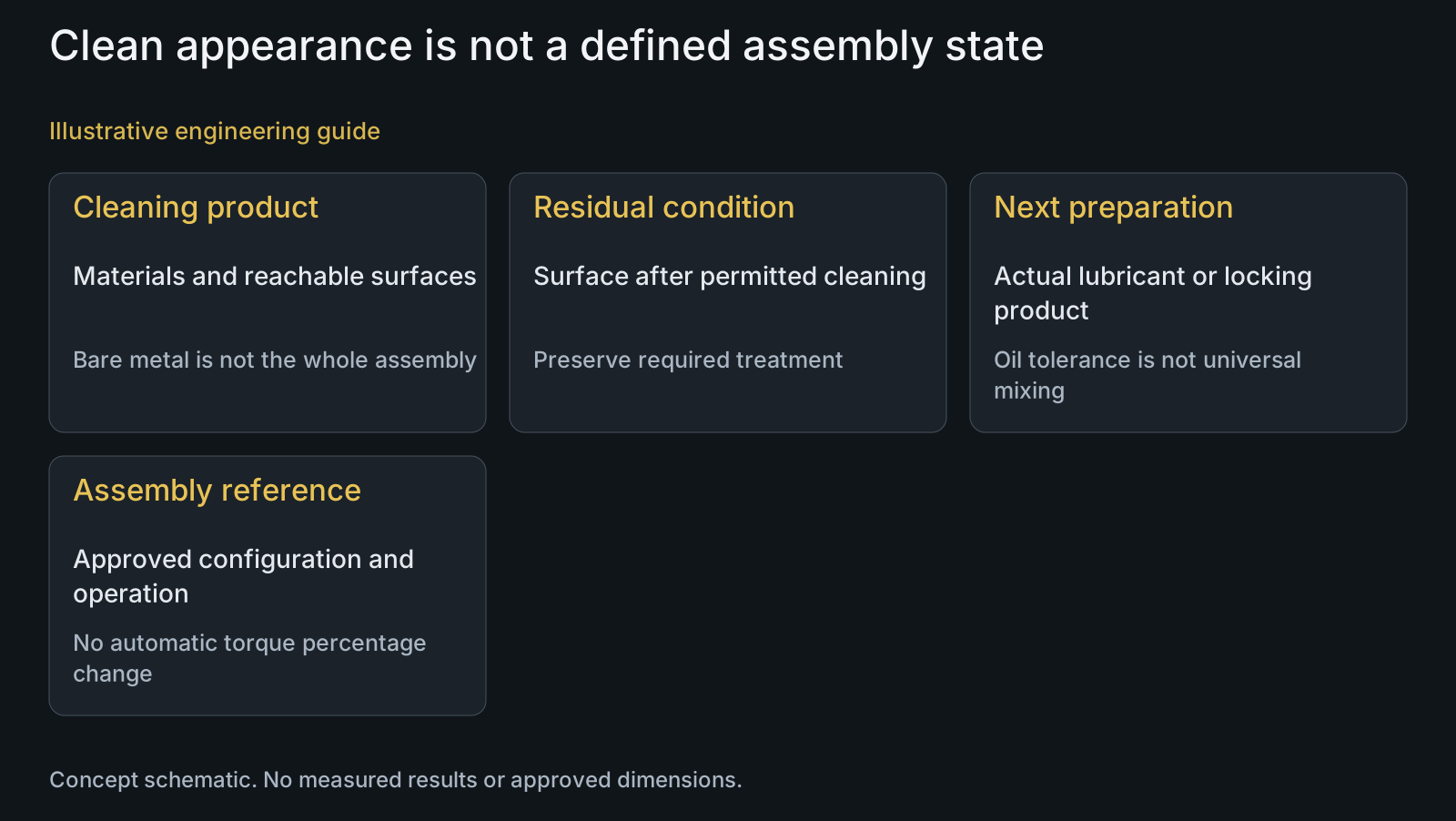
The stainless cleaning guide addresses dirt, staining and nearby-material hazards. Here, the additional decision is whether cleaning leaves the surface ready for its specified assembly state. Clean appearance does not prove that a functional coating or locking treatment remains intact.
| Surface or proposal | Decision to resolve | Risk of a generic rule | Required basis |
|---|---|---|---|
| Pivot shaft or journal | Which preparation is specified here? | Thread instruction copied to moving/contact surface | Actual component view and service notes |
| Threaded end | Which locking and residual condition applies? | Entire bolt greased by alloy name | Named system and applicable assembly state |
| Washer or under-head contact | Which face receives which product? | Both faces assumed equivalent | Surface-specific permitted instruction |
| Removed treated component | What must cleaning preserve? | Functional film or patch scrubbed away | Supplied state and handling criteria |
| Cleaner reaches seals or paint | Are all contacted materials covered? | Bare-metal compatibility used for whole assembly | Actual materials and permitted cleaning method |
| Oil-tolerant adhesive proposed | What contamination and preparation are represented? | Oil tolerance called unlimited product compatibility | Product-specific information and configuration review |
Do not confuse oil tolerance with permission to mix products
Henkel's April 2025 LOCTITE 243 technical sheet describes tolerance of minor oil contamination, while its best-results preparation calls for cleaning and drying. It also warns that aqueous washing solutions can affect adhesive cure and performance. The product's preparation guidance remains more specific than the label oil tolerant.
Those statements do not authorize deliberate grease mixing or establish compatibility with an unidentified patch. Identify the actual product and formulation and follow its requirements together with the bicycle's assembly instruction. A named threadlocker example is not permission to substitute it for a different specified system.
Keep cleaner, residual condition and subsequent product as separate fields when reviewing a workshop proposal. If compatibility is unresolved, record the gap rather than assert that all blue products behave alike. Do not copy an adhesive's specimen test torque into the bicycle's installation setting.
Preserve supplied finishes and treatment responsibilities
A dry-film lubricant, pre-applied locking feature and decorative or corrosion-protection finish are not interchangeable labels. Obtain the drawing-defined supplied state and the relevant handling/reuse instruction before removing residue or adding another product.
Distinguish an unwanted contaminant from a specified functional treatment. Scrubbing until every surface appears bare can change the condition the instruction represents. Conversely, the presence of an old patch does not prove it remains suitable after service; use the selected system and component criteria.
For OEM supply, mark treated and masked areas through surface treatment. The dry-film versus anti-seize guide separates supplied-process and installation-consumable decisions. Do not silently transfer an operation from the hardware supplier to the workshop.
Treat an altered preparation as an assembly change
If a workshop proposes grease where the instruction requires another state, identify the affected contact and obtain an approved basis before reuse. Tightening resistance and retention requirements belong to the configuration, not the metal name alone.
Use the model-specific torque reference to retain the applicable preparation and operation with the setting. An arbitrary percentage adjustment cannot establish that an altered cleaner, lubricant or locking product is acceptable.
Do not promise longer pivot life from a cleaning or lubrication change without represented evidence. If damage, new movement or seizure is observed, preserve its location and seek service assessment. Where structural security is uncertain, keep the assembly out of use rather than rely on quieter operation after lubrication.
Review example: clean threads, uncertain locking state
Illustrative engineering example: assume an OEM service proposal cleans a removed pivot and greases its entire surface. The released instruction instead distinguishes shaft preparation from a named threadlocking zone. No cleaning trial, failure or improved service life is assumed.
The reviewer compares the proposed resulting state with that instruction. It identifies the cleaner's compatibility with the supplied finish, the thread's residual condition and the subsequent locking requirement separately. A polished-looking part does not resolve those three questions.
The corrected proposal retains surface-specific preparation and seeks clarification for any unresolved compatibility. A replacement-hardware RFQ can specify the supplied treatment and marked zones without making PremFixer the service authority. The example illustrates an instruction mismatch, not a proven lubricant or repair result.
Questions buyers need to confirm
Should titanium, aluminum and stainless pivots all be greased?
Not by alloy name. Identify the permitted treatment of threads, shaft, contacts and any supplied patch or film. The component's actual preparation and service instructions govern, not a universal material-based rule.
Can a shaft-grease instruction also be used on the threads?
Do not transfer it by assumption. The named V10 example distinguishes shaft grease from threadlocking preparation. Use your actual hardware instruction and surface map; the example does not approve every pivot or lubricant.
Does an oil-tolerant threadlocker accept any grease residue?
No such general conclusion is supported. Henkel's cited 243 sheet distinguishes minor oil tolerance from preparation and cleaning requirements. Identify the actual product, residue and substrate and resolve compatibility rather than deliberately combine unspecified products.
Can all old-looking coating or patch material be cleaned away?
Not without establishing its role. Some material may be a specified functional treatment rather than contamination. Obtain the supplied-state and handling/reuse requirements, and identify whether renewal or replacement is required by the actual system.
Can a metal-safe cleaner be used around installed bearings?
Only if the complete permitted application is covered. Cleaner can reach seals, paint and retained-product areas as well as metal. Use the bicycle's method and material/product compatibility information instead of extending a bare-metal statement.
What information helps review an OEM care instruction?
Send the assembly view, materials and finishes, treatment zones and existing service instruction. Identify cleaner and assembly products, contacted neighboring materials, application method and residual-state requirements. Separate routine washing, disassembled preparation and observed damage.
Technical references and scope
Santa Cruz V10 8 MY25 Product Support. Named pivot axle and washer entries demonstrate separate thread, shaft and contact preparation. No numeric setting or cross-model instruction transferred.
Henkel LOCTITE 243 Technical Data Sheet, April 2025. Minor oil tolerance; cleaning/drying and aqueous-cleaner compatibility requirements. Not approval of a bicycle, a mixed lubricant system or a substitute for specified 242/patch products.
Explore related component, material and sourcing decisions in the customer decision knowledge center. For a drawing review, use the Drawing/BOM RFQ path.
Define supplied surfaces and installation preparation separately
Share the hardware drawings or STEP, BOM, assembly view and specified finish or pre-applied treatment zones. Include the applicable care/assembly instruction and proposed cleaner or lubricant changes. PremFixer can review custom manufacture and the delivered surface state; compatibility and service approval must address the actual assembled component and responsible OEM requirements.
Discuss the drawing and BOM