

A mudguard fastener can be cost-conscious, but its low accessory load does not make price the only criterion. Identify whether it secures a bridge bracket, fixes a stay adapter or belongs to another mounting arrangement. Check the represented frame or fork receiver, clearances, exposure and supplied retention requirements. Some front mudguards include a controlled stay-release feature; making that connection rigid is not automatically an improvement. Compare stainless, coated steel or other candidates only within the complete part and assembly definition. No universal cheapest alloy, aluminum permission or tightening setting follows from the word mudguard.
Hero: concept illustration of example hardware and its application. It is not a factory photograph, tested component or approved production geometry.
Identify the mounting item before comparing materials
Mark the screw on an assembly view with the mudguard, support stays and frame or fork. A bridge mount, eyelet-mounted stay and clip-on expansion mount need different components and contacts. Separate the fastener from the bracket, plastic adapter or nut it acts through.
The same nominal thread can appear at several locations without having the same length, head seat or retention requirement. Specify the receiving feature and supplied mating pieces for each BOM line. Do not purchase an undifferentiated bag of mudguard bolts from a photograph.
Keep rack hardware separate even if accessories share a nearby frame region. The rack-mounting guide addresses bracket support and luggage capacity; it does not approve the mudguard connection or its release behavior.
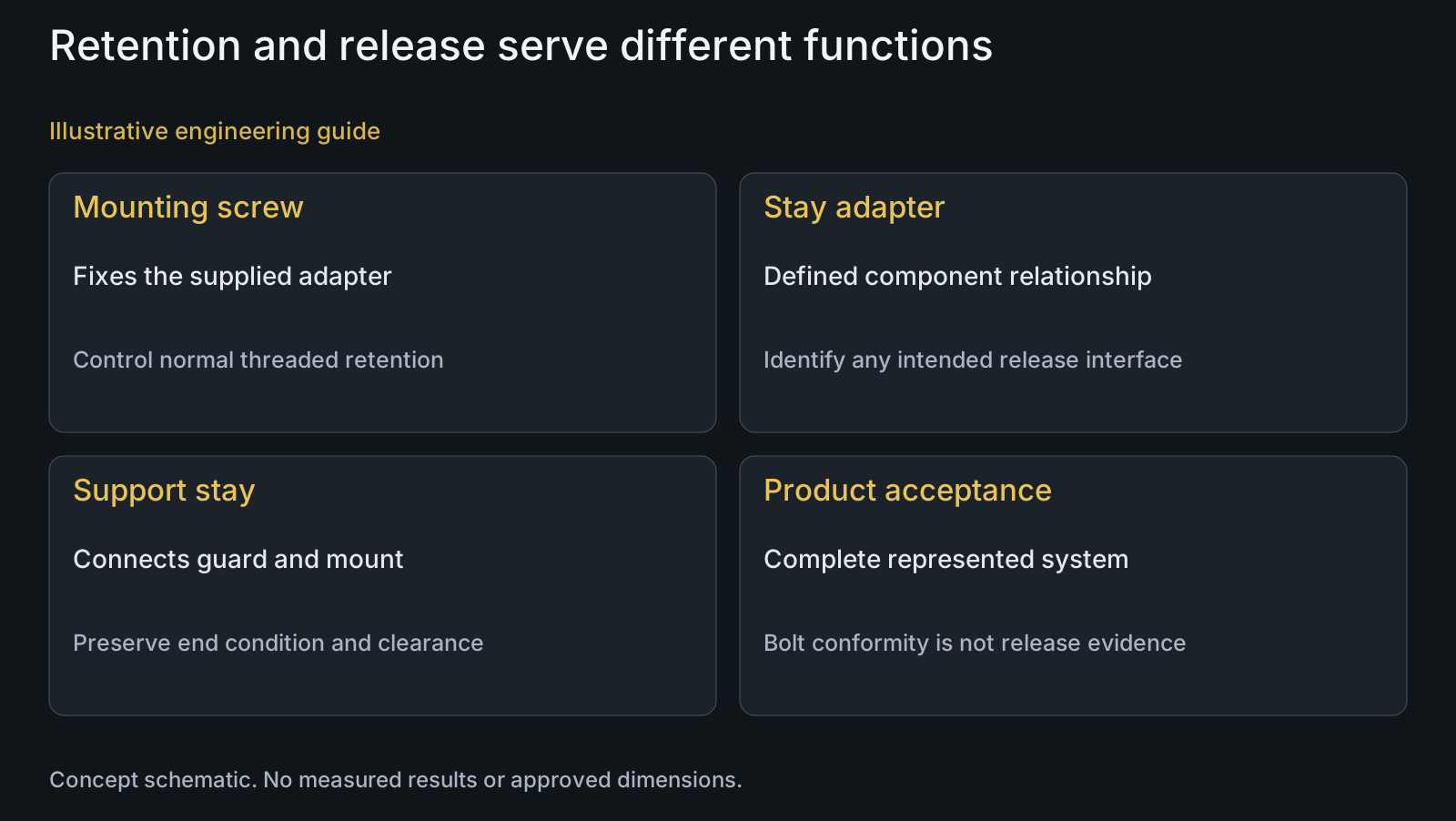
Distinguish threaded retention from a designed stay release
SKS describes its ESC system as a controlled separation of interlocking stay-adapter parts under heavy loading when an obstruction is caught at the front wheel. That named mechanism illustrates a release function distinct from the screw fixing the adapter to the bicycle.
Engineering analysis: the requirement to prevent unintended screw loosening does not imply that every adjacent connection should be made non-releasable. Identify which part retains the mount in normal use and which interface has an intended release role. Do not replace the latter with a rigid bracket merely because it feels stronger.
For service, follow the mudguard manufacturer's applicable parts and instructions. For an OEM custom system, the responsible product team must define and evaluate any required release behavior. PremFixer's bolt manufacture is not evidence that an adapter has a particular release force or safety performance.
| Item or proposed change | Relevant requirement | Shortcut risk | Verification basis |
|---|---|---|---|
| Bridge mounting screw | Bracket stack and receiver | All mudguard bolts treated alike | Marked location and component drawing |
| Stay-adapter fixing screw | Normal mount retention | Fixing screw confused with release interface | Adapter and fastener roles |
| Rigid replacement for release adapter | Intended obstruction response | More rigidity called automatic improvement | Product-owner design and evaluation |
| Different screw or stay length | Protrusion and moving-part clearance | Tight fit treated as sufficient | Represented assembly and instructions |
| Cheaper alloy or coated candidate | Final material, surface and contacts | Low torque called alloy approval | Same functional and exposure requirements |
| Lower-priced hardware set | Included parts and final acceptance | Required adapter or finish omitted | Comparable BOM and supply boundary |
Review clearance and protrusion independently of tightening
Show the bolt end, stay ends, bracket and guard profile relative to the tyre, wheel and other moving parts. Include the represented tyre and bicycle configuration. A secure mount can still place a screw end or support member in an unacceptable location.
The named SKS BLUEMELS CABLE LINE safety document calls for supplied mounting material and sufficient separation from moving parts. It also addresses protruding stays and protective caps. These are product-specific requirements, not a numeric universal clearance or a modification recipe for another mudguard.
For custom hardware, define overall and threaded lengths with actual receiver depth and bracket stack. Extra thread length does not automatically increase useful engagement, and bottoming can obscure the contact condition. Use the engagement guide for that distinct receiver question.
Compare exposure and final surface before claiming economy
Describe wet-road splash, contaminants, cleaning and sheltered contacts in the intended service. The bracket, adapter and receiving material matter as well as the screw. A visually clean stainless part is not evidence of unlimited corrosion resistance at every assembled contact.
Compare exact material grades and conditions, not stainless versus aluminum as broad labels. Specify the surface treatment and relevant final dimensions for coated candidates. Include any required appearance and reporting scope without inventing a salt-spray duration or service-life guarantee.
The alternative-material guide separates a proposed change from established equivalence. For a mudguard, use that approach on the specific mounting item; a low tightening value is not by itself proof that a softer or lighter candidate meets the head-contact and receiver requirements.
Quote comparable hardware without removing its function
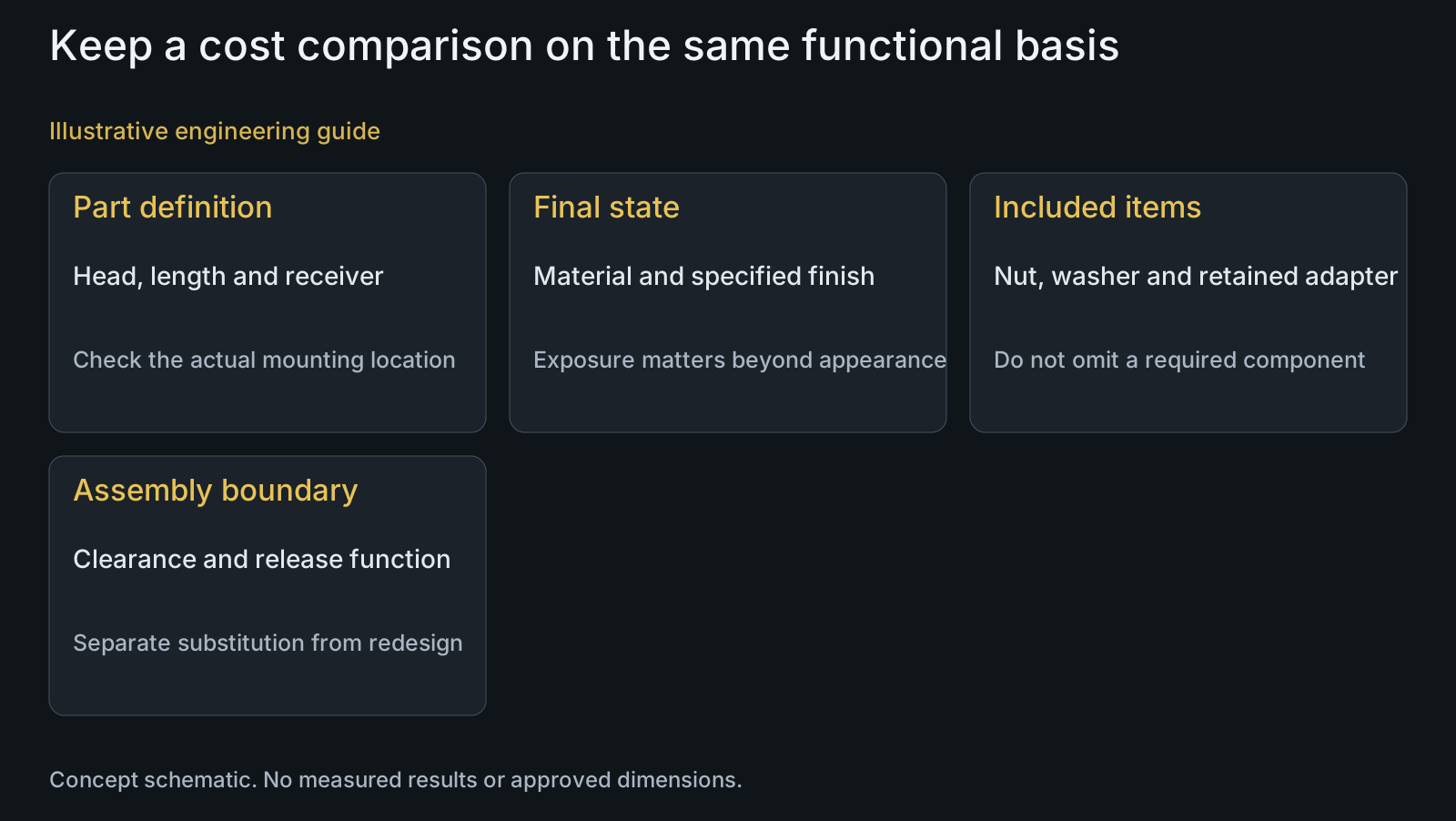
Compare offers for the same supplied set, quantities and final acceptance requirements. Include the screw, mating nut or washer where specified and distinguish retained original adapters from newly supplied items. A lower unit price may simply omit an associated part or finishing requirement.
For a genuinely custom part, discuss geometry through CNC turning and candidate stock through materials. Identify functional head contacts and tool access rather than machining every visible feature more tightly than needed. The drawing should show what the component must accomplish.
Preserve the applicable locking and assembly condition. Do not add a generic locking washer or adhesive to every connection, and do not delete a release feature as a cost simplification. Use the cost-breakdown guide to compare finished supply rather than assert that 304 always gives the best value.
Review example: lower-cost screw, unchanged release adapter
Illustrative engineering example: assume an OEM wants a lower-cost screw fixing a front mudguard stay adapter. The adapter has a separately defined release interface. A proposed supplier also offers a one-piece metal bracket as a simpler alternative. No price, release force or test outcome is assumed.
The reviewer separates the screw proposal from the bracket redesign. It compares the screw head contact, engagement, finish and installed clearance within the existing adapter definition. The rigid bracket changes the system function and cannot be accepted as merely another way to retain the same screw.
The RFQ therefore keeps the approved release arrangement intact while defining a comparable mounting-screw candidate. Any adapter redesign remains a separate product evaluation. The example supports a narrower cost discussion without claiming measured savings or improved safety.
Questions buyers need to confirm
Can the cheapest bolt be used because a mudguard is light?
Not without checking its requirements. Compare the exact mounting contacts, receiver, exposure, retention and clearance. A small accessory can have an important relationship to moving parts; low mass is not a complete part specification.
Is 304 stainless always the best-value option?
No universal ranking is established. Define the required grade/condition, final surface, mating materials, exposure and supply scope. Compare compliant offers on that same basis rather than declare value from the alloy name alone.
Can aluminum be used whenever tightening torque is low?
Treat it as a candidate requiring acceptance, not automatic permission. Low torque does not establish head-contact, receiver, retention or operating requirements. The exact alloy condition, geometry and represented assembly still need definition.
Should a stay-release clip be replaced with a stronger rigid bracket?
Not as a like-for-like improvement. A designed release interface serves a different function from screw retention. Preserve the manufacturer's arrangement for service; an OEM redesign needs its own functional requirements and evaluation.
What clearance should a custom mudguard screw have?
Use the actual product and bicycle requirements rather than a universal number. Show the screw and stay ends, bracket, tyre and moving components in the represented configuration. Check the applicable instructions and receiver depth alongside overall length.
What information is needed for a lower-cost mounting-hardware RFQ?
Send the mudguard/frame or fork identities, marked location, drawings, STEP or samples and BOM. Include bracket/adapters, receiver, clearance, material/final finish and retention requirements. Identify any release function and compare offers without changing that system boundary.
Technical references and scope
SKS ESC safety-system explanation. Named controlled stay-adapter separation illustrates release versus mounting-screw retention. No release-force value or universal safety guarantee claimed.
SKS BLUEMELS CABLE LINE 11847 safety instructions. Named supplied mounting material, stay-end caps and moving-part clearance requirements only. No numeric clearance, custom replacement permission or general repair recipe.
Explore related component, material and sourcing decisions in the customer decision knowledge center. For a drawing review, use the Drawing/BOM RFQ path.
Compare economical mudguard hardware without changing its role
Share the mounting location, mudguard and bicycle definitions, drawing, STEP or represented samples and BOM. Include receivers, bracket contacts, moving-part clearances, any stay-release adapter, final material/finish and applicable assembly requirements. PremFixer can review custom screw manufacture and comparable supply; product-function changes require the responsible owner's acceptance.
Discuss the drawing and BOM