
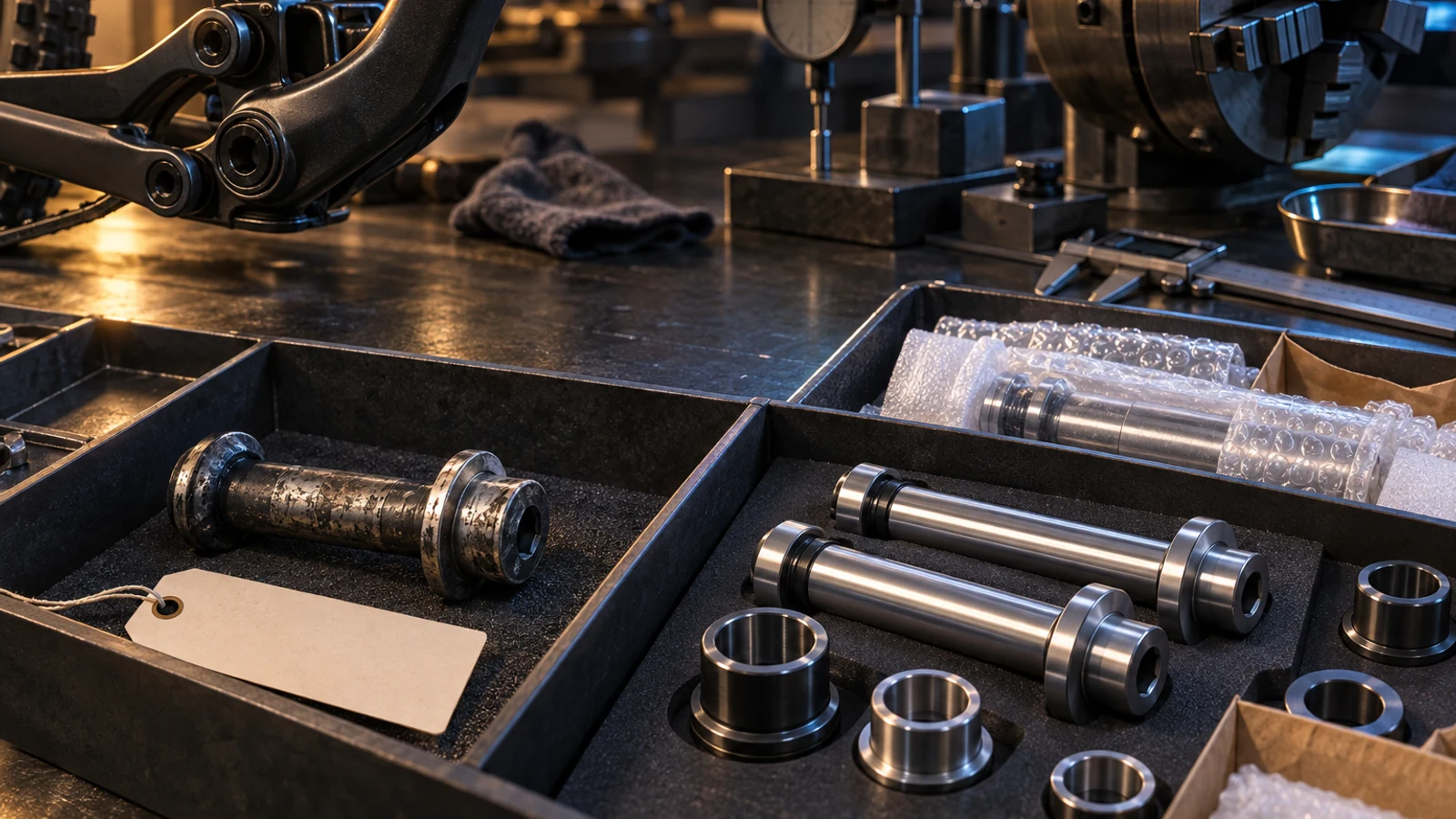
Control identified nonconforming pivot hardware while the appropriate authority decides whether it can be restored to requirements, replaced, returned or accepted under a defined concession. These are different dispositions, not four levels that every issue must follow. Start with the actual requirement, observed departure and affected parts. A cosmetic concern and an unresolved bearing-seat fit do not justify the same decision. Rework needs an achievable restoration route and relevant reinspection; concession needs explicit scope and authorization. Shipping replacements can recover supply while cause investigation continues. Neither a quick response nor a new report automatically proves that recurrence has been prevented.
Hero: concept illustration of example hardware and its application. It is not a factory photograph, tested component or approved production geometry.
Bound the affected stock without erasing uncertainty
Identify the requirement, measured or observed departure, supplied state, part revision and potentially affected population. Separate demonstrated nonconformity from an evidence gap. If a measurement record lacks its datum setup, establish what it actually supports before declaring every part undersize or accepting every part as conforming.
Prevent uncertain goods from mixing with accepted stock. Keep container, kit and component identities connected where available, and record unresolved boundaries honestly. The supplier audit findings guide addresses evidence-based findings; this article addresses what to do with the exposed physical goods.
Test whether rework can actually restore the requirement
Rework should have a defined route to the original requirement, not merely a more attractive appearance. Removing material cannot restore an already undersize finished seat. Additional processing may also affect a coating, thread, adjacent datum or material condition that was previously acceptable.
Assess the proposed operation and affected characteristics before authorizing it. Define the post-operation state and suitable examination for those consequences. Use the manufacturing scope to discuss feasible operations without assuming that machining, stripping or treatment can reverse every departure. Preserve the original observation and subsequent changes.
| Option | Appropriate condition | Main risk | Verification needed |
|---|---|---|---|
| Rework | Defined route restores requirements | Another feature changes | Post-operation affected characteristics |
| Replacement | Correct conforming goods available | Revision or kit mismatch | Identity and applicable acceptance |
| Return | Custody or examination agreed | Goods lose identity or protection | Documented movement and scope |
| Concession | Authorized bounded acceptance possible | Departure silently becomes normal | Named requirement and application review |
| Hold | Facts or authority unresolved | Uncertain goods enter use | Controlled identities and decision owner |
| Cause action | Evidence supports a preventive change | Supply recovery mistaken for closure | Cause verification and effectiveness |
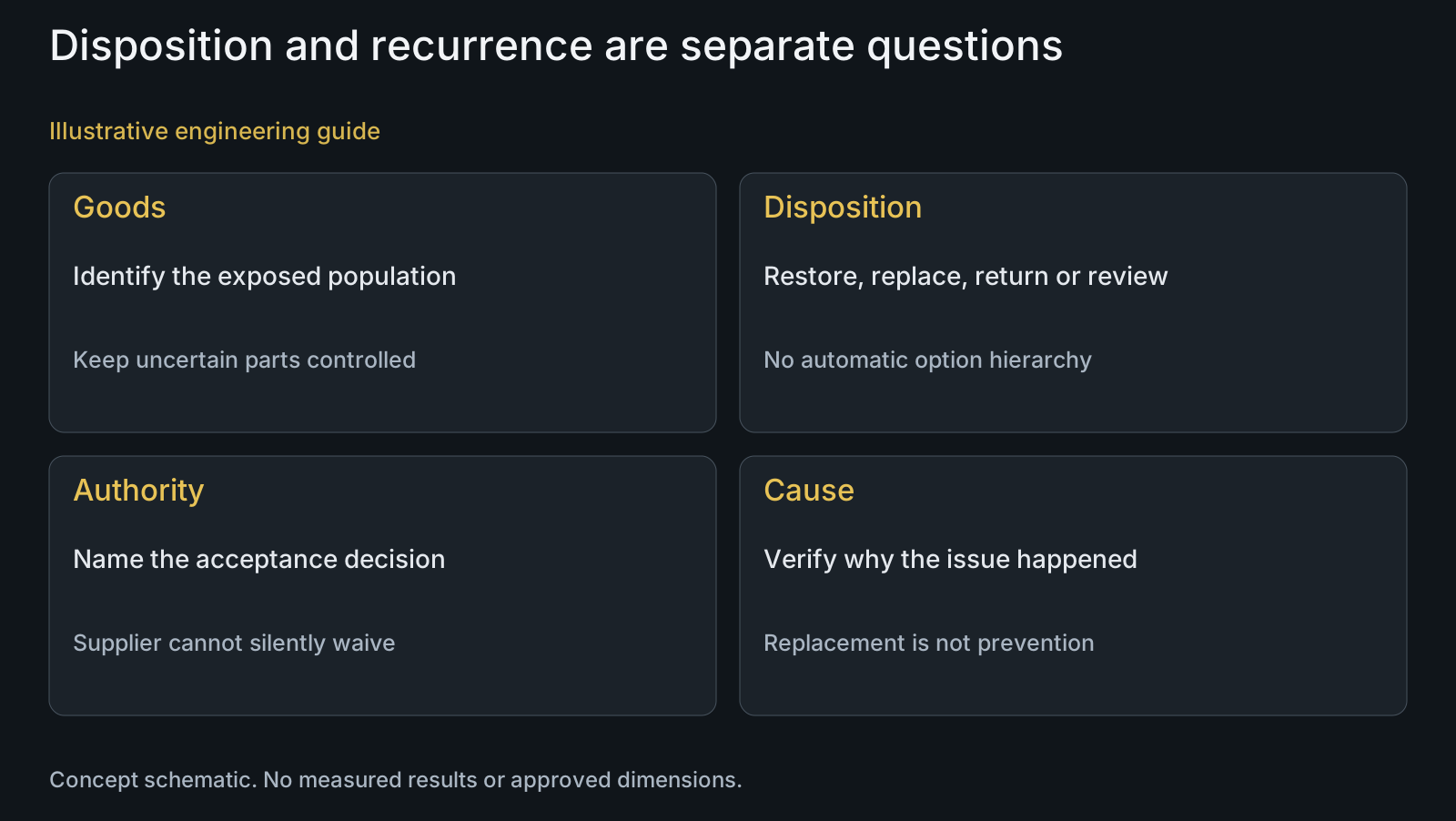
Separate replacement and return responsibilities
Replacement requires identified conforming goods with the right mating configuration, not simply another part bearing the same commercial name. Check the supplied revision, kit completeness and relevant acceptance evidence. Decide how the original goods remain controlled while supply is restored.
Return concerns movement and custody of affected goods. Clarify the receiving destination, identification, protection and permitted examination before dispatch. Returning a part does not by itself supply a replacement, resolve costs or establish the cause. Keep those commercial responsibilities distinguishable from the technical disposition.
Use concession as a bounded decision, not silent relabelling
State the departure and affected quantity explicitly. The responsible authority should assess the actual interface and application risk and determine whether an authorized concession is permissible. A supplier cannot unilaterally change the customer's acceptance requirement by marking a report approved.
A concession does not mean the original requirement was met. Preserve its boundaries and any conditions, including the relevant configuration and use scope. Do not carry acceptance of one defined population into future orders or treat a safety-relevant departure as acceptable because delivery is urgent. Unresolved engineering consequences need review, not a guessed waiver.
Close the cause separately from the stock disposition
ASQ's 8D guidance distinguishes interim containment, verified causes, chosen corrections and effectiveness review. That distinction helps explain why replacement and investigation can progress on separate tracks. It does not establish a mandatory response deadline or prove that a particular supplier has completed those steps.
Keep the recorded disposition beside the unresolved cause questions. Reinspection can establish examined post-rework characteristics; it does not necessarily explain why the departure occurred or why it escaped detection. For the agreement governing responsibilities, consult the quality agreement guide rather than treating this comparison as a contract.
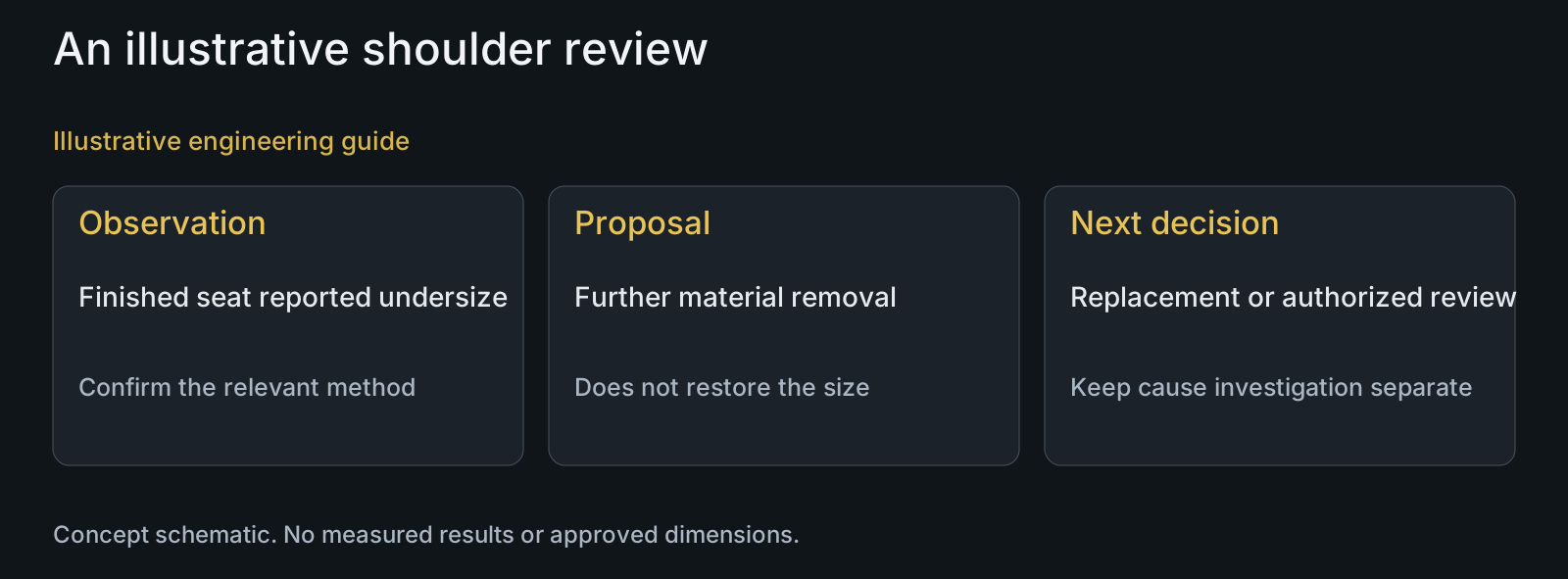
Review example: an undersize shoulder cannot be machined larger
Illustrative engineering example: assume an identified pivot shoulder is reported below its required finished size by a suitable agreed method. The proposed immediate action is further machining to improve appearance. No actual dimension, production lot or test result is supplied.
The reviewer notes that the proposal removes material and does not restore the reported size. The team considers compatible replacement goods and asks the responsible engineering authority whether any defined concession can be evaluated. It separately examines the operation and inspection history. This reasoning rejects an unsuitable restoration proposal without inventing an approved outcome or universal repair technique.
Questions buyers need to confirm
Can a supplier accept nonconforming hardware under concession?
Not unilaterally. Identify the departure, affected quantity and application, then obtain the appropriate authorized decision. Preserve the original requirement and concession boundaries.
Are return, rework, replacement and concession ranked steps?
No. Choose by the actual condition, feasible restoration route, compatibility and authority. Some parts cannot be restored by the proposed operation and some departures cannot be accepted for the intended use.
Does a replacement shipment close an investigation?
No automatic closure follows. Replacement can restore supply while causes and corrective-action effectiveness remain unresolved. Keep the stock disposition and cause-action status distinct.
What must be checked after rework?
Check the original departure and characteristics the operation could change, including relevant adjacent geometry, treatment and material condition. A repeat of one convenient measurement may miss a new consequence.
Can an accepted concession apply to the next batch?
Not automatically. Confirm its specified population, configuration and conditions. Future production remains subject to the actual requirements unless a separately authorized change establishes otherwise.
Is a forty-eight-hour response guaranteed?
No deadline is established here. Agree notification and response milestones for the actual issue. An investigation start, confirmed cause and demonstrated effectiveness are different events.
Technical references and scope
ASQ, Eight Disciplines 8D. Distinction between containment, verified causes and corrective-action effectiveness; no required response period inferred.
Explore related component, material and sourcing decisions in the customer decision knowledge center. For a drawing review, use the Drawing/BOM RFQ path.
Review the actual departure and feasible response
Send the controlled drawings, affected part and lot identities, relevant observations, proposed operation and required acceptance scope through the Drawing/BOM RFQ path. PremFixer can discuss manufacturing options and evidence needs without substituting for the customer's authorized acceptance decision.
Discuss the drawing and BOM