
An actionable pivot supplier audit finding identifies an unmet requirement, the observed evidence and the scope that needs a response. Material identity gaps, unsupported measurement status, missing process records and overdue actions are useful review subjects, but this article does not rank their industry frequency. The buyer is deciding whether available evidence supports the supplied hardware and what further investigation is needed. A missing record can prevent a justified acceptance decision without proving that every bolt or sleeve is physically defective. Conversely, an acceptable sample does not erase a demonstrated control failure. Keep the system finding, product exposure and shipment decision connected but distinct.
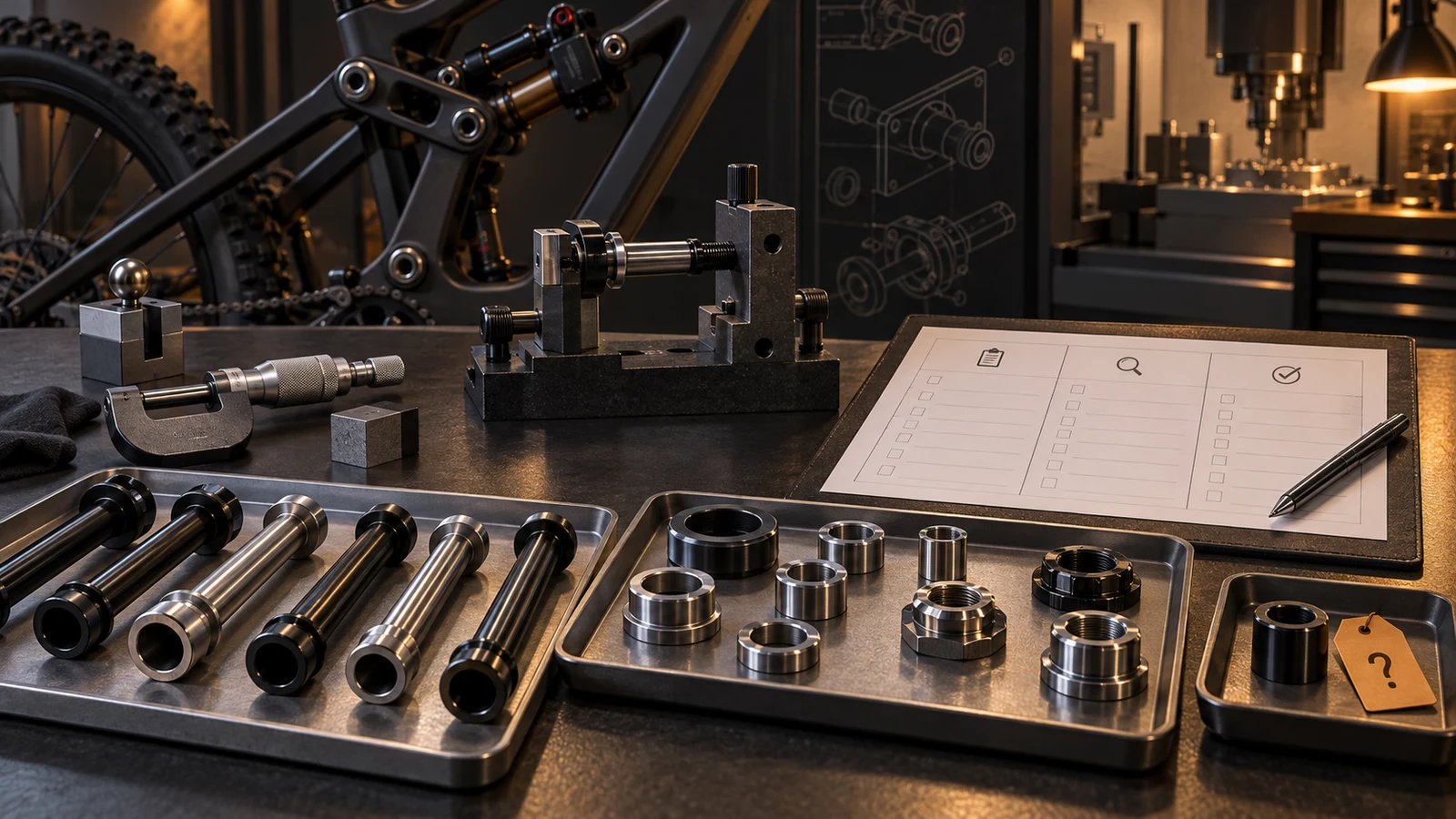
Hero: concept illustration of example hardware and its application. It is not a factory photograph, tested component or approved production geometry.
Build a finding from evidence and an identified requirement
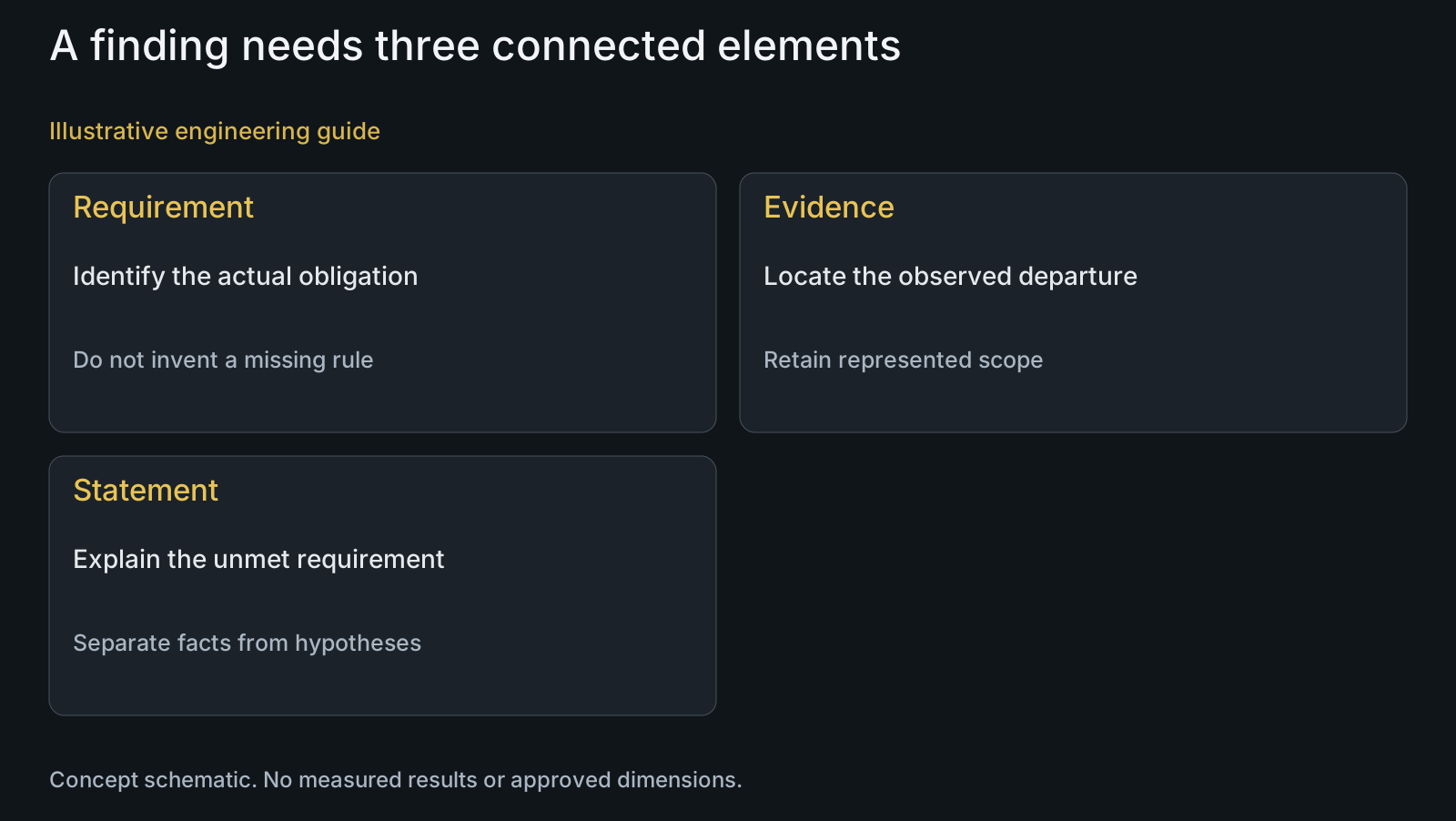
The ISO 9001 Auditing Practices Group's documenting paper describes three elements: evidence, the applicable requirement and the nonconformity statement. It is dated educational guidance, not the current standard text or an additional contractual obligation. Its structure helps distinguish an observation from a supported conclusion.
For a buyer review, identify the actual obligation: an agreed drawing note, purchase requirement or applicable documented procedure. Describe the observed part, record, operation and represented date. A broad heading such as poor traceability is not enough to locate the departure or decide what would resolve it.
When the requirement or evidence remains unclear, pursue the missing information rather than inventing a finding. When an unmet requirement is demonstrated, do not hide it inside a suggestion. The audit planning guide addresses review coverage; this article addresses the conclusion that the available evidence can support.
Material identity gaps concern a connection, not just a certificate
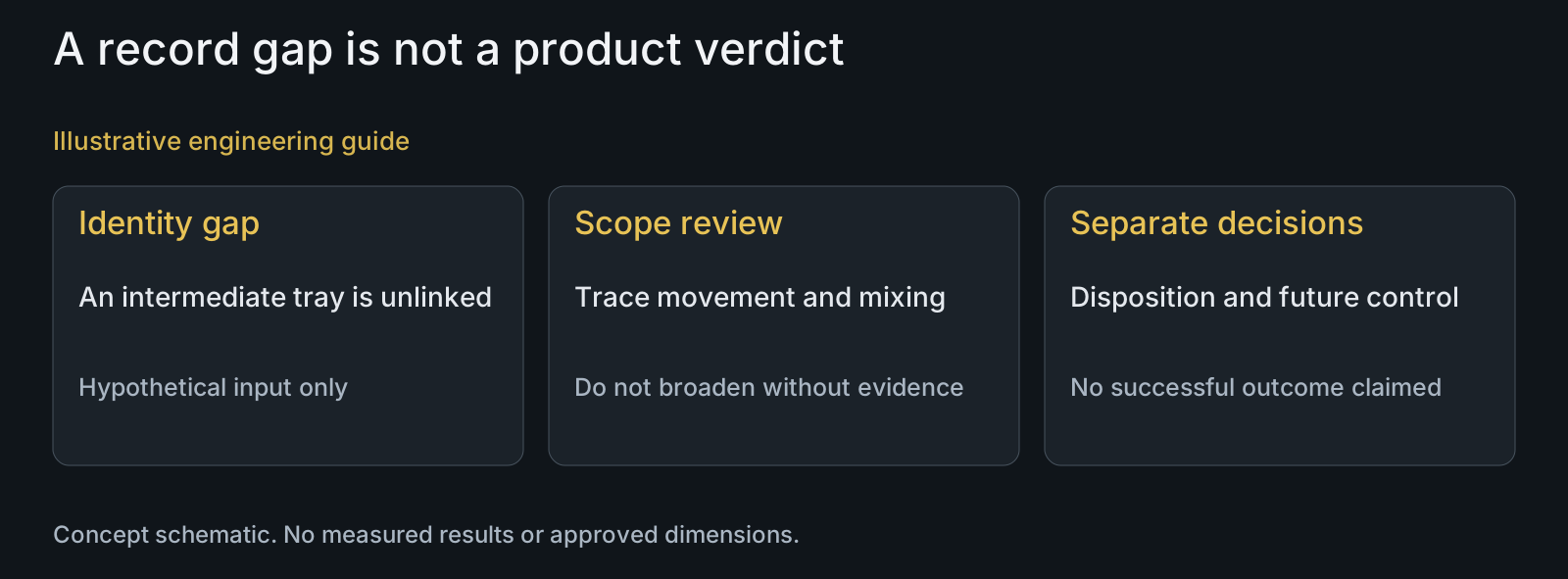
Trace the ordered material condition to the received stock, intermediate parts and delivered identities within the agreed scope. A certificate can be genuine while its connection to a mixed tray remains unsupported. Establish where identity stopped being retained before deciding which population is affected.
Composition testing may answer a material-identification question, but it does not recreate every missing history field or demonstrate treatment condition by itself. Do not relabel unlinked material as a particular heat merely because it resembles known stock. Any reconstruction should preserve its evidence source and remaining uncertainty.
Use the material handling audit to examine stock identity and eligibility. An investigation may justify restricting an uncertain population while separately reviewing adequately linked material. That boundary must follow evidence, not convenience or the visual similarity of the parts.
| Review subject | Potential gap | What not to infer | Useful verification |
|---|---|---|---|
| Unlinked sleeve tray | Required material identity lost | Every sleeve is the wrong alloy | Trace movement and possible mixing scope |
| Overdue measuring device | Required status not supported | All measured parts are out of limit | Review use, history and feature evidence |
| Missing operation entry | Required event evidence unavailable | Operation definitely never happened | Investigate permitted independent records |
| Overdue action | Agreed response remains unresolved | Shipment decision already determined | Review issue exposure and responsible disposition |
| New instruction issued | Change exists on paper | Relevant activity now works | Observe use at the affected boundary |
Measurement findings require a lookback on actual use
An instrument's overdue status and a demonstrated dimensional departure are different facts. Identify what the instrument measured, the relevant period, the required method and the records available. Review the features and supplied parts that relied on that measurement before making a product conclusion.
A current acceptable check can contribute evidence for the instrument's present behavior without automatically establishing every earlier result. The review may need instrument history, verification findings, setup information or a suitable independent examination of retained parts. State what each source can and cannot represent.
The inspection capability review considers feature coverage and method suitability. A calibrated instrument used against the wrong datum arrangement can still fail to evaluate the required interface. Avoid closing a method issue by updating a date label alone.
Missing process records and overdue actions have different consequences
A missing operation record creates a question about the event it was supposed to evidence. Identify the required fields and the affected route. Permitted machine history, external-process documents or retained identification may help investigate; a newly completed form must not be presented as a contemporaneous observation.
Late action closure concerns the agreed response obligation and unresolved issue. It does not automatically authorize or prohibit a shipment without reviewing the underlying requirement and product exposure. Keep an implementation statement distinct from a demonstrated effectiveness review.
For cause analysis and effectiveness, use the CAPA guide. Here the priority is a finding that another reviewer can understand and trace. Changing its wording must not conceal the original evidence or turn an uncertain hypothesis into a confirmed cause.
Compare response evidence with the original gap
Ask what evidence would address the specific unmet requirement. A new bin arrangement may show implementation of an identity change; examining a relevant subsequent handoff can address its use. Neither substitutes for disposition of the population whose identity is already unresolved.
Retain separate decisions for immediate containment, product acceptance and corrective-action closure. The responsible customer authority may need additional review before affected hardware is accepted. An audit-report status is not a dimensional concession or an agreed change to the manufacturing route.
Finding categories and severity rules depend on the applicable audit scheme and agreement. No universal major or minor classification is assigned here. Report evidence limitations explicitly so a positive review of one operation is not extended to unobserved partners or future production.
Illustrative review: an unlinked sleeve tray
Illustrative engineering example: assume an order requires retained material-lot identity for stainless pivot sleeves. During a hypothetical review, a tray at an intermediate operation has no retained identifier, and the available movement record cannot connect it to a documented incoming lot. No measured defect, real supplier finding or customer result is claimed.
The finding concerns the required identity connection for that tray, not an assertion that all stainless sleeves contain the wrong alloy. The team would identify the tray's movement, possible mixing boundaries and affected supplied identities. A composition check could narrow one uncertainty while leaving the requested lot history unresolved.
A clearer future tray label addresses only part of the response. The buyer still needs a justified decision on the uncertain population and evidence that identity is retained at the relevant handoff. This example shows why a precise finding supports a useful action while a general accusation of poor quality does not.
Questions buyers need to confirm
Does a missing record prove that pivot parts are defective?
No. It may demonstrate a failure to retain required evidence while physical conformity remains a separate question. Identify the required record, affected parts and available independent evidence before deciding product disposition; do not treat the gap as irrelevant either.
Does an expired calibration date invalidate every earlier inspection?
Not automatically. Review the instrument's actual use, relevant features, period, status history and available verification results. Those fields determine which decisions relied on unsupported measurement and whether further feature-specific examination is needed.
Can a material composition check restore missing heat traceability?
Not by itself. It can answer supported composition questions for the examined material, but cannot recreate a documented heat identity, movement history or treatment condition. Provide the stock documents, tray identities and mixing boundaries so each uncertainty can be reviewed separately.
May a missing production record be filled in after the audit?
Any permitted reconstruction should be identified as such, with its source, date and limitations retained. Do not backdate an inferred event as a witnessed entry. Whether the reconstruction addresses the obligation depends on the required fields and evidence that actually survives.
Is issuing a revised instruction enough to close a finding?
It can show an instruction change, not necessarily implementation or effectiveness at the affected activity. Compare the response with the original requirement and evidence gap, then examine the relevant handoff or measurement under the agreed review scope.
What should be sent for a focused finding review?
Provide the requirement, drawing and BOM revision, observed evidence, represented dates and identities, affected operation and permitted supporting records. Include current containment and unresolved questions so the review can separate evidence gaps, product exposure and action closure.
Technical references and scope
ISO 9001 Auditing Practices Group, Nonconformity: documenting. 2016 educational guidance on evidence, applicable requirements and precise findings; its disclaimer states that it has not undergone ISO/IAF endorsement. Not the current standard text or a supplier finding-frequency study.
Explore related component, material and sourcing decisions in the customer decision knowledge center. For a drawing review, use the Drawing/BOM RFQ path.
Define the evidence needed for your pivot hardware review
Send the drawing, BOM revision, material and inspection requirements, relevant part identities and permitted finding evidence through the Drawing/BOM RFQ path. PremFixer can discuss the manufacturing and interface questions within its supply scope; product disposition and audit authority remain with the responsible parties.
Discuss the drawing and BOM