
A high OEE figure does not prove spare capacity for your custom pivot order. It describes equipment effectiveness against a defined production-time, cycle and quality basis. Identify the measured process, period and product mix before treating the percentage as useful evidence. Then ask a separate question: can the proposed order fit the current route and delivery window? Scheduled time already serving other work is not free capacity, and good output at machining may still await treatment, final inspection or companion kit components. Review those boundaries without accusing a supplier of false reporting merely because its metric cannot answer an order-availability question.
Hero: concept illustration of example hardware and its application. It is not a factory photograph, tested component or approved production geometry.
Understand the metric before interpreting the percentage
Vorne's OEE calculation explanation gives OEE as Availability multiplied by Performance multiplied by Quality. Availability uses run time against planned production time; Performance uses an ideal-cycle basis; Quality relates good and total counts. Ask which process and period the stated inputs represent.
Those factors help interpret loss categories, but the combined percentage is not a component count or a delivery date. A report should keep the underlying definitions visible. Do not compare two supplier percentages when their cycle, time or output boundaries differ.
The order-capacity guide develops time-window resource assessment. This article owns interpretation of productivity evidence: which conclusions an OEE statement supports and which must remain separate order-planning questions.
Ask which calendar time the denominator excludes
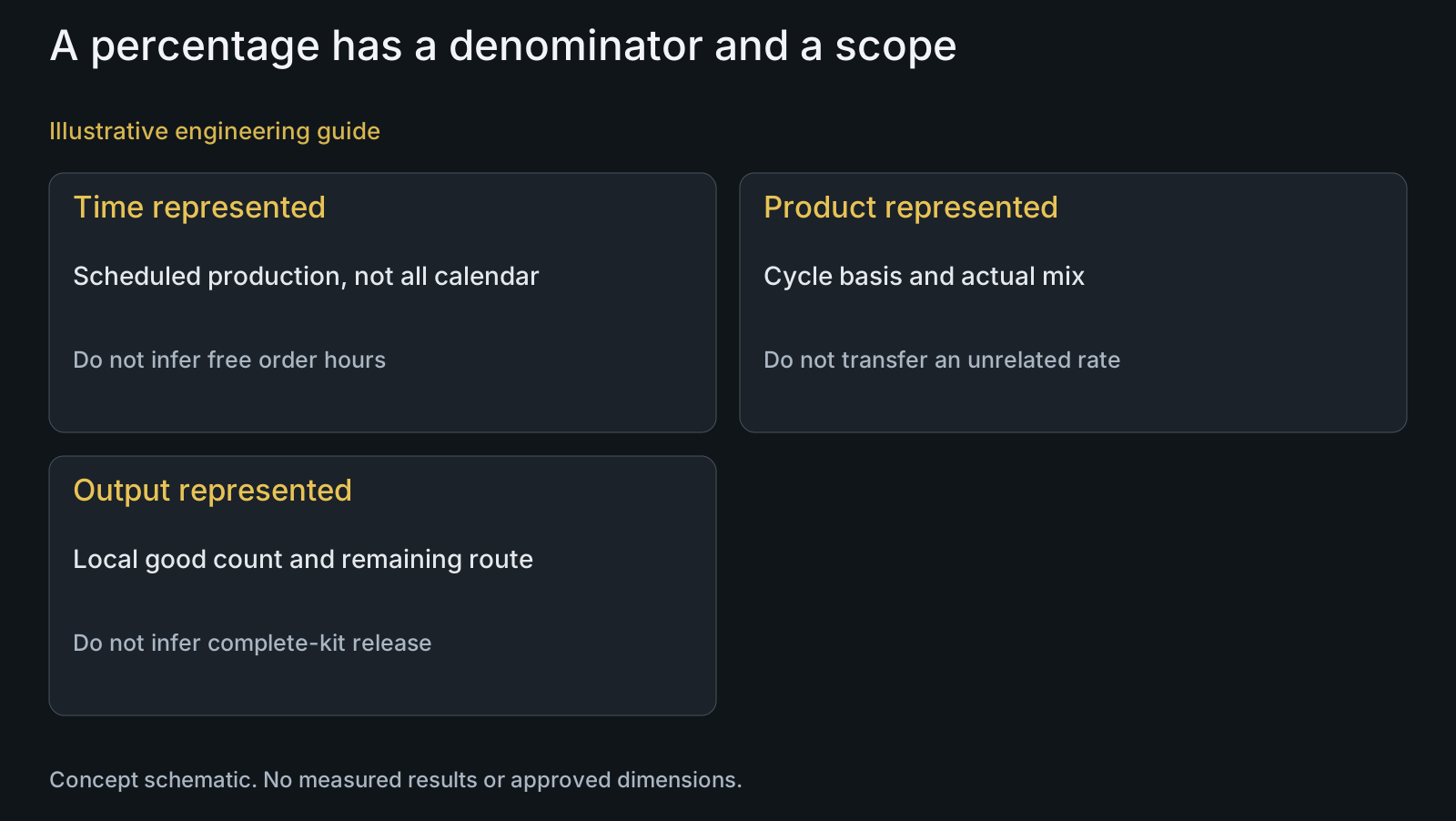
A planned-production-time denominator is not necessarily the whole calendar. Ask which shifts, planned nonproduction periods and stops are represented. A percentage can be calculated correctly yet provide no information about the additional hours a buyer hopes to use.
Vorne's public OEE FAQ distinguishes time scheduled to run from time not scheduled and discusses changeover treatment. Use the supplier's disclosed definitions when interpreting its record; do not silently reclassify all time outside the denominator as immediately available production.
Excluded time could require people, tooling, maintenance decisions or another agreed arrangement before it can serve the new job. Similarly, an existing scheduled window may already be committed. Productivity within that window and authority to allocate another order are different subjects.
| Reported basis | What to establish | Unsupported shortcut | Buyer follow-up |
|---|---|---|---|
| Period and process | Resource and measured interval | One factory-wide permanent score | Identify represented operation |
| Production-time denominator | Scheduled and excluded time | Excluded hours are free capacity | Review executable order window |
| Cycle and product basis | Rate for represented geometry | One pin rate serves all pivots | Request mix-specific assumptions |
| Good-count boundary | Accepted scope at that process | Machining output equals delivered kit | Identify remaining final-state work |
| Rejects and pending results | Count treatment and status | Preliminary count is final acceptance | Clarify represented quality evidence |
| Downstream completion | Finish, inspection and kit dependencies | High CNC OEE proves route headroom | Review limiting completion scope |
Keep the cycle basis matched to the product mix
A simple pin and a hollow shoulder pivot can require different operations and setups. Ask which part family supports the rate or ideal-cycle assumption. A percentage calculated from one family does not establish the number of another family that the same resource can produce.
For a mixed record, ask how the individual cycle bases and units relate to the represented products. A raw average of component cycle times or an unweighted average of percentages can hide differences in the actual work. Request a scoped explanation rather than transfer the most attractive rate to every kit position.
Setups and first-off checks can affect the proposed mix even when a long repeat run produced convincing historical data. The new order should retain its own route and planning assumptions. Do not claim a demonstrated rate until the evidence actually represents comparable geometry, material and operations.
Identify where the good count stops
Ask what the record calls good and where the count is made. A locally accepted machining output may still require partner finishing and final-state measurement before delivery. Its relevant process result should not be described as the complete kit's supplied acceptance.
Keep the treatment of rejects, rework and pending results understandable. A number may be preliminary if relevant evaluation is still open. Without its count definition, the buyer cannot tell whether a returned piece, repeated operation or unresolved inspection was included once, twice or not at all.
The final-inspection guide develops delivered-feature coverage separately. For OEE review, the important question is the metric's own output boundary, not an assumption that a favourable quality factor proves every component and assembly requirement.
Reconcile local productivity with downstream readiness
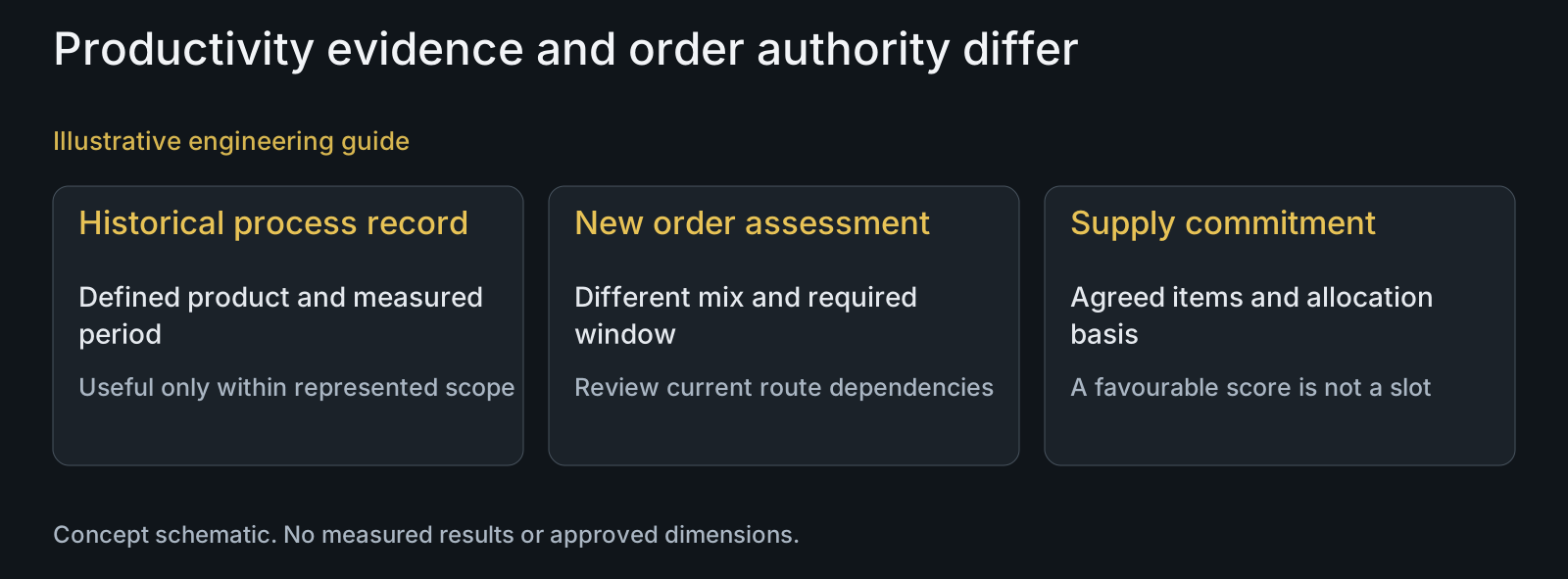
A productive turning step can feed a queue elsewhere. Ask which remaining process controls finished acceptance for the proposed mix and whether the cited metric covers that process. A machining OEE record is not a measurement of the finishing partner's current window or the packing team's complete-kit availability.
The manufacturing overview and surface-treatment scope identify route boundaries relevant to the discussion. PremFixer's confirmed in-house and partner model does not establish a public OEE record, deployed scheduling system or unlimited downstream capacity.
Historical delivery evidence can help check whether previous output reached the stated endpoint. Compare its configuration and period with the proposed order without treating successful past deliveries, overtime records or a machine screenshot as proof of an uncommitted current slot.
Illustrative review: a repeat-run score meets a different kit
Illustrative engineering example: assume a supplier provides an OEE summary for a long run of simple pins. A new bicycle program requires hollow pivots, sleeves and treated washers, with a defined finished-kit receipt window. No actual score, cycle time, quantity or supplier schedule is assumed.
The buyer asks which process, planned hours and good count the summary represents. It keeps that evidence within the repeat-run scope, then requests product-specific route assumptions and downstream availability for the different kit. It does not multiply the pin rate by the score and call the result deliverable kits.
The seasonal-capacity guide separately addresses reservation authority. Any proposed allocation still needs its own scope and start conditions. The review can identify useful productivity information and missing order evidence without inventing either a delivery guarantee or a finding of falsified capacity.
Questions buyers need to confirm
What should accompany an OEE percentage?
Identify the measured resource, period, product mix, planned-production-time basis, cycle basis and good-count definition. Explain any preliminary results. Without those fields, the percentage cannot support a meaningful comparison or a particular kit-output interpretation.
Does a higher OEE mean more spare capacity?
Not automatically. The relevant production time may already serve committed work, and excluded time may not be executable. Review the new order's current resource window separately instead of treating equipment effectiveness as unallocated hours.
Can a simple pin's rate estimate hollow pivot output?
Not without a justified product and route comparison. Geometry, material, operations, setup and evaluation requirements can differ. Ask for the basis relevant to the proposed pivot mix rather than transfer a repeat-run rate because both parts are turned.
Does the good count establish finished-kit acceptance?
Only within the record's actual represented output scope. A machining count can leave finishing, final-state inspection and other kit positions unresolved. Identify what was accepted and what remains before interpreting it as delivered complete hardware.
Can overtime records prove a new production slot is available?
They can describe past working conditions, not automatically a current allocation. Ask what people, tools, route and downstream work would support the proposed extra window. Do not infer unlimited shifts or a supplier commitment from historical overtime alone.
What should accompany an OEE-related capacity RFQ?
Send the drawings and kit BOM, product mix, material and finish, quantities and required usable-receipt window. Identify the productivity record you want interpreted and its output basis. Ask separately for current route availability and any conditional allocation proposal.
Technical references and scope
Vorne: OEE calculation explanation. Primary manufacturing-monitoring provider's public factor and time/count definitions; no published example values, supplier scores or software deployment transferred to PremFixer.
Vorne: OEE public FAQ. Relevant public discussion of scheduled versus nonscheduled time and changeover treatment; context only, not a universal bicycle factory scheduling policy.
Explore related component, material and sourcing decisions in the customer decision knowledge center. For a drawing review, use the Drawing/BOM RFQ path.
Interpret productivity evidence for the kit you need
Send the drawings or STEP files, BOM, product mix and required receipt window through the Drawing/BOM RFQ path. Identify any OEE or production summary you want reviewed. The discussion will distinguish its represented scope from the new order's manufacturing, downstream and allocation questions.
Discuss the drawing and BOM