
Protect peak-season pivot hardware supply by separating the rolling forecast from authorised releases and any agreed capacity reservation. The forecast helps expose expected demand, but it does not independently secure every operation or authorise unlimited stock. Define the represented parts, revisions, quantities and delivery window, then agree which changes can occur without disturbing committed work. Check material, partner operations and complete-kit release together. A late increase, deferral or cancellation can affect those commitments differently. No universal three-month planning horizon or safety-stock rule guarantees unchanged lead time; the useful outcome is a visible boundary for what is planned, what is committed and what still needs a decision.
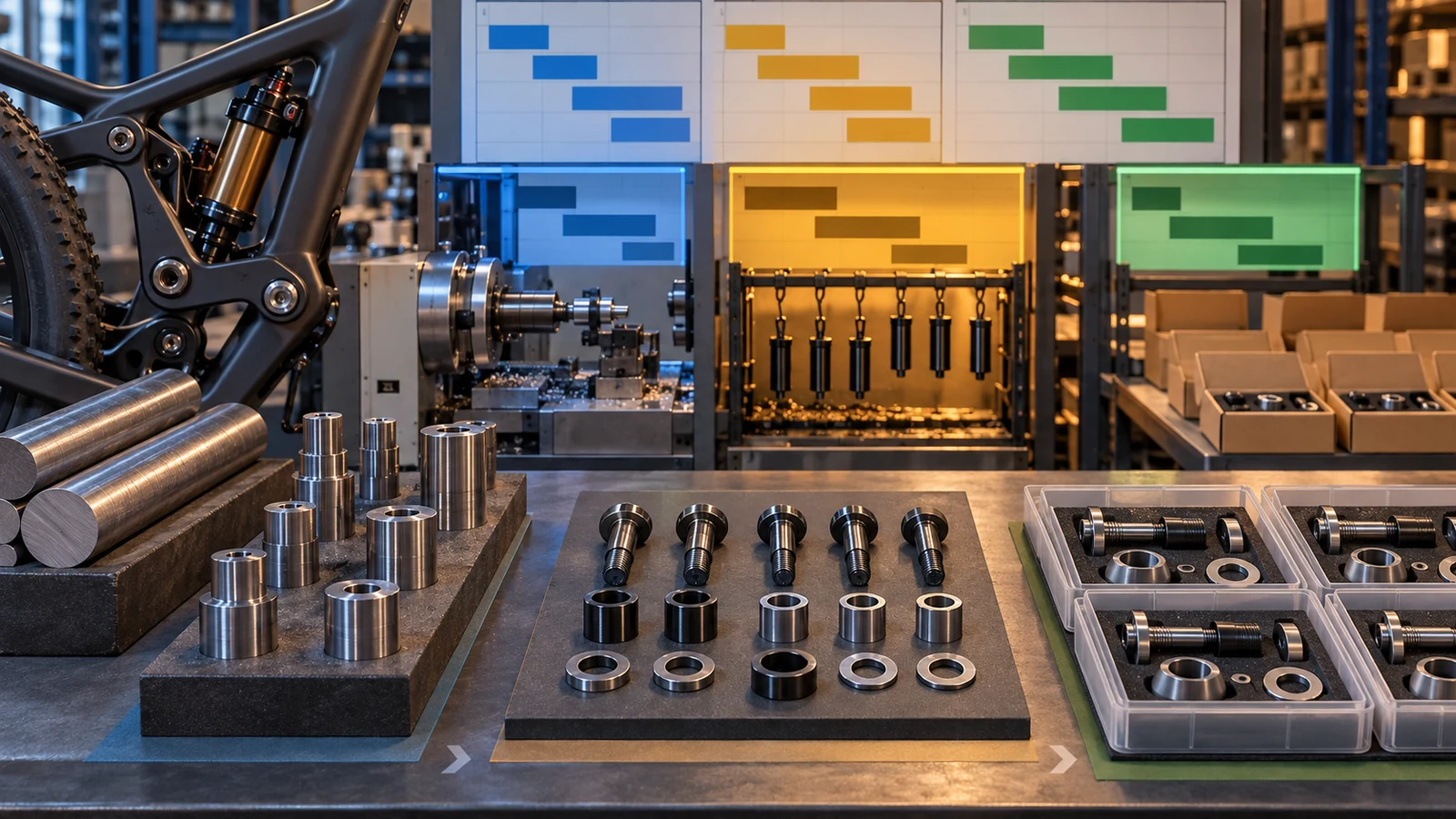
Hero: concept illustration of example hardware and its application. It is not a factory photograph, tested component or approved production geometry.
Give forecast, release and reservation different meanings
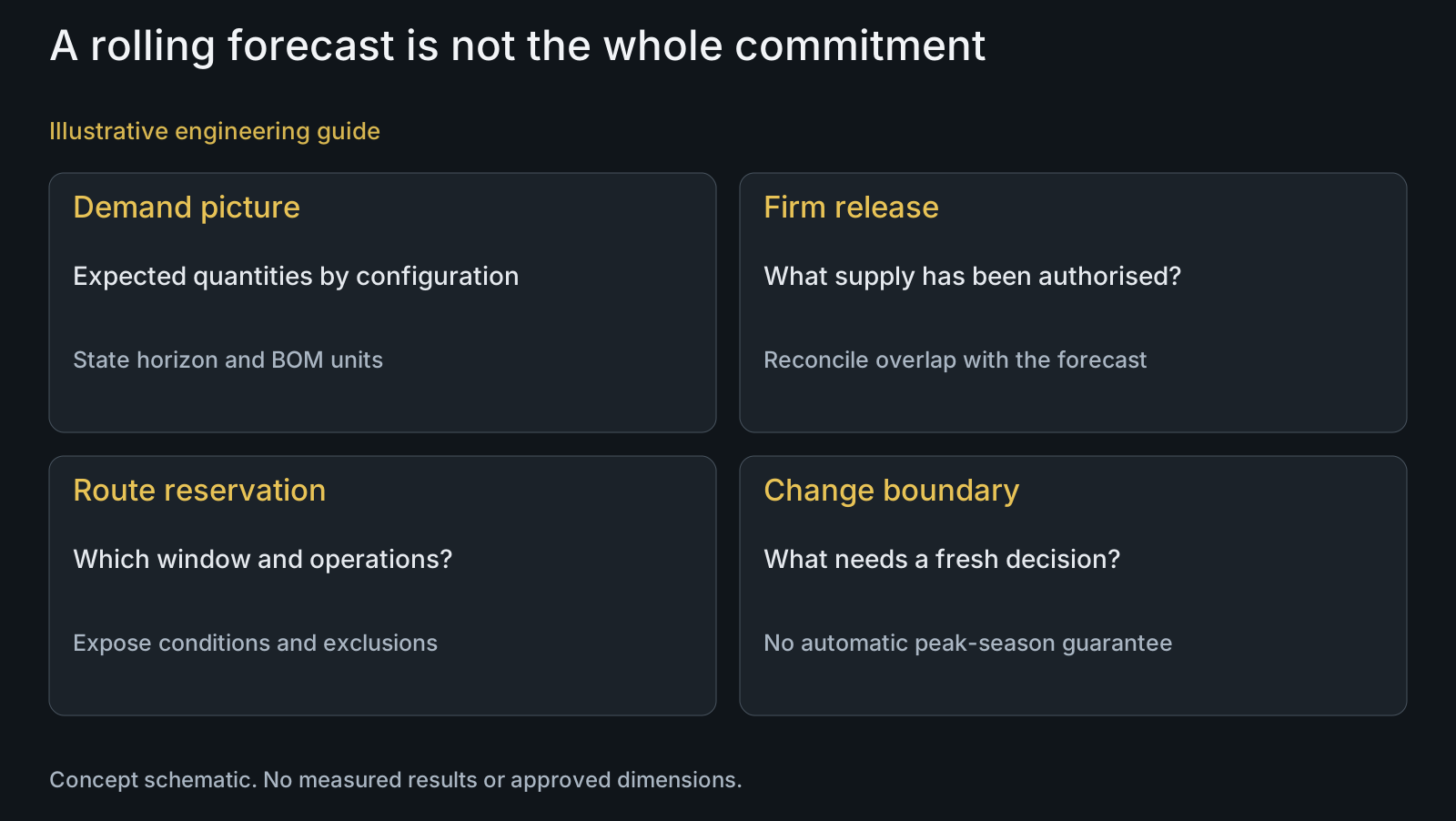
A rolling forecast describes expected demand over a stated horizon. A firm release authorises defined supply under the agreed arrangement. A capacity reservation concerns a represented resource window and its conditions. Avoid using one label for all three because their quantity and change responsibilities can differ.
Identify whether the forecast is in bicycles, kits or individual components. Expand the applicable BOM before comparing it with part quantities. When a firm release replaces forecasted demand, reconcile that overlap so the same requirement is not interpreted as both extra forecast and additional authorised production.
The seasonal demand-planning guide addresses how demand assumptions are represented. This article concentrates on the authority and flexibility of the resulting supply arrangement. An accurate forecast can still lack a committed route or a defined rule for a late change.
Choose planning windows from the actual supply decisions
Use windows that reflect when material, setups, partner work and shipment decisions become difficult to change. Do not assign every pivot program the same advance period. A stable stocked configuration and a new treated custom sleeve may have different unresolved dependencies before the proposed delivery.
Oracle's legacy time-fence documentation illustrates policy boundaries for changes within a planning horizon. It is software-specific context, not a current PremFixer system claim or a contract rule. The project still needs its own agreed scope and authority.
For each window, state what remains indicative, which input permits commitment and what changes need renewed review. A planning freeze must not block correction of a safety or conformity concern. Technical acceptance and commercial schedule flexibility remain separate decisions.
| Planning state or event | Decision it supports | Risk if conflated | Review basis |
|---|---|---|---|
| Rolling forecast | Expected demand for planning | Every forecast quantity treated as authorised production | Horizon, units, BOM and overlap with firm releases |
| Firm release | Defined supply commitment | Later forecast silently overwrites committed work | Items, quantities, conditions and responsible authority |
| Route reservation | Represented resource-window arrangement | Turning slot mistaken for complete-kit capacity | Covered operations, start conditions and exclusions |
| Late increase | Additional requirements and remaining opportunity | Existing reservation assumed unlimited | Incremental mix, materials and downstream windows |
| Deferral | Revised receipt and resource/inventory treatment | Moved arrival automatically cancels production | Committed work, stock holding and proposed reallocation |
| Cancellation | Disposition of authorised work and releases | Reduced forecast assumed consequence-free | Affected commitments and separately reviewed responsibilities |
Reserve the represented route, not an unexplained quantity
Identify the product family, configuration, relevant resource period and supplied-condition boundary behind a reservation. Ask which start conditions remain, including input material, tooling and customer decisions. A generic statement that capacity is reserved can omit the operation that actually controls complete-kit readiness.
The capacity-assessment guide tests resource availability for the actual mix. Carry that basis into the seasonal arrangement: more turning availability does not independently reserve finishing, final inspection or a required sleeve position. Make any excluded operation visible.
Discuss the manufacturing route and surface-treatment scope against the represented peak window. PremFixer's coordinated in-house and partner model does not prove that every proposed future slot is secured. Confirm the particular arrangement instead of inferring unlimited peak-season flexibility.
Give increases, deferrals and cancellations separate responses
An increase asks whether additional requirements fit the remaining resource and material windows. A deferral may leave authorised parts or resources committed while receipt moves later. A cancellation raises the treatment of authorised work and stock. One generic change-allowed statement cannot answer all three.
Name the decision owner and the facts needed to reassess each change. Identify the difference between changing an expectation and modifying an existing commitment. Do not silently transfer residual stock, storage or rescheduling responsibility when a forecast is refreshed.
Use the supply-contract discussion for the wider commercial boundary and obtain qualified review of binding terms. The scheduling aid here is not a cancellation-charge rule, a legal remedy or a promise that late demand can always be absorbed.
Review a deferral against an already proposed production window
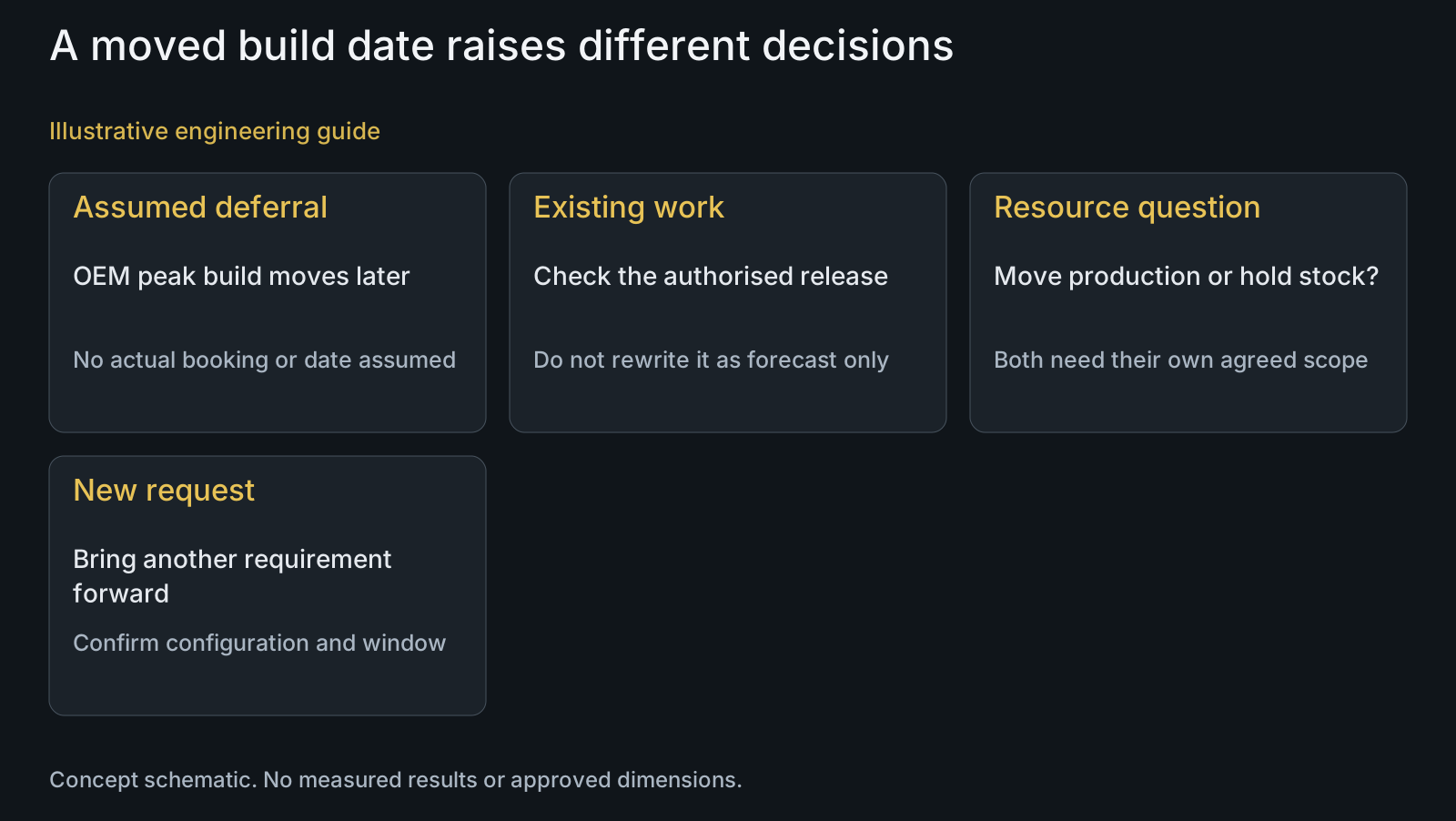
Illustrative engineering example: assume an OEM moves its peak build later after a finishing window has been proposed for the current pivot kit. It also asks whether part of the later forecast can be brought forward. No real reservation, stock quantity or agreed change charge is assumed.
The planner first separates the existing authorised release, the conditional finishing proposal and the uncommitted forecast. It asks whether moving receipt requires moving production or whether accepted stock would need a separately agreed holding arrangement. Bringing another requirement forward may use a different configuration or resource window.
The next decision is a scoped reallocation proposal with its remaining conditions, not an automatic yes or a blanket refusal. The example assumes no slot transfer or successful delivery. It demonstrates why calendar movement, production authority and inventory responsibility must remain visible together.
Use buffers selectively and update the commitment picture
A buffer may protect a defined demand or replenishment uncertainty, but it cannot replace an unavailable approved process indefinitely. Check usable configuration and complete-kit balance before describing stock as peak-season protection. More inventory can also expose the current revision to a later model change.
The safety-stock guide examines the purpose and revision horizon of the quantity. Seasonal coordination additionally needs the relation between that buffer and authorised releases. Decide who can allocate it and which assumption triggers review without claiming a universal supplier-stock service.
Keep the latest forecast, firm releases and reservation decisions reconciled with the same BOM and material definition. Use the materials overview and knowledge center for related engineering inputs. The useful seasonal review exposes changed conditions early; it does not guarantee that all disruptions or late increases will leave lead time unchanged.
Questions buyers need to confirm
Will a rolling forecast prevent all peak-season delay?
No. It improves visibility but does not secure every operation or absorb unlimited late increases. Define firm releases, any reservation, start conditions and change boundaries. Assess the actual kit route instead of promising that a universal horizon guarantees unchanged lead time.
Does a capacity reservation authorise material purchases?
Only if the agreed arrangement gives that authority for the represented scope. Resource planning, material commitment and firm releases can be different decisions. State parts, revisions, quantities and conditions rather than infer unlimited purchasing permission from the word reserved.
How far ahead should the forecast extend?
Use the decisions it must support: relevant material, setup, partner and delivery windows. A fixed advance period cannot fit every route. Identify what is reliable, what is conditional and which input must be resolved before a commitment is made.
What happens when seasonal demand falls?
Review authorised releases, material, work in progress and finished stock under the agreed arrangement. A reduced expectation does not automatically cancel committed work without consequence. Separate the forecast update from decisions about residual inventory and resources.
Can we move a reserved slot to a different pivot design?
Not automatically. Compare the new mix, tooling, route and supplied condition with the represented reservation. A different sleeve or finish can need different resources. Ask for a revised scoped proposal and approval of any technical change.
Does safety stock replace a seasonal capacity plan?
No. It protects only its defined uncertainty and usable configuration. Check complete-kit positions, allocation and version horizon. An inventory buffer cannot establish that every required future operation or release remains available during peak demand.
Technical references and scope
Oracle legacy time-fence control explanation. Historical software-specific example of policy boundaries within a planning horizon. No current PremFixer deployment, mandatory three-month period or contractual authority inferred.
Explore related component, material and sourcing decisions in the customer decision knowledge center. For a drawing review, use the Drawing/BOM RFQ path.
Define seasonal releases and capacity conditions for your pivot program
Send the drawing, STEP file or sample, BOM revisions, rolling demand and firm-release picture, needed receiving windows and known model changes through the Drawing/BOM RFQ path. Identify proposed reservation scope and how increases, deferrals or cancellations should be reviewed. PremFixer can discuss the relevant route and conditions without turning a forecast into an unconditional peak-season guarantee.
Discuss the drawing and BOM