
Assess pivot bolt supplier capacity against the actual order: part revisions, material, quantities, delivered condition and the window in which usable hardware is needed. Ask how the required route fits the available resource calendar after competing work, setups and applicable checks are considered. Machined pieces are not necessarily finished accepted kits. An equipment list shows possible resources, not free hours or approved capability for your geometry. Identify the limiting operation and what would change the assessment. A second machine, extra shift or partner proposal can support more output only if its necessary people, tooling, route and downstream release capacity are also available.
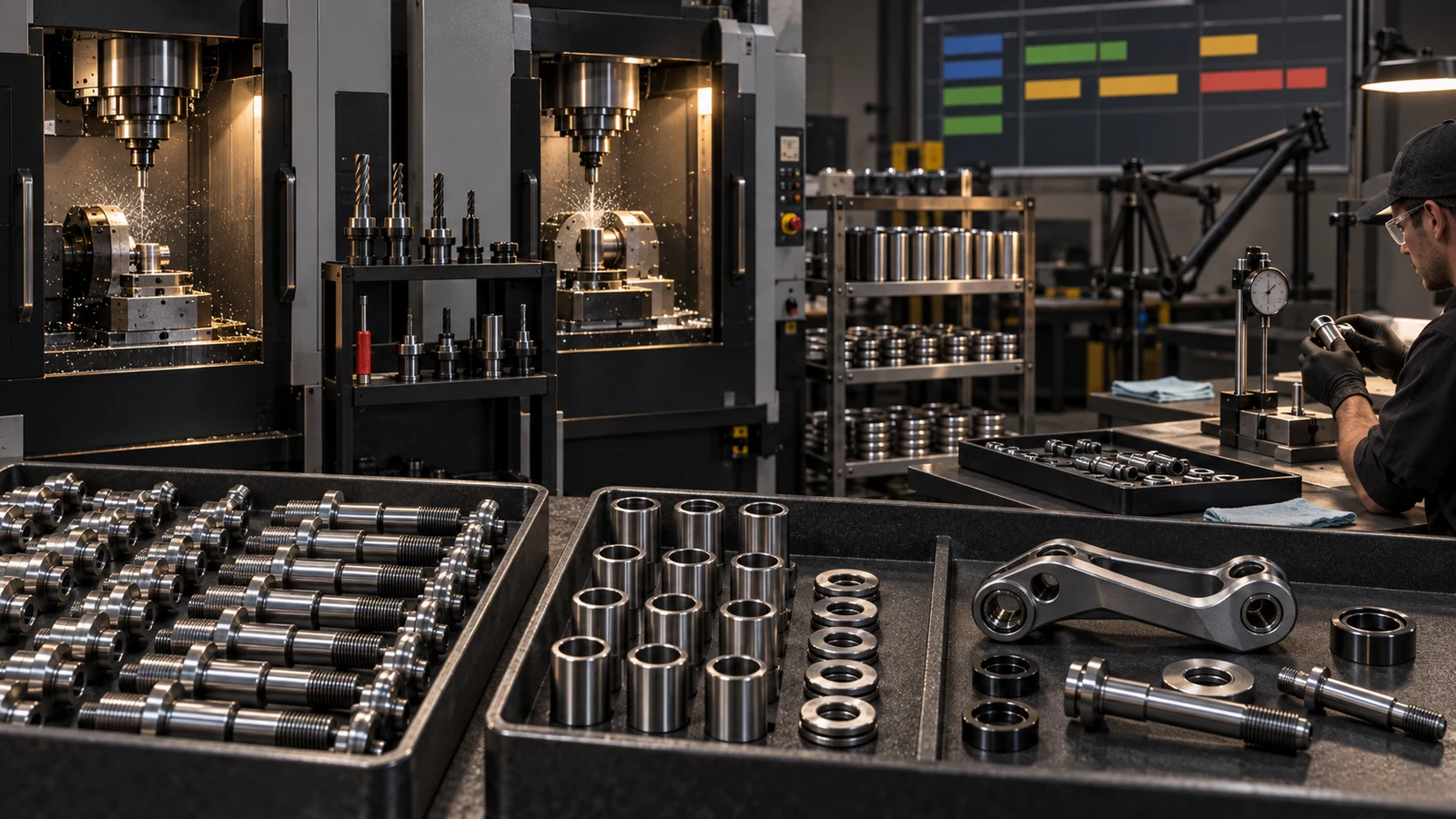
Hero: concept illustration of example hardware and its application. It is not a factory photograph, tested component or approved production geometry.
Define what output the capacity statement represents
Start with the supplied part family and approved definition. A simple threaded fastener and a stepped pivot axle with a controlled bearing seat can consume different machining, setup and inspection resources. A general pieces-per-month figure does not distinguish those requirements.
State whether the claimed quantity means started parts, machined components, accepted finished parts or complete kits. Include the represented period and configuration. Converting a machining count directly into deliverable kits ignores treatment, inspection and missing positions.
The supplier-audit guide places capacity within a broader execution audit. This review concentrates on the proposed order's resource and time basis. Evidence that a supplier executes a control does not, by itself, show that the resource has an uncommitted slot for your quantity.
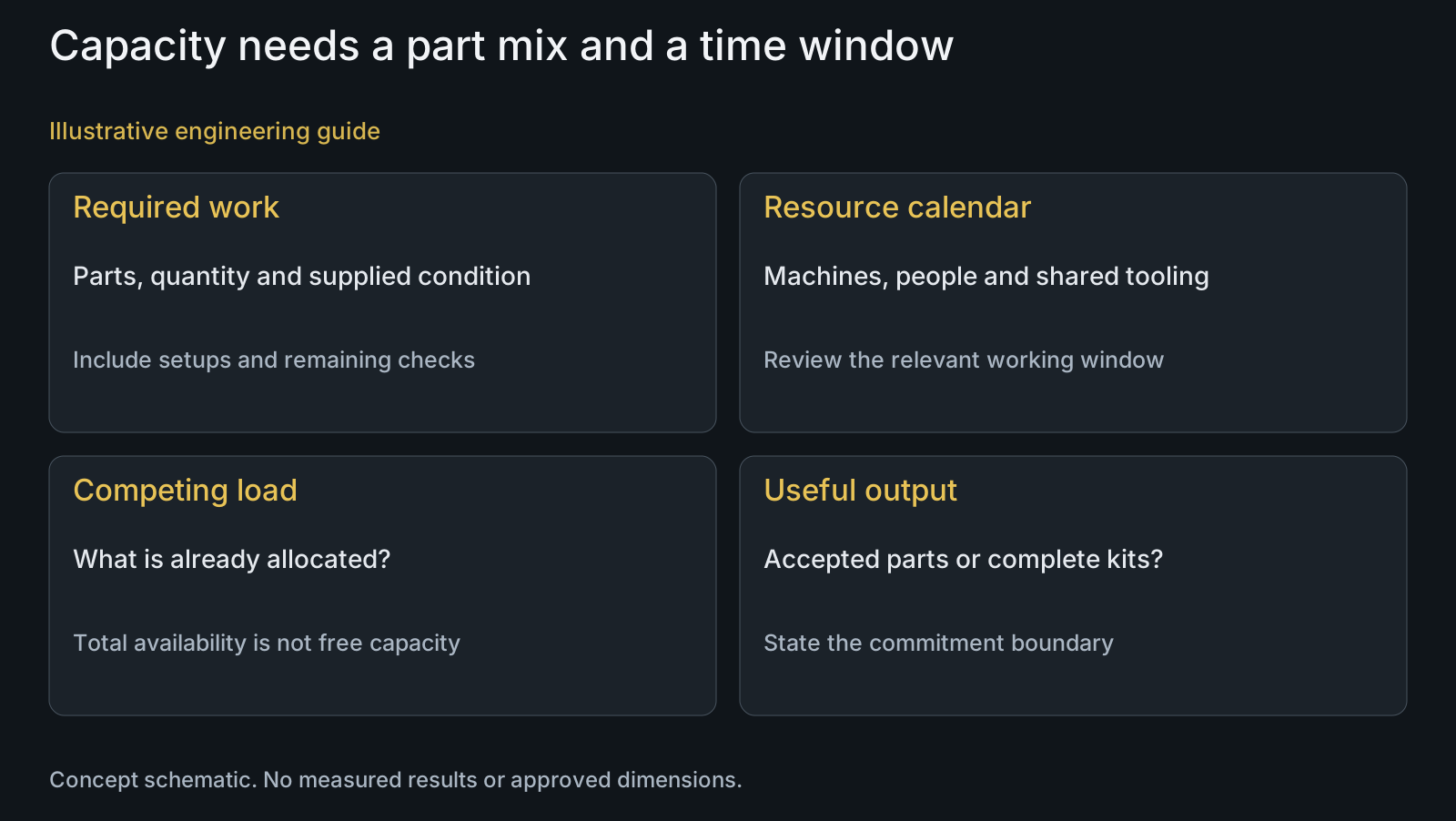
Compare required work with the relevant resource calendar
Identify the operations, resource needs and applicable setup work for the requested mix. Check whether parts can genuinely run in parallel or share the same fixture, specialist operator or measurement setup. Two visible machines do not create two independent production paths when another required resource is shared.
Use the requested production window rather than a generic annual capacity. Examine working shifts, planned unavailable periods and competing allocations. Separate total calendar availability from the portion that can actually be assigned to the proposed order.
Autodesk's capacity-and-load explanation illustrates time-specific resource and shift calculations in its software. It is supporting context for a scoped calendar review, not evidence that PremFixer uses that system or that a displayed utilisation automatically equals available capacity for a customer order.
| Claim or input | What it can show | What remains unresolved | Relevant evidence |
|---|---|---|---|
| Machine inventory | Potential equipment resources | Suitability and uncommitted availability | Part/route capability and requested-period calendar |
| Ideal cutting cycle | Local process-time assumption | Setups, interruptions and accepted output | Comparable cycle basis and represented conditions |
| Current resource load | Work assigned to a time window | Whether your order and shared resources fit | Scoped allocations, people, tools and setup needs |
| More turning equipment | Possible local parallel opportunity | Finishing, inspection or kitting constraint | End-to-end route comparison after the proposed change |
| Historical deliveries | Output achieved in a represented scope | Current mix, load and remaining route | Comparable configuration, period and acceptance boundary |
| Proposed production slot | Conditional allocation proposal | Start conditions and reservation authority | Defined items, window, dependencies and commitment basis |
Follow the route to its limiting completion resource
Compare the machining opportunity with the remaining delivered-state route. Partner treatment, final measurement, sorting, packing or an unavailable kit position can control the usable completion date. Expanding an unconstrained step may create more work in progress without increasing the output the buyer needs.
Ask which resource is limiting for the stated mix and period, what evidence supports that conclusion and which proposed change would remove it. The constraint can move when the mix, route or availability changes. Avoid treating one machine as the permanent bottleneck for every product.
The manufacturing overview, CNC turning scope and surface-treatment discussion help identify relevant route boundaries. PremFixer's confirmed in-house and partner arrangement does not establish unlimited downstream slots or simultaneous availability at every operation.
Use relevant records without inventing a conversion factor
Ask for evidence from a comparable part family, route and defined period where disclosure is permitted. Confirm what cycle or output record represents, including setup boundaries and accepted output. Do not apply a record from unrelated simple parts to a complex pivot merely because both were turned.
If the proposal assumes an acceptance allowance or recovery of rejected parts, identify that assumption and its supporting records. A theoretical rate for uninterrupted cutting is not a demonstrated finished-part rate. No universal yield percentage or performance multiplier is established here.
Where live customer schedules are confidential, agree a redacted scoped explanation or representative exercise. State the access limitation. Missing evidence is an unanswered capacity question, not proof that a claimed number is fraudulent or that every operation at the site is ineffective.
Test whether a second machine removes the actual constraint
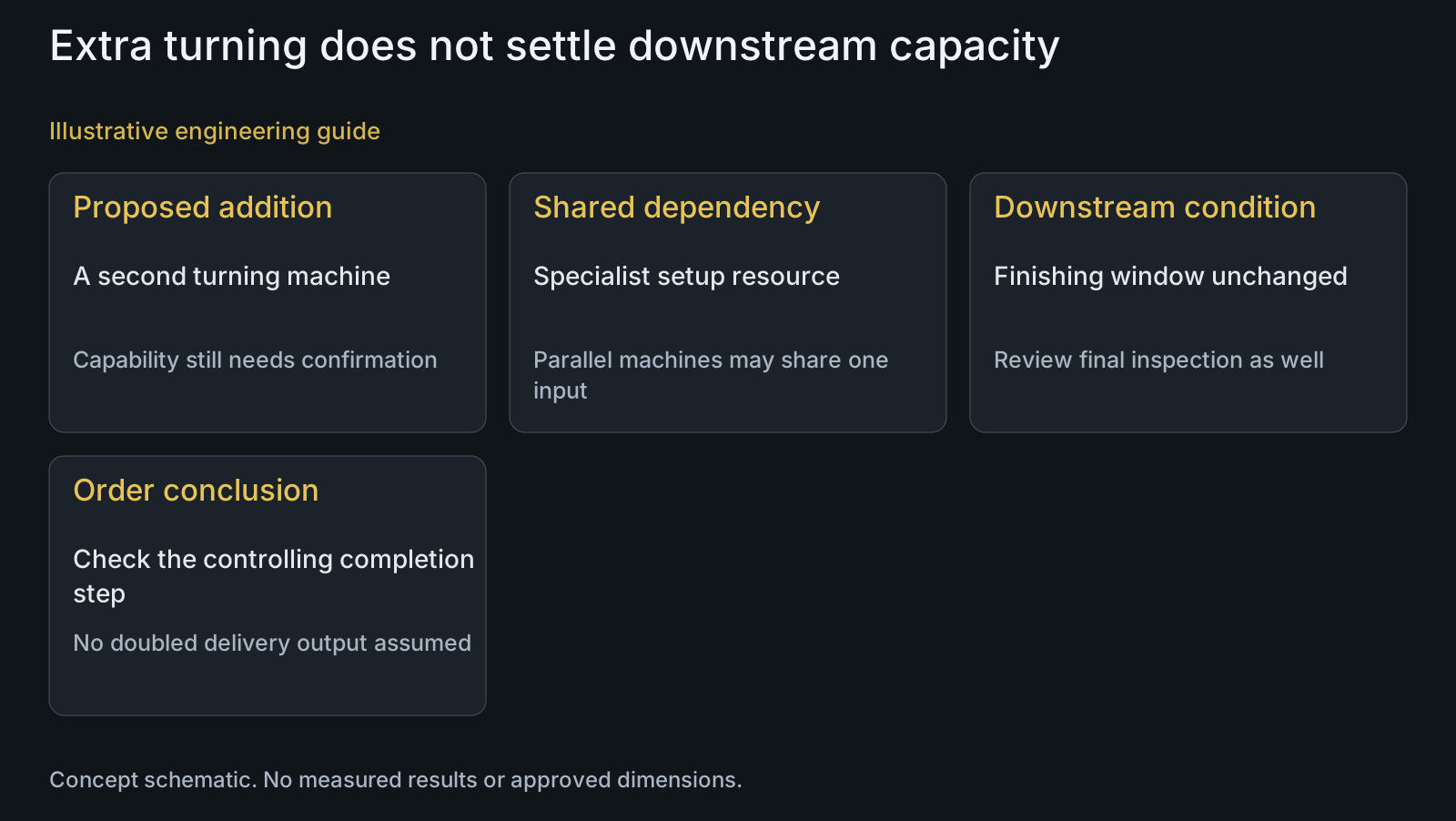
Illustrative engineering example: assume a second suitable turning machine is proposed for a pivot order, but both machines need the same specialist setup resource and the finishing slot has not changed. The supplied kit also requires final delivered-state inspection. No actual machine count, cycle time, order quantity or measured output is assumed.
The reviewer compares setup availability, parallel running conditions and downstream completion capacity. If the proposal adds turning opportunity but leaves the controlling finishing window unchanged, it cannot be treated as evidence that complete-kit delivery capacity doubles.
The useful follow-up is to identify the constraint and the additional arrangement needed, not reject the extra machine as useless. Its value depends on the represented route and timing. The example demonstrates a conditional capacity assessment without promising an achieved production increase.
Distinguish an available option from a committed slot
A capacity proposal can describe what might be feasible. A commitment needs the represented parts, period, required start conditions and the allocation basis. Clarify whether material, tooling, customer decisions or partner confirmation remain unresolved before interpreting a date as a firm slot.
An extra shift or alternate route has its own staffing, qualification and final-condition requirements. Review those dependencies instead of assuming every proposed expansion is immediately executable. The supply-interruption guide addresses recovery selection; this article tests the output basis before making the ordinary or expanded order commitment.
Provide material requirements through the materials overview and related decision context through the knowledge center. PremFixer can review a defined RFQ against the relevant route. No generic monthly capacity, permanently reserved customer slot or unconditional peak-season expansion is claimed.
Questions buyers need to confirm
Is a machine list enough to verify pivot order capacity?
No. It identifies potential resources, not the appropriate route or their free time. Supply the part mix, revisions, quantity and needed period, then review suitability, competing work, staffing, setup and downstream completion requirements.
Does adding a second machine double capacity?
Not necessarily. Shared tooling or people can limit parallel work, while finishing or inspection can still control accepted output. Compare the full route after the proposed addition; a local processing increase is not automatically a complete-kit delivery increase.
Which output figure should a buyer ask for?
Ask for the represented accepted supplied output in the relevant period. Distinguish started, machined and finished parts from complete kits. Confirm the configuration and remaining operations so the figure answers the quantity you actually need to receive.
Can historical delivery records prove current availability?
They can support capability within their represented scope, but not establish a present uncommitted slot. Compare the old mix, route and acceptance boundary with the proposed order and current resource window. Do not transfer an unrelated production rate without justification.
What can replace access to confidential schedules?
Agree a redacted scoped capacity explanation or representative exercise that shows relevant availability and assumptions without another customer's details. State what was not observed. Restricted access is not itself evidence of false capacity, but it limits the supported conclusion.
When is a quoted production date a committed slot?
When the represented parts, window, start conditions and allocation basis are agreed and the responsible party confirms the commitment. An available-machine proposal or provisional partner date can remain conditional. Identify unresolved tooling, inputs and approvals before relying on it.
Technical references and scope
Autodesk Fusion Operations capacity and load explanation. Software-specific time-window, resource and shift basis for capacity and operation load. No PremFixer deployment, normative calculation or proven order availability inferred.
Explore related component, material and sourcing decisions in the customer decision knowledge center. For a drawing review, use the Drawing/BOM RFQ path.
Assess capacity for your defined pivot hardware order
Send the drawing, STEP file or sample, material and finish requirements, BOM revisions, quantities and required usable receiving window through the Drawing/BOM RFQ path. Identify sample or series scope and known customer decisions. PremFixer can review the relevant route and dependencies without turning a generic equipment count into an unsupported delivery promise.
Discuss the drawing and BOM