
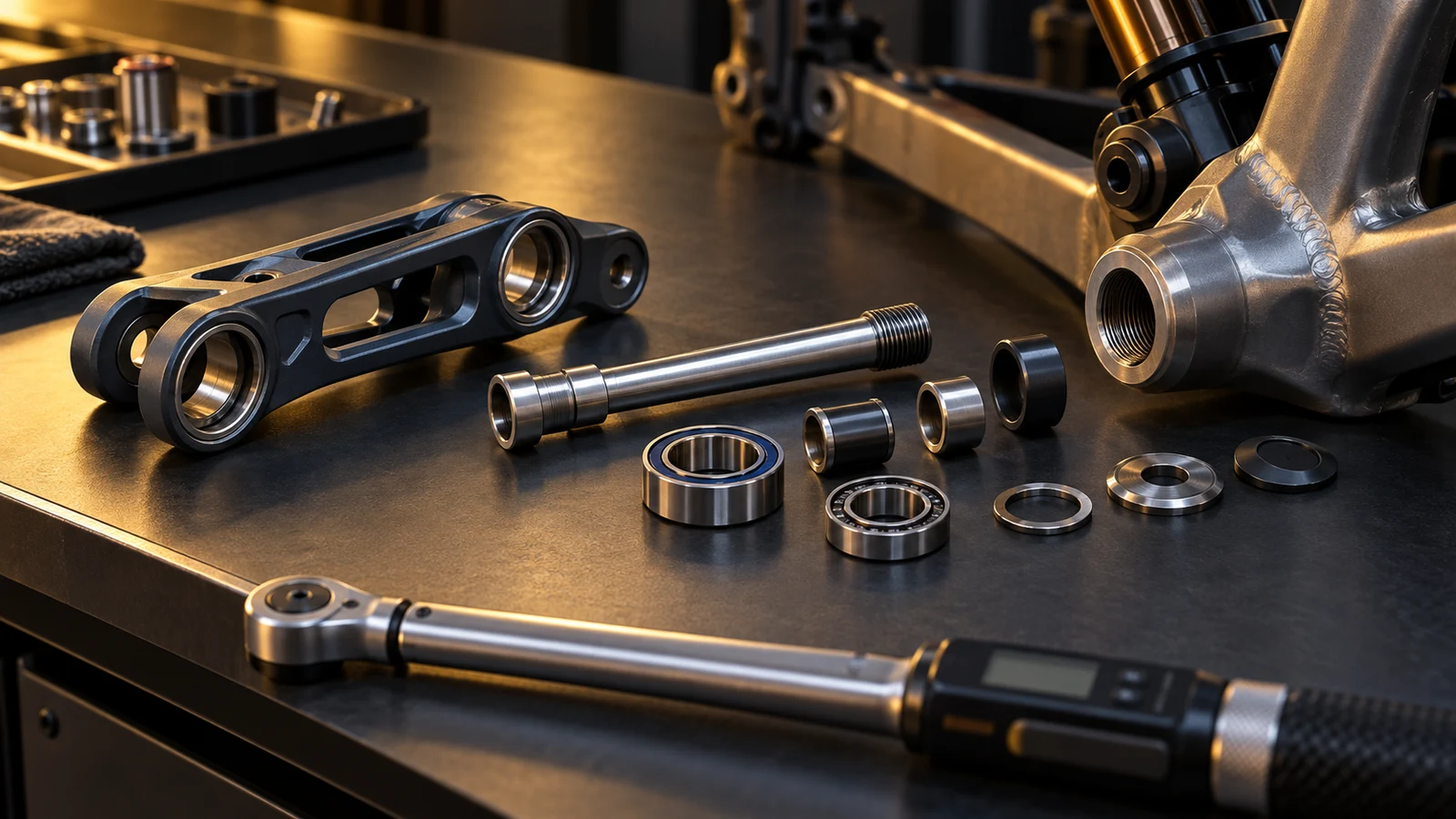
An overtightened pivot bolt can put more than the bolt at risk. The receiving thread, under-head contact and bearing-spacer arrangement may limit the joint before the fastener visibly breaks. Returning the wrench to the specified setting does not prove that an earlier event left those parts intact. For an OEM or service team, preserve the known tightening conditions and identify the actual clamped path before deciding inspection, replacement or another approved disposition. Do not ride an assembly with unresolved structural security. A generic bolt torque table, a later click or a stronger replacement alloy cannot provide clearance for the complete pivot.
Hero: concept illustration of example hardware and its application. It is not a factory photograph, tested component or approved production geometry.
Locate the parts that carry the tightening reaction
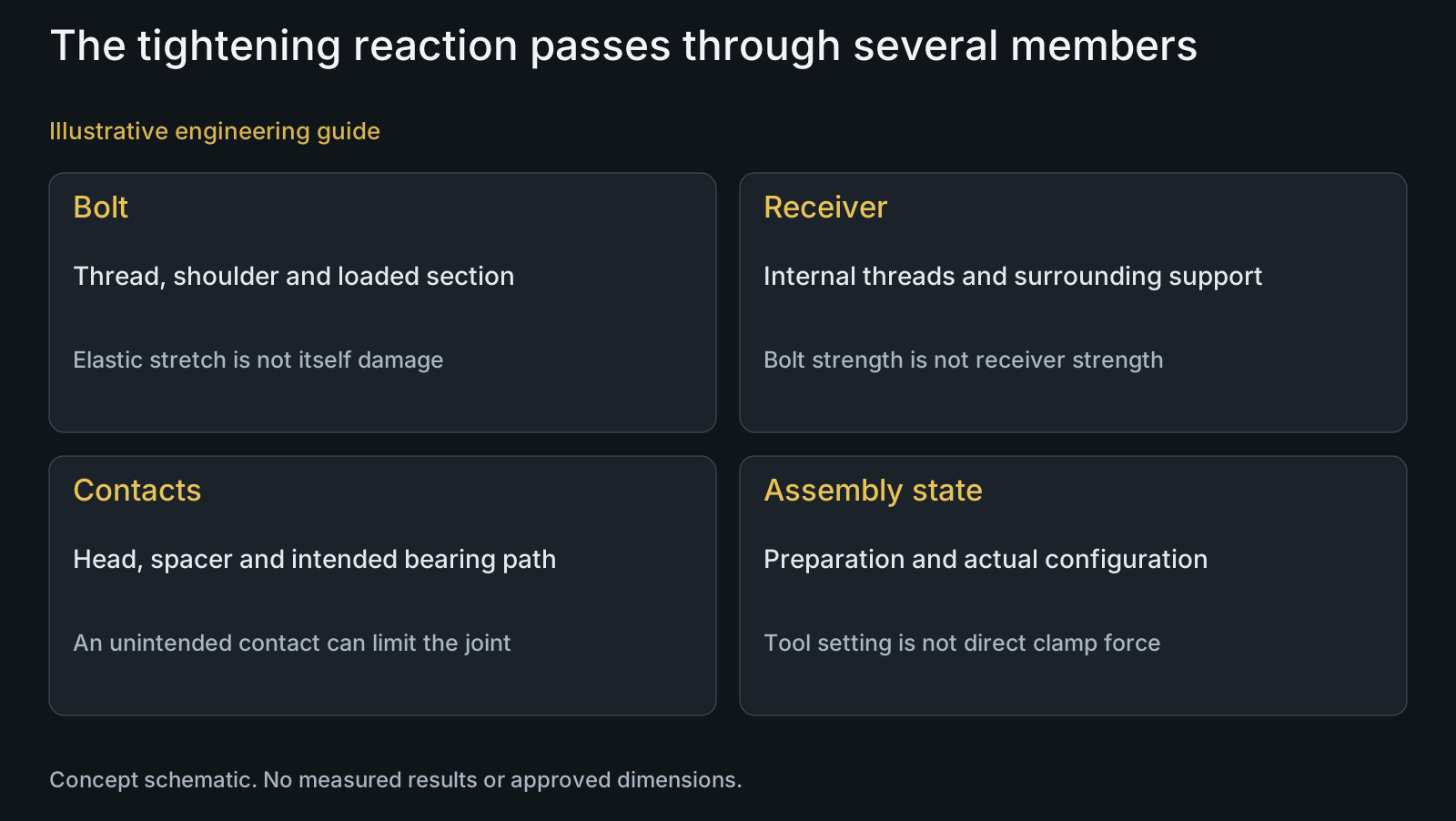
Trace the thread reaction through the receiver and the compressive path through the head, shoulder, spacers and intended bearing contacts. A shoulder may set an axial relationship rather than behave like an ordinary fully threaded bolt. The actual assembly view determines what is clamped and where an unintended contact can occur.
The limiting member can be an internal thread, a contact face or an incorrectly assembled stack rather than the bolt's tensile section. A high fastener strength does not establish equal capacity of a lightweight receiver. Engagement length, receiver material condition and wall/support geometry remain separate design inputs.
Use the pivot fit and tolerance-stack discussion to retain the actual interfaces. Do not solve a damaged or incorrect contact path by substituting a higher-strength bolt without reviewing the path that receives its load.
Distinguish normal elastic stretch from permanent change
Bolts normally extend elastically while generating clamping. The presence of bolt extension alone is not proof of damage. The concern is whether the specified assembly process or capacity was exceeded and permanent deformation or other unacceptable change occurred.
Nord-Lock's manufacturer discussion notes that exceeding a bolt's yield point starts permanent deformation and emphasizes tightening control. Its product-specific guidance is not an allowable margin for bicycle pivots. No percentage of yield or excess-torque allowance is transferred here.
Excessive tightening does not have one mandatory outcome. It may damage the bolt, strip receiver threads, deform a contact or reach another assembly limitation. The framework's claim that preload always falls after overtightening is therefore too broad: the retained state depends on the actual event and changed components, and requires its own evidence.
| Evidence or proposal | Useful conclusion | Unresolved risk | Assessment basis |
|---|---|---|---|
| Known excessive applied input | Departure from specified operation | Actual clamp state and damage location | Tool, units, preparation and joint definition |
| Possible bolt elongation | Feature requiring suitable examination | Normal elastic versus permanent change | Applicable feature and disposition method |
| Receiver thread anomaly | Mating thread needs assessment | A stronger bolt masks the weaker interface | Actual engagement, material and support |
| Changed contact or restricted motion | Assembly behavior differs | Cause not established by feel alone | Stack, shoulder and approved functional criteria |
| Later specified wrench reading | Present operation reaches setting | Earlier irreversible change not excluded | Event history and affected-member evidence |
| Replacement bolt installed | Fastener identity has changed | Original receiver and stack unexamined | Whole-joint service disposition |
Applied torque does not uniquely identify the overload
Nord-Lock's torque/preload explanation identifies friction in the threads and at the rotating contact. Consequently, a torque reading is not a direct reading of useful clamp force. A changed lubricant, coating or locking system can change the relationship even when the tool setting is unchanged.
Record the applicable setting and units, tool configuration, tightening operation and actual surface preparation. A wrong-unit input and an altered friction state are different departures. If an extension or adaptor was used, its arrangement is relevant to reconstructing the operation; do not invent a universal correction from tool appearance.
The cleaning and lubrication guide separates preparation by surface. If the specified state was changed, review that departure rather than assume the original number still describes the same assembly. Neither lower friction nor higher applied torque alone identifies which part was damaged.
A later reading cannot undo an earlier event
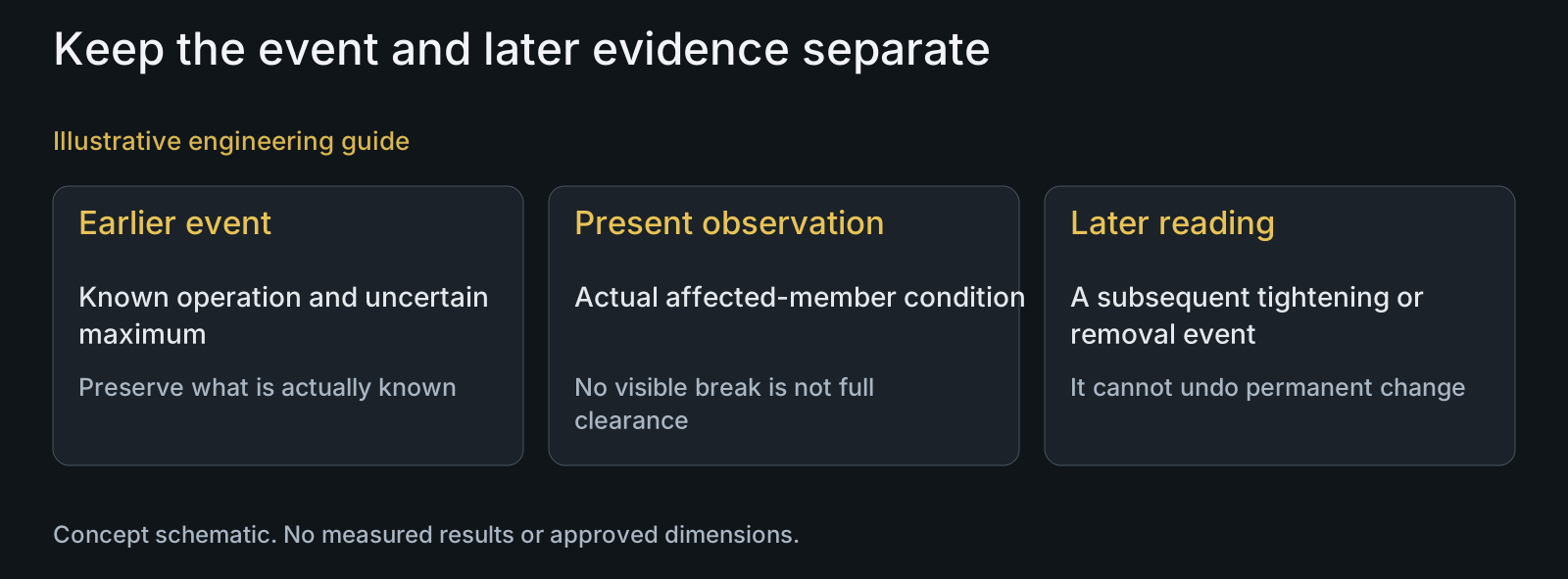
Distinguish the recorded tightening event from a subsequent check or removal reading. They can involve different movement, friction and locking conditions. Reaching a setting later does not restore a plastically changed thread or contact, and does not demonstrate that no such change occurred.
Preserve the known state before repeated interventions. Record which parts were turned, removed, replaced or cleaned and when. An uncertain maximum must remain uncertain; a technician's description of very tight is not a calibrated event measurement.
Use the destructive torque discussion to distinguish terminal test evidence from assembly instructions. Do not overload a suspect installed joint again to see whether it holds. A test on a spare with a strong laboratory nut cannot accept the original frame receiver.
Choose disposition for the affected joint, not an isolated spare
The responsible manufacturer or qualified service route should determine the necessary inspection and replacement scope. Include the receiver and intended contact stack, not just the part that is easiest to replace. Visible absence of a crack does not establish thread integrity or inaccessible contact condition.
Unusual restriction after tightening is a relevant observation, not proof of bearing damage or a basis to loosen the axle until movement feels satisfactory. Compare it with the applicable assembly method and approved functional criteria. Incorrect spacers or unintended ring/contact loading remain questions to investigate.
For an OEM manufacturing review, separate a design change from recovery of a damaged assembly. PremFixer can review drawing-defined hardware through CNC turning and specified surface treatment. That review does not authorize frame repair, certify a serviced bicycle or guarantee the condition of existing mating parts.
Review example: a new bolt and an unresolved receiver
Illustrative engineering example: assume a service report describes an excessive-tightening event in a lightweight receiver. The bolt is replaced and a later wrench reading matches the instruction, but the report contains no receiver or spacer-contact assessment. No actual damage, torque value or service outcome is asserted.
The reviewer identifies the missing conclusion: the new fastener and present input do not establish whether the earlier event changed the original mating parts. Receiver engagement and the clamped contacts remain within the disposition question even if the replacement bolt appears normal.
The appropriate route assesses those interfaces under the applicable requirements before release. If replacement hardware is needed, the RFQ retains the exact supplied configuration. The example supports a whole-joint evidence boundary, not an automatic assertion that every excessive reading causes every listed failure.
Questions buyers need to confirm
Can I simply loosen and retorque an overtightened pivot?
Not as clearance for the whole joint. A later setting does not exclude permanent or mating-part damage from the earlier event. Preserve the known conditions and follow the responsible manufacturer's inspection and disposition route before use.
Does any bolt stretch mean it has been ruined?
No. Elastic extension is part of generating clamp force. Permanent change and other unacceptable conditions are different questions. Use the applicable geometry, assembly requirements and assessment method; no universal visual elongation threshold is supplied here.
Is the receiver at risk even when the bolt did not break?
It may be. Receiver threads, support and contact geometry have their own limits. No visible bolt break accepts those features. Identify actual engagement, material condition and the affected stack for the appropriate assessment.
Will a stronger replacement bolt solve an overtightening problem?
Not by itself. It can leave the same limiting receiver or contact path unchanged. Review the complete design and released configuration; changing alloy or strength is not proof of compatibility or absence of prior damage.
Does difficult pivot movement prove that bearings were crushed?
No. Restriction is an observation, not a unique diagnosis. Compare the intended stack, shoulder contacts, bearing arrangement and permitted functional criteria. Do not loosen the assembly to a comfortable feel and treat that as an approved tightening method.
What should an OEM send after a suspected excessive-tightening event?
Provide the bolt and receiver drawings, assembly/BOM, supplied finishes and preparation, applicable instruction and known tool/units/operation. Include observed changes and later interventions. Keep uncertain event values explicitly uncertain and request the appropriate whole-joint assessment.
Technical references and scope
Nord-Lock: Can I Yield My Bolt by Over-Tightening?. Manufacturer describes permanent deformation beyond yield and tightening control. Product-specific percentages and wedge-lock performance are not applied to bicycle pivots.
Nord-Lock: Relationship Between Torque, Preload and Friction. Thread and rotating-contact friction affect torque/preload relationship. No numerical friction split, scatter or generic lubrication correction transferred.
Explore related component, material and sourcing decisions in the customer decision knowledge center. For a drawing review, use the Drawing/BOM RFQ path.
Review the complete pivot configuration and supplied hardware
Share bolt and receiver drawings or STEP, BOM, spacer/bearing contacts and the released assembly instruction. Include the known tightening event, preparation and subsequent changes. PremFixer can review drawing-based hardware manufacture and interface questions; inspection, repair and service release of an affected bicycle remain with its responsible manufacturer or qualified service route.
Discuss the drawing and BOM