
Do not approve WD-40, isopropyl alcohol or a bike cleaner for every pivot from its name alone. Identify the exact formulation and whether the task is exterior washing, cleaning a removed component or preparing a threaded assembly. The product may contact paint, seals, polymer parts and supplied treatments as well as the bolt's metal. It must also leave the condition required for the next assembly operation. A chemical can remove grime without being an approved bearing lubricant or thread-preparation method. Follow the applicable bicycle and chemical instructions; if compatibility or the required residual state is unresolved, retain the released method rather than experiment on the installed joint.
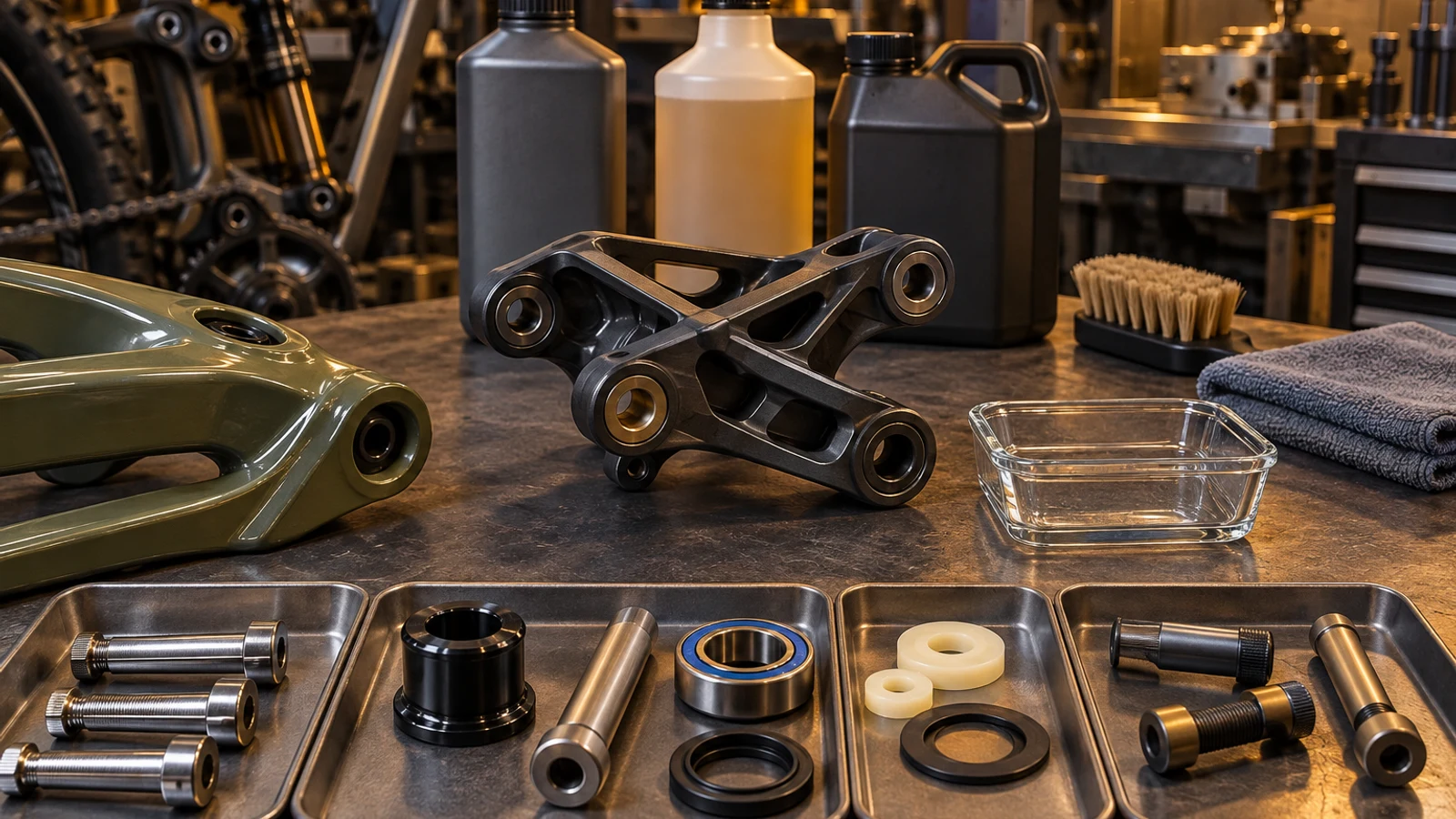
Hero: concept illustration of example hardware and its application. It is not a factory photograph, tested component or approved production geometry.
Replace a brand-only request with an exact product definition
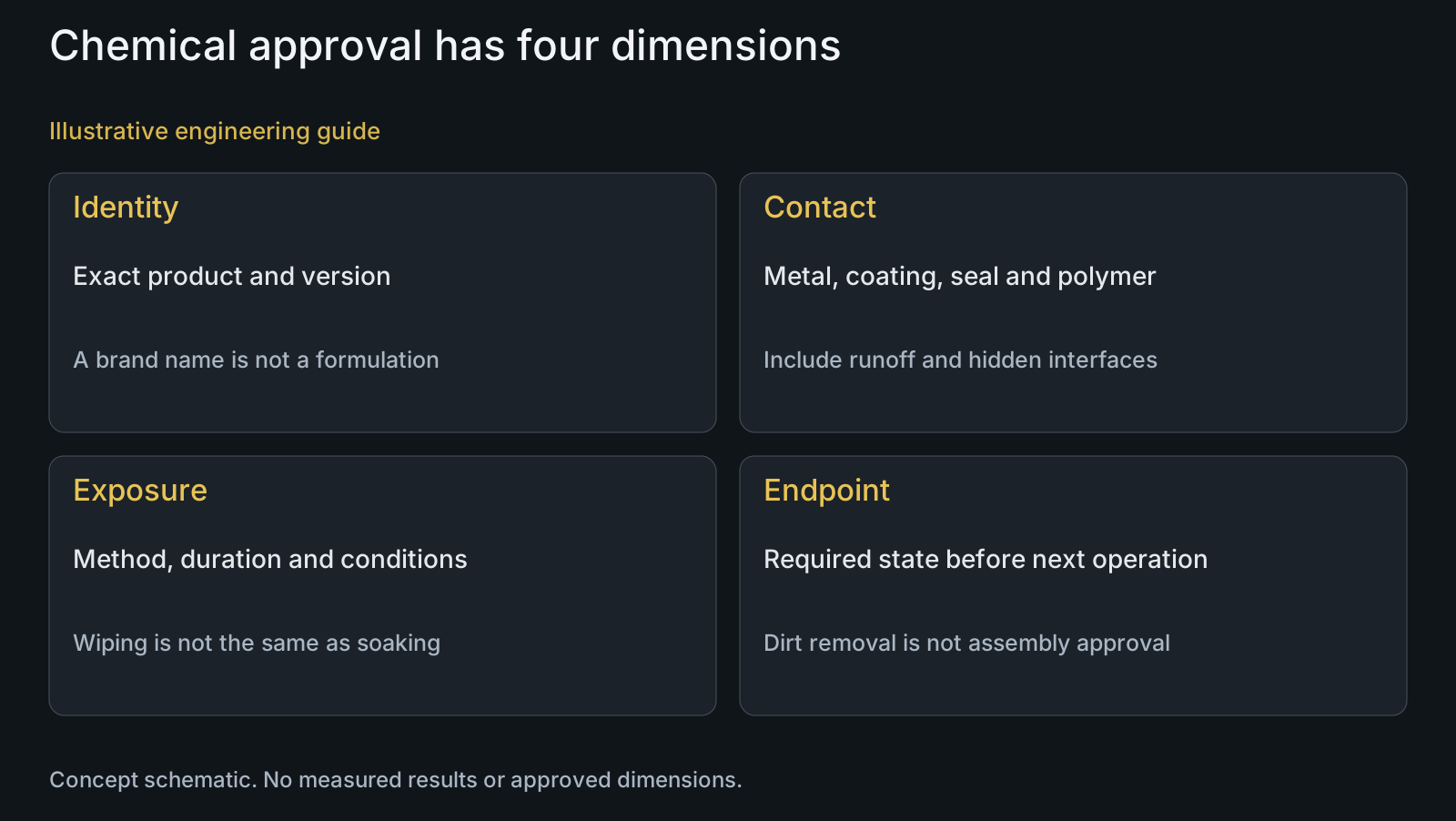
Record the full product name, supplier, formulation or market version and applicable technical information. A multi-use spray, degreaser and specialized lubricant can share a brand while serving different functions. The question is which particular product is proposed for which operation.
WD-40's Multi-Use Product page lists broad material uses but specifically excludes polycarbonate and clear polystyrene. That is useful evidence of product-specific limits, not a guarantee for every bicycle seal, coating or locking treatment. Do not extend this page to every product sold under the same brand.
Safety information describes handling hazards; it does not alone establish component compatibility or the surface condition needed for assembly. Keep safety requirements, technical suitability and OEM service permission as separate questions. A familiar workshop can is not a complete process specification.
Compare the chemical's complete contact area
An installed pivot exposes more than a bolt head. Application, overspray, runoff and retained liquid can reach frame paint, bearing seals, washers and shielded interfaces. The proposed method needs to identify those paths rather than review only the visibly dirty surface.
For a removed part, retain its actual finish and supplied treatments in the definition. Bare stainless, anodized aluminum and a coated thread are different surfaces even when the loose hardware looks similarly metallic. Specified surface-treatment review should identify treatment zones and handling constraints.
Exposure also has concentration, duration and temperature conditions. Wiping a permitted exterior area is not equivalent to soaking a treated part or spraying an assembled bearing. Resolve the intended application before relying on a material table that represents a different contact condition.
| Claim or proposal | What it can address | What remains unresolved | Required comparison |
|---|---|---|---|
| Named multi-use spray | Stated product uses and exclusions | Whole-joint compatibility and preparation endpoint | Exact formulation, materials and service method |
| Alcohol for bare stainless | Relevant metal-cleaning task | Paint, seals and supplied treatments | Actual exposure and component permissions |
| Bike-specific cleaner | Its own named application instructions | Every hidden interface and locking product | Scope, dilution and contacted assembly |
| Acid or bleach removes stubborn marks | Observed cleaning ability only | Stainless corrosion hazard and part integrity | Avoid routine adoption; assess affected part |
| No visible mark in a spot check | Limited cosmetic observation | Seal function or thread retention | Represented materials and relevant acceptance |
| One spray for all maintenance | Workshop convenience | Different cleaning and lubrication endpoints | Separate each operation and released state |
Treat stainless chemical hazards without inventing a safe alternative
BSSA's cleaning guidance warns that hydrochloric-acid cleaning agents and hypochlorite bleach can cause stainless surface staining and pitting. Do not adopt these as routine pivot cleaners. That warning supports avoiding a hazard; it does not establish the cause or severity of damage on an individual component.
The same guidance lists solvents including isopropyl alcohol for grease marks on stainless surfaces. Its scope is not a compatibility release for an assembled bicycle. The original stainless-care recommendation must not become an instruction to spray alcohol across paint, seals or a functional patch.
The stainless pivot cleaning guide addresses metal care and observed stains. This article's decision is broader chemical approval: exact product, contacted materials, application conditions and resulting assembly state. No generic acid concentration or soaking time is prescribed.
Specify what the cleaning operation must leave behind
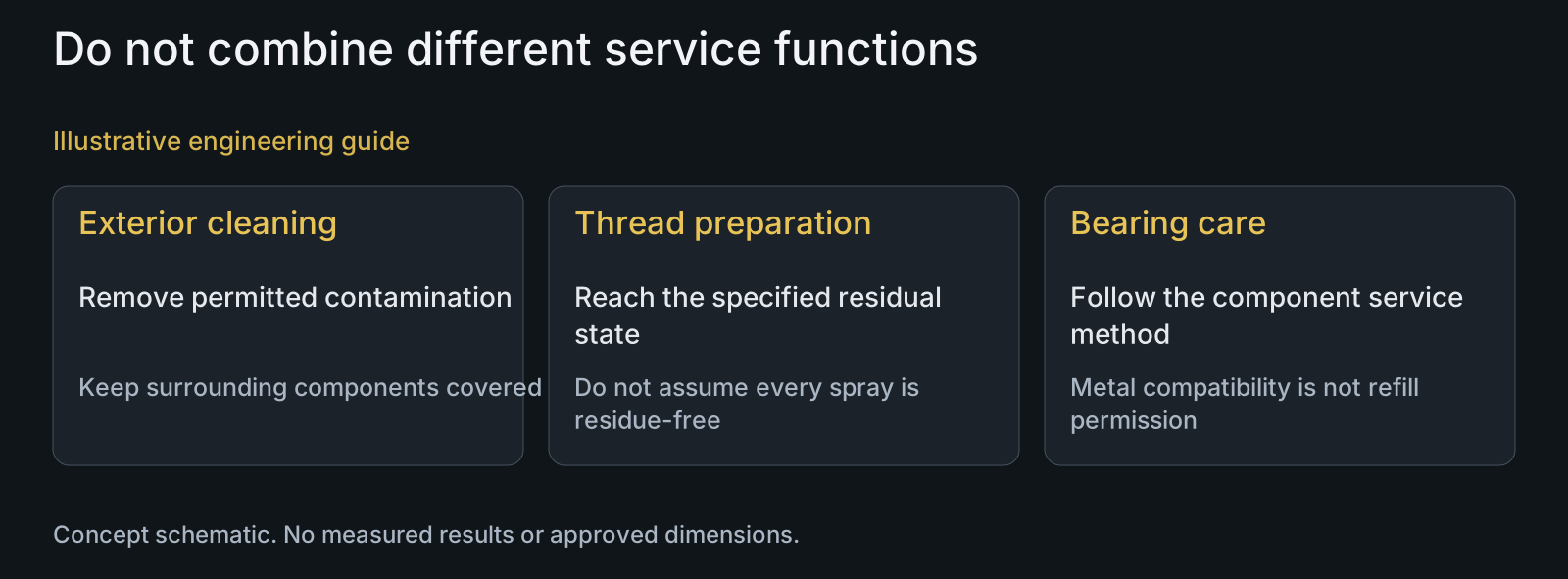
Define the endpoint before choosing a product. Exterior care may aim to remove contamination while preserving the installed system. Thread preparation may instead need a particular clean, dry or treated condition. Restoring a shaft's permitted lubrication is another task, not proof that thread preparation is complete.
A product marketed to clean, lubricate or protect should not be assumed to provide residue-free preparation for every adhesive. Conversely, removing every visible film can remove a deliberately supplied functional treatment. Ask which material should be removed and which should remain.
The surface-specific care article separates shaft and threaded-end requirements. Use its contact-map approach with the released assembly instruction. Do not correct an uncertain residual condition through a guessed torque adjustment or additional threadlocker.
Use compatibility evidence at the right scale
A cosmetic spot check can show a visible surface reaction under its limited conditions. It cannot demonstrate hidden seal function, long-term material behavior or the performance of a locking interface. Do not make an installed structural assembly the experiment when the permitted method is unknown.
For an OEM proposal, identify the actual parts and products represented by any trial. State application conditions, relevant acceptance features and post-cleaning preparation. A test on an uncoated coupon cannot silently accept an anodized or patched production part.
Separate an observed change from a causal conclusion. If a surface becomes discolored after service, preserve product identity, contact history and affected location for assessment. A cleaner comparison should not claim that all discoloration proves passivation failure or that a clean-looking part is fit to reuse.
Review example: one spray, three different tasks
Illustrative engineering example: assume an OEM receives a proposal to use one multi-purpose spray for exterior dirt, removed threaded components and a sealed bearing. The product's available page addresses general material uses; no assembled-pivot trial or adhesive compatibility result is supplied.
The reviewer splits the proposal. Exterior contact requires the actual neighboring-material and care permissions. The removed thread requires its defined preparation endpoint. The sealed bearing requires its own component service decision; exterior material compatibility cannot establish permission to alter its contents.
The proposal therefore cannot be approved as one universal operation. The team retains applicable released methods and requests evidence for each intended change. This example demonstrates a scope mismatch without alleging damage from a named product or inventing a successful cleaning test.
Questions buyers need to confirm
Can WD-40 be used to clean a pivot bolt?
Only within the actual product and component instructions. Identify which WD-40 product, surfaces and cleaning task are intended. The cited Multi-Use page has material exclusions; it does not release every pivot, seal, coating or locking preparation.
Is isopropyl alcohol always safer for pivot cleaning?
No universal comparison is supported. BSSA lists it for a stainless cleaning task, not the complete bicycle. Confirm actual finish, seal and neighboring-material compatibility plus the required residual state. Do not spray an assembled pivot based on bare-metal suitability.
Should bleach or hydrochloric-acid cleaner be used for stubborn stains?
Do not adopt them as routine stainless pivot cleaners. BSSA identifies staining and pitting hazards. A persistent mark needs the permitted care or condition assessment, not stronger chemistry or a borrowed soaking method.
Does bike-specific labeling approve a cleaner for every pivot?
No. Use the exact product's stated application and the component's care method. Contacted seals, coatings, patches and hidden surfaces may differ. Record dilution, application conditions and the next operation rather than rely on the category name.
Does no visible damage in a spot check prove compatibility?
It proves only that limited observation. Hidden seal behavior or threadlocking performance is not established by unchanged appearance. An OEM review needs evidence representing the actual materials, exposure and relevant acceptance features.
What should a cleaner-compatibility review include?
Send the exact product information, hardware finish/treatment zones, neighboring materials, proposed application conditions and required post-cleaning state. Include current component instructions and any observed changes separately. These inputs define what approval is missing without inventing a universal solvent rule.
Technical references and scope
WD-40: What Multi-Use Product Is Safe On and What to Avoid. Exact product's material-use scope and polycarbonate/clear-polystyrene exclusions. Broad marketing statements not extended to pivot systems, seals or adhesive preparation.
BSSA: Cleaning Methods for Stainless Steel. Stainless hazards from hydrochloric-acid cleaners and hypochlorite; solvent listing limited to bare-metal cleaning scope. Household concentrations, chemical repair and cosmetic polishing methods not transferred.
Explore related component, material and sourcing decisions in the customer decision knowledge center. For a drawing review, use the Drawing/BOM RFQ path.
Define the cleaning endpoint with the supplied hardware state
Share drawings or STEP, BOM, material and finish definitions, treatment zones and the existing care instruction. Add the exact proposed cleaner, contacted materials and intended application and reassembly state. PremFixer can review the supplied custom-hardware requirements; chemical and component compatibility need the responsible product and OEM approval.
Discuss the drawing and BOM