

A pivot bolt cost breakdown becomes useful when it explains what changes the quoted work. The buyer is deciding whether a different quantity, production pattern or approved design will change the price without losing required deliverables. Classify material, preparation, machining, treatment, inspection and packaging by their actual triggers: per component, per lot, per configuration or per delivery. Do not assign universal cost percentages. A setup charge can be hidden inside a unit price, and a repeated shipment need not mean repeated manufacture. First hold the finished kit constant, then ask which activities genuinely change. The answer identifies a credible cost discussion without inventing the supplier's confidential accounts.
Hero: concept illustration of example hardware and its application. It is not a factory photograph, tested component or approved production geometry.
Distinguish the work from the way it is charged
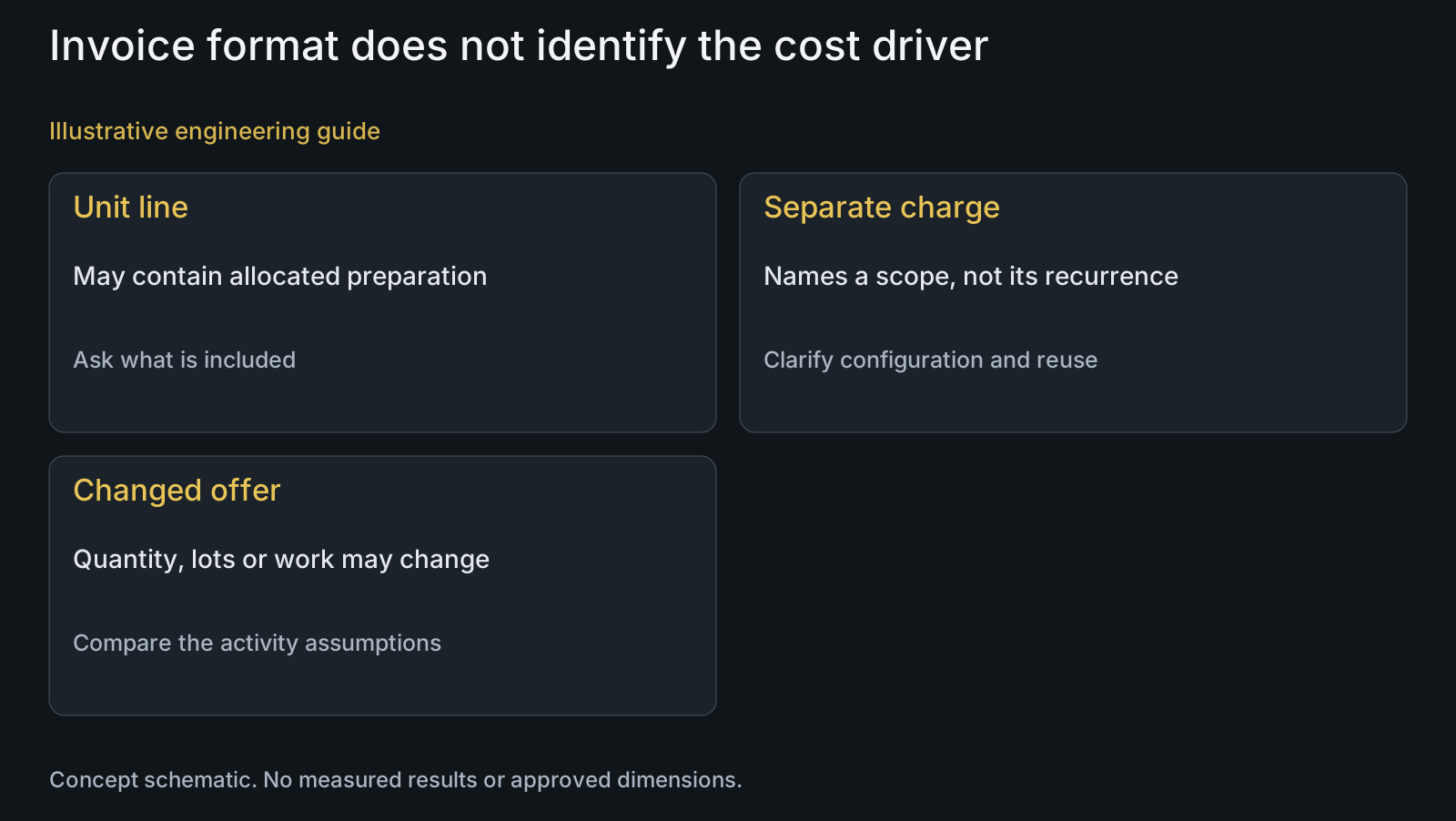
A quotation can present one unit price or several preparation and production lines. Neither format proves the underlying activity pattern. Ask whether a listed charge covers programming, a fixture, a production setup or a particular evidence package; those objects can have different repeat-order consequences.
A useful explanation need not disclose every internal rate or margin. It should identify the quoted output and assumptions well enough to explain a changed offer. Do not estimate a supplier's actual profit by subtracting guessed stock and cycle-time costs from its price.
The existing cost comparison guide establishes equivalent deliverables. This article goes further into cost response: what triggers additional work when quantities, batches or revisions change. The negotiation guide handles the resulting commercial exchange.
Ask which costs follow components and which follow lots
Material consumption and repeated machining relate to the components produced, but purchased stock may have availability and procurement boundaries. A finished axle's mass does not establish the required purchased quantity. Confirm grade, stock form, condition and the proposed production quantity through Materials.
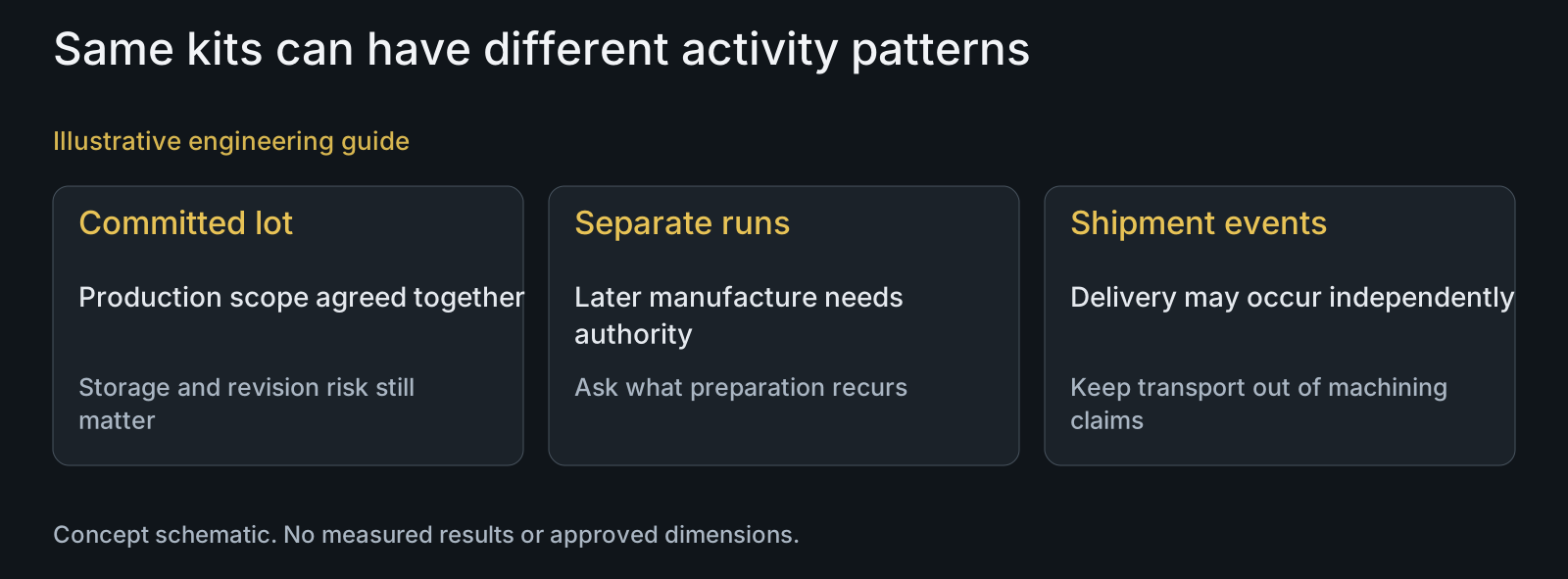
Preparation and batch work may depend on how production is organized. One firm manufacturing lot with staged shipments is not the same assumption as several independently authorized runs. Ask which activities recur in each option rather than divide all named charges by the annual forecast.
Finishing can also combine component-related work with a lot boundary. Keep the treatment, protected areas and final acceptance fixed when asking for alternatives. A lower charge obtained by omitting a required functional surface condition is a different component, not merely improved allocation.
| Cost area | Potential trigger | Misleading allocation | Useful verification |
|---|---|---|---|
| Stock purchase | Grade, form, procurement and produced quantity | Finished weight treated as purchased stock | Quoted stock and quantity assumption |
| Programming or fixture | Applicable configuration and route | Every repeat assumed entirely new | Reuse scope and change trigger |
| Production setup | Authorized manufacturing runs | Annual forecast treated as one run | Lot pattern represented by offer |
| Machining | Required features on produced components | Cycle time treated as complete price | Included operations and secondary access |
| Treatment and evidence | Final condition and lot/coverage scope | Required work silently removed | Treatment areas and represented checks |
| Packaging and delivery | Kit contents and shipment events | Lower freight called machining saving | Protection and delivery boundary |
Model alternatives without pretending to know the factory accounts
Use a simple activity map before any spreadsheet formula. Name the fixed scope, proposed quantity, production lots and deliveries. Ask the supplier to identify which included activities change and whether any assumptions remain unresolved. This is a review structure, not a reconstruction of internal costing.
For a clearly labeled comparison, total offered scope can be grouped into preparation, lot-related work, component-related work and delivery-related work. Avoid counting a separately listed setup again if the unit offer already includes it. Clarify inclusion rather than assume the supplier charged twice.
Unit-price dilution is meaningful only for a committed quantity represented by that offer. A lower calculated allocation over a larger forecast does not create production authority, free storage or protection against revision obsolescence. The separate supply arrangement must identify those responsibilities.
Locate the design feature behind extra manufacturing work
A feature can require a second holding position, additional access, a different stock size or a special measurement arrangement. Ask which feature creates the extra activity. 'Complex part' is too broad to evaluate a design alternative; the reviewer needs the affected geometry and its functional role.
Discuss proposals through CNC turning and the DFM/DFA review. A simplified drive or consolidated feature can change manufacturing and assembly differently. Quote the proposed definition separately until engineering has accepted its effect on the interface.
An unchanged nominal diameter does not guarantee unchanged cost after a revision. Final treatment, inspection coverage, marking and packaging can change work independently of the model. Conversely, an administrative drawing update need not imply new tooling if the actual manufacturing definition remains valid.
Keep delivery allocation outside the machining conclusion
ICC describes Incoterms 2020 as rules allocating costs, risks and obligations between trading parties. That public explanation supports keeping the delivery boundary explicit. It does not turn a shipping charge into machining cost or establish a particular PremFixer trade term.
Compare currency, quoted place and rule where applicable, included transport and separate shipment events. A consolidated shipment can alter a delivery-related offer without changing the work needed to machine each axle. Avoid describing every lower delivered total as a manufacturing efficiency gain.
The result should identify the source of the difference: changed physical activity, different allocation, removed scope or changed commercial responsibility. Several can coexist. Ask for clarification at that level before judging either quality or value from the lowest visible line.
Review example: one quantity, two production patterns
Illustrative engineering example: assume the same defined pivot kit is requested either as one committed production lot with staged delivery or as two separately authorized runs. No actual prices, setup counts or stock arrangement are assumed.
The buyer first checks whether preparation, treatment and evidence recur between runs. They then identify delivery events and any storage responsibility in the consolidated option. A unit-price difference cannot yet be attributed solely to material or machine time because the activity pattern differs.
If the supplier confirms an included charge is shared across the consolidated lot, the buyer can compare that stated offer while evaluating inventory exposure separately. If no activity difference is established, they seek a commercial explanation. The example does not prove that consolidation saves money; it shows which assumptions must explain the difference.
Questions buyers need to confirm
Are material and machining shares fixed for pivot bolts?
No. Their proportions depend on the part, route, produced quantity and included work. Use project-specific offers rather than assign the unverified percentage ranges from a general framework.
Does a separate setup line mean it repeats on every order?
Not necessarily. Clarify the covered configuration, route and manufacturing event. A reusable fixture and a new production setup are different activities, so the charge description and reuse agreement matter.
Can we spread preparation across an annual forecast?
Only as a labeled planning assumption, not an accepted price or production commitment. Ask which firm quantity the offer represents and who carries stock and revision exposure. Forecast dilution cannot authorize manufacture.
Is a unit price with no tooling line more competitive?
Not on that fact alone. It may include preparation within the unit offer. Compare complete delivered scope and repeated-order assumptions, checking that a separately listed charge is not counted again in your comparison.
Which drawing fields can change the cost response?
Geometry requiring new access or holding, stock size, final treatment zones, inspection coverage and marking can change activities. Identify the affected field and quote any design alternative separately from the accepted baseline.
Does a lower delivered total prove lower machining cost?
No. Transport, packaging, shipment grouping or trade responsibilities may explain the difference. Keep the production scope fixed and identify the delivery boundary before attributing the change to manufacturing.
Technical references and scope
ICC Incoterms 2020 public explanation. Allocation of trading costs, risks and obligations; no manufacturing cost rates, contractual advice or chosen PremFixer term inferred.
Explore related component, material and sourcing decisions in the customer decision knowledge center. For a drawing review, use the Drawing/BOM RFQ path.
Ask for quantity alternatives on an explicit activity basis
Send drawings, STEP, BOM revisions, final material and finish, required evidence, kit packaging and firm versus forecast quantities through the Drawing/BOM RFQ path. Include proposed production and shipment patterns so PremFixer can explain the activities and assumptions behind a comparable manufacturing offer.
Discuss the drawing and BOM