

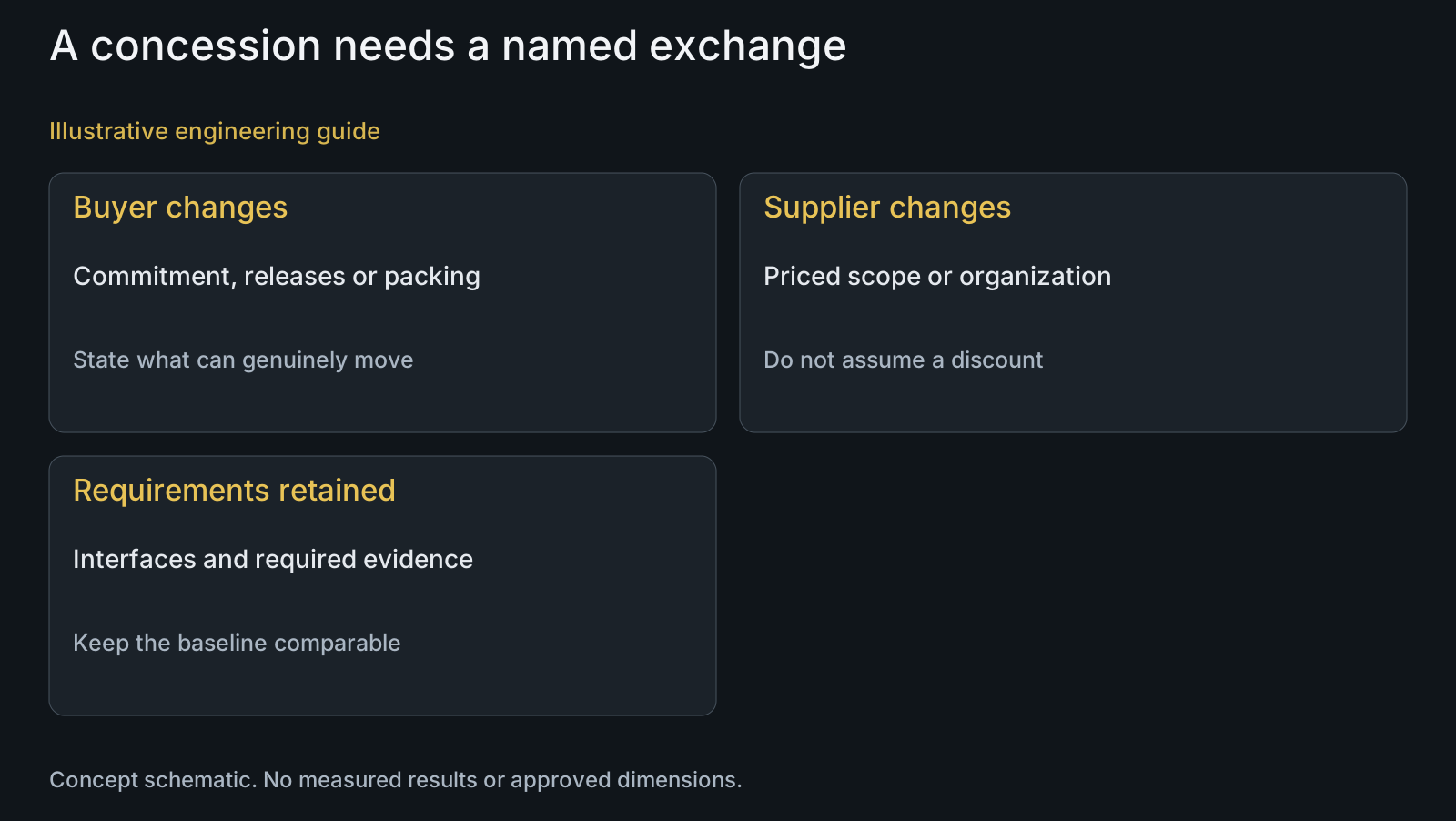
An OEM can negotiate custom pivot hardware prices by making ten specific exchanges visible: quantity certainty, batch organization, stock responsibility, tooling, design alternatives, material procurement, finishing, inspection, packing and commercial timing. The answer is not to ask for every line to be cheaper. State what the buyer can genuinely change, what the supplier would change in return and which interface or evidence requirements stay fixed. Price an alternative definition separately from the original drawing. This prevents a lower offer from concealing omitted work or transferred responsibility. No discount, credit policy or stocking arrangement is assumed here; every proposed exchange needs an actual project offer.
Points 1 and 2: exchange demand certainty and batch organization
Point 1 concerns firm quantity versus forecast. Identify the quantity the buyer can actually commit and the scope that remains indicative. A forecast can inform planning, but it is not an authorized purchase or a guarantee that the same revision will remain usable. State how any requested pricing basis treats that distinction.
Point 2 concerns production organization. Ask whether combining compatible releases into a defined run changes repeat preparation or external process handling. Similar part names do not establish a common setup, material or finishing route. Specify the candidate group instead of demanding an unspecified volume concession.
The quantity-tier comparison tests additional commitment against usable kit demand. Keep that test beside the negotiation sheet: ordering extra axles is not a useful concession if the matching members cannot support the intended assemblies.
Points 3 and 4: name stock responsibility and tooling rights
Point 3 addresses releases and stock. Separate shipment timing from when pieces are manufactured, owned or paid for. If a proposal involves held stock, identify quantity, revision, release conditions and treatment of a changed requirement. Moving inventory physically does not necessarily reduce the buyer's exposure.
Point 4 addresses tooling and dedicated preparation. Ask what the charge covers, whether it is recurring and what use or ownership rights are actually offered. A separate tooling line and an amortized piece price are allocation choices; neither alone proves who owns a tool or who can use it elsewhere.
Record these as commercial exchanges rather than claimed manufacturing savings. The cost-trigger breakdown distinguishes the work that causes a charge from the way it is invoiced. Do not count a charge moved into another line as work removed.
| Negotiation point | Explicit exchange | Hidden risk | Confirmation |
|---|---|---|---|
| 1. Quantity certainty | Firm commitment versus forecast | Indicative demand treated as an order | Quantity and commitment basis |
| 2. Batch organization | Compatible work grouped into a run | Unrelated process routes aggregated | Actual grouping and preparation scope |
| 3. Releases and stock | Timing and responsibility change | Held stock assumed risk-free | Ownership, revision and release terms |
| 4. Tooling | Charge allocation and use rights | Payment mistaken for ownership | Offered scope and rights |
| 5. DFM alternative | Approved feature change | Functional work silently omitted | Separate drawing and approval |
| 6. Material procurement | Defined grade and sourcing basis | Specification substituted for cost | Grade, condition and evidence |
| 7. Finishing | Zones and appearance scope | Functional masking lost | Treatment and post-process checks |
| 8. Inspection evidence | Reporting duplication removed | Required measurement removed | Acceptance and evidence mapping |
| 9. Packing and logistics | Protection, grouping and delivery | Work transferred without pricing | Pack unit and delivery basis |
| 10. Commercial timing | Payment and review events | Undefined future adjustment | Written milestones and conditions |
Points 5 and 6: keep design and material alternatives identifiable
Point 5 concerns a DFM alternative. Define the proposed feature change, the work it may remove and any assembly or inspection work it may add. Keep the drawing-compliant offer visible until the engineering owner accepts an alternative. A buyer cannot approve a bearing interface change merely by accepting a cheaper quote.
Point 6 concerns material procurement. Clarify the required grade, product condition, traceability and acceptable sourcing arrangement before comparing alternatives. A substitute material is an engineering option, not a routine price concession. Changing the stock purchase arrangement is different from changing the material specification.
Use CNC design-cost review for transferred-work analysis and material cost comparison for equal-function evaluation. Neither route supplies universal savings or a blanket substitution permission.
Points 7 and 8: negotiate finishing and evidence without hidden omissions
Point 7 addresses finishing scope. Identify treated and excluded zones, cosmetic expectations and required post-treatment checks. If an appearance-only requirement changes, specify its separate effect. Do not remove a functional masking boundary because the coating name remains the same in both offers.
Point 8 addresses inspection organization. Distinguish duplicated reporting from necessary measurement. Ask whether one agreed evidence set can satisfy named recipients, but retain checks required by the specification or acceptance plan. Removing a duplicate document is not equivalent to removing a measurement or its traceable result.
The finishing route comparison helps identify what the quoted treatment actually includes. PremFixer coordinates the project manufacturing scope through manufacturing; required external process or test evidence must remain explicit rather than assumed to be in-house.
Points 9 and 10: price delivery and payment exchanges transparently
Point 9 concerns packing and logistics. Define protection, kit grouping, labels and the delivery basis. ICC's public Incoterms material explains that named rules allocate relevant delivery responsibilities, costs and risk; it does not make two manufacturing quotations identical. Read the offer's named rule and location together with the packing definition.
Point 10 concerns payment timing and price-review conditions. State the proposed milestones and what event permits a review, rather than accepting a vague promise to revisit prices. The US International Trade Administration describes advance payment as shifting payment exposure and affecting buyer cash use. That general tradeoff is not a PremFixer payment policy.
Document who may accept each proposal and keep actual terms in the project offer. This article is a procurement review tool, not advice on credit approval, legal enforceability or a preferred financing method. No numerical discount or bank arrangement follows from the example.
Review example: a lower total conceals two different exchanges
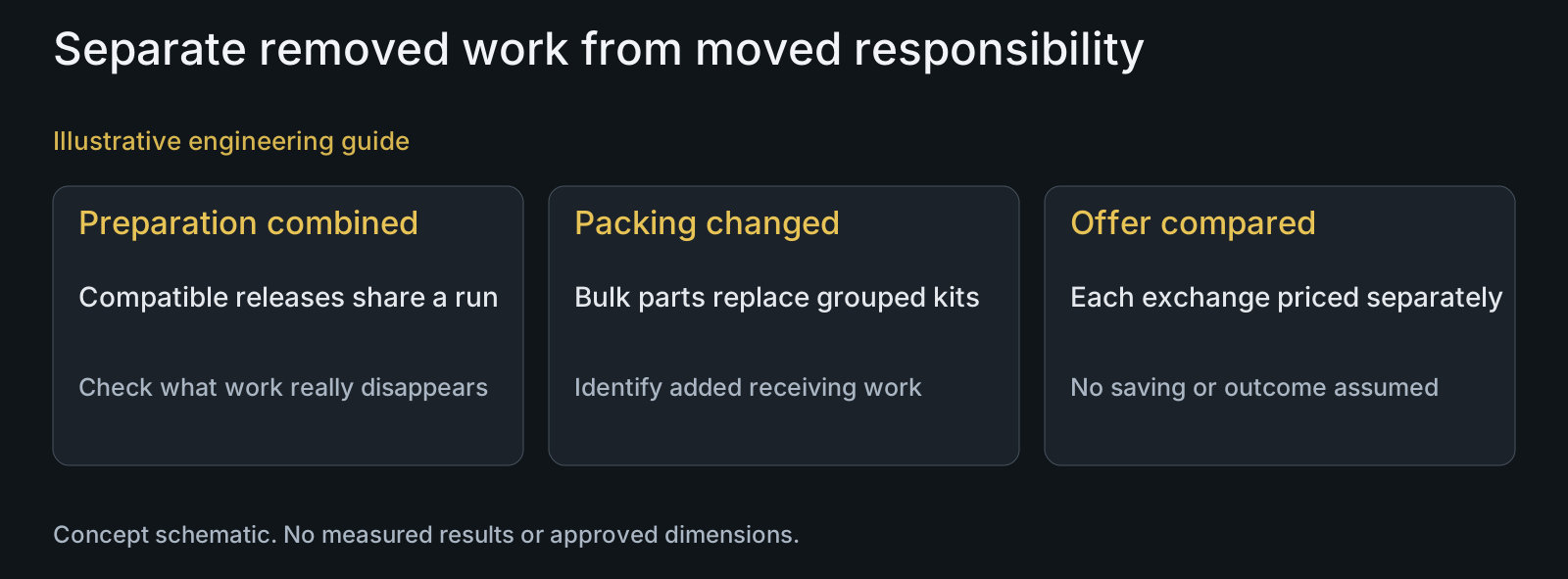
Illustrative engineering example: assume an OEM compares its original pivot-kit offer with a proposed lower total. The alternative combines releases into one run and replaces kit grouping with bulk component packing. The interface, material and required inspection remain unchanged. No actual customer, prices or savings are assumed.
The buyer records the two exchanges separately. A single run may alter repeated preparation, while bulk packing transfers kit identification and grouping to the receiving team. They ask whether that team's added work and error exposure are acceptable instead of labelling both changes a pure factory efficiency saving.
The result is a decision worksheet: accept, reject or request separate pricing for each exchange while retaining the original offer. No outcome is claimed. The example shows how a transparent lower quote can still require a different operational choice, even when the manufactured geometry is unchanged.
Questions buyers need to confirm
Can annual forecast volume justify a negotiated unit price?
It can be discussed as a planning input, but identify its uncertainty and the actual committed quantity. Ask whether the offer requires a firm purchase, compatible releases or another defined arrangement; do not present a forecast as an order.
Should we ask for tooling to be free?
First identify the dedicated work and the offered rights. Removing a separate invoice line may move the charge into pieces rather than eliminate it. Tool ownership, access and reuse conditions need their own stated terms.
Which design concessions can purchasing accept alone?
Do not treat an engineering change as a purchasing-only concession. Identify the affected feature, interface and acceptance requirement, then obtain the relevant design decision before selecting the alternate manufactured definition.
Can duplicate inspection reports be removed?
Possibly, if one agreed evidence set meets the named recipients' requirements. Map recipients and required results first. A duplicated report can be redundant while the underlying measurement and traceability remain necessary.
Does simpler packaging always lower total project cost?
No. It may transfer grouping, protection or identification work to the receiving operation. Compare those tasks and their risks with the stated offer rather than infer a project saving from the supplier's packing line.
What should a negotiation RFQ include?
Supply the baseline drawing and BOM, required evidence and delivery definition, then list each proposed exchange with its authorized boundary. Label firm quantities, forecasts, design alternatives and commercial proposals separately so the offer remains comparable.
Technical references and scope
ICC public Incoterms 2020 overview. Delivery obligation, cost and risk allocation context; no proprietary rule wording or negotiated contract interpretation.
International Trade Administration: cash in advance. General payment exposure and buyer cash-use tradeoff only; no company credit terms or financial recommendation.
Explore related component, material and sourcing decisions in the customer decision knowledge center. For a drawing review, use the Drawing/BOM RFQ path.
Request a comparable baseline and explicit alternatives
Send drawings, STEP, BOM, grade and finish, required evidence, firm and forecast quantities, release plans and the specific proposed exchanges through the Drawing/BOM RFQ path. PremFixer can review which alternatives alter manufacturing scope and which need a separate project decision.
Discuss the drawing and BOM