

Define a pivot bolt material-price adjustment around the part of the agreed price that the selected reference is intended to represent. Identify the material form and configuration, then specify comparison periods, data version, calculation and affected releases. A raw-material movement does not automatically reprice machining, treatment, packing or the entire kit. A fixed-price proposal also needs a quantity, duration and stated exceptions; it cannot silently cover unlimited future demand or changed drawings. Agree how decreases, thresholds and missing data are handled before relying on the mechanism. No standard PremFixer quarterly lock or universal percentage trigger is established here; binding commercial terms need qualified review.
Hero: concept illustration of example hardware and its application. It is not a factory photograph, tested component or approved production geometry.
Identify the price boundary before choosing a reference
State the quoted unit: one bolt, a finished component or a complete kit. Identify the drawing revision, material condition, treatment and included work. A material reference cannot reconcile two offers that already cover different supplied scopes.
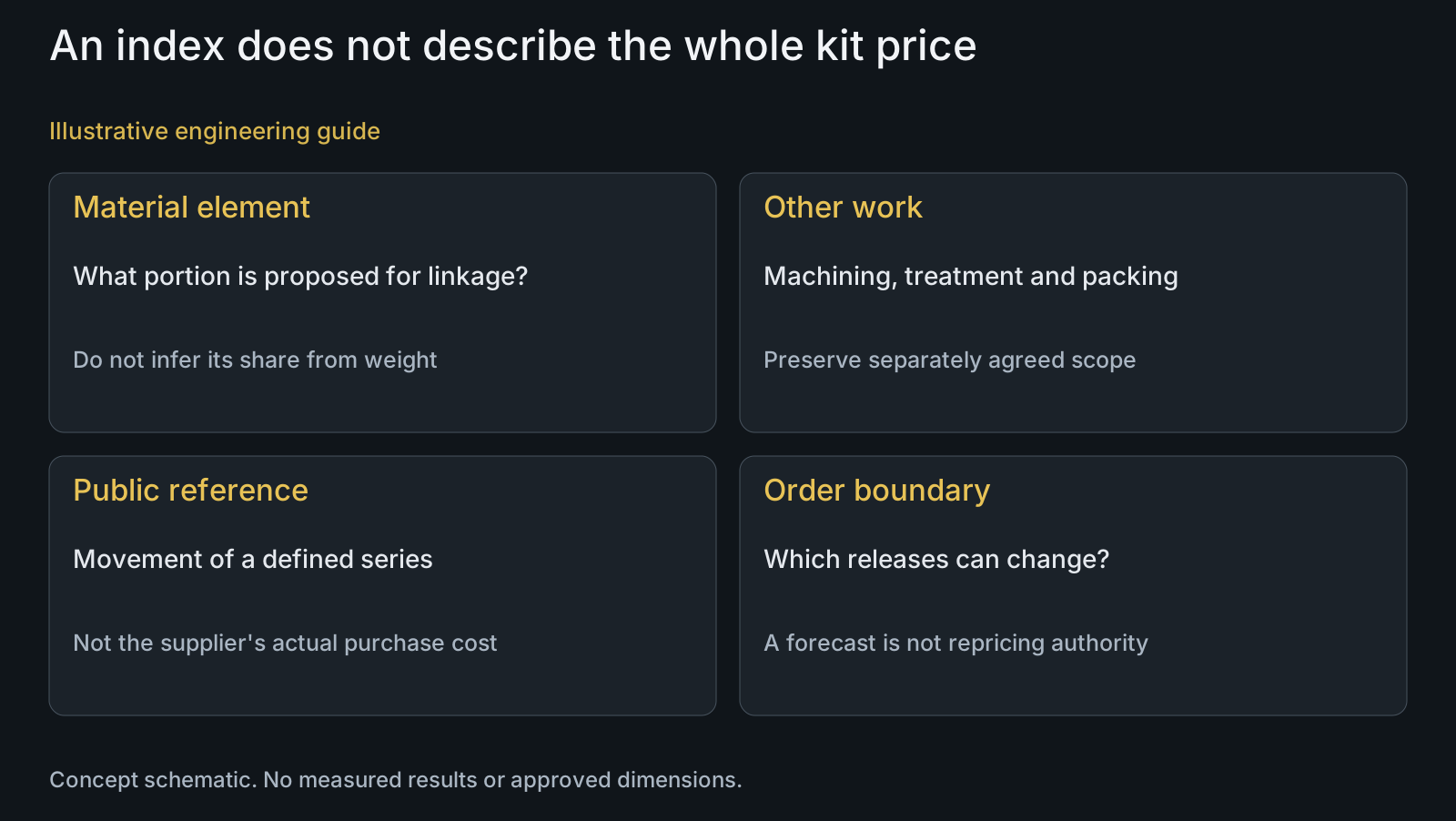
Separate the portion proposed for index adjustment from the portion proposed to remain unchanged. A kit containing steel bolts and aluminium sleeves does not necessarily have one material exposure. Any allocation is an agreed commercial input, not a share that can be inferred from the photograph or total component weight.
The price-negotiation guide examines alternatives that can change an offer. This article preserves the selected scope while clarifying an ongoing adjustment mechanism. It does not establish actual cost shares, profit margins or a buyer's right to demand confidential costing.
Check what the index represents and what it does not
BLS's PPI price-adjustment guide explains that PPI measures average selling-price movements, not directly a producer's cost. Its guidance also distinguishes selected series and partial-price adjustments. A public reference therefore needs an agreed scope; it is not proof of PremFixer's actual material purchase price.
For the proposed hardware, compare the reference's material and supply form with what is purchased. A broad metal category, ore reference or unrelated market form may not describe the billet or bar needed for the route. Ask why the proposed reference is relevant rather than choosing it merely because a chart is readily available.
Include grade, condition and supply form in the materials definition. If a reference is only a proxy, state that limitation. Do not promise that its movement tracks every alloy, region, purchase timing or supplier surcharge exactly, and do not invent current commodity values.
| Decision | Definition needed | Risk if omitted | Review action |
|---|---|---|---|
| Indexed portion | Priced material element and unchanged work | Metal movement applied to the whole delivered kit | Compare against the quoted component and activity scope |
| Reference suitability | Series identity, material form and limitations | Public chart mistaken for actual bar purchase cost | Explain relevance and any proxy relationship |
| Period and version | Base/comparison periods and calculation event | Publication timing produces conflicting inputs | Use reproducible agreed data and consistent basis |
| Trigger meaning | Discussion or calculation; treatment beyond threshold | One threshold produces different invoice changes | Resolve full-movement versus excess-only interpretation |
| Direction and limits | Upward/downward treatment and proposed bounds | Neutral wording conceals upward-only pricing | Compare both directions under the same agreed rule |
| Order applicability | Affected releases and price-lock boundaries | Already committed or unrelated supply repriced | Identify configuration, quantity, period and authority |
Separate the reference period from the calculation event
Identify the base and comparison periods, data source and version to use. A month represented by an index is not necessarily the month when it is published or when the adjustment is made. A vague as-of date can leave those events confused.
Specify the calculation basis clearly enough that both parties can reproduce it with the agreed inputs. If the mechanism uses a ratio, keep the base and comparison values on a consistent series basis. An index-point difference is not automatically a percentage change.
Define what happens if the chosen data are missing, corrected or replaced. Preserve the agreed evidence and ask the relevant commercial reviewers to resolve a substitute reference. Unilateral use of a convenient new chart can alter the purchase mechanism even if its label looks similar.
Make the trigger and order effect separate decisions
A threshold can trigger discussion or a calculation, but those are different actions. State which one is intended. If an adjustment is calculated, decide whether it covers the entire movement or only the portion beyond the threshold; no default interpretation is established here.
State how upward and downward movements are treated, including any proposed limits. Do not hide an upward-only arrangement behind neutral index-linked wording. Commercial symmetry is a subject for agreement, not a benefit automatically supplied by naming an official reference.
Identify whether the decision applies to unquoted demand, future releases, a newly authorised quantity or already committed orders. The seasonal commitment guide distinguishes forecast and release authority. A forecast update does not independently authorise repricing an existing commitment.
Review a mixed-material kit without repricing every activity
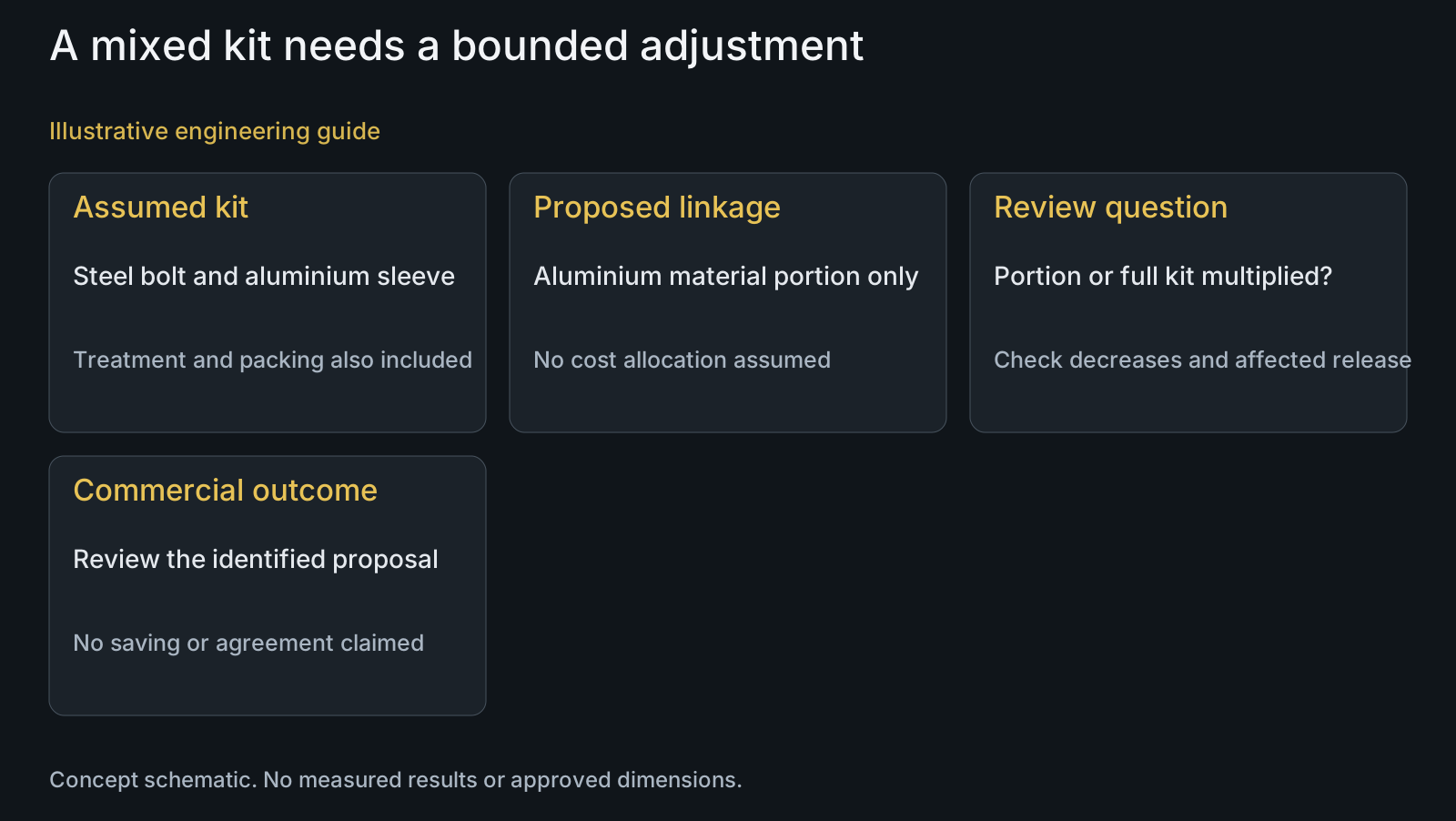
Illustrative engineering example: assume a quotation covers a steel pivot bolt, an aluminium sleeve, treatment and kit packing. The proposal links only the agreed aluminium material portion to a reference, while other priced elements remain unchanged. No real price, index value or cost share is assumed.
The buyer checks whether the comparison changes that defined portion or mistakenly multiplies the full kit total. It also checks which release the adjustment concerns and whether a decrease would follow the same agreed treatment. The steel component and packing do not become aluminium exposure simply because they share a kit.
The team can then review the proposed calculation against its scope and order conditions. The example establishes no savings, actual cost movement or accepted commercial term. Its value is detecting a boundary error before an apparently precise formula becomes a disputed invoice.
Define what supports a price lock and what reopens it
A lock-price proposal should identify configuration, quantity, covered period and exclusions. Ask what commitment supports it and whether material or production authority is needed. A date range without a quantity boundary can be read as covering more supply than was priced.
Treat changed geometry, material, treatment or evidence scope separately from a movement in the agreed reference. The manufacturing overview and surface-treatment discussion help identify that physical scope. A changed purchase is not necessarily a commodity adjustment, and a commodity rule does not approve a technical substitution.
Keep unresolved terms visible and have qualified advisers review the binding agreement. The knowledge center supports related buyer decisions. PremFixer can discuss a defined quotation and adjustment proposal; this article promises no universal lock duration, threshold, cost disclosure or acceptance of an index-linked arrangement.
Questions buyers need to confirm
How long can PremFixer lock a pivot hardware price?
No universal duration is established here. Request a quotation identifying configuration, quantity, covered period, supporting commitments and exclusions. Changed drawings, supplied scope or release quantities may need a separate review under the actual agreed terms.
Should a raw-material increase apply to the entire kit price?
Not automatically. Identify the element linked to the selected reference and the work outside it. Mixed materials, machining, treatment and packing can have different scope. Use an agreed allocation rather than assume that the whole kit follows one metal chart.
Does an official index prove the supplier's cost increased?
No. It represents its defined market measure, not a particular purchase record. Check material form, grade relevance, period and any proxy limitation. An agreed reference can support a calculation without establishing exact actual cost at PremFixer.
What should a percentage trigger mean?
Define whether it opens discussion or directly invokes an agreed calculation. Also specify whether the full movement or only the excess is used. A threshold without those decisions can lead to different outcomes from the same inputs.
Must a lower index produce a lower price?
The actual arrangement must say how decreases are treated. Do not assume symmetry, a floor or upward-only pricing from the index-linked label. Make direction and limits explicit for the affected price portion and order releases.
Can a revised forecast change already released order pricing?
Not by itself. Identify which orders the agreed mechanism covers and who authorises any change. A forecast, firm release and price-lock commitment are separate subjects. Review binding terms with qualified advisers rather than infer retrospective authority from updated demand.
Technical references and scope
BLS PPI price-adjustment guide. Official PPI scope and selected guideline sections on reference identity, partial-price mechanics, timing and data conditions. Not a recommended pivot-specific index, actual supplier cost record or contractual advice.
Explore related component, material and sourcing decisions in the customer decision knowledge center. For a drawing review, use the Drawing/BOM RFQ path.
Clarify the material reference and releases behind your price proposal
Send the drawing, STEP file or sample, material and finish definition, BOM revisions, quantities and release pattern through the Drawing/BOM RFQ path. Identify the proposed indexed element, reference periods and lock scope. PremFixer can discuss a bounded quotation proposal; calculation authority and binding commercial terms require explicit agreement.
Discuss the drawing and BOM