

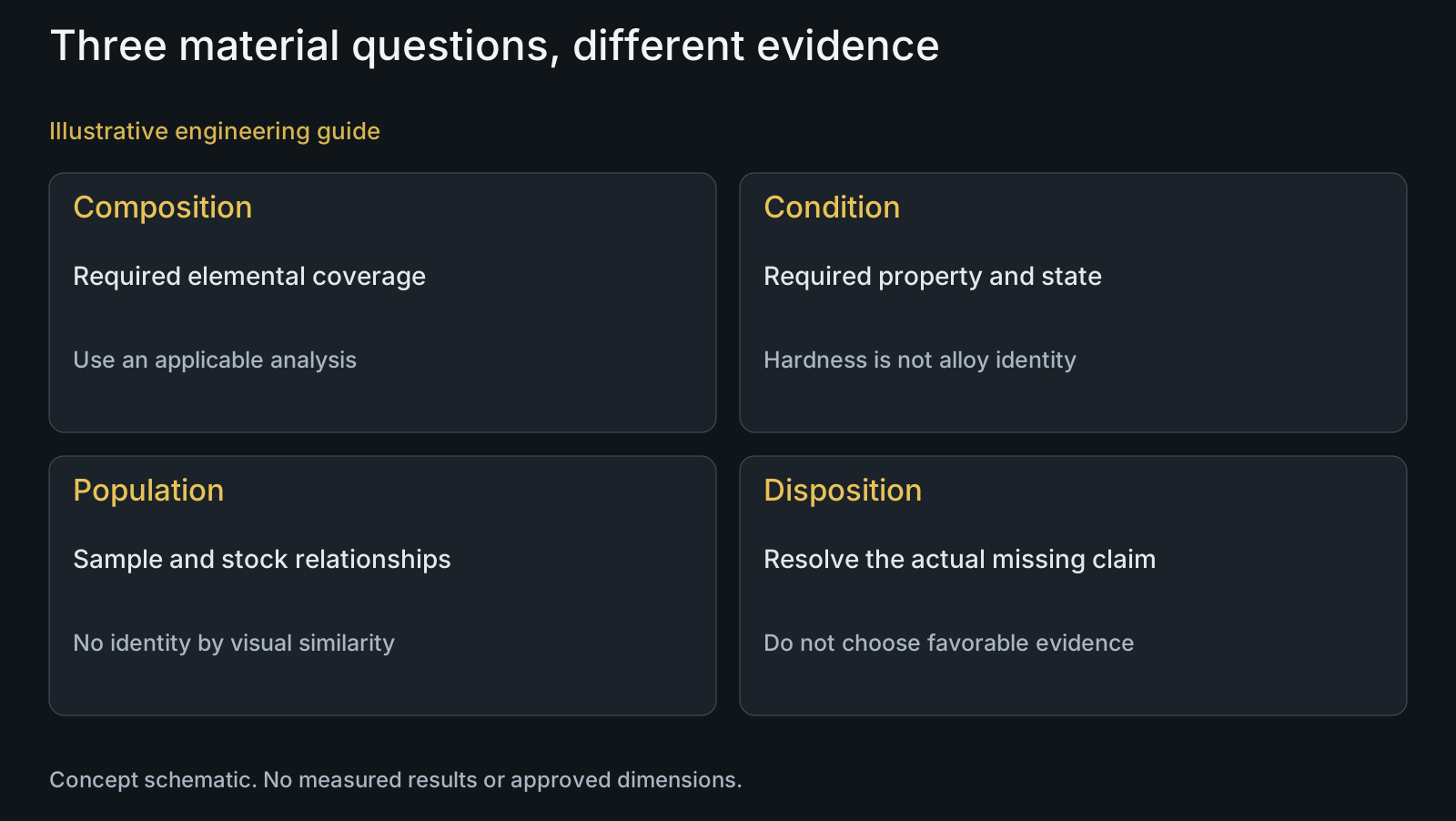
Verify a claimed 304, 316 or TC4 pivot material against the complete purchasing specification, not appearance or one hardness reading. Suitable elemental analysis can address composition; it does not automatically establish the supplied condition, mechanical properties or identity of every part in a delivery. Begin with the required designation, specification edition, product form and condition, then choose methods that cover the actual disputed requirements. Retain the sample-to-stock and stock-to-part relationship. If a certificate and a test appear to disagree, control the affected population while reconciling their subjects and methods. Neither the most favorable result nor the most expensive instrument is automatically the decisive evidence.
Hero: concept illustration of example hardware and its application. It is not a factory photograph, tested component or approved production geometry.
Define the material claim before selecting a test
A grade name is incomplete if the order also controls product form, supply condition, chemistry limits, mechanical properties or approved origin. Identify those requirements separately. Do not declare TC4 and another titanium purchasing designation interchangeable without comparing the applicable specifications and obtaining the required authorization.
The materials review should distinguish verification of the ordered material from evaluation of an alternative. Testing can show evidence relevant to a specification; it cannot authorize substitution or decide whether the selected alloy is suitable for an unexamined pivot load case.
Match chemistry analysis to required elements
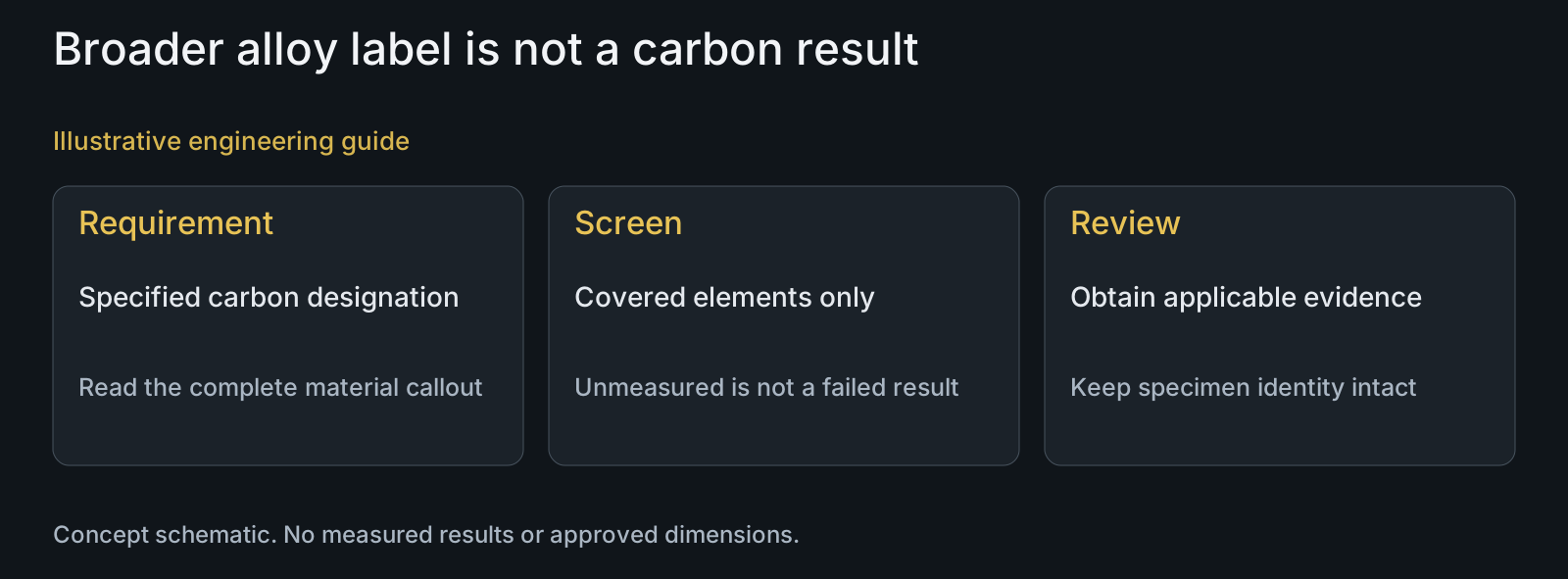
Thermo Fisher's official comparison explains differing capabilities of XRF, OES and LIBS, including the inability of XRF to measure carbon. A displayed stainless grade match cannot therefore resolve every low-carbon designation. Confirm the configured method's required elemental coverage rather than requesting generic spectral testing.
Do not assume OES is always a quick complete answer while chemical analysis is a separate universally superior category. OES itself is elemental analysis. Matrix, calibration, preparation, geometry and reporting scope determine what a proposed method can support. The stainless stock analysis guide addresses that narrower analytical task.
| Evidence | Useful question | Unsupported extension | Confirm |
|---|---|---|---|
| Applicable elemental analysis | Measured composition requirements | All mechanical properties proven | Required elements and limits |
| XRF grade screen | Covered alloying elements | Low-carbon designation resolved | Unmeasured element requirements |
| Hardness test | Defined hardness requirement | Unique alloy identity established | Method, location and supplied state |
| Stock document | Represented material requirements | Every finished piece tested | Issuer, population and linkage |
| Origin record | Named source relationship | Composition alone restores history | Stock-to-part evidence |
| Repeat analysis | Identified method uncertainty | Unfavorable result disappears | Reason, specimen and retained records |
Use hardness for the property it measures
A hardness test concerns indentation response under its defined method and conditions. It is not a unique alloy identifier. Similar readings cannot establish equal chemistry, while different processing or test conditions can complicate comparison within the same nominal material.
ZwickRoell's hardness guidance identifies material, expected hardness, surface condition and precision as selection factors. For a small curved pivot, ask the laboratory about applicable specimen support, preparation and test location. Do not indent a functional seat simply because it is accessible. State whether the result is intended to assess stock condition, a treated layer or a finished-part requirement.
Link both documents to the tested population
A material certificate has a subject. A test report has a submitted specimen. Establish their connection before comparing numerical results. An offcut selected from one bar cannot establish the composition of an unlabelled neighboring bar by proximity, and a finished component may have passed through further processes after the stock test.
The titanium origin guide explains stock-to-part relationships. Additional analysis may resolve composition but cannot reconstruct a missing original manufacturer or supply history. If origin approval is part of the order, that missing evidence remains a separate decision.
Resolve apparent disagreement without selecting a winner
Compare sample identity, required element, reported units, method coverage, supplied state and applicable limits. Determine whether the records address the same question. Preserve the original unfavorable result and its circumstances; repeat analysis under a justified method only when it resolves an identified uncertainty.
Illustrative engineering example: assume a stainless material document includes a low-carbon designation while an incoming XRF screen reports only a broader alloy match. No elemental values or real shipments are assumed. This is not necessarily a contradictory carbon result: the screening method has not answered the carbon question. Obtain suitable evidence for that requirement rather than accepting the broader label as proof or alleging substitution without a conflicting measurement.
Quote a bounded verification deliverable
Specify what must be determined, which stock or finished population is represented, allowable specimen preparation and required report fields. If testing consumes material or marks a surface, reserve appropriate specimens before manufacture and distinguish them from deliverable parts.
PremFixer's confirmed model includes manufacturing and qualified-partner testing, not a blanket owned-laboratory or every-batch analysis claim. Discuss the manufacturing scope, required documents and unresolved material questions together. Component geometry, surface acceptance and complete-pivot validation still need their own relevant evidence.
Questions buyers need to confirm
Can hardness prove a pivot is 304, 316 or TC4?
No. It addresses a defined hardness property, not unique alloy identity. Supply the complete material designation and condition, then obtain suitable composition evidence and any separately required property results.
Is a handheld alloy match enough for low-carbon stainless?
Not if the required carbon evidence is absent. Confirm which elements the configured method measures. Thermo Fisher identifies XRF's carbon limitation; a broader alloy label cannot close that requirement.
Is OES always better than other chemistry methods?
No universal hierarchy is established. The required elements, matrix, specimen geometry, preparation and method capability determine suitability. Ask the laboratory how its proposed analysis answers the actual specification question.
Can TC4 be substituted with another titanium designation?
Only through the required technical and purchasing authorization. Compare complete specifications, product form, condition and required properties rather than relying on a naming-equivalence claim or similar chemical composition.
What if a certificate and independent test disagree?
Control the affected population and compare subjects and methods first. Provide both originals, sample identity, preparation, element coverage and applicable limits. Preserve unfavorable evidence while resolving whether the records truly conflict.
Can extra chemical testing restore missing origin records?
No. Analysis can address composition but does not establish the original manufacturer or historical supply relationship. Resolve any required origin approval separately and retain stock-to-part identity.
Technical references and scope
Thermo Fisher Scientific, PMI technology comparison. Elemental-method coverage and carbon limitations of XRF; not an approval of any supplied pivot material.
ZwickRoell, Hardness testers and selection. Manufacturer guidance on method and specimen selection factors; no universal grade-identification or property limits.
Explore related component, material and sourcing decisions in the customer decision knowledge center. For a drawing review, use the Drawing/BOM RFQ path.
Define the material evidence for your pivot drawing
Send the material specification, product form and condition, required properties, existing documents and proposed sample scope through the Drawing/BOM RFQ path. PremFixer can review manufacturing and coordinated testing requirements without overstating what one method proves.
Discuss the drawing and BOM