

A useful pivot bolt order-tracking update tells the buyer what happened to the represented items, what remains estimated and what action can change the next outcome. Identify the order, part revision, quantity and information time before interpreting a status label. Keep bolts, sleeves and other required kit positions visible if they are at different stages. Material availability is not finished-part acceptance, and a dispatch scan is not the customer's usable receipt. Ask for the next controlling dependency and any specific buyer decision. Agree the update channel and timing for your project; an attractive progress bar does not establish real-time data, a deployed portal or a guaranteed delivery date.
Hero: concept illustration of example hardware and its application. It is not a factory photograph, tested component or approved production geometry.
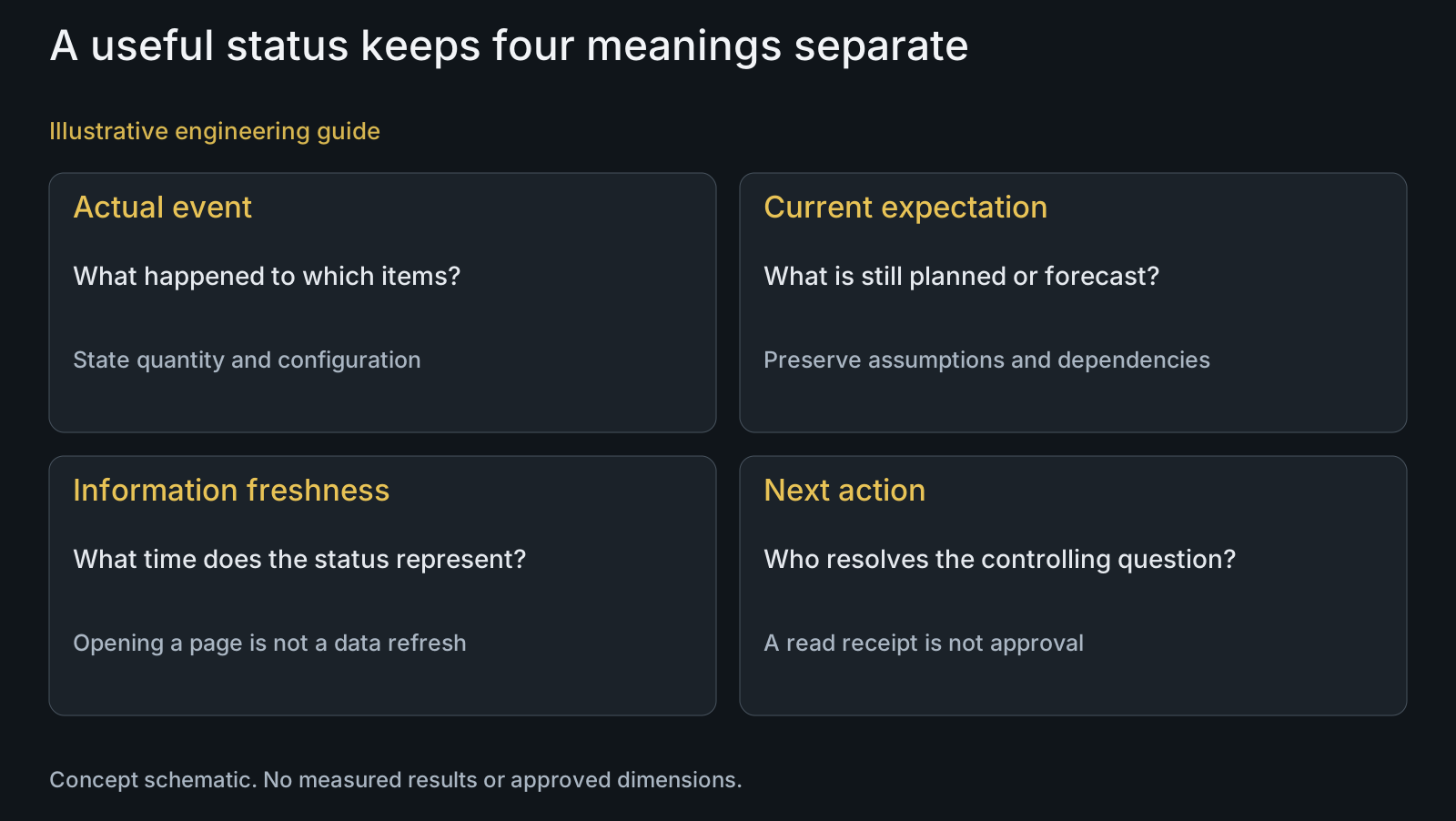
Give each status a represented subject and event
Identify which order line, part number, revision and quantity the update concerns. If it covers only some units, state that scope. A correct statement that machining is complete for one bolt position cannot describe every sleeve or the whole kit.
Define the event behind the label. Material available, machining complete, treatment complete, required inspection complete and kit packing complete have different meanings. Some routes do not use every operation, so the update must follow the actual supplied scope rather than a universal sequence.
GS1's EPCIS explanation describes visibility events by what was involved, when and where it happened and the business context. This supports event-specific communication; it does not establish GS1 implementation, a mandatory pivot dashboard or the truth of a supplier's reported event.
Keep actual events, forecasts and data freshness separate
An actual completion event describes something that has occurred. A planned date describes the scheduling intention, and a forecast describes the current expectation based on stated dependencies. Preserve those distinctions when a forecast changes instead of rewriting the earlier plan as though it had always been different.
Identify the information's effective time and, where relevant, the later reporting time. A status may accurately describe yesterday while leaving a new hold unreported. A recently opened dashboard does not prove that the underlying manufacturing information has just been refreshed.
Where an essential input is unresolved, give a conditional expectation or explain why a reliable date cannot yet be stated. Do not invent a precise shipment date from the number of stages already marked complete. The manufacturing overview provides route context, not an automatic lead-time calculator.
| Reported statement | What it may establish | What it cannot establish alone | Useful buyer question |
|---|---|---|---|
| Material available | Represented input position | Complete finished hardware readiness | Which grade, condition and accessible quantity? |
| Operation complete | Defined work on stated items | Final acceptance after later operations | Which items and delivered-state work remain? |
| Inspection complete | Stated check scope finished | Uninspected positions or whole application approval | What characteristics and population were covered? |
| Customer input pending | A named unresolved dependency | Authority from a read notification | Which decision, owner and feature are needed? |
| Forecast shipment date | Current conditional expectation | An actual dispatch or guaranteed receipt | Which dependency could change that expectation? |
| Package collected | Represented transport event | Full order completion or usable assembly release | Which contents, receiving point and work remain? |
Show the kit dependency instead of averaging progress
A stage count gives every stage the same apparent weight even when their remaining work differs. A large component quantity can also dominate a percentage while a small missing kit item blocks assembly. Ask what the percentage measures before using it for a receiving or build decision.
A concise item-level update should show the required positions, represented quantities and next limiting dependency. It need not expose proprietary manufacturing detail to state that the finished bolts are available while required sleeves remain unresolved. Complete-kit readiness is a different conclusion from component progress.
The one-stop manufacturing guide follows functional requirements across process handoffs. Here the emphasis is what the buyer can infer from a status report. A coordinated supply contact should not conceal whether partner work, customer-supplied items or an excluded operation still affects the order.
State the buyer action that would unblock the order
If the supplier needs a technical decision, name the affected feature, alternatives under review and responsible customer owner. Asking the buyer to approve progress is not useful when the real need is to resolve a sleeve interface or choose between incompatible requirement interpretations.
Separate receipt of an update from authorisation to change the component. A message marked read is not an approved drawing revision. Likewise, supplying missing information is not automatically permission to alter quantities, finish or delivery scope. State which action the next step actually needs.
If no buyer action is required, say so and identify the supplier-side dependency and next update basis. The engineering-change guide helps define affected scope, while the surface-treatment discussion helps identify the delivered-condition question. Avoid generic approval requests unrelated to either decision.
Evaluate an update with different bolt and sleeve states
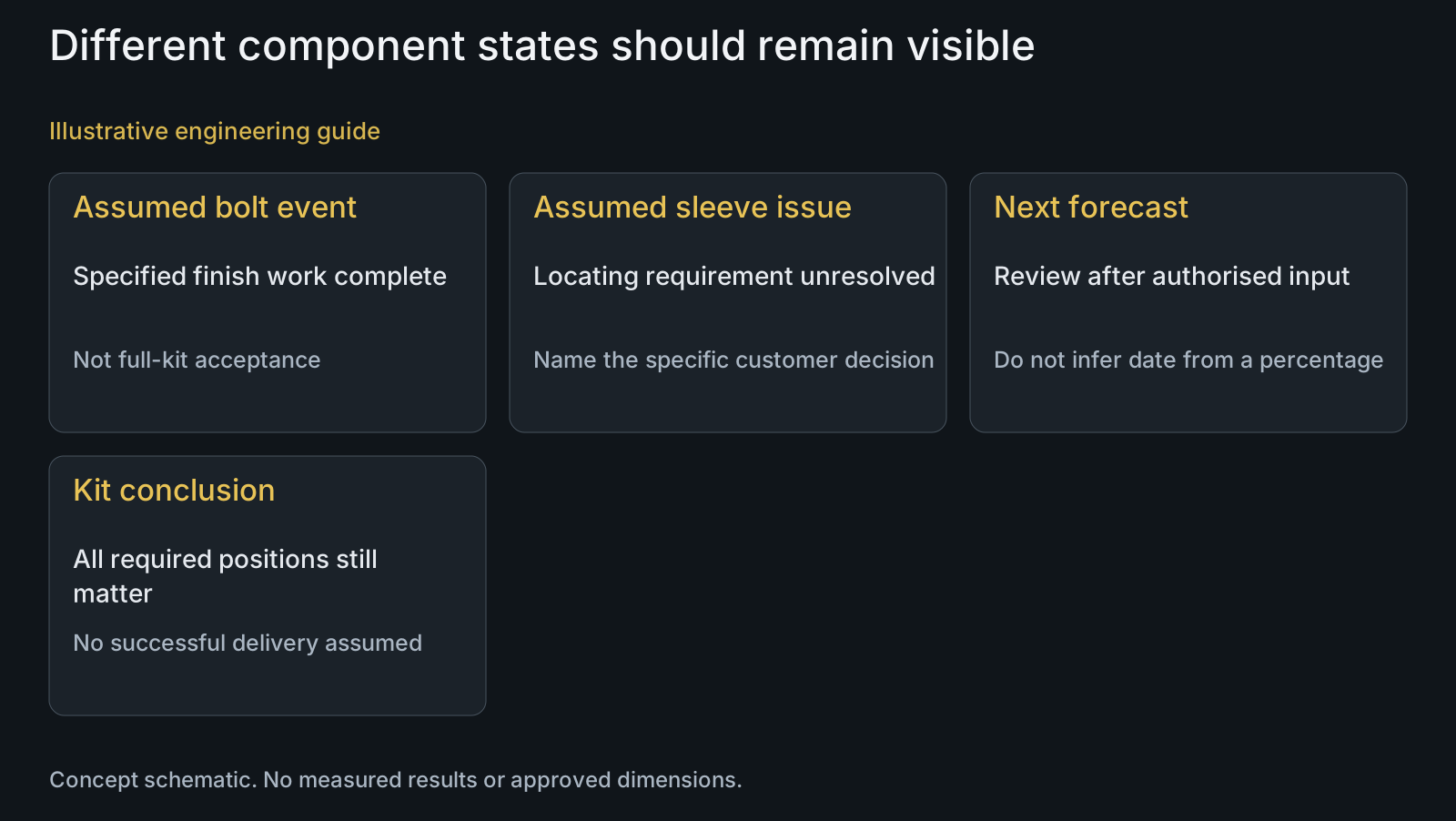
Illustrative engineering example: assume the update says the bolt's specified finishing work is complete while a sleeve's locating requirement still needs an OEM decision. Both are required for the planned kit. No actual order, progress percentage, manufacturing date or accepted result is assumed.
The reviewer keeps the completed bolt event separate from the unresolved sleeve question. It asks which sleeve field needs a decision, who may decide and what subsequent work depends on that answer. Calling the kit nearly complete would hide the active dependency without establishing when it can close.
Once the customer provides its authorised requirement, the supplier can reassess the represented remaining route and forecast. The example does not assume the decision has been made, parts accepted or delivery achieved. It demonstrates how a short action-oriented update can be more informative than a combined percentage.
Separate manufacturing status from transport visibility
A carrier event identifies the represented package or movement. Check which order lines and quantities it contains before treating the scan as status for the entire order. Partial dispatch, a created shipping label and an actual collection are not interchangeable events.
Connect transport visibility to the named receiving point and the remaining customer release work. The JIT delivery-window guide explains why arrival alone may not support assembly. A tracking number cannot resolve a missing component, wrong revision or inspection hold.
Agree the communication channel, represented milestones, exception contacts and update basis with PremFixer for the actual project. No always-on online order-query platform or automatic notification service is established here. Use the materials overview for the item definition and the knowledge center for related decisions; the status discussion should preserve the promised scope rather than create a new service claim.
Questions buyers need to confirm
Can I track a custom pivot hardware order?
Agree the update channel, milestone meanings and exception contacts for the project. Request item/revision scope, actual events, current expectations and next actions. This article does not establish an always-on PremFixer portal or automatic notifications for every order.
Does a nearly complete progress bar establish the ship date?
No. Ask what is counted and which required item or operation remains. Equal stage weights or aggregate quantities can conceal a controlling dependency. A forecast needs the represented route and remaining assumptions, not merely a percentage.
Why should bolts and sleeves have separate status?
They may be at different states while both are needed for the kit. Show their required revisions, represented quantities and remaining work. Completion of one position cannot establish that the complete accepted configuration is ready.
Is the latest displayed date an actual completion date?
Not necessarily. Distinguish the event time, reporting time and current forecast. A recent message or dashboard view can contain older information. Ask which time the status represents before changing a receiving or assembly plan.
Does reading an update approve a technical change?
No. The update must identify the specific required decision and its authorised owner. Receipt, missing-input submission and approval of changed requirements are separate actions. Do not treat a read receipt as permission to alter geometry, finish or quantity.
Does a carrier tracking number cover the entire order?
Only the represented shipment contents and events. Identify the included lines, quantities and revisions, then distinguish collection, movement and receipt. Partial transport visibility does not establish complete kit readiness or customer release after receiving checks.
Technical references and scope
GS1 public EPCIS explanation. Public event-based visibility context includes represented subject, time, location and business meaning. No GS1 deployment, mandatory dashboard schema or supplier data guarantee inferred.
Explore related component, material and sourcing decisions in the customer decision knowledge center. For a drawing review, use the Drawing/BOM RFQ path.
Define the milestones needed for your pivot order
Send the drawing, STEP model or sample, BOM revisions, quantities and required receiving milestone through the Drawing/BOM RFQ path. Identify customer decision owners and the updates needed for manufacturing, kit completion and transport. PremFixer can discuss an appropriate scoped communication arrangement without treating a generic dashboard as a delivery guarantee.
Discuss the drawing and BOM