
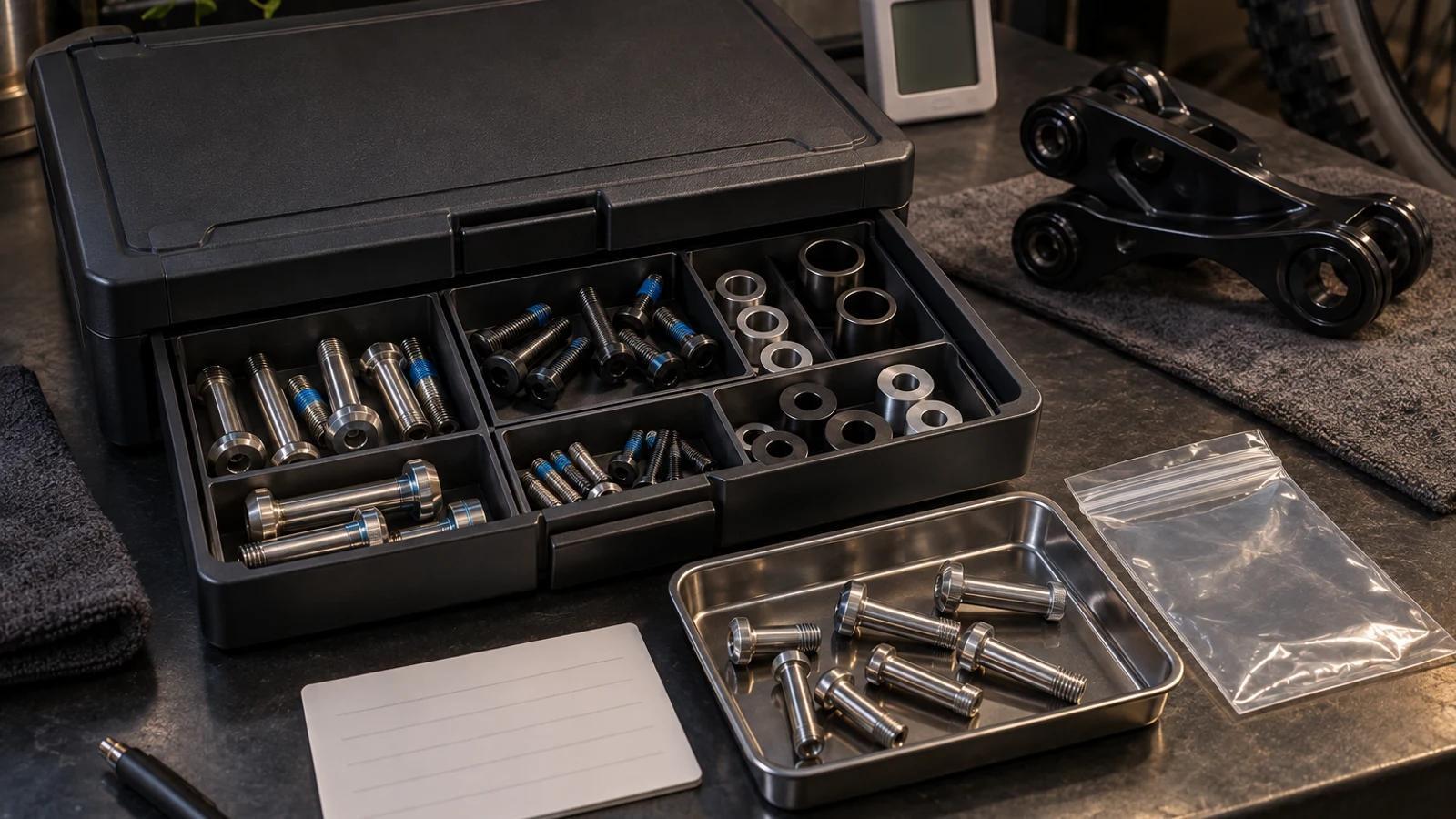
Stored pivot bolts should not be declared indefinitely usable because their base material is stainless steel or titanium. Review the complete supplied configuration: metal, surface treatment, any pre-applied locking product, packaging and the conditions experienced before assembly. A manufacturer may specify a conditional storage period for an applied product even when the bolt has no obvious corrosion. Conversely, a calendar date alone does not describe contamination or handling damage. Identify the applicable instructions and the event from which time is counted, then decide what inspection or product-specific assessment is needed. There is no supported universal two-year expiry rule for every anodized aluminum pivot.
Hero: concept illustration of example hardware and its application. It is not a factory photograph, tested component or approved production geometry.
Separate the metal from what has been applied to it
A machined pivot can carry an anodized or plated surface, lubricant, pre-applied locking product or other specified treatment. Each has a different purpose and may have different storage or handling instructions. An alloy designation does not describe these additional inputs.
For a mixed kit, identify the configuration of each component rather than attach one unsupported shelf-life statement to the whole box. An untreated spacer and a coated threaded bolt may need different review questions. The relevant material selection does not establish the applied product's storage period.
Keep service life separate from shelf life. Storage information concerns the condition before use under stated circumstances. It does not establish riding durability, permissible reuse or the fatigue life of the installed pivot. Those are different application decisions.
Use the actual product's instructions, not a generic adhesive date
As a specific example, precote 80's manufacturer information states a coated-part shelf life of four years at a maximum 30°C and maximum 65% relative humidity, with its packaging information also applicable. This is a product-specific conditional statement, not a recommendation to apply those values to every pivot or locking patch.
A liquid product in its original container and a dried pre-applied product on a screw are different supply states. Ask for the instructions that represent the delivered item. A container expiry copied onto a part record can answer the wrong question unless the manufacturer explicitly connects those states.
Identify the specified start event and relevant lot information rather than assume time starts at customer receipt. A later shipment date does not make an older applied product newly manufactured. This example does not identify the product supplied on your order; confirm the actual specified system.
| Configuration or observation | Relevant question | Unsafe shortcut | Useful action |
|---|---|---|---|
| Bare metal component | Surface condition and exposure history | Alloy name means unlimited usability | Review condition and applicable requirements |
| Treated component | Specific finish and handling restrictions | All aluminum expires at one age | Identify the actual surface system |
| Pre-coated thread | Product instructions and application event | Copy liquid-container shelf life | Use delivered-part instructions |
| Unknown exposure | What required conditions can be established? | Clean appearance proves function | Obtain technical disposition |
| Split inner pack | Identity and retained instructions | Outer carton date covers everything | Preserve item-level relationship |
| Proposed recoating | Changed condition and acceptance basis | New packaging renews old stock | Define the rework scope |
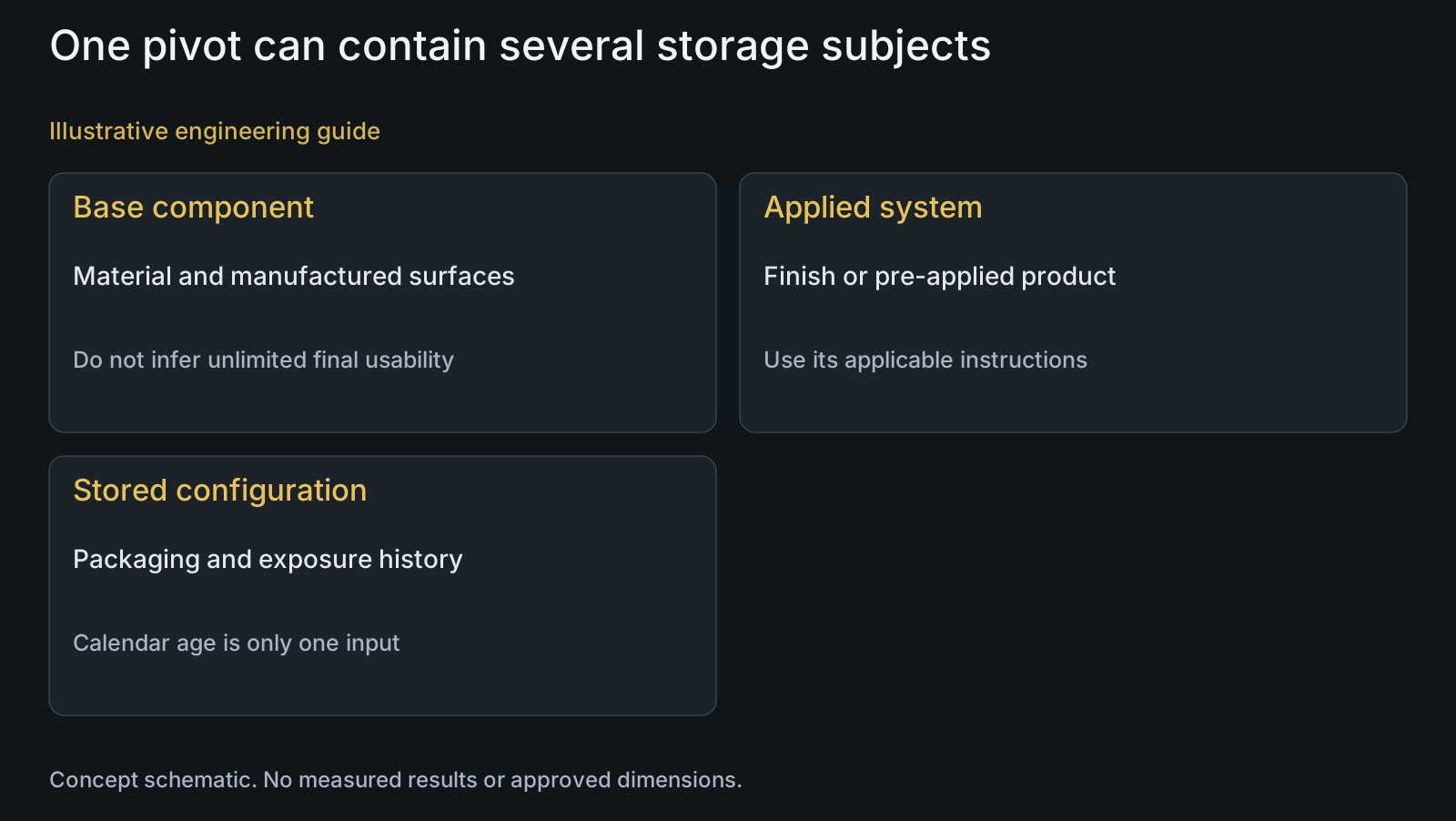
Review exposures that elapsed time cannot describe
Record relevant temperature and humidity history, condensation, contamination, package opening and handling where they affect the supplied system. An intact-looking bag is not evidence that every internal condition remained within the required limits throughout storage.
The coating manufacturer's storage guidance treats exposure and handling as functional considerations and calls for assessment when its recommendations are not followed. That supports consulting the applicable product supplier; it does not establish a universal warehouse recipe for unrelated coatings.
Avoid adding an unapproved oil, cleaner or protective product to stored pre-coated threads. The compatibility question belongs to the actual system and assembly requirement. A treatment intended to protect the metal may alter another product's installation behaviour. Coordinate changes with the surface-treatment scope.
Make stock release proportional to the actual uncertainty
Separate known compliant storage from an unknown or out-of-condition history. The latter is not resolved by relabeling the date or visually checking the metal alone. Identify the affected supply and ask the responsible technical team for a disposition appropriate to the uncertainty.
Visual review can identify visible corrosion, contamination, damaged surfaces or damaged applied material. It does not automatically confirm remaining locking function. If that function matters to the assembly, specify the applicable assessment with the product supplier and customer's engineering team.
Do not substitute an invented tightening value for that assessment. The torque-testing scope guide distinguishes measured outputs and their applicability. A single torque observation is useful only when the specimen, method and acceptance question are defined.
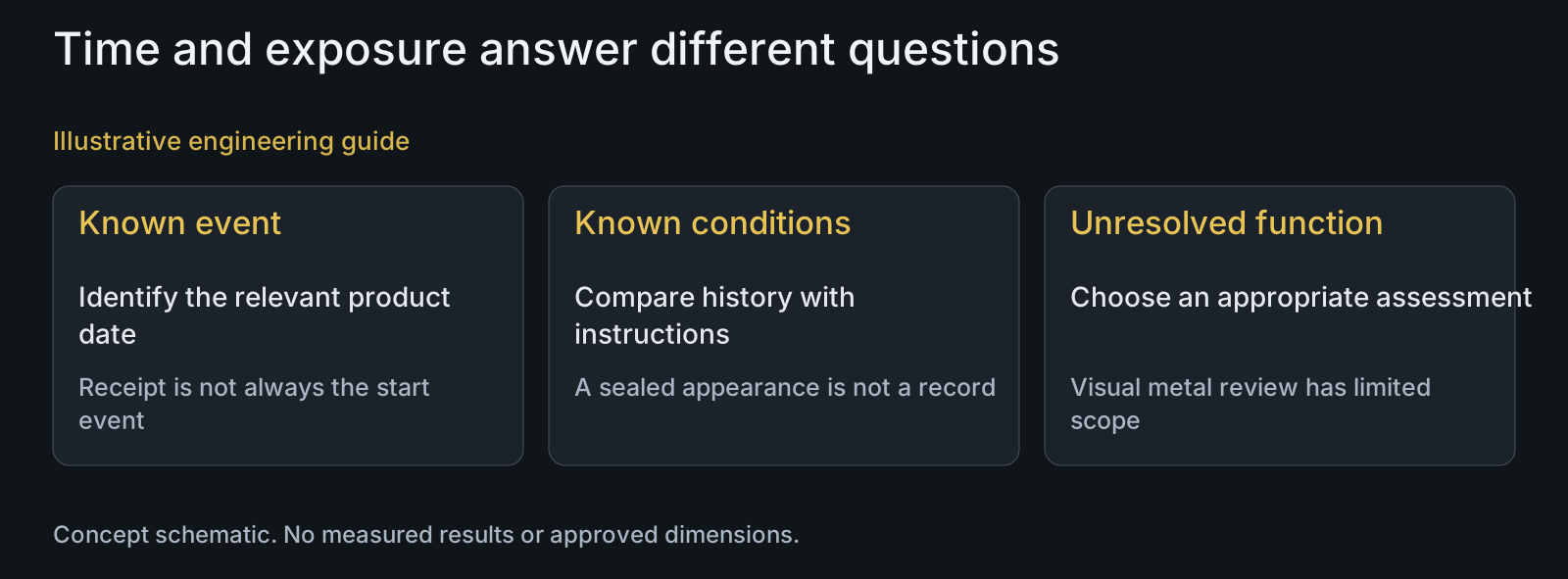
Plan inventory without erasing identity or changing the configuration
Where a specified expiry applies, inventory selection should respect that date as well as the requested component revision. Simply selecting the earliest received carton can be insufficient if its product dates differ from those of a later delivery. Preserve the relevant event information.
Splitting packs should retain component and lot identity along with applicable storage instructions. The package-labeling guide addresses which identity must remain with inner packs. Here the question is whether the remaining stock still represents the known configuration and history.
If rework, cleaning or recoating is proposed, identify the change rather than treating it as routine inventory administration. The new condition may need its own manufacturing and acceptance basis. Customer approval and product-specific instructions remain relevant; fresh packaging alone does not renew the component.
Illustrative review: clean metal, uncertain locking-product history
Illustrative engineering example: assume a kit contains titanium pivots with a specified pre-applied locking product. The metal shows no obvious corrosion, but the customer only retained the receipt date and the package was opened during stock handling. No elapsed period, exposure limit or measured failure is assumed.
The team identifies the actual product and its applicable instructions, establishes available application and storage records, and separates the uncertain stock. It does not infer unlimited usability from titanium or conclude failure solely because the pack was opened. The disposition depends on what uncertainty remains and the appropriate product-specific assessment.
The useful decision is whether the intended delivered and installation condition can still be supported. This example explains a review method; it does not claim a recovered batch, proven locking performance or customer experience. A replacement or rework proposal would need an explicit scope rather than a new date sticker.
Questions buyers need to confirm
Can titanium's corrosion resistance establish unlimited kit shelf life?
No. The kit may include an applied product, different component materials and packaging-dependent conditions. Review that actual configuration and its history. A material-family statement does not establish every item's remaining installation function.
Do all anodized aluminum pivots expire after two years?
No universal period is established here. Identify the actual finish, storage instructions and customer requirements. A blanket date would ignore differences in supplied condition and exposure. Use supported configuration-specific requirements instead.
Is customer receipt necessarily the shelf-life start date?
No. Identify the event specified for the actual product or delivered configuration. Keep its relationship to the supplied lot. A receipt or shipping date cannot silently replace an earlier relevant event.
Does opening a package automatically make the parts unusable?
Not automatically. It changes the available protection and may affect exposure history. Review what occurred and which instructions apply. Do not assume either immediate failure or unchanged condition without considering the actual system.
Can a visual check establish that an old thread patch still functions?
Not by itself. Appearance and installation function are different questions. Use the applicable product-specific assessment and customer's assembly requirements where function is uncertain. Do not invent a universal torque test or acceptance value.
What should accompany a stored-stock review?
Provide item and lot identity, finish and applied-product specifications, relevant dates, packaging condition and available exposure history. Include the intended assembly and any proposed cleaning or rework. These inputs help distinguish usable evidence from an unsupported age-based assumption.
Technical references and scope
precote80 manufacturer's product information. Conditional coated-part storage example only; no claim that every PremFixer order uses the product or meets its performance values.
precote transportation and storage guidance. Product-system-specific exposure and handling context; no universal limits for other coatings, shelf-life extension or component acceptance inferred.
Explore related component, material and sourcing decisions in the customer decision knowledge center. For a drawing review, use the Drawing/BOM RFQ path.
Review the stored configuration, not just the alloy
Share the component BOM, finish and pre-applied-product requirements, relevant dates and available storage history. Add packaging changes and the intended assembly use. PremFixer can review the manufacturing or rework scope without promising a universal shelf life or unsupported extension.
Discuss the drawing and BOM