
ISO 898-1 is not a universal tightening-torque standard for bicycle pivots. Its steel-fastener mechanical requirements, a torque/clamp-force test and a bicycle assembly requirement answer different questions. An OEM requesting data should first name the output: failure event, clamping response or acceptable assembled behavior. Then define the fastener, receiver, bearing-spacer stack, supplied surfaces and locking condition represented by that output. A torque-only reading does not directly measure clamp force, and a material property class does not establish a service setting. Select the applicable procedure and acceptance source without transferring a steel requirement to every titanium, stainless or aluminum component.
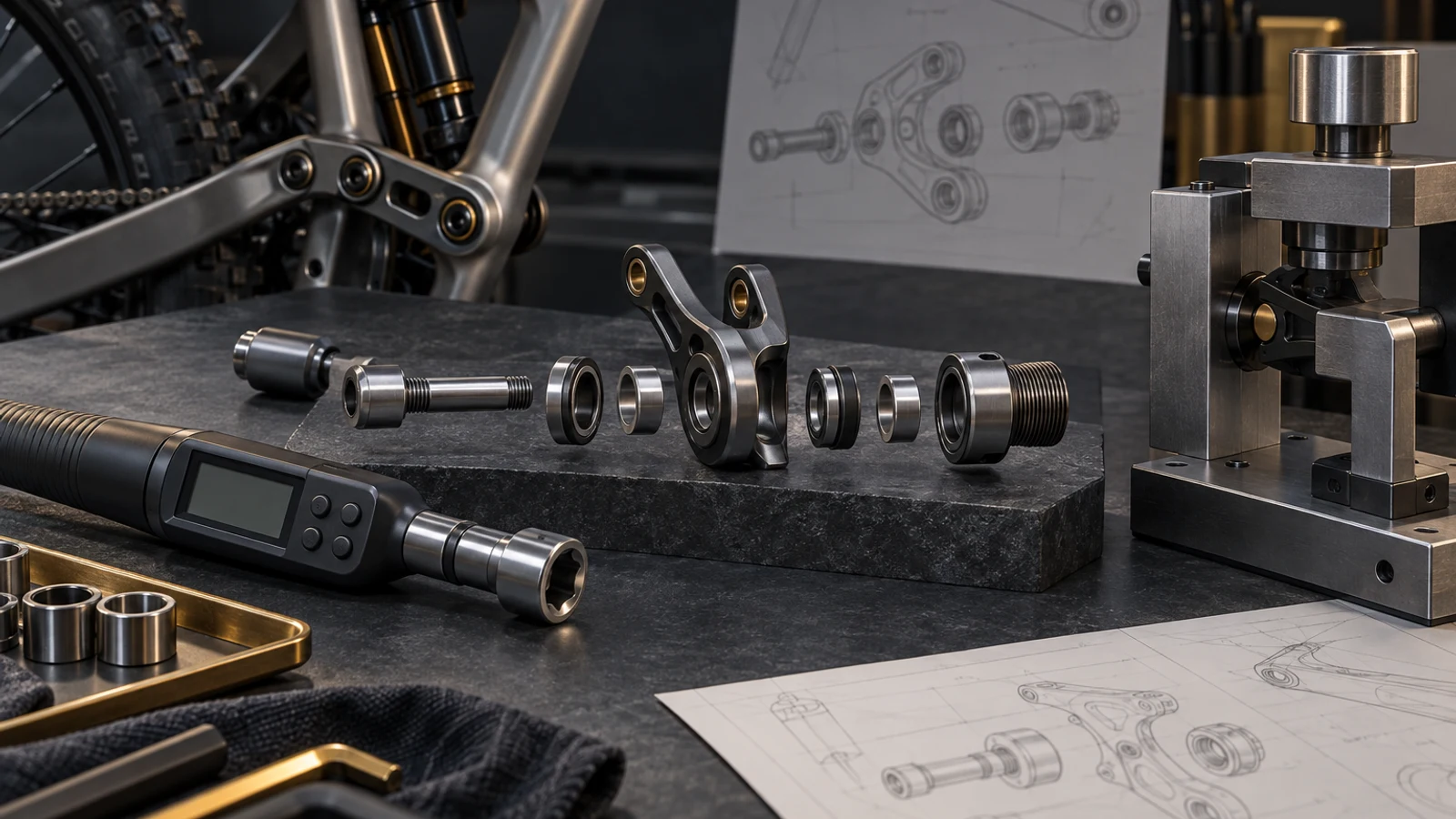
Hero: concept illustration of example hardware and its application. It is not a factory photograph, tested component or approved production geometry.
Turn the phrase torque test into a named output
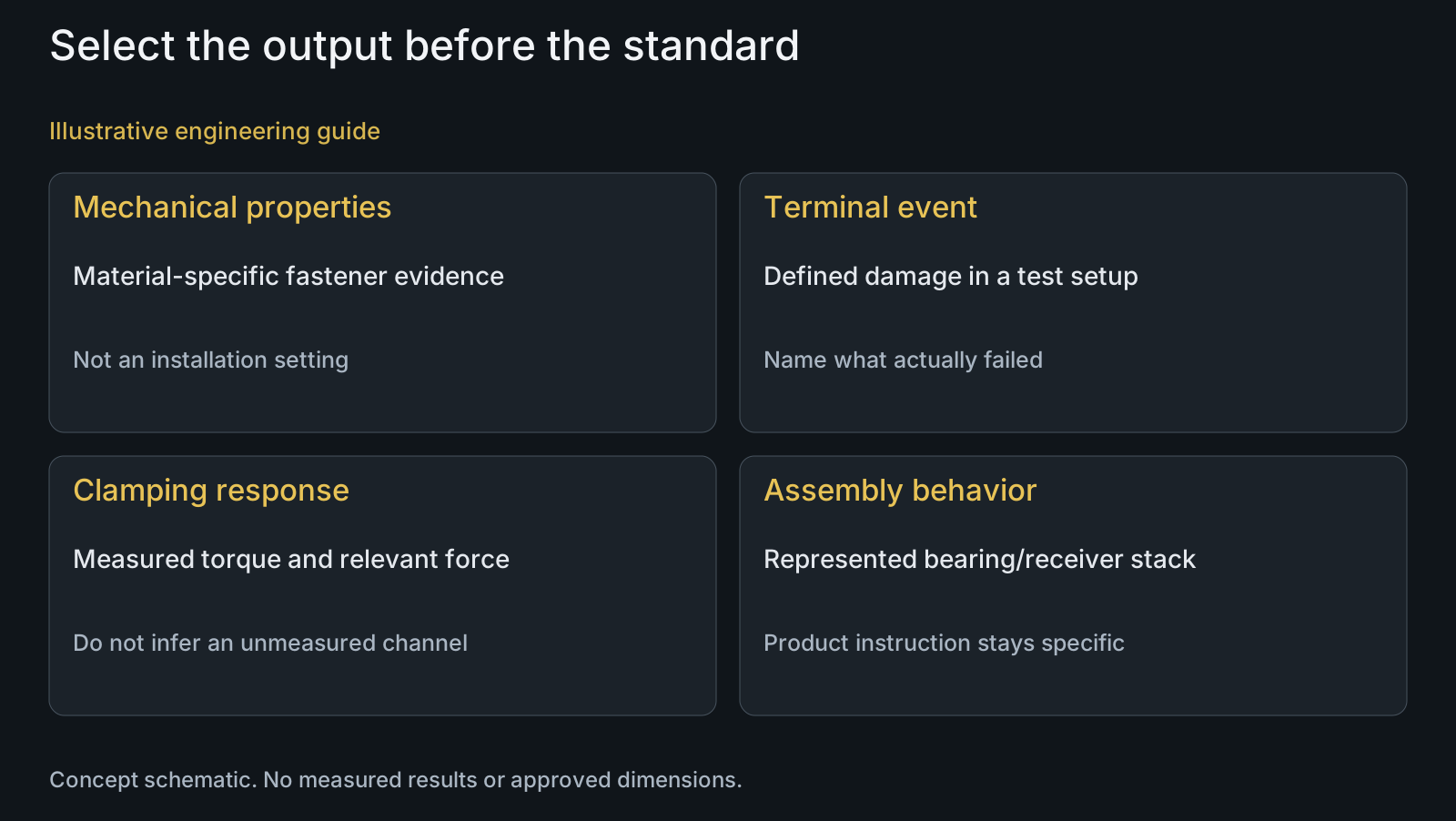
A terminal test can identify the first defined damage in a specimen or assembly. A tightening characterization can relate measured torque to another measured response. An assembly evaluation can ask whether the intended contacts and motion remain acceptable. These outputs are not interchangeable just because each test uses a turning tool.
Specify which channels are required: torque, rotation, force or an identified functional observation. Do not add a clamp-force conclusion to a torque-only report. If a relationship is inferred rather than measured, the report should identify its basis and limits.
The destructive-torque comparison explains terminal failure subjects. Here the purchasing task is assigning the right reference and requested output, before the supplier or laboratory quotes an unsuitable test.
Use ISO 898-1 within its steel mechanical-property scope
ISO 898-1:2013's public scope concerns carbon-steel and alloy-steel fasteners with specified property classes. It expressly excludes torque/clamp-force performance. A familiar steel property-class label is therefore not an installation specification or a measured torque-to-force relationship.
For stainless, titanium or aluminum hardware, identify the actual material and condition and an appropriate evidence basis. Do not copy the steel designation onto a non-steel quotation to suggest equivalent tested behavior. Similar head and thread geometry do not change the named material scope.
Even a relevant mechanical-property result leaves the receiver and clamped surfaces to be considered. Specify those interfaces separately. The material-selection guide supports that choice without turning one alloy name into a universal torque guarantee.
| Buyer question | Relevant evidence | Wrong substitution | Scope review |
|---|---|---|---|
| Steel mechanical requirements | Applicable property evidence | Treating class as service torque | Material and fastener applicability |
| Terminal damage | Named specimen/assembly event | Assuming bolt broke when receiver stripped | Fixture and failure definition |
| Torque-to-clamp response | Defined measured quantities | Force label on torque-only data | Applicable method and surfaces |
| Self-locking feature | Agreed applicable evaluation | Ignoring ISO16047 exclusion | Method and locking condition |
| Bicycle assembly acceptance | Represented joint and instruction | Part record becomes system approval | Category, interfaces and responsible criteria |
Check ISO 16047 applicability before requesting a compliant report
ISO 16047:2005 addresses torque/clamp-force tests for threaded fasteners and related parts within stated applicability. Its public scope excludes, among other subjects, fasteners with additional self-locking features. A request involving a locking patch needs a scope review rather than a silent claim that all combinations are covered.
Distinguish the reference-test configuration from the production pivot. A defined test can support characterization without reproducing every bearing contact or receiver detail. If application-specific parts are used, name them and agree what that choice means for the requested procedure and conclusion.
An engineering evaluation may be useful even when a standard-conformity claim is not appropriate. Describe the agreed evaluation accurately. Do not relax or extend a method privately and still label the result fully compliant without a supported basis.
Keep bicycle safety and installation responsibility visible
ISO 4210-2:2023 concerns safety and performance requirements for covered bicycles and subassemblies. Check the actual category and relevant requirements. Its title alone does not identify a torque procedure for every custom pivot or approve a component supplied without the rest of the joint.
The bicycle team's instruction should describe the relevant model and assembled condition. A supplier's manufactured-part report is supporting evidence, not permission for purchasing to choose a service setting from another product. Use the model-specific torque reference for the separate instruction-lookup task.
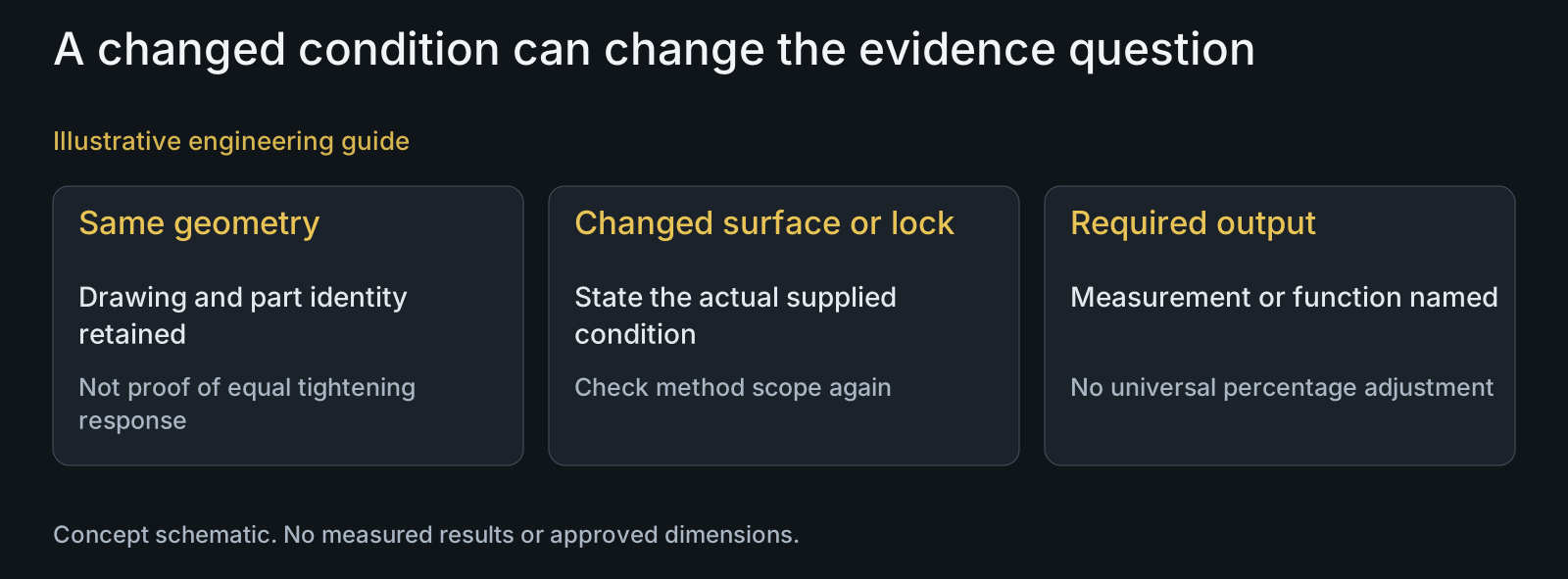
If an existing setting is proposed for a redesigned shoulder, receiver or surface, identify the changed interface and responsible review. The old instruction may belong to a different configuration even when diameter and appearance are unchanged. Do not replace that review with a generic percentage adjustment.
Match surface and locking condition to the claimed response
Thread and bearing-contact friction affect tightening behavior. A coating, lubricant or locking product can change the relationship between applied torque and achieved tension. Record the specified supplied and assembly condition so later readers know what the measurement represents.
Also distinguish threaded retention from the shoulder's locating function. A wrong spacer stack can direct contact to an unintended surface; a torque reading alone does not explain whether the bearing contact path is correct. Review the assembled geometry and relevant functional observation alongside measurement channels.
Discuss the drawing and surface-treatment scope in the order. PremFixer can coordinate represented component manufacture and agreed partner testing, but no universal torque result, owned test fixture or included test package is assumed.
Illustrative review after a locking-condition change
Illustrative engineering example: assume a buyer retains the pivot drawing but changes the supplied surface and adds a self-locking feature. The previous file contains a steel mechanical-property record and a torque-only assembly observation. No test value, damage event or customer result is assumed.
The reviewer does not infer that the property record covers the new tightening response. The new locking feature also triggers a review of the proposed ISO 16047 claim. The team specifies the relevant output, actual parts and surface condition, then agrees an applicable test or accurately described engineering evaluation.
The mechanical drawing remains useful, but the earlier torque observation is not relabeled as force measurement or new-condition validation. Send the changes, receiver and stack information through the RFQ-input guide. This separates unchanged geometry from evidence that needs reconsideration.
Questions buyers need to confirm
Is ISO 898-1 a torque/clamp-force performance standard?
No. Its published scope expressly excludes that performance and concerns defined carbon/alloy steel fasteners. Select the actual test subject separately. A property-class record does not establish installation torque or measured clamp force.
Can a titanium pivot simply use the same steel property-class request?
Not as if ISO 898-1 covered that material. Specify the titanium grade and condition and an appropriate evidence basis. Similar diameter or head shape does not transfer a steel material requirement to the non-steel component.
Does ISO 16047 automatically cover a self-locking pivot?
No automatic coverage follows. The public scope excludes fasteners with additional self-locking features. Describe the actual feature and have the procedure reviewed. An agreed engineering evaluation should not be mislabeled standard conformity.
Does a torque reading establish clamp force?
Not directly. Identify the measured channels and any justified relationship used for the actual configuration. Surface condition, locking features and contacts matter. Do not attach a force conclusion to a report that measured only torque.
Does ISO 4210 supply every pivot's installation setting?
No universal setting follows from that reference. Identify the applicable bicycle requirements and model-specific instruction. Part evidence supports the product review but does not replace the assembled configuration or responsible acceptance criteria.
What makes a torque-test RFQ unambiguous?
Send the bolt and receiver drawings, stack contacts, material and surface state, locking condition and proposed procedure. Name the output, measured channels and acceptance source. This distinguishes terminal damage, clamping response and acceptable bicycle assembly.
Technical references and scope
ISO 898-1:2013 public scope. Carbon/alloy steel mechanical-property subject and explicit torque/clamp-force exclusion; no universal installation value asserted.
ISO 16047:2005 public scope. Torque/clamp-force subject and additional-self-locking-feature exclusion; full procedure or bespoke test compliance not reproduced.
ISO 4210-2:2023 public scope. Covered bicycle safety and assembly subject, distinct from a universal custom-pivot tightening instruction.
Explore related component, material and sourcing decisions in the customer decision knowledge center. For a drawing review, use the Drawing/BOM RFQ path.
Specify the torque evidence your pivot decision requires
Share drawings or STEP for the fastener, receiver and bearing-spacer stack, plus the supplied surface and locking condition. State whether you need terminal, clamp-response or assembly evidence, and identify the acceptance source. PremFixer can discuss the manufactured specimens and agreed testing scope without inventing a universal installation value.
Discuss the drawing and BOM