
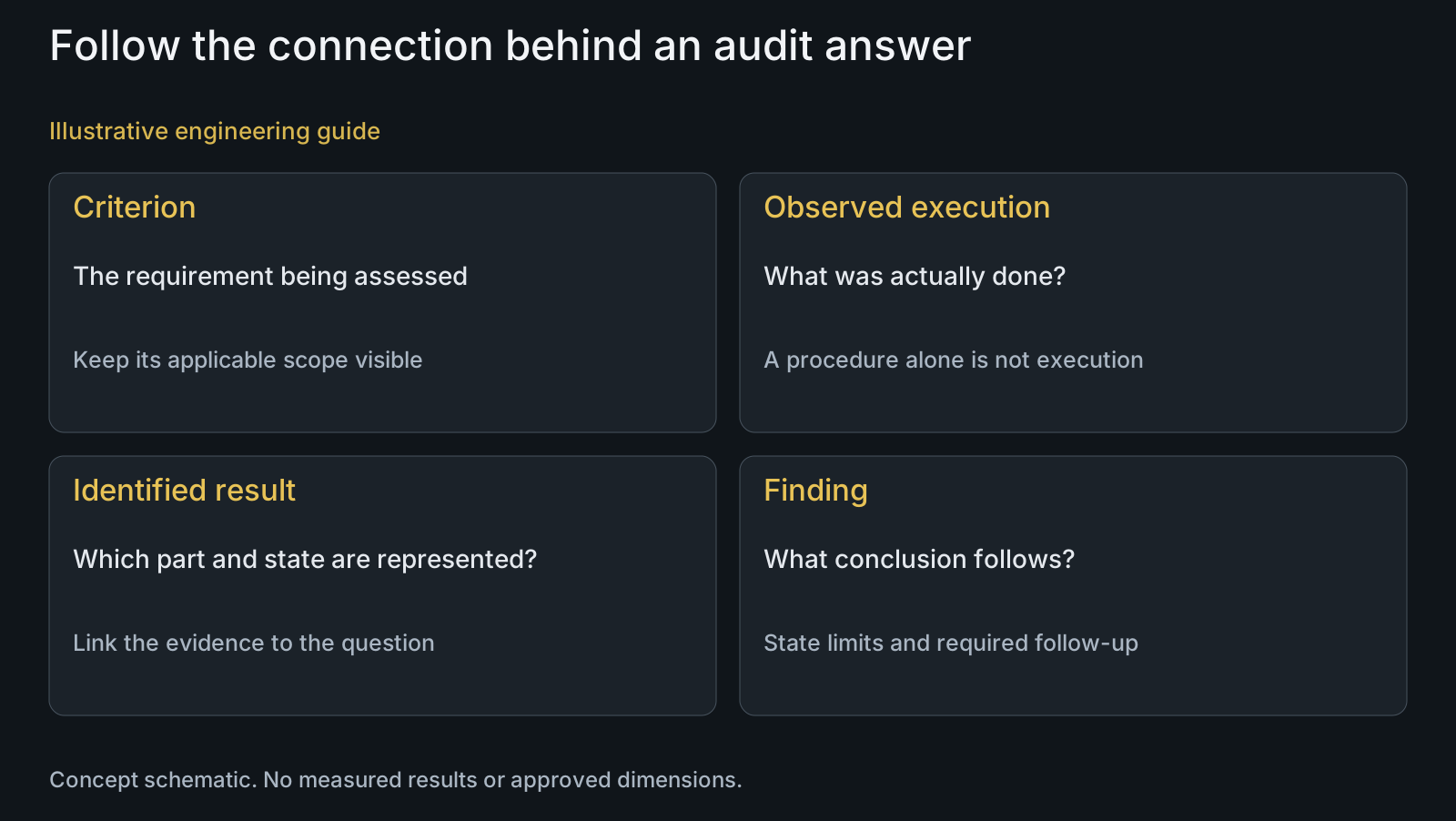
A useful pivot supplier audit tests how defined requirements become manufacturing and acceptance decisions. Follow a relevant identified order or agreed representative exercise, asking for evidence of execution rather than only a machine list or policy folder. Connect the drawing revision, material, functional feature, treatment state and delivery identity. Then examine a change or nonconformity to see whether the controls still work when the normal route is interrupted. These fifteen questions support a scoped OEM audit; they are not a universal scoring system. Good observations in one area cannot close an unexamined critical feature or approve an unrelated site and product.
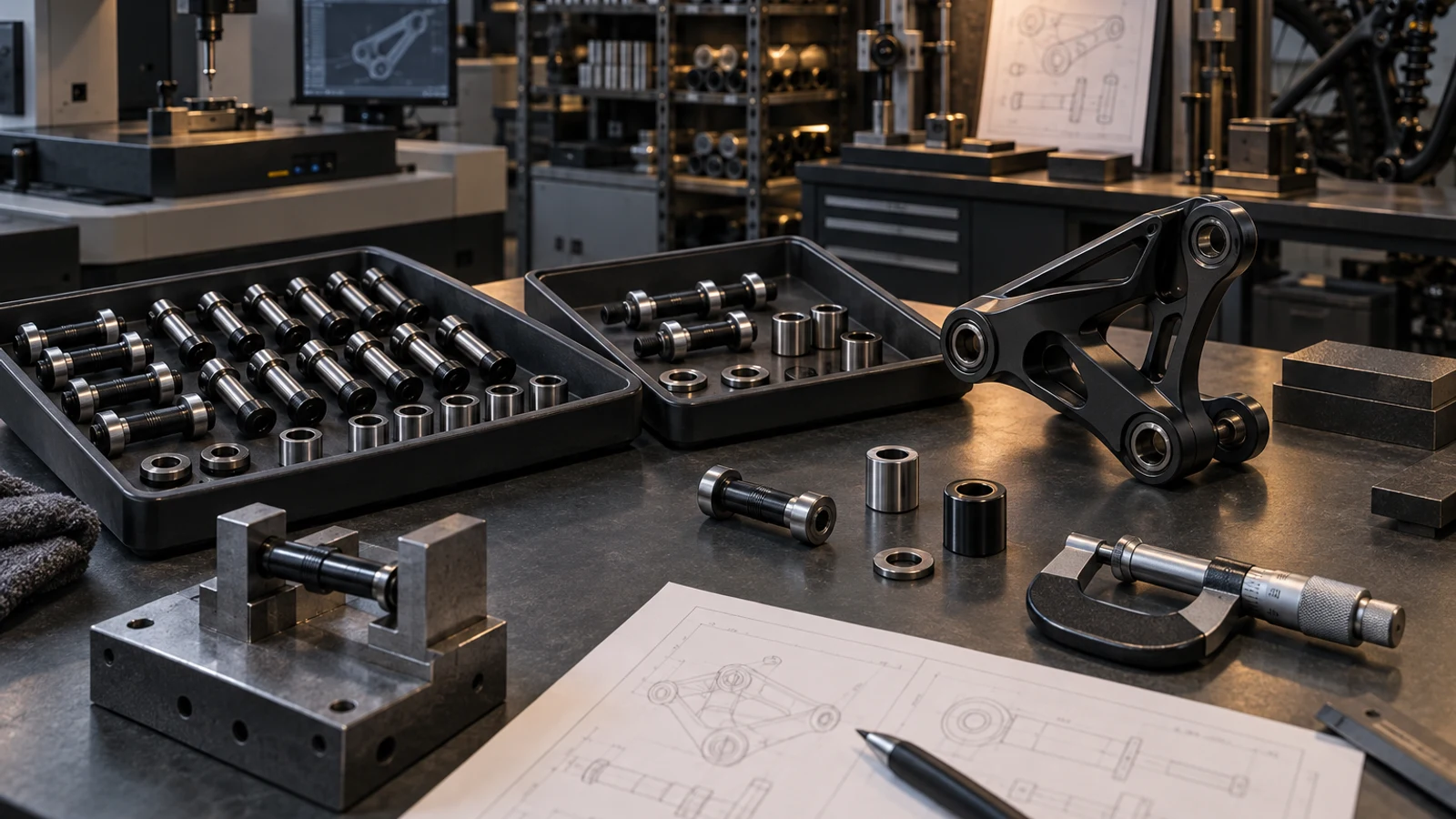
Hero: concept illustration of example hardware and its application. It is not a factory photograph, tested component or approved production geometry.
Set criteria and select a relevant audit trail
Identify the proposed site, parts or family, route and customer requirements before selecting evidence. A tour of available machines cannot answer whether a treated pivot shoulder is controlled against its datum. Choose an order or exercise that represents the feature and supplied condition you need to assess.
ISO 19011:2026's public scope concerns guidance for management-system auditing, including audit programmes and conducting audits. It does not itself provide product certification or this article's fifteen-question checklist. Apply any required customer audit criteria separately.
The ten-question supplier RFQ guide evaluates a candidate's initial response. This audit guide moves to observed execution: whether the described control was used, on which configuration, with what result and decision. Keep those tasks distinct.
Questions one to five: identity, requirements and the route
Confirm the actual manufacturing entity and site, then ask how the current customer requirement reaches the workplace. Look for the relevant part and revision, not merely a document-control procedure. Compare the active production definition with the agreed drawing and any accepted change.
Follow material identity into the selected manufacturing lot. Ask what happens when stock is split, reworked or combined for planning purposes. A certificate kept in a folder is not evidence that the represented material connection remains available for the component under review.
Observe how functional geometry is referenced and how specialist operations are controlled. The relevant question is not whether a CNC machine or treatment partner exists, but how the required feature and delivered state remain defined through the actual route.
| Audit question | Evidence to follow | Risk behind a vague answer | Decision supported |
|---|---|---|---|
| 1. Which entity and site perform this work? | Selected order and producing scope | Another site's capability is substituted | Applicable manufacturing identity |
| 2. Which requirement reaches the workplace? | Active part revision and accepted changes | Old definition remains in use | Current instruction applicability |
| 3. How does material identity reach this lot? | Stock-to-part relationship and splits | A loose certificate has no part link | Represented material coverage |
| 4. How is functional geometry referenced? | Setup and drawing datum relationship | Machine category replaces feature control | Feasible control of the required geometry |
| 5. How are specialist operations bounded? | Provider scope and final-state requirement | Responsibility disappears at the handoff | Required delivered-condition control |
| 6. What does this measurement represent? | Method, datum, sample and processing state | Result answers a different feature | Relevant inspection evidence |
| 7. How are instruments suitable for the task? | Applicable status and measurement setup | A calibration label alone is overinterpreted | Measurement suitability for this feature |
| 8. How are held parts and exceptions managed? | Physical identity and authorized disposition | Held items enter usable supply | Bounded nonconformity handling |
| 9. What did the sample demonstrate? | Identified sample purpose and evidence | Prototype result covers unstated production | Applicable sample conclusion |
| 10. Which output supports the capacity claim? | Relevant mix, remaining route and constraints | Machine count becomes a delivery promise | Order-specific production basis |
| 11. What event did the delivery commitment name? | Start conditions and represented milestone | Dispatch is reported as plant receipt | Comparable schedule performance |
| 12. How did a technical issue reach closure? | Answer reflected in active requirements | Fast reply is mistaken for resolution | Executed technical ownership |
| 13. Which demand authorized the work? | Forecast versus committed release | Indicative demand creates unagreed stock | Valid work authority |
| 14. Which supplied scope was priced? | Quoted items, final condition and exclusions | Unlike offers are compared | Defined commercial boundary |
| 15. How did change reach stock and kits? | Affected revisions, disposition and contents | New files coexist with old shipment identity | Controlled physical configuration |
Questions six to ten: measurement, exceptions and represented output
For inspection, select a characteristic that matters to the proposed assembly. Ask which datum, method, instrument and process state the result represents. ASQ's auditing explanation distinguishes process, product and system audit purposes. Decide which question your selected evidence actually answers.
Look at how held parts and a nonconformity are separated from usable supply, and how the disposition is authorized. A written quarantine procedure is only one input; inspect the represented identity and decision trail. If actual records cannot be disclosed, agree a bounded exercise and state that limitation.
Compare claimed relevant experience, sample purpose and production output with their represented scope. A sample made for appearance does not demonstrate production inspection. A capacity statement without its product mix and remaining operations does not establish output for the requested complete kit.
Questions eleven to fifteen: delivery and change execution
Examine a delivery promise against its start conditions and endpoint. Then follow a technical question to the controlling requirement, not only the speed of the first reply. A rapid acknowledgment and an executed correction are different evidence.
Check how forecast and firm work authority are distinguished, and how the quoted scope identifies exclusions. For a change, follow the affected parts, work in process and stock into the new boundary. The audit needs to show what happened to earlier material, not merely that a newer drawing exists.
Finally reconcile kit identity with the shipment's supplied contents. Commercial and packing controls matter because accepted individual parts can still form the wrong configuration. Use the kit labeling guide to define the relevant identity subjects.
Review an unresolved datum after a convincing equipment tour
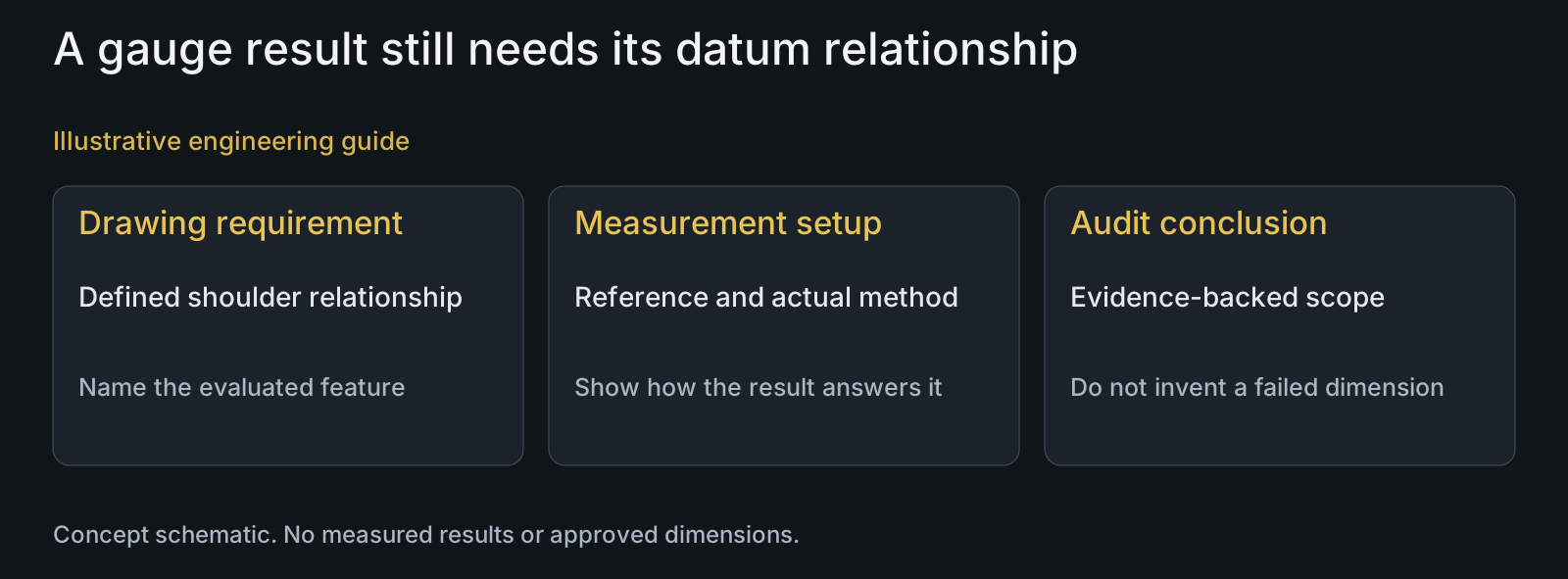
Illustrative engineering example: assume a proposed pivot requires a shoulder location relative to a datum. During a representative exercise, an auditor sees the relevant machining equipment and an inspection sheet, but the reported result is not linked to the stated datum setup. No actual supplier, measurement or failed audit is assumed.
The auditor asks the operator to explain the setup and how the result answers the drawing relationship. If that basis is not established, record the specific missing evidence and its affected scope. Do not invent a failed dimension or conclude that every process at the site is ineffective.
The next action concerns the measurement relationship and evidence of its execution. An attractive facility, valid system certificate or good commercial response does not resolve this particular gap. The example distinguishes a bounded finding from an unsupported overall supplier verdict.
Turn observations into scoped findings and follow-up decisions
Record the applicable criterion, observed evidence, identified configuration and conclusion. Separate a demonstrated deviation from an unanswered question or an improvement suggestion. Explain the consequence instead of blending everything into a numerical score without an agreed basis.
State the limits of sampling and access. One selected order does not prove every future lot conforms, and an unobserved partner operation should not be described as audited. The certificate assessment guide addresses organizational evidence separately.
PremFixer's confirmed model combines in-house manufacturing and qualified partner scope; discuss the relevant manufacturing route and proposed audit boundary. Agree evidence access and confidentiality without demanding another customer's drawings. Any supplier approval must identify its actual site, part and process coverage.
Questions buyers need to confirm
Is a completed checklist enough to approve a pivot supplier?
No. Evaluate the evidence against the applicable criteria and state the covered site, parts and processes. Completed rows do not close a critical unanswered feature or automatically approve unrelated work.
What order should an auditor follow?
Choose one relevant to the proposed geometry, material and delivered state, with an identifiable revision and route. If actual customer records are restricted, agree a representative exercise and disclose what it can and cannot demonstrate.
Does a calibration label prove the inspection method is suitable?
Not alone. Review the characteristic, datum setup, instrument status and actual measurement relationship. A valid instrument can still be used in a setup that does not answer the required drawing question.
Can a management-system certificate replace a process audit?
No. It supplies organizational assurance within its stated scope. The proposed order's functional route and executed controls need relevant evidence; a certificate is not a dimensional result or a record of your audit.
Should missing evidence be recorded as a failed measurement?
No. Record what is actually known, the affected criterion and the missing basis. Distinguish unanswered questions from demonstrated deviations and improvement suggestions, then define the appropriate follow-up.
What is needed to arrange a useful supplier audit?
Provide the proposed site and manufacturing scope, drawing and BOM, critical features, customer criteria and requested evidence access. Agree confidentiality and any representative exercise so the audit can evaluate execution without inventing unavailable project records.
Technical references and scope
ISO 19011:2026 public scope. Management-system audit guidance and current public edition; this original checklist is not claimed to be the standard or a certification scheme.
ASQ auditing explanation. Public distinction between audit purposes and evaluation of execution. Its older ISO edition reference is not used as current-edition evidence.
Explore related component, material and sourcing decisions in the customer decision knowledge center. For a drawing review, use the Drawing/BOM RFQ path.
Set the audit boundary around the proposed pivot work
Share the drawings, STEP model, BOM, material and final-condition requirements, proposed scope and customer audit criteria. Identify the critical interfaces and required evidence access. The review will establish a relevant audit trail, distinguish observed execution from descriptions and define the site and process coverage under assessment.
Discuss the drawing and BOM