
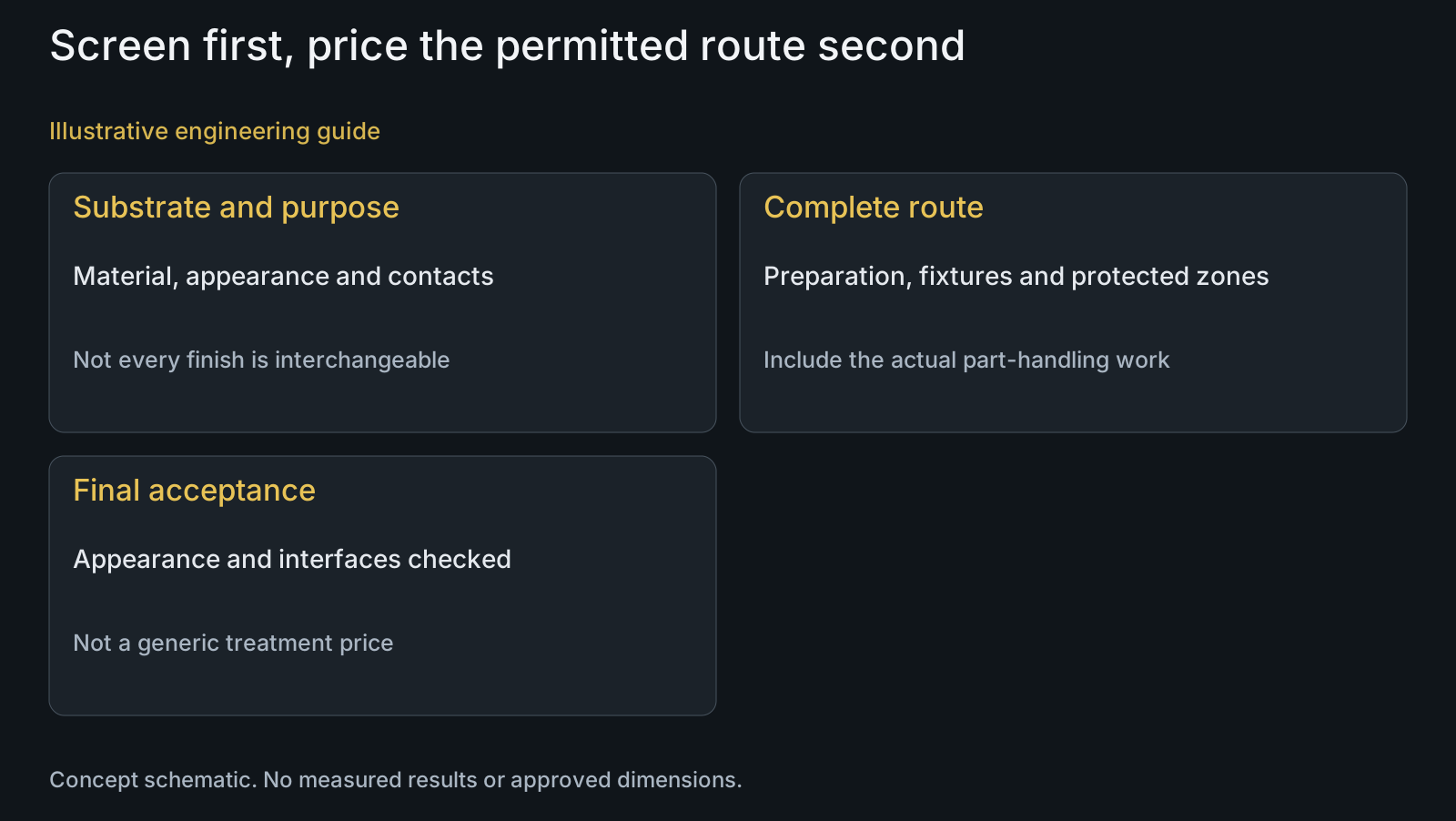
Passivation, anodizing and PVD cannot be ranked responsibly as three interchangeable pivot finishes with fixed per-part prices. The buyer must first identify the substrate, required appearance, functional contacts and final acceptance state. Only routes that address those requirements belong in the cost comparison. Include preparation, fixture or rack arrangements, protected zones, batch quantities and the checks needed after treatment. A low coating line can exclude the work that preserves a bearing seat or thread. PremFixer coordinates agreed surface work with qualified partners where required; this discussion does not establish every treatment as an in-house service. Compare complete finished routes, with unsupported prices and performance promises left out.
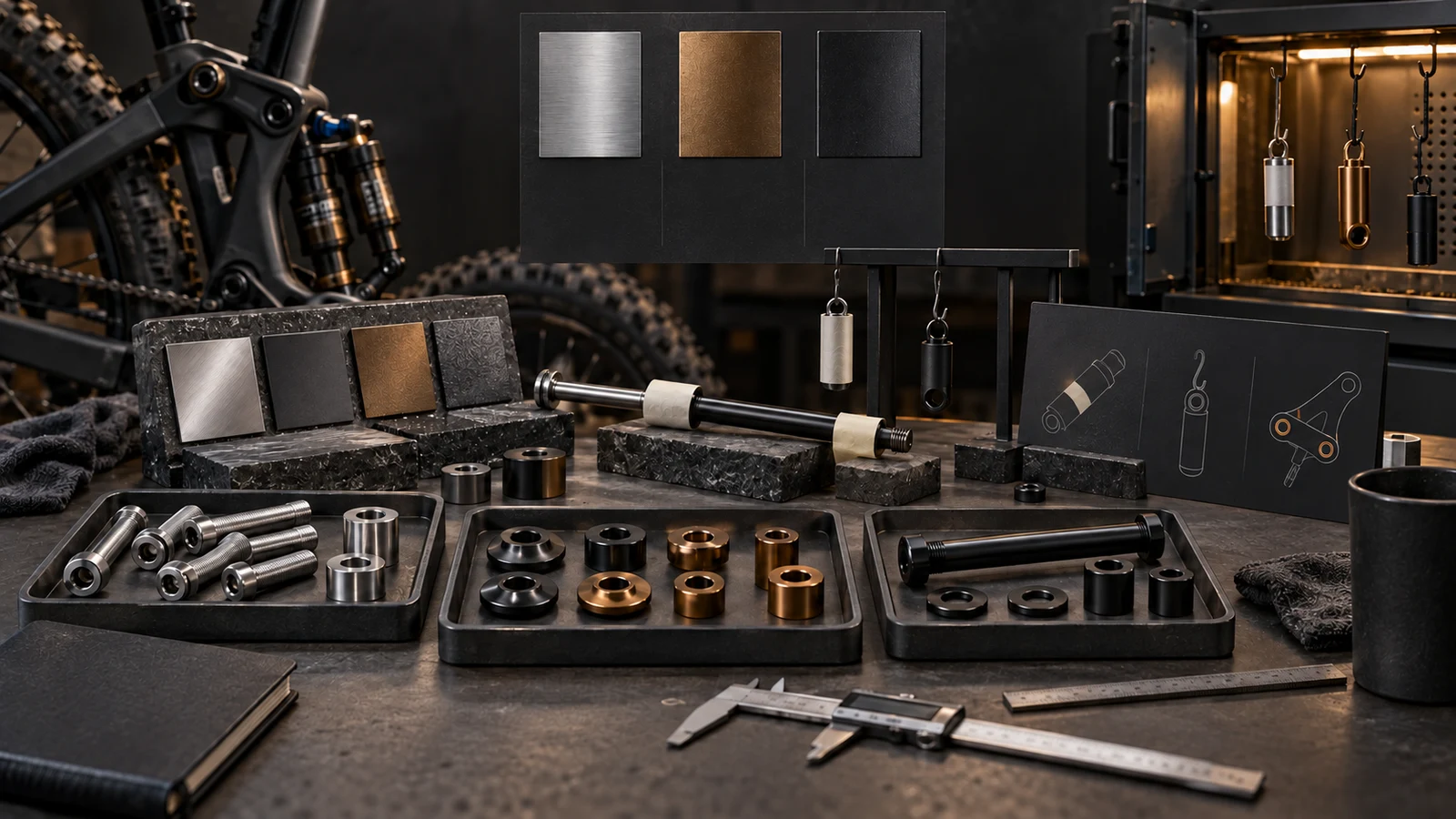
Hero: concept illustration of example hardware and its application. It is not a factory photograph, tested component or approved production geometry.
Screen the process before comparing its price
Stainless passivation, aluminum anodizing and a specified PVD coating describe different substrate and process relationships. A shared color objective does not make them interchangeable. Start with the actual material and condition; if the substrate also changes, identify a separate material-and-finish alternative.
ASTM A967/A967M's public scope addresses stainless passivation treatments and checks of treatment effectiveness. It does not select a suitable grade or treatment for every application. A quoted passivation operation is therefore not automatically a complete answer to wear, color or installed corrosion requirements.
The environment-based finish guide evaluates exposure and functional zones. Here the independent task is commercial route completeness: what must be included for the proposed finished condition to be comparable. Use Materials to keep the underlying substrate explicit.
Identify preparation and part-handling work
Record the incoming surface and any preparation included in the offer. An already prepared part and an untreated part may need different work before the same named process. Do not assume a low unit treatment line includes every cleaning or surface-preparation step needed by the proposed system.
Ask how the actual geometry is held or presented to the process. Rack contacts, fixtures and handling can matter to visible areas and functional features. The quotation should define their permitted locations or the decisions still needed; a generic flat coupon cannot resolve every restriction on a recessed pivot component.
For repeat orders, clarify what setup remains applicable and what quantity or geometry change affects it. No universal minimum finishing batch or free fixture reuse is implied. These are provider-specific quotation assumptions, not facts inferred from the part's small size.
| Comparison item | Required basis | Risk of a cheaper line | What to verify |
|---|---|---|---|
| Passivation candidate | Specified stainless substrate and purpose | Treatment check called application approval | Controlling treatment and evidence scope |
| Anodizing candidate | Actual alloy, condition and surface objective | Color label hides preparation or protection | Reference, zones and delivered fit |
| PVD candidate | Named system and substrate compatibility | Premium label substitutes for requirements | Process proposal and application evidence |
| Fixturing or rack contact | Actual component geometry | Unpermitted marks or coverage assumptions | Allowed locations and handling |
| Masking and final operations | Functional zones and final dimensions | Necessary interface work excluded | Protected features and inspection state |
| Batch and repeated supply | Same quantity and acceptance output | Assumed minimums or free reuse | Dated provider assumptions and changes |
Price functional-zone protection as part of the route
Show bearing seats, threads, clamp faces and visible surfaces separately. State which receive treatment, which are protected and which require another agreed final operation. A whole-part finish name leaves those decisions unresolved and may produce quotes for different physical outputs.
Masking is not simply a cosmetic option when it preserves a controlled interface. Conversely, omitting treatment from a seat can affect the protection expected there. Resolve the surface and dimensional requirement together instead of choosing the cheapest masking arrangement without engineering review.
Ask which final checks are included and what supplied state they represent. A dimension reported before treatment cannot automatically accept the delivered interface. Review the proposed route through surface treatment, without imposing an invented universal coating allowance.
Specify the actual PVD system instead of a premium label
Oerlikon's PVD overview distinguishes process variants and explains that coating properties depend on the selected materials and process. It also emphasizes the application system when assessing friction and wear. That supports identifying the proposed coating, not treating PVD as one guaranteed outcome.
Discuss substrate compatibility, preparation, processing conditions and geometry coverage with the provider. A decorative dark appearance and a wear-related contact requirement may need different definitions and evidence. Do not quote an unspecified PVD label as though it approves both purposes.
Keep the finished interface and material condition in scope. A process temperature or thickness from another provider's general page is not a bicycle acceptance limit or proof of compatibility with the ordered part. The review needs the actual proposed system and its evidence boundary.
Compare acceptance scope before calling an option cost-effective
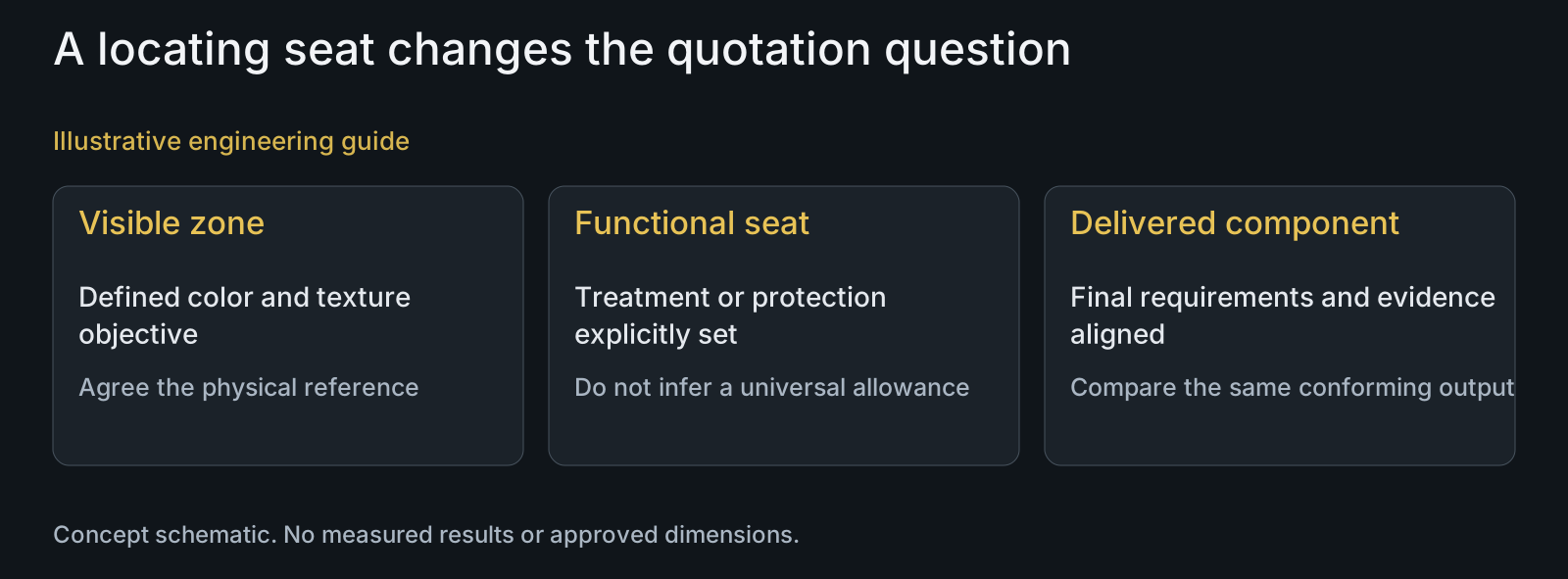
Separate appearance acceptance, final size, process evidence and any relevant performance evaluation. A visually matched sample cannot answer all four. Define which reports, representative items and checks the quotation includes so a cheaper offer is not merely a reduced evidence scope.
For aluminum appearance, identify the alloy, preparation and physical reference. The appearance and marking review treats those inputs separately. Different routes need not produce the same shade, gloss or surface texture merely because they share a color name.
Compare total delivered scope and permitted repeat-order conditions, not only the finishing line. Include specified protection during packing and any separately agreed handling of nonconforming work. Do not presume a rework rate, automatic free rework or a guaranteed life benefit from the chosen finish.
Review example: two anodizing offers cover different seats
Illustrative engineering example: assume an aluminum pivot cap has a visible color surface and a controlled locating seat. One proposed offer describes whole-part anodizing; another includes a specified protected seat and final interface check. No dimensions, prices, coating changes or acceptance result are assumed.
The buyer asks which route the drawing actually permits. If the seat requires protection, the whole-part offer is not yet an equivalent lower-cost option. If engineering permits treatment there, the final fit definition and evidence must still be clear. Neither offer wins from its treatment label alone.
The reviewer compares preparation, permitted contact locations, protected areas, appearance and final checks on the same batch basis. The resulting quotation question concerns a conforming finished component. It does not establish which route is cheaper or approve a seat from a conceptual image.
Questions buyers need to confirm
Which finish is cheapest for pivot hardware?
No universal ranking is established. First identify routes compatible with the actual substrate and required function, then compare dated complete offers. Fixed per-piece prices from a framework cannot represent current project quotations.
Can passivation, anodizing and PVD be quoted for the same purpose?
They need not provide the same function or fit the same substrate. Specify material, appearance, contacts and protection objectives. If a route changes the substrate or performance basis, identify it as a separate alternative.
Why do finish quotes need the component drawing?
Geometry determines treated and protected zones, fixture access and final interface checks. A generic part description can support only a limited estimate because it does not resolve those operations or acceptance requirements.
Is masking an optional extra?
Not when the accepted definition requires a protected functional area. Identify the zone, final dimension and protection objective together. Omitting required masking or another final operation changes the supplied component, even if the finish name stays the same.
Does PVD automatically justify a higher price through longer life?
No. Specify the actual coating system and relevant application evidence. A manufacturer's general coating description cannot establish life for the supplied pivot, and price itself is not performance evidence.
How should repeat finishing orders be compared?
Keep substrate, geometry, preparation, references, zones, quantity and evidence scope identifiable. Ask what provider setup remains valid and what changes trigger another offer. No universal batch minimum or free fixture reuse is promised.
Technical references and scope
ASTM A967/A967M-25 public scope. Stainless passivation treatment/effectiveness scope, not application-specific suitability. Full paid clauses not accessed; no process recipe prescribed.
Oerlikon Balzers PVD overview. PVD process variation, selected system properties and application assessment; no temperature, thickness, life or ownership transferred to PremFixer.
Explore related component, material and sourcing decisions in the customer decision knowledge center. For a drawing review, use the Drawing/BOM RFQ path.
Quote the complete finish route and its final interfaces
Send drawings, STEP, exact substrate and condition, visible references, functional zones, required protection, quantities and final inspection scope through the Drawing/BOM RFQ path. PremFixer can coordinate a route review and identify which provider assumptions must be resolved for a comparable finished offer.
Discuss the drawing and BOM