
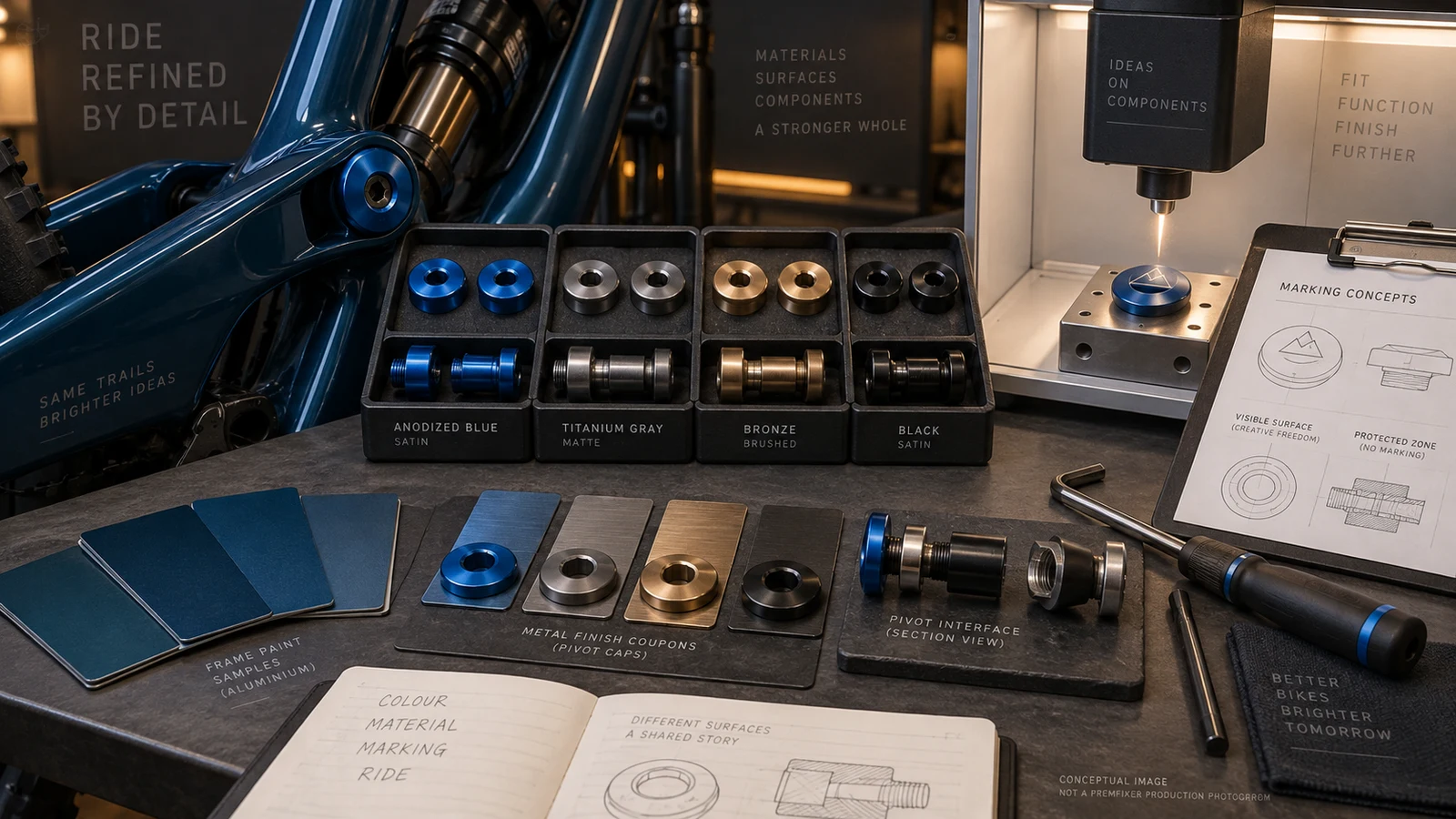
A frame brand color can guide pivot hardware development, but it does not by itself define an achievable or accepted metal finish. The OEM is deciding how visible axle heads, caps and spacers should look beside the painted frame and which markings belong on them. Separate the brand's visual objective from the hardware reference that the chosen material and finish must reproduce. Agree visible regions, comparison conditions and marking content while retaining independent fit and surface requirements. No universal color-difference limit or exact paint-to-anodized-metal match is promised. An assembly instruction marked on the part must already be valid for its identified configuration.
Hero: concept illustration of example hardware and its application. It is not a factory photograph, tested component or approved production geometry.
Separate the brand objective from the supplied-part reference
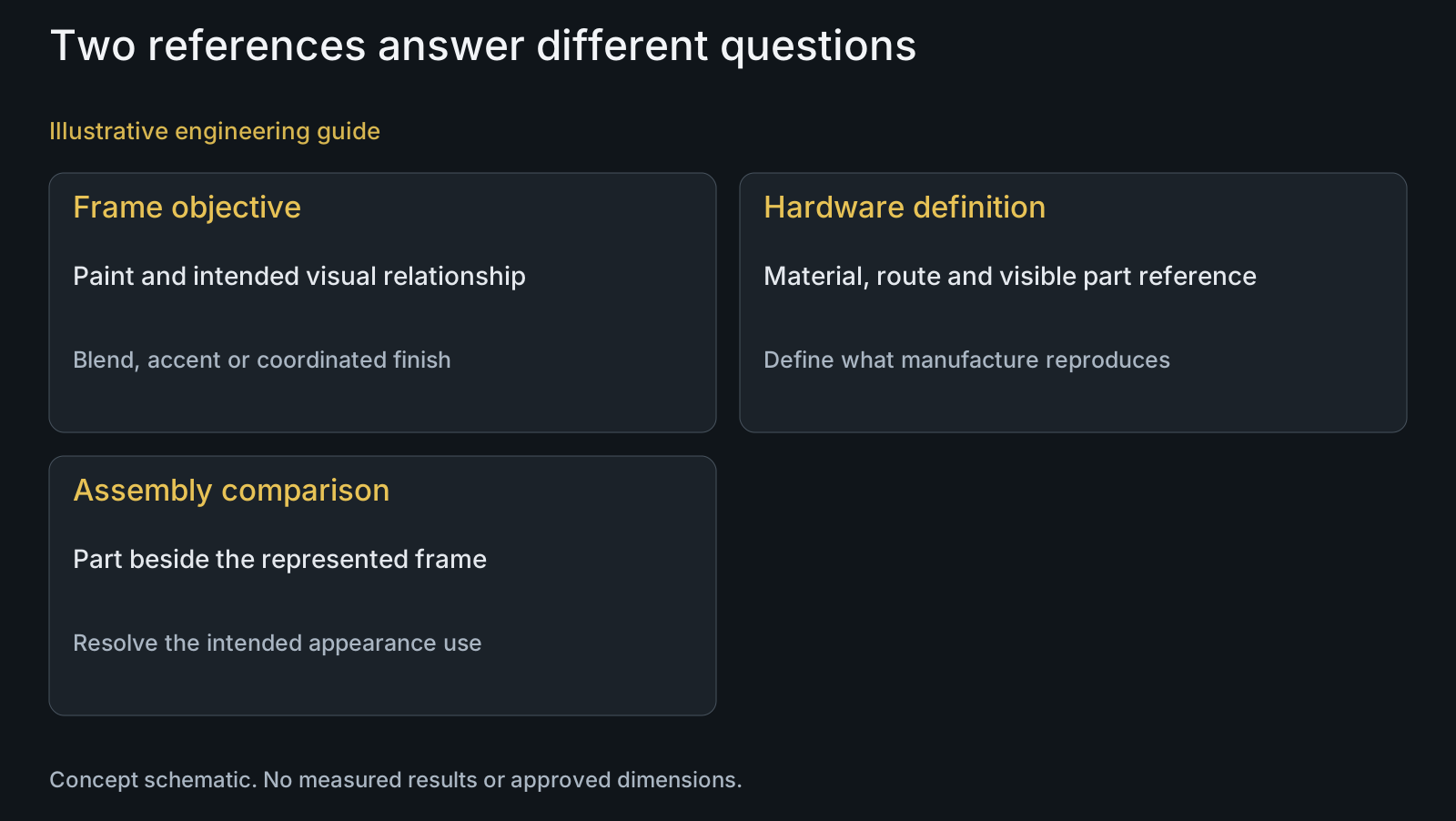
Identify the frame reference, its revision and what the hardware should do visually: blend with it, provide a deliberate accent or coordinate with another component. Those are different objectives. A part that is intentionally metallic need not be specified as an identical painted surface.
Develop a hardware reference on the represented material and finish rather than treating a screen image or color name as final acceptance. Preserve its relationship to the frame objective. If the buyer approves an accent sample, that decision should not later be described as an exact paint match.
Include the intended assembled view. A cap evaluated alone and a cap beside a large curved frame can pose different appearance questions. The batch-consistency guide addresses later lot mixing; this article defines the initial cross-material appearance and brand-marking requirement.
Choose the finish with the material and texture visible
The Aluminum Anodizers Council explains that alloy and temper influence anodized appearance and that mechanical preparation affects the visible surface. Its bulletin treats alloy, preparation and anodic finish as specification inputs. Those relationships apply to its aluminum scope, not a promise about titanium or stainless coloring.
Review the actual grade and condition through the materials discussion. Compare proposed finish routes using representative surfaces rather than assuming one named color means the same result on every material. Do not change a load-carrying material solely to chase an appearance without a separate engineering decision.
State the texture or sheen expected on visible regions and which features must retain their functional finish. A brighter reference and a matte candidate can disagree even when the color description is similar. Request a route review through surface treatment, without assuming a particular process is supplied for every alloy.
| Input or decision | Useful purpose | Risk if used alone | Define or verify |
|---|---|---|---|
| Brand color code | Communicating the visual objective | Called exact paint-to-metal acceptance | Actual reference and intended relationship |
| Painted frame sample | Representing the neighboring surface | Treated as the anodizing process master | Separate hardware development reference |
| Flat finished coupon | Comparing route candidates | Curved cap appearance left unresolved | Representativeness of the visible part |
| Finished cap reference | Defining the delivered appearance | Functional finish ignored | Visible zones and protected interfaces |
| Logo artwork | Controlling brand content | Placement compromises working features | Approved zone, orientation and final condition |
| Instruction marking | Communicating a valid assembly instruction | Number treated as engineering approval | Configuration and authorized instruction |
Make the comparison method answer the appearance question
Name the visible region, reference, illumination and viewing arrangement. If an instrumental criterion is proposed, agree its calculation and measurement configuration for that surface. A bare color-difference number does not identify which part, region or comparison conditions it governs.
For a small curved head, identify how the assessment represents the assembled view. A flat coupon can help develop the finish without automatically settling the appearance of a recessed or curved component. Keep that representativeness question explicit instead of choosing whichever photograph looks closest.
Separate development selection from batch acceptance. The first chooses the intended appearance; the second checks delivered parts against an agreed requirement. A selected sample does not itself demonstrate process variation, long-term appearance or a numerical capability across every future order.
Plan brand marking and instruction marking differently
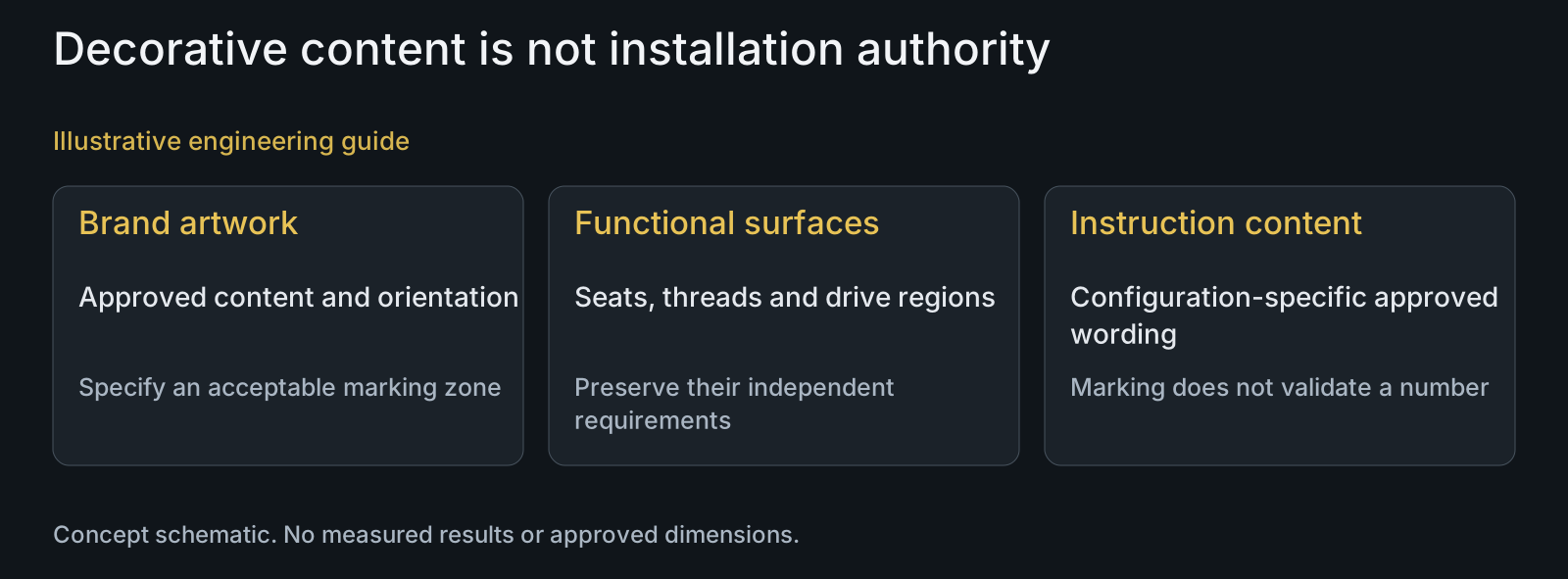
Define the approved artwork, orientation, visible location and readability requirement for a brand mark. Specify its allowed zone relative to seats, threads, drive features and other working regions. A visually convenient location is not automatically an acceptable manufacturing location.
An instruction such as a torque value has a different authority requirement from a logo. Identify the assembly configuration and approved instruction it represents. Do not invent a number to complete the artwork, or retain a marked instruction after changing the relevant surface and assembly basis.
Review the sequence of marking and finishing so the final requirement is clear. State how the resulting appearance and functional features will be accepted through manufacturing review. This does not claim that laser marking is harmless under every setting or that any marked number validates installation.
Keep appearance changes connected to production and service
When the frame paint or approved hardware reference changes, identify which objective changed and which supplied-part requirement follows. A new frame color does not automatically authorize refinishing previously accepted hardware or changing protected surfaces.
State whether service replacements should follow the current hardware reference or another defined requirement. An installed part may no longer represent its original new appearance. Avoid promising a replacement will visually match every aged frame or exposed cap without an applicable basis.
Keep marking identity consistent with the finished member and its use. The packaging and identification guide supports selecting the correct supplied item. Decorative similarity is not evidence of platform compatibility, and updated artwork must not hide a changed component definition.
Review example: the paint chip is not the metal master
Illustrative engineering example: assume a brand provides a painted frame chip and requests anodized aluminum caps with a matching brand appearance. An early flat metal coupon is selected, but the final visible parts are curved caps beside the frame. No measured color difference or successful match is assumed.
The reviewer separates the paint objective from the proposed hardware reference and assesses whether the coupon represents the curved caps. The visible part and assembled comparison are then included in the acceptance definition. A torque marking request remains subject to the approved installation instruction, independent of color selection.
The outcome is a better-defined development request, not a guaranteed color result. If the selected route cannot support the visual objective without compromising functional requirements, the brand can consider a deliberate accent or another reviewed appearance rather than quietly relax the engineering definition.
Questions buyers need to confirm
Can a brand color code guarantee the cap matches the frame?
No. It defines an objective, not the complete appearance of a different substrate and finish. Provide the actual frame reference, intended visual relationship and proposed hardware material so development can establish an appropriate part reference.
Should the paint chip be the only acceptance master?
Not by default. Separate its role as the brand objective from the hardware reference for the chosen process. Define how the finished part is compared with both, rather than assuming painted and treated metal surfaces are identical.
Can a flat coupon approve every curved pivot cap?
Only with a basis that it represents the stated appearance question. Consider the visible region, viewing arrangement and assembled relationship. The coupon can select a route while leaving actual cap appearance unresolved.
Is one universal color-difference limit appropriate?
No universal value is specified here. Agree the reference, calculation, measurement configuration and relevant region for the actual requirement. Do not treat an unsupported threshold as confirmed manufacturing capability.
Can a torque value be added as part of the logo artwork?
It needs separate engineering authority. Use the approved instruction for the identified component and assembly condition, with its applicable scope. Artwork approval or a legible laser mark does not create a torque specification.
What belongs in an appearance and marking RFQ?
Provide the frame reference, hardware drawings and material, proposed finish, visible and protected zones, artwork and any authorized instruction content. Include comparison conditions, prototype quantities and service expectations so both appearance and functional questions are defined.
Technical references and scope
Aluminum Anodizers Council: specifying anodized finishes. Educational bulletin, initial release February 2013: alloy, temper and preparation are inputs to aluminum anodized appearance. Not current certification clauses or a universal numeric matching requirement.
Explore related component, material and sourcing decisions in the customer decision knowledge center. For a drawing review, use the Drawing/BOM RFQ path.
Develop the hardware appearance without losing function
Send frame reference samples, part drawings and STEP, material and finish requirements, visible-zone views, approved artwork and prototype quantities through the Drawing/BOM RFQ path. PremFixer can review the manufacturing definition and candidate scope without assuming an exact color guarantee or creating installation instructions.
Discuss the drawing and BOM