
A shorter pivot CNC program is useful only if it preserves the required operation and produces the specified component. Start with the changed movement, tool sequence or check, and ask what it previously accomplished. Non-cutting motion can provide necessary clearance or positioning; an inspection pause can supply required process evidence. Neither is automatically waste. Compare the revised program against the actual stock, tools and workholding, and distinguish a visual animation from the checks performed by the verification system. Then evaluate the manufactured output on the same drawing and supplied-state requirements. Keep any claimed delivery benefit separate until the order schedule supports it.
Hero: concept illustration of example hardware and its application. It is not a factory photograph, tested component or approved production geometry.
Describe the change rather than quoting a saving
Identify whether the proposal changes an approach or retract motion, a tool change, an operation sequence or a measurement activity. These changes have different consequences. A single total-time number conceals whether the part is produced differently or whether work has simply moved outside the reported cycle.
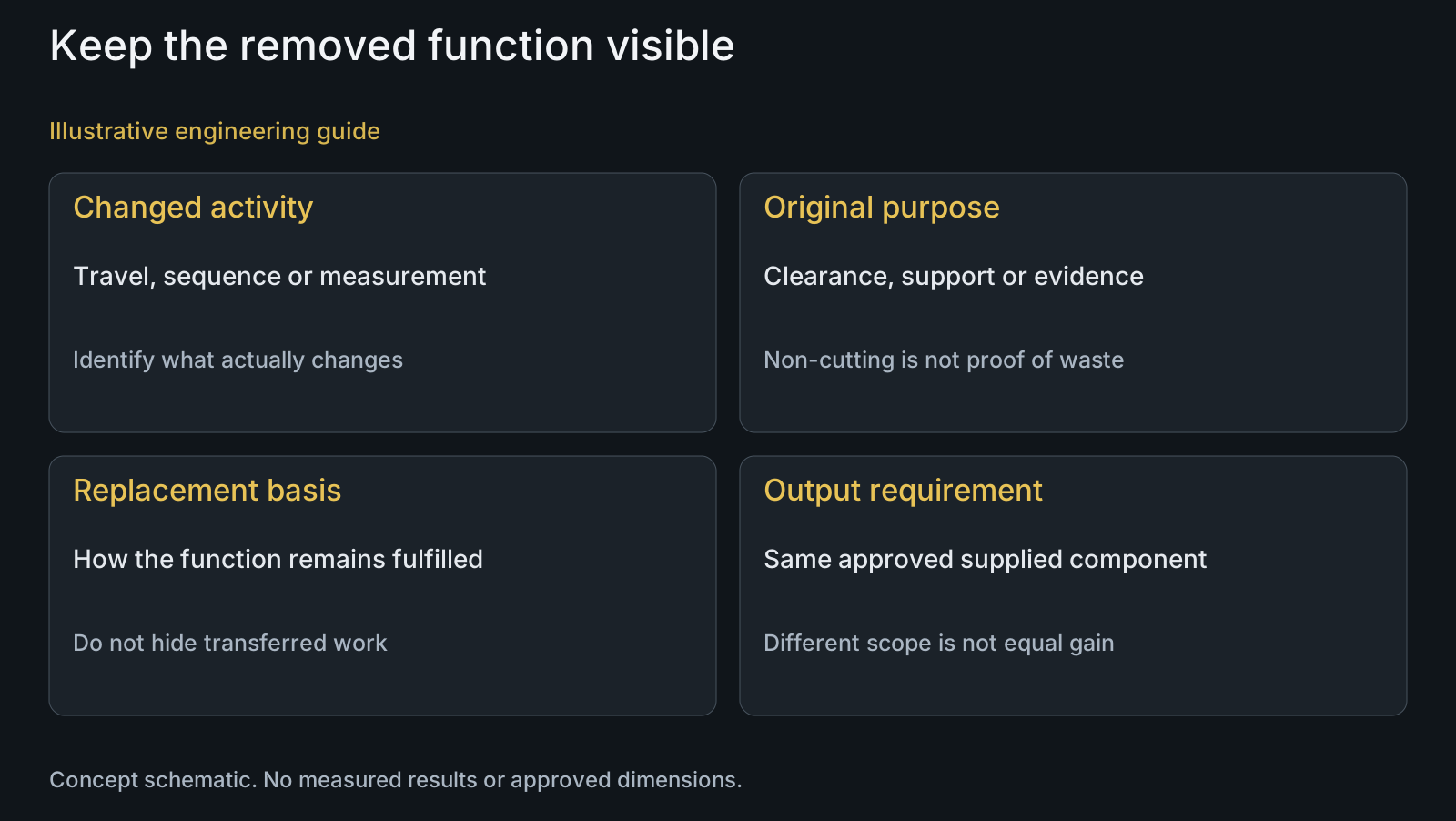
For each removed or combined activity, state its original purpose and how the revised route fulfills that purpose. Repeated travel may be a candidate for review, but the responsible manufacturing team must assess the actual clearance and setup. This article provides no suggested coordinates, reduced clearance value or runnable program.
Keep the component revision and required supplied state constant in a like-for-like comparison. If the proposal changes a feature, material allowance or finish, describe it as a changed scope requiring its own approval. Do not present a different component as a faster version of the approved one.
Non-cutting does not mean unnecessary
Consider the workholding, stock and tools represented during a movement. A path clear of the finished CAD shape may still need to account for the current stock and surrounding setup. Shortening a motion on the screen does not establish a safe path on the actual machine.
Ask what changes when operations are reordered. The part's support and remaining material can differ at successive stages, and a later operation may affect a feature already finished. An altered sequence needs its own manufacturing assessment, not an assumption that fewer transitions preserve every earlier conclusion.
Keep any required process or inspection function visible. If measurement is relocated rather than removed, identify the new coverage and state. If it is removed, the proposal must explain why the required control remains adequate; an omitted activity cannot be counted as unchanged acceptance scope.
| Proposed change | Function to preserve | Misleading conclusion | Evidence to compare |
|---|---|---|---|
| Shorter non-cutting travel | Setup-specific access and clearance | No cutting means no necessary function | Represented stock, tools and setup assessment |
| Changed operation sequence | Support, feature relationships and final requirements | Fewer transitions prove unchanged output | Revised sequence basis and affected-feature checks |
| Relocated inspection | Required characteristic and piece coverage | Outside-cycle work has disappeared | New check location, condition and usable results |
| Deleted measurement | Justified process and acceptance control | Less checking is like-for-like efficiency | Explanation and evidence for retained control scope |
| Shorter simulated estimate | Actual program and accepted supplied output | Animation proves production duration | Applicable verification and comparable actual output |
An animation is not the complete verification result
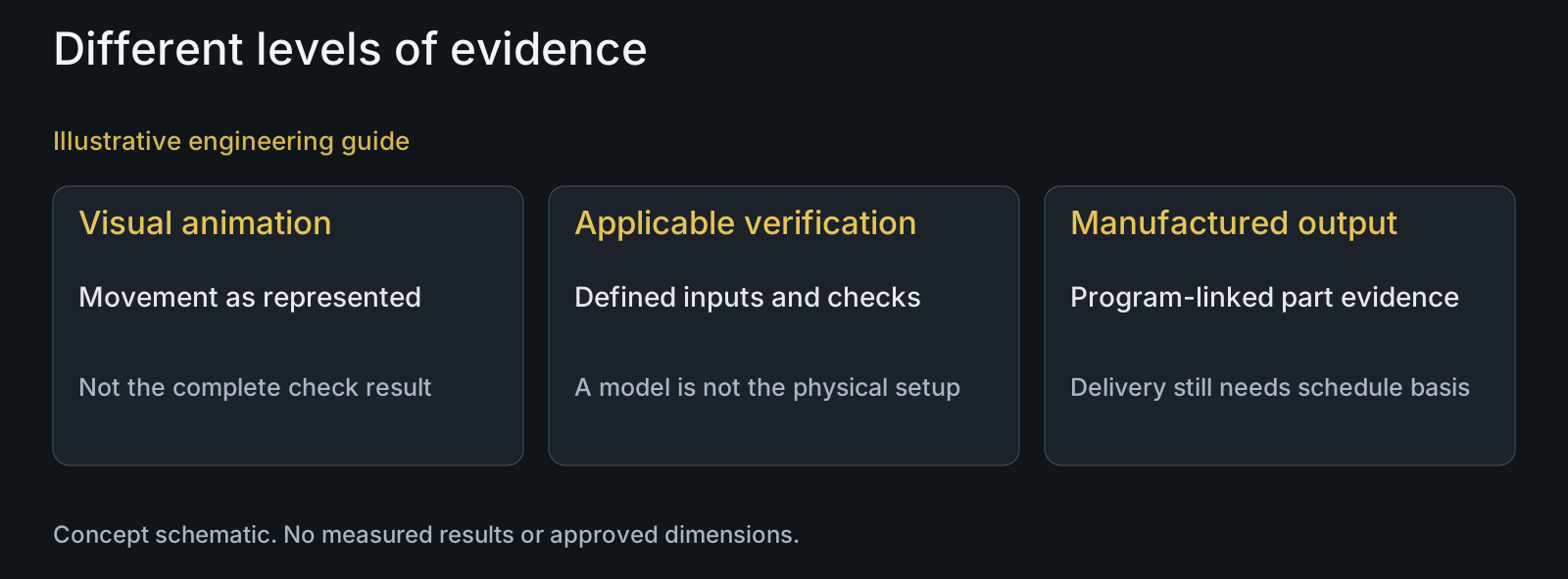
Autodesk's simulation documentation distinguishes animation from verification. It also distinguishes simulations with and without machine information. Its listed capabilities depend on the mode and setup; machine simulation on that page is specifically described for milling setups.
For a pivot review, ask what was actually represented and checked: component revision, stock, tools, workholding and relevant machine or post-processor information where applicable. Do not infer complete collision coverage from a smooth animation or apply a milling-specific software capability to every turning program.
The documentation also notes that visual animation can skip collision detection while verification performs it. Therefore, a video with no visible warning is not the same evidence as the relevant verification results. No software installation, configured model or collision-free program is claimed for PremFixer here.
Screen review and physical output answer different questions
Haas's lathe graphics explanation describes displayed movement without physical machine motion. That is useful context for program review, not a manufactured sample, measured feature or proof of a particular cycle duration.
The manufacturing team must assess the actual program and setup using the applicable equipment instructions and approved local procedures. Record which revision produced the evaluated output. A checked earlier program does not automatically validate a later edited one or a different fixture arrangement.
Compare required characteristics on the manufactured part, not just program appearance. Include any affected thread, locating surface, transition or internal feature. If additional finishing or inspection has moved elsewhere, keep it in the complete comparison rather than declaring it absent because it is outside the machine cycle.
A shorter retract and a deleted check are different proposals
Illustrative engineering example: assume a stepped pivot has two revised-program proposals. One changes repeated travel while retaining the required checks. The other removes a measurement activity and reports a shorter estimated cycle. No actual times, proven toolpath or component results are assumed.
The first proposal needs a setup-specific movement assessment and suitable output evidence. The second additionally needs a justified control arrangement: the buyer asks which characteristic the deleted activity monitored and how that function remains covered. Neither proposal wins solely because its displayed estimate is smaller.
Only after the relevant program, setup and output evidence are available can the comparison support an accepted-cycle claim. Any later delivery or price statement requires its own order and commercial basis. This example explains two different evidence tasks, not a qualified change, measured saving or recommended program edit.
Make the efficiency request inspectable
Send the drawing, STEP, stock condition, final finish, quantities and required inspection scope to the CNC manufacturing review. Identify whether the requested outcome is reduced machine occupation, a complete supplied cost comparison or a delivery review.
Use the measurement-coverage guide when a program proposal affects checks. The 7075 timing-boundary guide separately explains why a changed cutting segment, full cycle and finished-order milestone are different claims; the present decision is whether the proposed program change is supported.
PremFixer manufactures to the customer's agreed component requirements. An optimization proposal should preserve those requirements and explain relevant route changes. Do not infer a universal percentage saving, reduced order lead time or lower selling price from the CNC program label.
Questions buyers need to confirm
Should every non-cutting movement be removed?
No. Identify its clearance, positioning or other required purpose in the actual setup. The responsible manufacturing team must establish that the revised arrangement fulfills that function; no universal shortened movement is recommended.
Does a smooth toolpath animation prove collision-free operation?
No. Identify the inputs, mode and checks actually performed. Animation and verification can differ, and absent fixtures, stock or machine information cannot support conclusions about what was not represented.
Can a required inspection be removed to report a better cycle?
Not as an unchanged-scope comparison. Explain which characteristic and population it covered and how the required control remains addressed. A relocated check must remain visible in the complete route and cost scope.
Does a graphics run establish the physical machining time?
No. A screen representation is not a physical run or measured duration. Use evidence from the actual compared program, setup and required output when reporting a production result.
Why review output if the component CAD model is unchanged?
The manufacturing sequence, support or checking can still change. Identify affected characteristics and verify them against the same approved requirements. Unchanged design intent does not independently establish unchanged manufacturing output.
Will a shorter accepted cycle cut delivery time by the same percentage?
Not necessarily. Review the actual order dependencies and remaining operations. Report the supported program or cycle result separately from dispatch timing and quoted price; none is automatically the same percentage change.
Technical references and scope
Autodesk Fusion: Simulation for manufacturing. Full57-line page read; animation/verification, represented inputs and milling-specific machine-simulation boundary. No software ownership or transferred turning capability claimed.
Haas: Lathe operation, graphics mode. Graphics section430–452 read; no physical machine motion during display review. No control procedure, settings or installed-machine claim adopted.
Explore related component, material and sourcing decisions in the customer decision knowledge center. For a drawing review, use the Drawing/BOM RFQ path.
Evaluate a pivot CNC efficiency proposal
Send the drawing, STEP, material condition, required finish, quantities and critical-feature inspection scope. PremFixer will review the relevant route-change and comparison basis so reduced machine work is evaluated alongside retained component requirements and the requested commercial or delivery outcome.
Discuss the drawing and BOM