

A previous REACH declaration does not automatically cover a changed bicycle pivot BOM. An OEM buying bolts, receivers and spacers for a European program should match the statement to the actual supplied components, materials and treatments, then check the information date and question it answers. Candidate List information and restriction assessment are not the same deliverable. A generic supplier letter or an unspecified SVHC screening report cannot establish permanent coverage for every configuration. Start by identifying the changed item and relevant evidence. The review may confirm existing coverage or reveal a defined gap; it should not begin by assuming either compliance or a violation.
Hero: concept illustration of example hardware and its application. It is not a factory photograph, tested component or approved production geometry.
Identify the supplied article before asking for a declaration
List the individual pivot components in the BOM and connect them to part revisions and delivered conditions. A steel bolt, a treated receiver and a supplied sealing component may rely on different information. A kit name alone can conceal which item a document actually represents.
Include specified coatings, topcoats, patches and any supplied ancillary material in the request. Do not assume a base-metal statement describes every retained treatment. Ask the responsible compliance reviewer to establish the correct assessment scope where products combine several components or materials.
The finish-specific REACH and RoHS guide develops surface-system questions. Here the focus is maintaining usable REACH information across the complete supplied BOM and subsequent revisions, not selecting a particular finishing chemistry.
Name the REACH question rather than request universal approval
ECHA's supply-chain explanation identifies Article 33 information duties for articles containing a Candidate List substance above 0.1% by weight. That specific communication basis must not be described as a general limit proving every aspect of REACH conformity.
ECHA distinguishes restrictions as controls that can apply to substances on their own, in mixtures or in articles. A Candidate List statement therefore does not answer every restriction question. Determine relevant obligations for the actual product and responsible supply-chain role.
Customer requests can also be contractual, such as a specified reporting format or broader substance disclosure. Label that request separately from the legal basis. The supplier's component information supports the responsible party's assessment; it does not decide every importer or finished-product obligation.
| Change or request | Question to resolve | Risk of assuming coverage | Useful evidence |
|---|---|---|---|
| Material or treatment changed | Does the statement represent the new item? | Old configuration retained under same kit name | Identified part and revised supply information |
| Candidate List basis changed | Does available information address the list? | Unchanged hardware treated as permanent coverage | Named reference date and coverage review |
| Restriction question requested | Which provision applies to the actual product? | SVHC statement mistaken for all REACH duties | Applicable requirement and responsible assessment |
| Screening report supplied | Which specimen and substances were evaluated? | Report title treated as universal absence | Sample identity, methods and limitations |
| Multiple suppliers in kit | Which item does each statement cover? | Bolt document assigned to receivers and seals | Component-level information mapping |
Read a declaration and a screening report as different evidence
A declaration should identify the represented products, question, reference date and information basis. That basis may include relevant supply-chain information or a defined analysis. An unqualified sentence that all products comply gives a buyer little help in deciding whether a particular revised BOM is represented.
A screening report applies to identified specimens, selected substances and stated methods. Check what was actually evaluated and any limitations. A report name containing SVHC does not establish that every candidate substance, component or delivered treatment was assessed under the question now being asked.
Do not interpret not detected as absence of every substance in the entire kit. Nor should an older statement be rejected only because it is old. Compare its evidence coverage and reference date with the current product and request before deciding what additional information is needed.
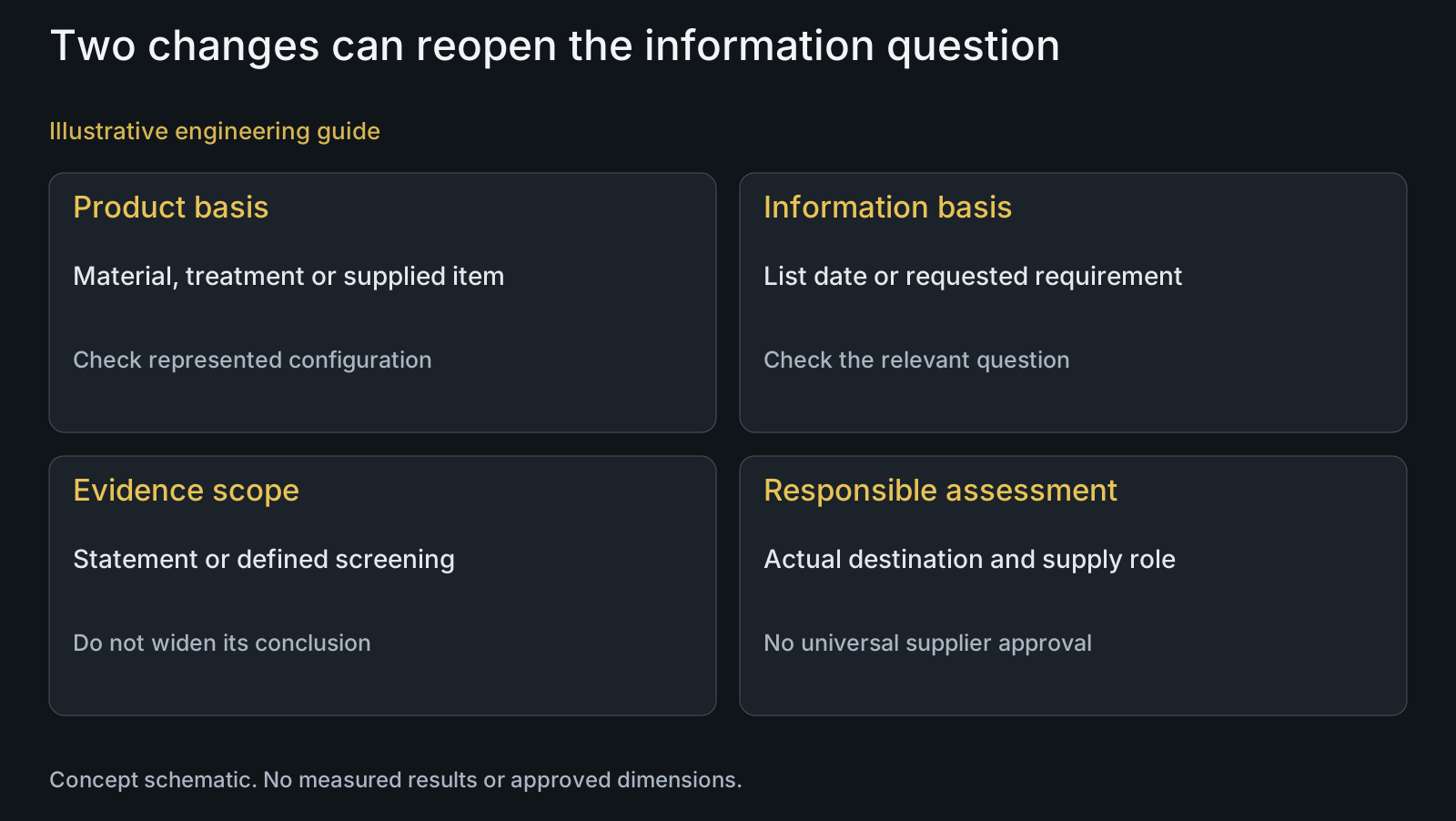
Review two independent kinds of change
Product change concerns what is supplied: material grade or source, finish system, patch, lubricant or additional component. Information change concerns the list, requirement or disclosure question used for assessment. Either can create a gap even when the other remains unchanged.
The official ECHA Candidate List provides the reference for listed substances and notes that inclusion can create immediate obligations. Use a clearly identified list basis rather than an undated claim of latest coverage. This article does not freeze the list at a numerical substance count.
A reassessment is not an automatic order for an unspecified laboratory retest. Ask whether existing evidence represents the changed item and requirement. Target additional information or analysis at the identified gap; document coverage where the existing basis remains applicable.
Keep reporting and manufacturing responsibilities explicit
Agree who supplies component information and who evaluates the relevant legal and market obligations. State the requested product identifiers, information date, format and supporting evidence before quotation. Do not infer a declaration for every variant from a factory's general quality-system certificate.
PremFixer's manufacturing scope can be discussed against the defined hardware and requested documentation. Evidence availability depends on the actual material and treatment supply arrangement. No blanket all-product REACH status, in-house chemical laboratory or automatic screening package is claimed here.
If a receiver, seal or another component is purchased through a separate source, include that item in the information handoff rather than assuming the bolt supplier's statement covers it. An accurate component package can still leave a separate finished-product assessment with the responsible economic operator.
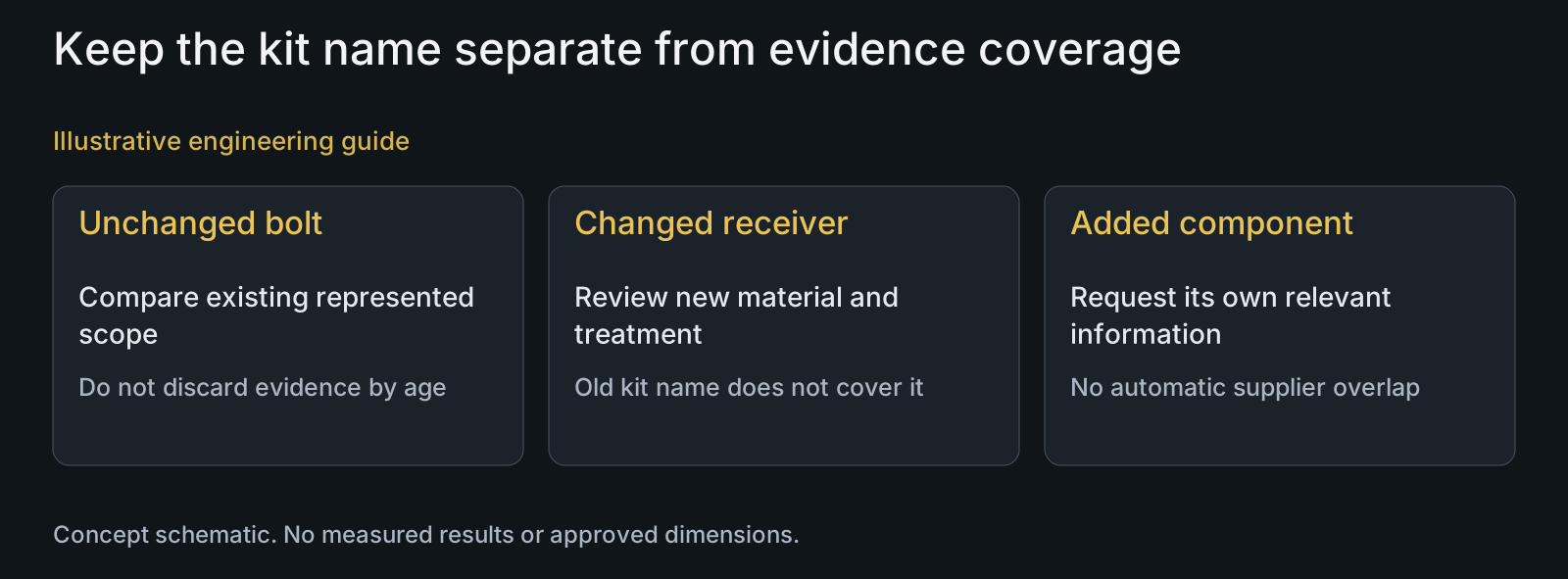
Illustrative review of an unchanged kit name and changed receiver
Illustrative engineering example: assume a pivot kit retains its commercial name while a receiver changes material and receives a different supplied topcoat. The existing REACH statement identifies only the prior configuration and an earlier Candidate List basis. No substance content, customer or compliance outcome is assumed.
The reviewer separates the changed receiver from unchanged bolts and spacers, then asks what each document represents. The receiver's new material and finish require a coverage review. The list basis also needs comparison independently; an unchanged part does not automatically settle that second question.
The resulting request identifies the specific information gap without claiming a chemical failure or testing the whole kit indiscriminately. Send the component details through the RFQ-input guide, including existing statements so the requested documentation reflects the actual decision.
Questions buyers need to confirm
Can an older REACH statement still be useful?
Yes, if its represented configuration and information basis remain relevant to the request. Check component identity, material, treatment and reference date rather than the age alone. A changed list basis or product can leave a gap even where other evidence remains useful.
Does below 0.1% Candidate List information establish complete REACH compliance?
No. That communication threshold answers a particular article-information question. Other relevant obligations, including restrictions, need their own applicable assessment. Do not turn one disclosure basis into a universal certification or purchasing approval.
Does every change require another laboratory screening?
No universal retest rule is prescribed here. Determine whether existing evidence covers the changed product and current question. Additional supply-chain information may resolve one gap; a defined analysis may be needed for another. State what the requested evidence is intended to establish.
Does an SVHC report prove every substance is absent?
No. Read its identified sample, substances considered, methods and limitations. A non-detection result applies within that scope. It does not automatically represent another material, finish, receiver or complete pivot kit.
Can one bolt supplier's statement cover the entire bicycle?
Not automatically. Identify the supplied products and evidence scope. Other sourced components and finished-product obligations remain separate questions for the responsible parties. An e-bike or mountain-bike application label does not settle those boundaries.
What should a REACH information request include?
Provide the BOM and revisions, material and full delivered treatment, changed components, destination, responsible party and exact legal or contractual question. Include the required reference basis and existing statements or reports. This makes any additional documentation or analysis specific to the unresolved requirement.
Technical references and scope
ECHA communication in the supply chain. Article 33 Candidate List communication basis; not every REACH obligation or a PremFixer declaration.
ECHA restriction overview. Restrictions can concern substances, mixtures and articles; no specific product legality or exemption determined.
ECHA official Candidate List. Current reference location and stated obligation implications; no permanently fixed substance count or all-product coverage claim.
Explore related component, material and sourcing decisions in the customer decision knowledge center. For a drawing review, use the Drawing/BOM RFQ path.
Send the BOM and the REACH information question
Provide the part revisions, materials, supplied surface and ancillary treatments, destination, requested information date and existing statements or reports. PremFixer can discuss component documentation for the quoted manufacturing scope. Identify changed items and the responsible compliance reviewer so evidence is requested for the actual product rather than an undefined all-product claim.
Discuss the drawing and BOM