
Automatic replenishment of custom bicycle pivot hardware should respond to a defined supply need, not simply a low warehouse total. Identify the current kit configuration, usable quantities, reservations and expected receipts, then determine which component limits assembly coverage. A reminder can flag that question without authorizing a purchase. An automated buying action needs its own agreed quantity, price and authority limits, plus exceptions for changed revisions, stale stock data or unresolved holds. Otherwise the system can hide a shortage by counting unusable parts or create excess by ignoring an existing order. The useful rule replenishes the missing applicable supply, not every item that shares a kit name.
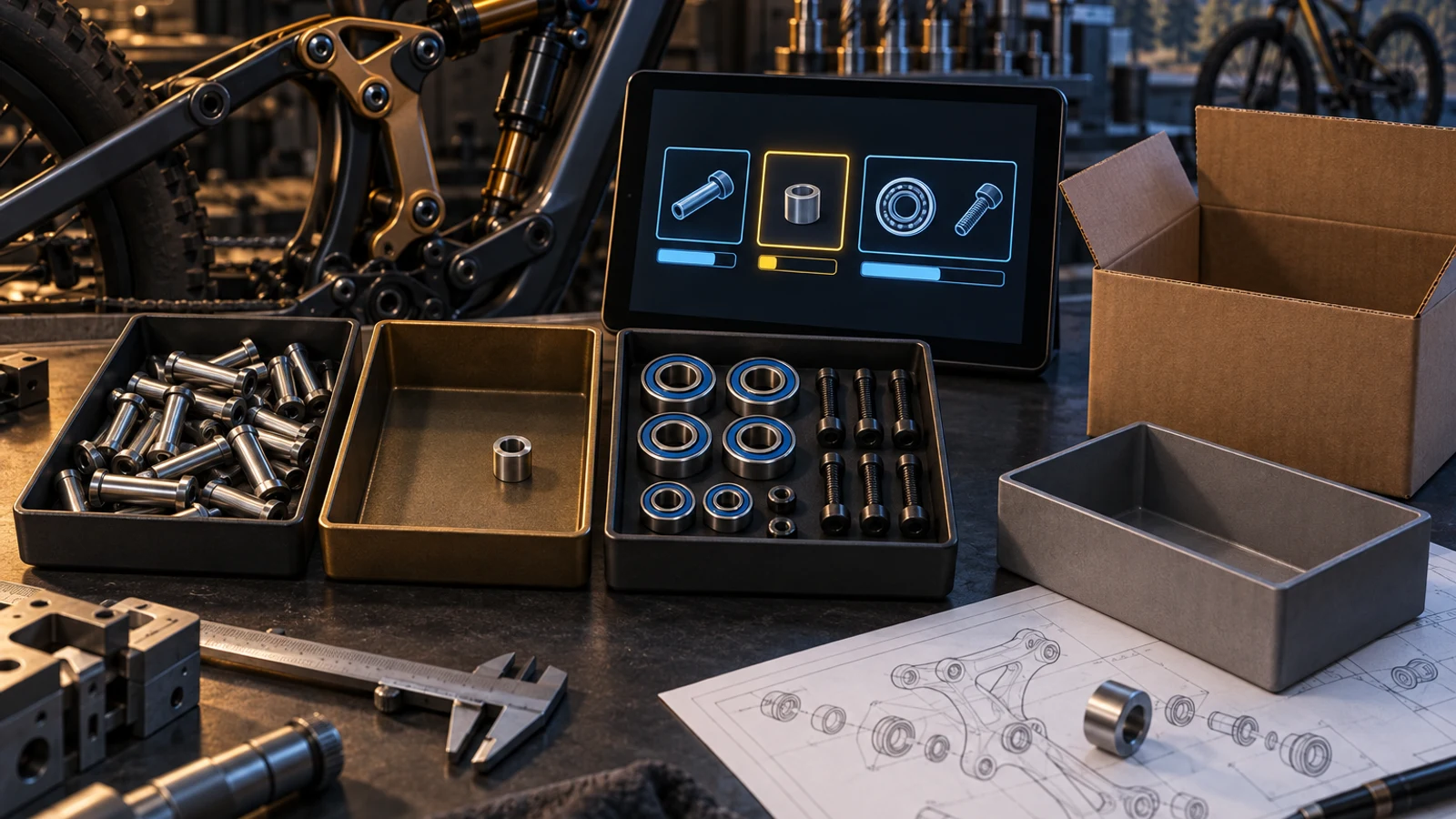
Hero: concept illustration of example hardware and its application. It is not a factory photograph, tested component or approved production geometry.
Choose the object the replenishment rule represents
Define whether the rule covers a complete supplied kit or individual BOM members. For loose-component planning, compare each member's usable quantity with its quantity per kit. The limiting member determines how many complete assemblies can be supported under the accepted configuration.
A common part name is not sufficient when revisions or material conditions differ. Establish applicable combinations before combining balances. A purchasing identifier is an internal planning reference, not evidence that custom drawing-led hardware is an interchangeable stock SKU for every bicycle platform.
Use stock meaning and timing, not an unexplained total
Exclude quantities that are held, incompatible or allocated elsewhere from currently usable coverage. Keep them visible with the correct status. Similarly, a committed receipt is future supply under its stated timing, not stock physically available for today's assembly.
Microsoft's priority-planning documentation illustrates a product-specific calculation using on-hand, on-order and qualified demand to generate planned orders. Its formula and priorities are not universal rules for custom pivots. The transferable question is which represented supply and demand the rule actually considers, and whether those quantities describe the needed configuration.
| Condition | Meaning | Appropriate question | Risk of immediate purchase |
|---|---|---|---|
| One member limits kits | Assembly coverage is constrained | Which applicable member is missing? | Extra stock of already sufficient parts |
| Accepted inbound supply | A commitment already exists | Will its timing cover the need? | Duplicate order for the same gap |
| Stock held or reserved | Parts exist but are not usable here | Who owns disposition or allocation? | Wrong availability assumption |
| New revision proposed | Future applicability is unresolved | Which definition is authorized? | Purchase of an unaccepted combination |
| Alert below threshold | Policy needs attention | Is a request or commitment permitted? | Notification mistaken for authority |
| Acknowledgement missing | Action outcome is uncertain | Did the earlier order occur? | Repeated commitment on retry |
Separate a threshold alert from quantity determination
The trigger answers when attention or action is needed. The replenishment quantity answers how much applicable supply is required under the chosen policy and ordering constraints. Repeated low-stock scans should not independently create repeated orders for the same uncovered need.
Review expected receipts, existing proposed requests and accepted orders before forming another commitment. Quantity multiples or agreed batch conditions can change the proposed amount, but should not silently become permission to overbuy. The rolling-budget guide addresses the inventory and demand scenario behind the purchase basis.
Define what automatic execution is allowed to do
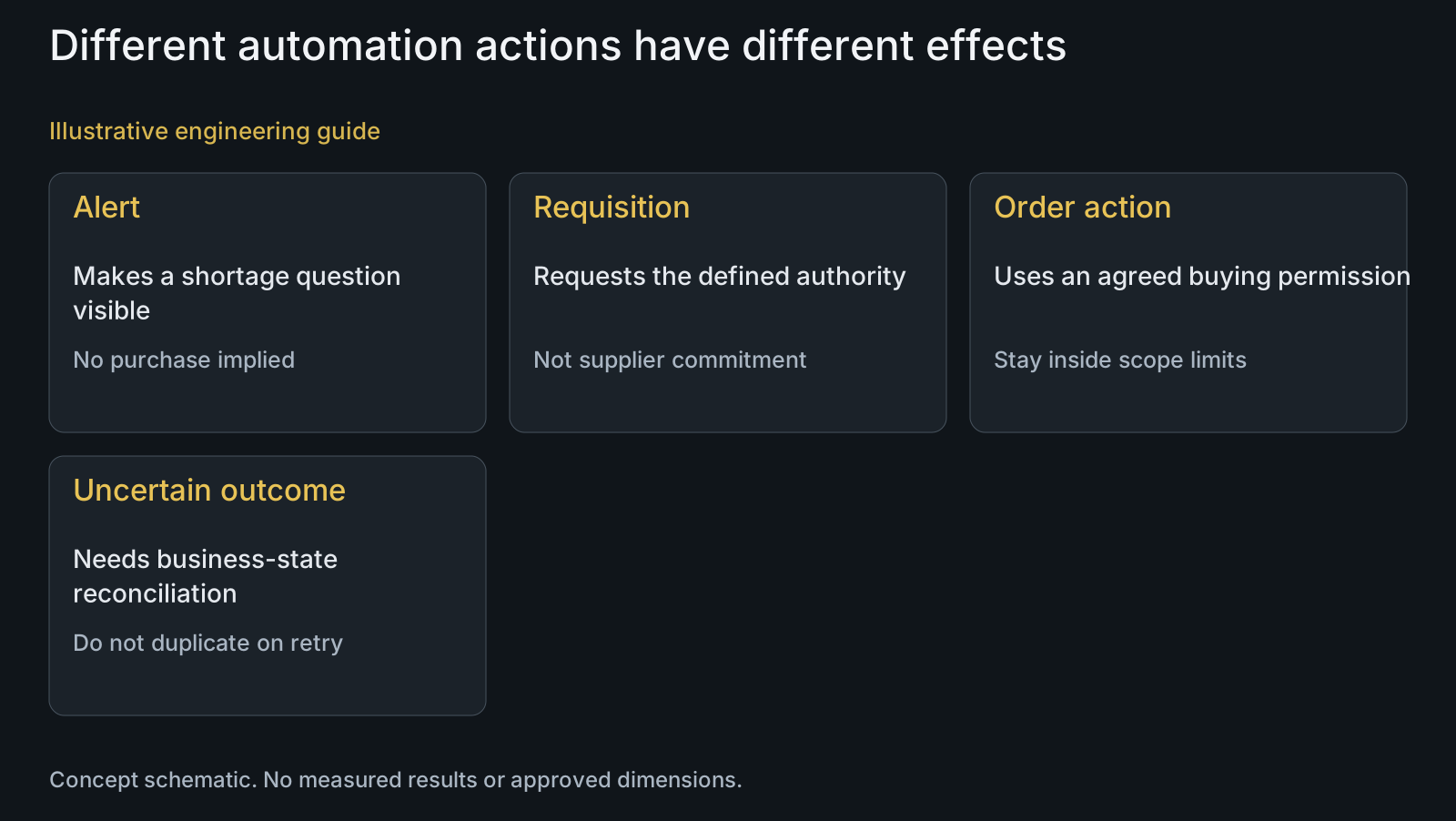
A notification may ask a buyer to investigate. A requisition can request authorization. An actual purchase communicates a commitment according to the agreed arrangement. Specify the permitted action rather than using automatic as if those events had the same consequence.
Define the eligible supplier, configuration, quoted scope, quantity and commercial limits within the organization's authority rules. A changed drawing, unusual quantity or unavailable price basis should route to the responsible person. Do not claim a particular threshold, cancellation right or supplier reservation from a generic automation design.
Reconcile uncertainty before retrying an order action
If an order acknowledgement is missing, first establish whether the authorized business action occurred. Retrying merely because a screen still shows a shortage can duplicate the commitment. Preserve the request identity and reconcile the affected order rather than treating each scan as a new independent need.
The ERP availability guide covers physical stock and message meaning. This replenishment task adds the action boundary: which state permits another purchase, which pauses it, and who resolves uncertainty. Confirm the supplied definition through manufacturing and materials, without claiming a deployed PremFixer ordering interface.
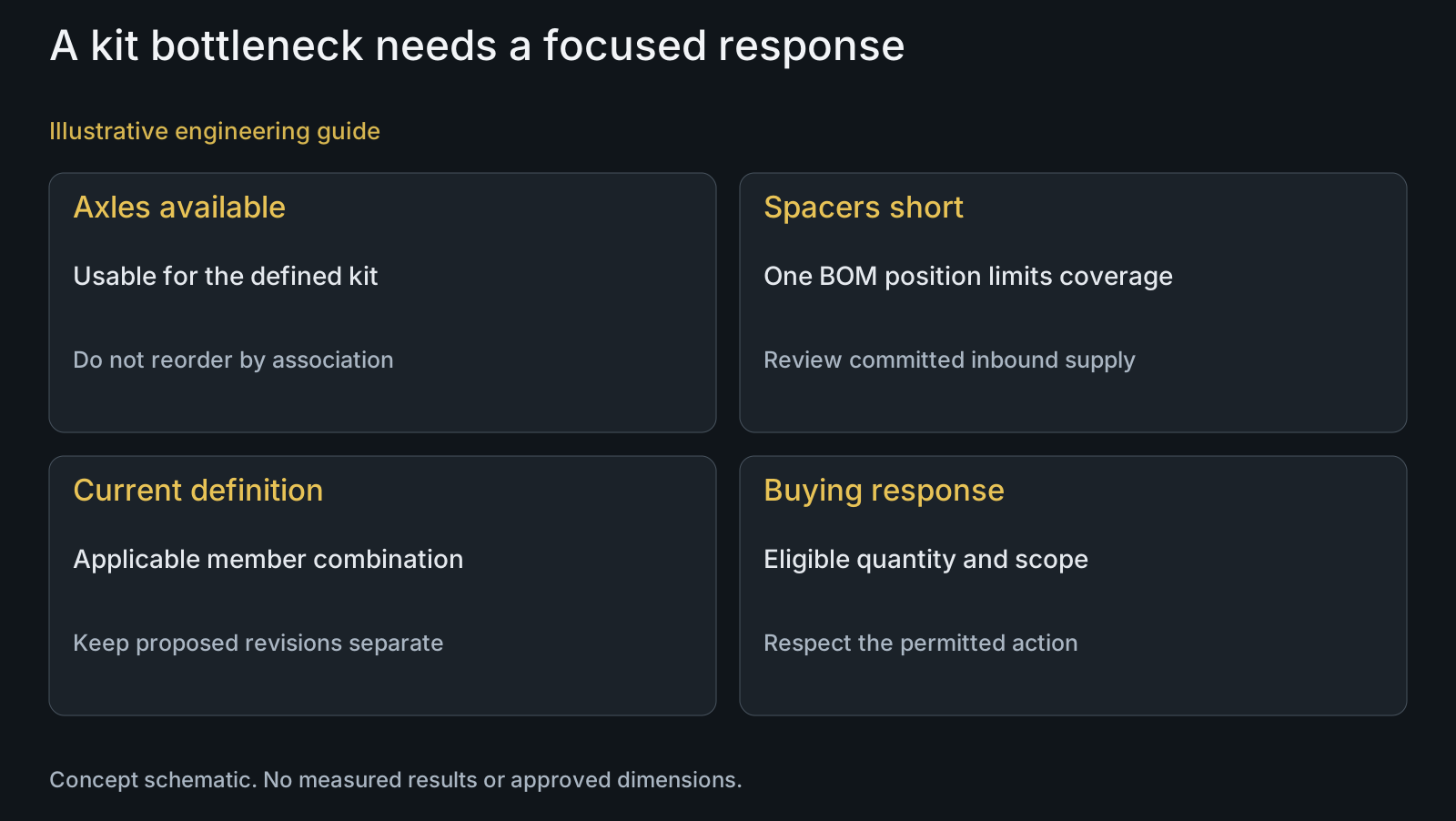
Example: a spacer shortage does not require more axles
Illustrative engineering example: assume an OEM holds usable axles and screws for a pivot kit, but matching spacers are insufficient. A spacer order is already accepted with an expected receipt, while a newer proposed spacer revision is not yet approved. No actual counts, lead times, quote or software result is assumed.
The reviewer identifies the limiting spacer position and asks whether the committed receipt supports the required build timing. They do not order another complete set merely because complete-kit coverage is low. If the proposed revision would affect applicability, the rule pauses that alternative until the design decision is resolved.
The example separates a genuine shortage question from an unnecessary duplicate purchase. Explore full-suspension applications, revision compatibility and the customer decision knowledge center for the related definition decisions.
Questions buyers need to confirm
Should every low-stock alert create an order?
No. Determine whether the rule permits only a reminder, a requisition or an actual commitment. Changed configuration, unusual quantity, uncertain stock or missing price basis can require review even when the threshold is crossed.
Can we replenish only the missing spacer?
Potentially, if that component is a defined supply scope and its applicability is established. Compare BOM quantities and usable member balances, then discuss the relevant batch and quotation conditions. Low kit coverage does not inherently require buying every member again.
Should inbound orders count in the trigger?
They should be represented according to their timing and actual commitment state. Ignoring them can duplicate supply; treating them as already received can hide an immediate shortage. Identify the event each expected quantity supports.
What if the latest drawing differs from the replenishment rule?
Pause the affected automatic action and resolve the controlling configuration and applicability. Update the rule only under the authorized decision, rather than allowing a newer upload to silently select a different spacer or axle.
How do we handle a missing order acknowledgement?
Reconcile the earlier request with the authoritative business state before retrying. Keep the same request identity and determine whether a commitment already exists. A continuing shortage display does not prove the earlier action failed.
Does PremFixer offer automatic ordering from our stock system?
No universal deployed service is established here. Share the proposed trigger, part and BOM definitions, stock-state meanings, permitted actions and exception needs for a bounded feasibility discussion. Actual access and commercial arrangements require confirmation.
Technical references and scope
Microsoft: Priority-based planning. Official product-specific example of represented on-hand, on-order and demand inputs generating planned orders; no universal formula, software configuration or PremFixer deployment asserted.
Explore related component, material and sourcing decisions in the customer decision knowledge center. For a drawing review, use the Drawing/BOM RFQ path.
Define the missing supply before automating its purchase
Send the current drawings and kit BOM, usable-member and inbound-state definitions, proposed trigger, permitted buying action and revision exceptions through the Drawing/BOM RFQ path. Ask PremFixer to discuss the component supply scope and quotation basis without assuming a live ordering integration.
Discuss the drawing and BOM