
A rolling budget for custom bicycle pivot hardware should begin with the parts needed for planned builds, not last year's spending multiplied by an assumed growth rate. Convert build plans into the applicable kit BOM, separate expected demand from committed orders, and reconcile usable stock and expected receipts before pricing additional purchases. Show any change in desired closing inventory separately from consumption. The answer is a defined supply scenario with quantity, revision, price and timing assumptions, not a guaranteed sales forecast or permission to place an order. Obsolete revisions, incomplete kits and overlapping demand records can otherwise make a reasonable-looking budget misleading.
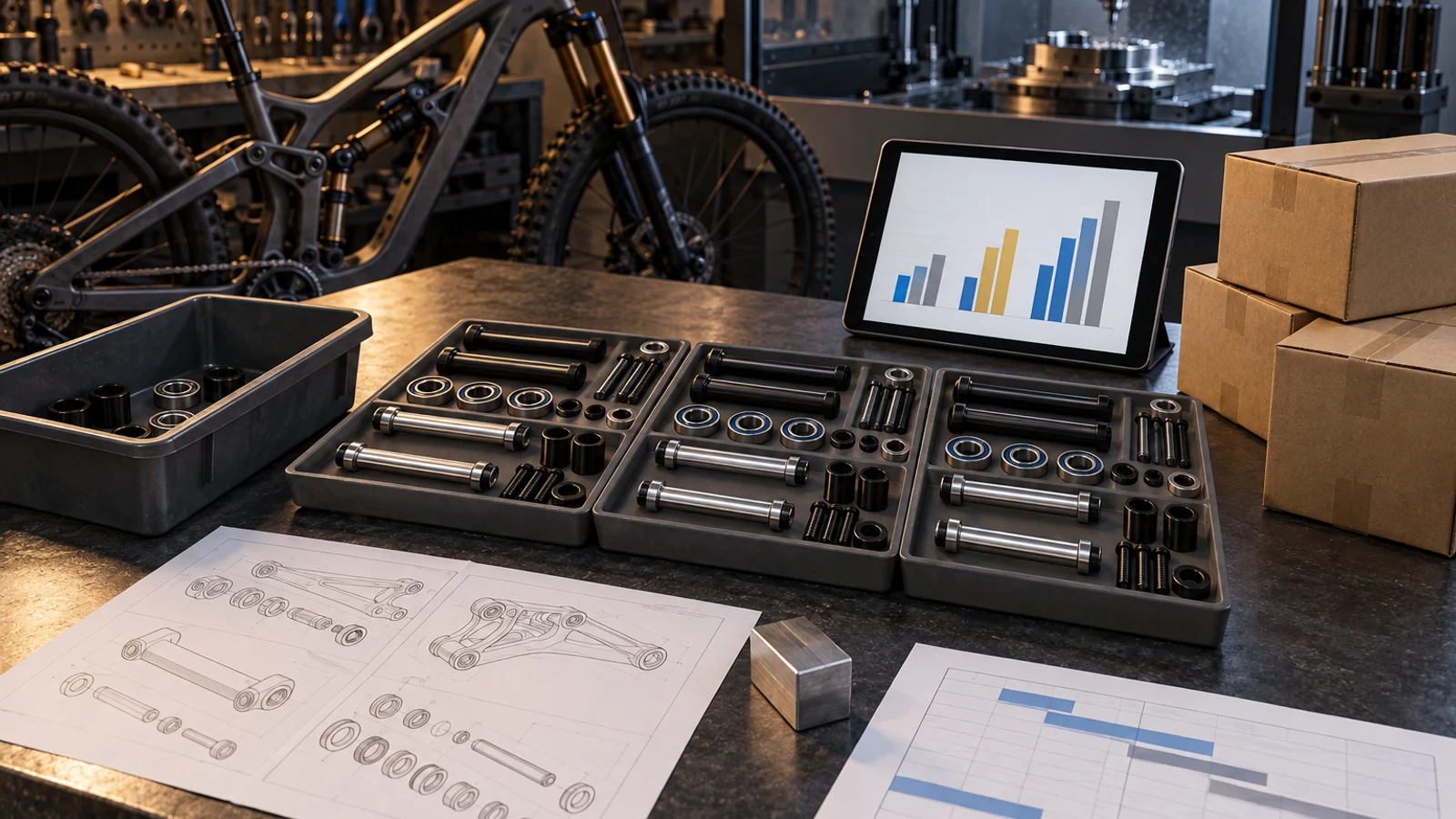
Hero: concept illustration of example hardware and its application. It is not a factory photograph, tested component or approved production geometry.
Translate frame plans into the correct kit quantities
Use the applicable BOM for each frame or linkage configuration. A build may consume several hardware positions, and different platforms may share only some of them. Separate service demand, development samples and production builds when their supplied scope differs.
Historical issues help explain consumption patterns, but examine what they represent. Inventory adjustments, rework use and exceptional sample demand should not silently become recurring production consumption. Keep the unit basis explicit: a complete kit, one axle and one loose screw are not interchangeable budget units.
Reconcile movements before calculating new purchases
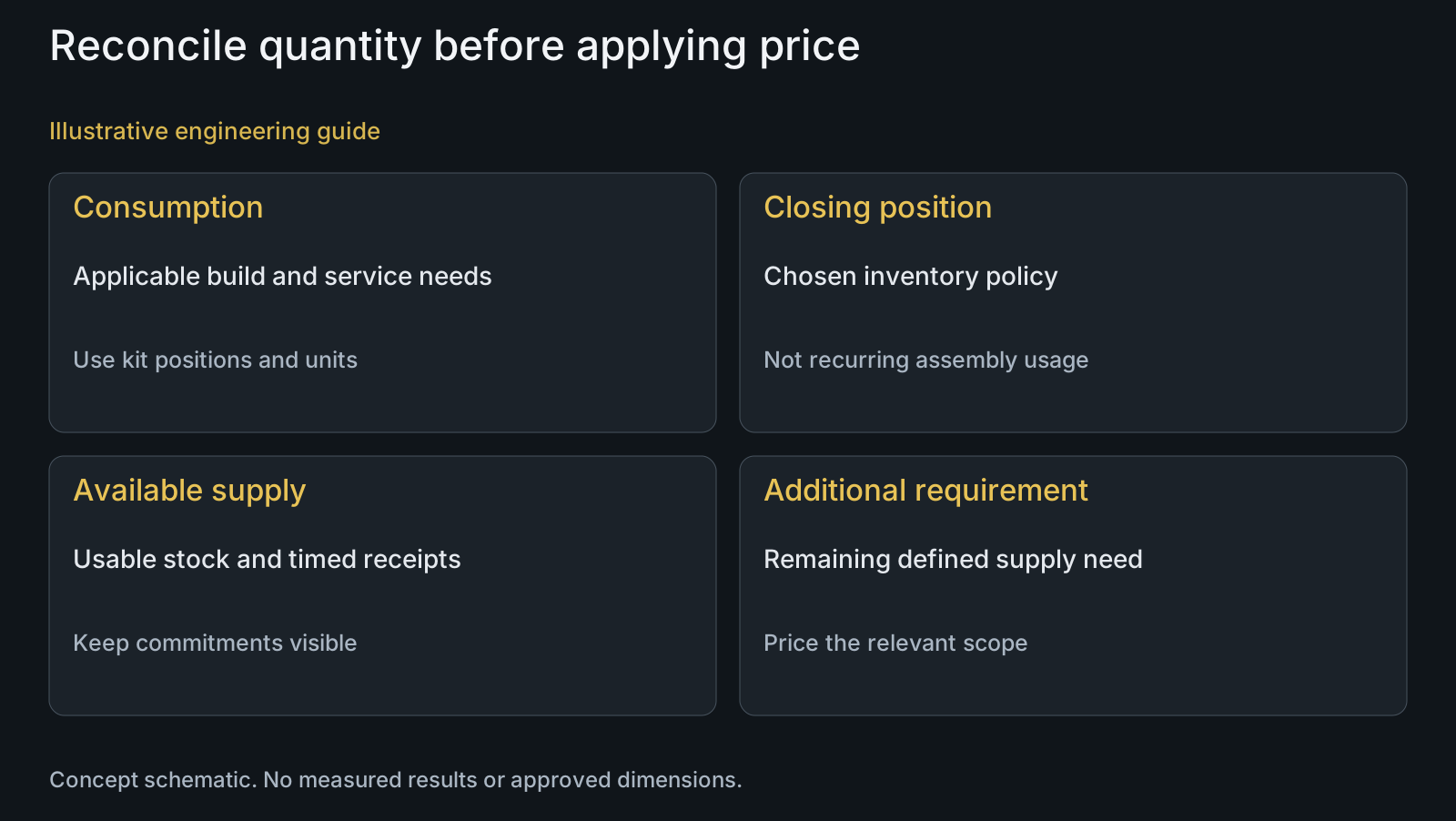
In a simplified period review, required additional supply reflects consumption plus the desired closing stock, less applicable opening stock and usable committed receipts. This is a planning relationship, not a universal ERP algorithm. Time the receipts and demand within the period; a late receipt cannot support an earlier build merely because annual totals balance.
Do not subtract quarantined, incompatible or incomplete-kit inventory as if it were ready for the build. The ERP inventory-integration guide explains those availability distinctions. Keep the purchase commitment and receipt expectation separately identifiable so an updated forecast does not accidentally count them twice.
| Change | Supply consequence | Common budgeting error | Review basis |
|---|---|---|---|
| More planned builds | More applicable BOM consumption | Multiply spend without checking kit contents | Configuration and build timing |
| Lower forecast demand | Potential excess committed receipts | Delete an existing commitment | Order terms and closing position |
| Higher buffer target | Additional inventory investment | Count buffer as recurring consumption | Opening and desired closing stock |
| Revised component | Stock may be incompatible | Subtract all nominally similar pieces | Approved applicability by revision |
| Incomplete kit stock | One member can limit coverage | Budget only aggregate loose-part count | BOM positions and usable quantities |
| Different quote basis | Price assumption needs review | Apply a price outside its quantity scope | Validity, delivered scope and currency |
Treat a buffer as a stock position, not repeated consumption
A safety buffer represents an inventory policy. Once the desired position is included in the movement reconciliation, adding the same buffer again as monthly consumption can overstate purchases. A changed target can create additional supply needs, but identify that movement separately from actual assembly usage.
Microsoft's safety-stock journal documentation provides a software-specific example of historical-usage proposals and their inventory-value impact. Its calculated proposals are distinct from applying new settings. No formula, service level or system implementation from that product is prescribed for PremFixer or your organization.
Price the defined scope and explain each changed assumption
Apply the quantity basis and current defined scope of the relevant quote. Separate recurring component charges from agreed one-time work, sample scope, packing and delivery costs. A planning price outside its stated quantity or validity conditions is an assumption needing review, not a binding factory offer.
Track changes caused by volume, configuration, material condition, finishing scope and reporting currency separately. The annual cost-reduction guide evaluates improvement initiatives; a budget update should not claim improvement merely because lower demand reduced total spending. Ask purchasing or finance to define the organization's valuation and currency conventions.
Use scenarios to expose different consequences
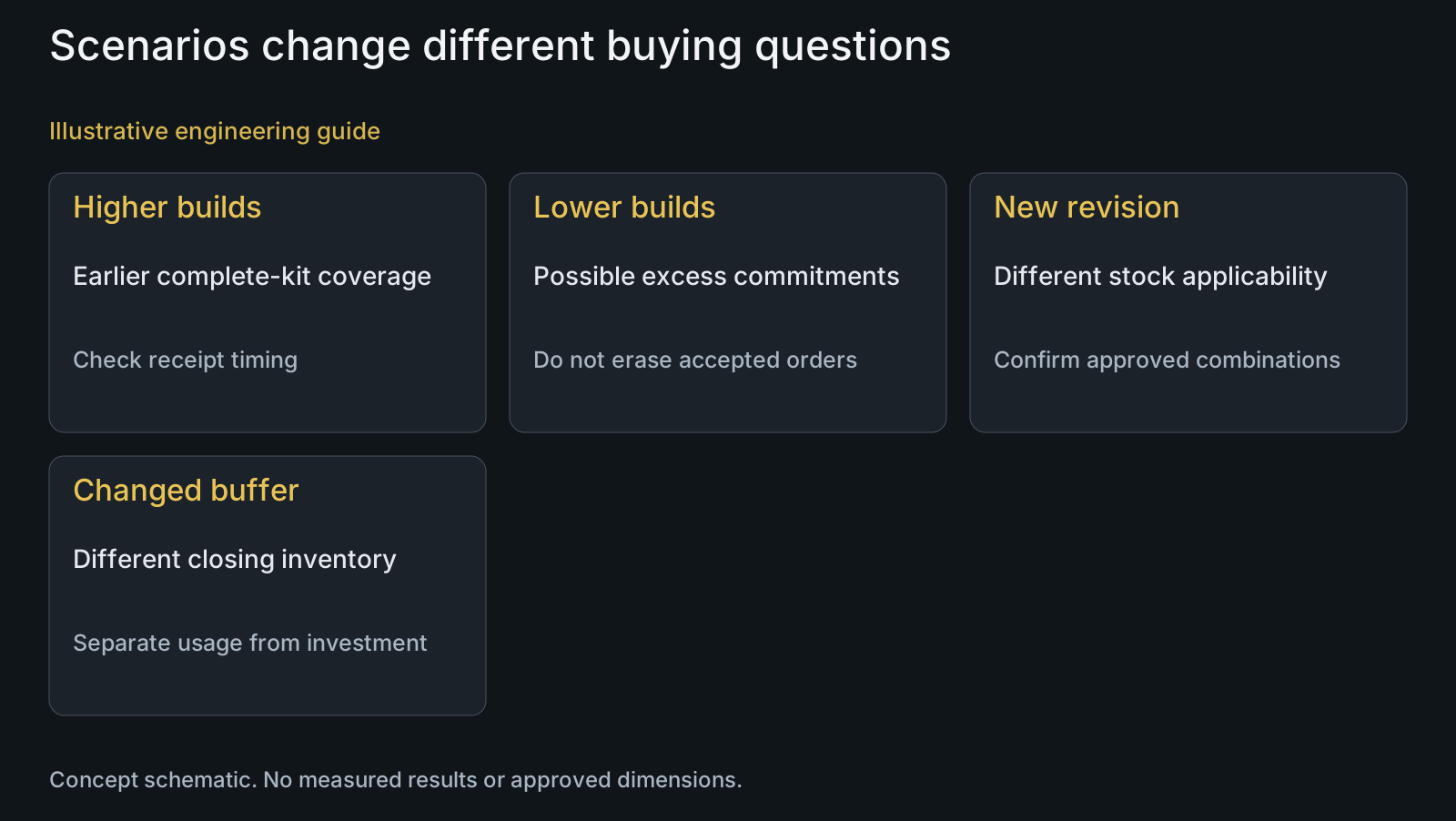
A higher-build scenario can require earlier usable receipts and more complete kits, not just more total bolts. A lower-build scenario can leave committed receipts above current needs. A revision-change scenario can make existing stock unsuitable for the new configuration even if aggregate quantity is unchanged.
Compare those consequences against existing commitments before asking a supplier to change production. A revised internal forecast does not automatically cancel or alter an accepted order. Discuss quantities and manufacturing scope through manufacturing and materials, without promising reserved capacity or free stock exchange.
Example: lower demand does not erase a previous order
Illustrative engineering example: assume an OEM reduces planned builds after committing to a pivot-kit order. Its warehouse also holds an earlier revision that has not been approved for the new kit. No actual quantities, prices, financial results or compatibility verdict are assumed.
The reviewer keeps the committed receipt visible, excludes the unresolved earlier stock from usable coverage, and compares the resulting closing position under the revised demand scenario. They then discuss whether an authorized order change is possible. Simply lowering the forecast purchase line would hide the existing commitment rather than solve the inventory question.
Use the revision-compatibility guide, solutions and customer decision knowledge center to keep configuration decisions connected to the planning basis.
Questions buyers need to confirm
Should we base the budget only on historical consumption?
No. Reconcile what the history represents with current build configurations, service needs and exceptional issues. Then add explicit future assumptions rather than treating every past inventory movement as recurring assembly usage.
Should safety stock be counted as consumption?
Not as the same item. Show the desired closing position and the stock movement needed to reach it. Adding the same buffer as consumption after already including it in the movement calculation can double count its purchase requirement.
Can existing stock always reduce the purchase budget?
Only if it is usable for the planned configuration when needed. Check revision compatibility, release status and complete-kit positions. Nominal part similarity or aggregate stock quantity does not establish applicable coverage.
Does a revised forecast cancel an accepted purchase order?
No automatic cancellation follows from an internal plan. Keep committed quantities visible and discuss any authorized change under the applicable supply agreement. The forecast and actual buying commitment are different records.
How should a price increase be shown?
Separate it from demand, mix, revision and scope changes on a consistent comparison basis. Identify the affected quotation conditions and reporting-currency convention so a changed total is not assigned entirely to unit price.
What should we send for a supplier planning discussion?
Provide the drawing and kit BOM, scenario quantities by period, existing applicable stock, committed orders and known revision changes. Distinguish assumptions from commitments so the discussion addresses supply scope without presenting the forecast as an order.
Technical references and scope
Microsoft: Safety stock journal and minimum coverage. Software-specific example of historical-usage proposals, inventory-value impact and distinction between calculating proposals and applying settings. No universal stocking formula, service level or PremFixer system use asserted.
Explore related component, material and sourcing decisions in the customer decision knowledge center. For a drawing review, use the Drawing/BOM RFQ path.
Connect your rolling plan to a defined manufacturing scope
Share the current drawings and kit BOM, period demand scenarios, applicable inventory, committed order quantities and anticipated revision or finish changes through the Drawing/BOM RFQ path. Ask PremFixer to clarify quantity-dependent supply and quotation assumptions; keep budget authorization within your organization.
Discuss the drawing and BOM