

Before connecting an ERP to a pivot hardware supplier, agree the data and business meaning that the connection must preserve. Map the customer and supplier part references, approved revision, kit or piece unit, order line and quantity. Then define whether each message conveys a forecast, requests an order, acknowledges receipt or confirms commercial acceptance. Test repeated messages, missing replies and changes before permitting live commitments. A successful transmission cannot approve a new sleeve geometry, authorise payment or prove usable stock. Ask PremFixer to confirm the feasible project scope; this article does not establish an existing universal EDI endpoint, API or real-time inventory connection.
Hero: concept illustration of example hardware and its application. It is not a factory photograph, tested component or approved production geometry.
Map the ordered object before automating the quantity
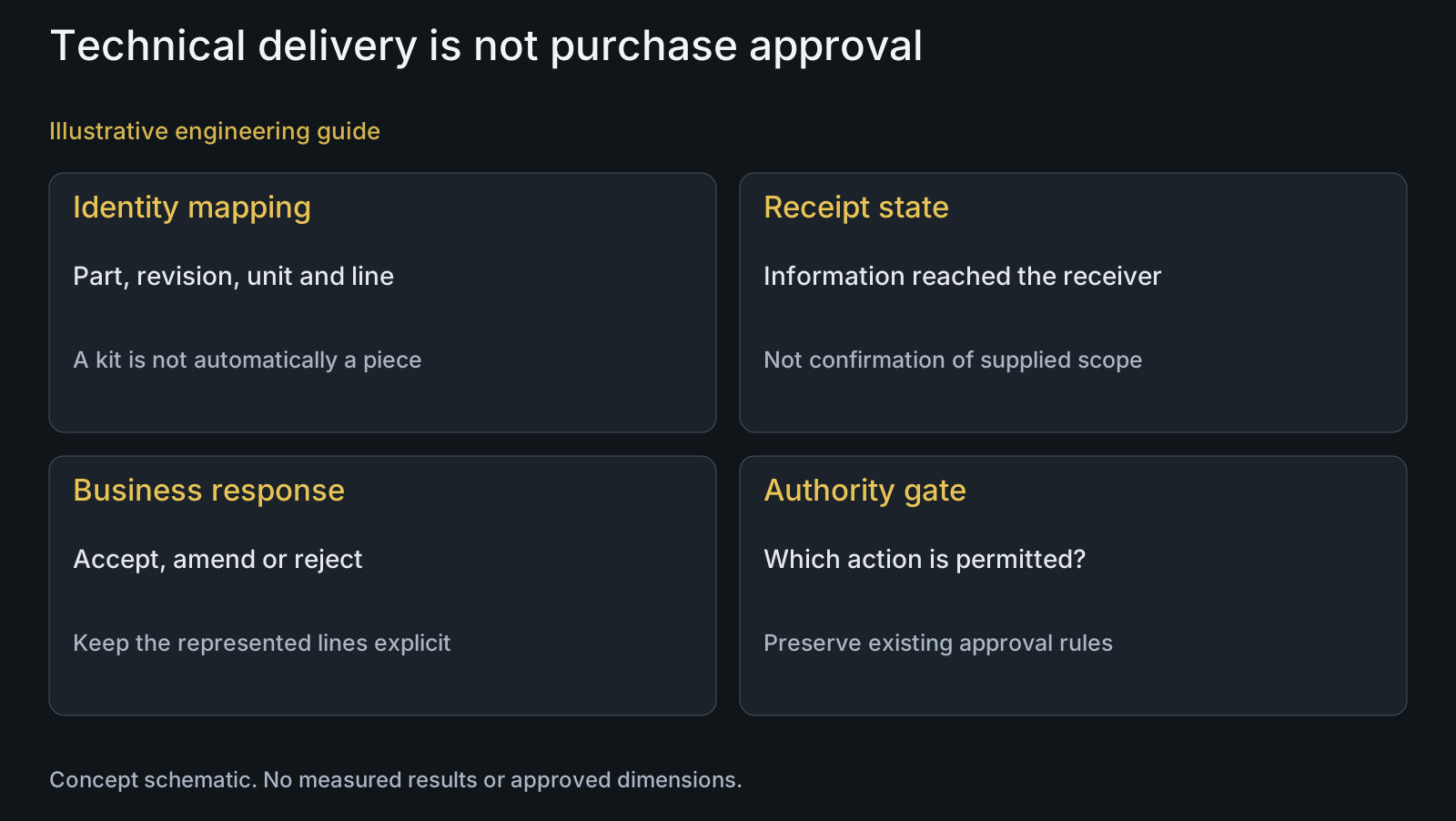
Define both parties' part references and the controlling revision. If one reference identifies a kit and another a component, map the contents explicitly instead of assuming the same label describes the same purchase. Identify the applicable drawing and BOM separately from a file's upload date.
State the order unit and its conversion basis. A quantity of kits is not the same as that many bolts when the BOM requires several bolts per kit. Avoid applying a generic conversion across model revisions that change the contents or quantities.
The digital traceability guide links material, process and packing identities after supply. This integration review instead asks what an incoming purchasing message means before action is taken. A retrieval code or lot relationship cannot repair an incorrect order-unit mapping.
Separate receipt, acceptance, amendment and rejection
Name each message's business purpose and the scope of its response. Technical receipt says the information arrived; it does not independently establish that the supplier accepts the requested quantity, price or date. Partial acceptance needs identified lines and quantities rather than a general success label.
GS1's EANCOM purchase-order-response introduction distinguishes acknowledgement, acceptance, proposed amendment and non-acceptance. This supports keeping response meanings separate, not a prescribed integration format or a claim that PremFixer implements EANCOM.
Define what closes an amendment proposal. A seller's proposed date or quantity must not silently become the buyer's approved change merely because the message was received. Use the order-status guide to separate actual events and forecasts; order acceptance remains its own business decision.
| Exchange question | Mapping or rule needed | Risk of a technical-only check | Meaningful test |
|---|---|---|---|
| What is being ordered? | Part references, revision and controlling BOM | Correct file orders the wrong configuration | Unknown and superseded revision handling |
| What does the quantity mean? | Kit/piece unit and configuration-specific conversion | Same number creates different component quantities | Compare expected kit contents with resulting lines |
| What did the reply confirm? | Receipt, acceptance, amendment or rejection | Message success becomes purchase acceptance | Partial acceptance and pending amendment states |
| Is this the same request again? | Stable business identity and retry treatment | Lost reply leads to duplicate commitments | Repeat identical request and reconcile one order |
| Who can change the requirement? | Technical and commercial authority | Revision proposal overwrites accepted supply | Conflicting content and unauthorised changes |
| What happens outside the normal path? | Named owner, fallback and reconciliation | Manual recovery creates a parallel second order | Uncertain state and return-to-normal review |
Design repeated-message handling around the same commitment
Agree how one business request is identified across retries and how a receiver distinguishes a retry from a genuinely new release. Repeated transmission should not create a second production commitment for the same authorised request. The rule must preserve order and line scope, not merely suppress every similar-looking quantity.
A missing reply leaves an uncertain communication state: the sender may not know whether the receiver acted. Check the agreed order state or route the uncertainty to the responsible owner before issuing a new independent request. Do not treat every timeout as proof that no action occurred.
Specify how changed content using an existing reference is handled. A repeated identifier with different revision or quantity is not a harmless identical retry. Flag the conflict and preserve the earlier decision until the agreed amendment authority resolves it. No particular software mechanism or endpoint is mandated here.
Preserve technical and commercial release authority
Identify which approved message can create a commitment and which only informs planning. A forecast update should not purchase unlimited material, and an inventory message should not release held parts. The business rule needs to survive the move from manual communication to electronic exchange.
Keep changed geometry, material or finish subject to the applicable engineering authority. The revision-compatibility discussion defines configuration questions that a message cannot answer by itself. A valid file transfer does not approve a mixed bolt-and-spacer combination.
Payment messages and credit changes also need their own authority and secure handling. The payment-milestone guide distinguishes cash timing from work commitment. Do not embed private credentials, banking details or another customer's records in a public integration example or open RFQ.
Review a lost reply without doubling a kit order
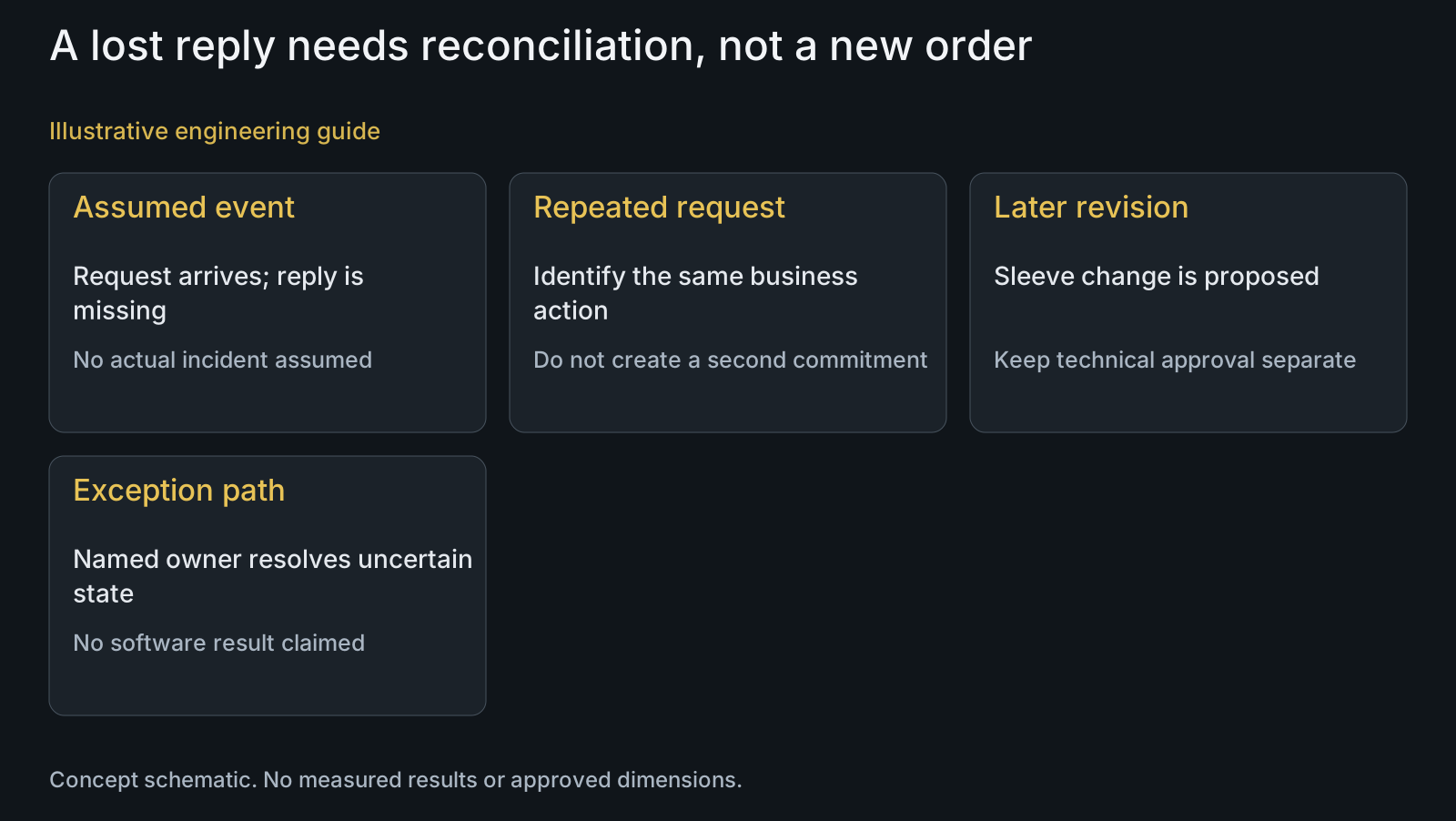
Illustrative engineering example: assume an authorised kit-order message reaches the receiver, but the sender does not receive its reply and retransmits the same request. A later message proposes a sleeve revision. No actual endpoint, order quantity, outage or approved change is assumed.
The reviewer checks whether the repeated request is reconciled to the same order and line rather than treated as a new release. It then checks whether the revision proposal remains a pending technical change instead of overwriting the earlier accepted configuration.
The assessment also tests how an unresolved state reaches a named owner. Successful transmission alone would not reveal duplicate commitments or silent revision replacement. The example demonstrates required acceptance questions, not a built integration, measured error reduction or proven software recovery.
Pilot the bounded exchange and keep an exception path
Agree a limited message scope and representative non-live test cases before any real purchasing write. Include wrong units, unknown revisions, partial responses, rejection, duplicate transmission and changed-content conflicts. Compare the resulting business states, not only whether a file or network request completed.
Define the owner and agreed fallback for an unresolved exchange. A manual fallback needs reconciliation before normal automation resumes so it does not create a second order alongside the electronic path. Specify how the parties identify the authoritative state and retain evidence of the decision.
Discuss the actual manufacturing scope, materials and required supply definition alongside the integration proposal. Use the knowledge center for adjacent decisions. No interface is built, enabled or promised by this article; feasibility, access and operational support must be agreed for the particular project.
Questions buyers need to confirm
Can PremFixer connect to our ERP?
Confirm the feasible project scope, formats, access and support arrangement before assuming availability. Provide non-sensitive examples of the required messages and their business meanings. No universal live EDI endpoint, API or real-time inventory service is established by this article.
Does a successful API response approve our order?
Not without the agreed business meaning and authority. Technical receipt, commercial acceptance and approval of changed requirements are separate. Identify the affected order lines and quantities before treating a response as a commitment.
Why must kit and piece units be mapped explicitly?
They can represent different quantities and contents. Use the applicable BOM revision and conversion basis. A numerical match alone can create an incorrect component order, particularly when a new kit revision changes the required positions.
Should a timed-out order message be sent as a new order?
Not automatically. The receiver may already have acted while its reply was lost. Reconcile the agreed business state and identify any retry as the same request. Escalate uncertainty before creating an independent additional commitment.
Can an electronic drawing update replace the approved revision?
Only through the applicable authorised change process. Identify the proposed difference, affected order scope and owner. File delivery or message validity alone does not approve new geometry, finish or cross-version component combinations.
What tests matter before live order exchange?
Test business outcomes for units, revisions, partial acceptance, rejection, repeated requests and changed-content conflicts. Include uncertain states and manual-fallback reconciliation. A successful normal transmission does not establish that these exception paths preserve the correct commitment.
Technical references and scope
GS1 EANCOM purchase-order response introduction. Official indexed introductory text distinguishes acknowledgement, acceptance, amendment proposal and non-acceptance. Full document fetch unavailable; no segment-level implementation or compliance interpretation used.
Explore related component, material and sourcing decisions in the customer decision knowledge center. For a drawing review, use the Drawing/BOM RFQ path.
Scope the order-data exchange before a live integration
Send the drawing, STEP file or sample, BOM revisions, unit definitions and non-sensitive example order messages through the Drawing/BOM RFQ path. Identify required responses, technical and purchasing decision owners and desired exchange scope. PremFixer can discuss feasibility without treating the request as approval to enable live ordering or disclose private credentials.
Discuss the drawing and BOM