
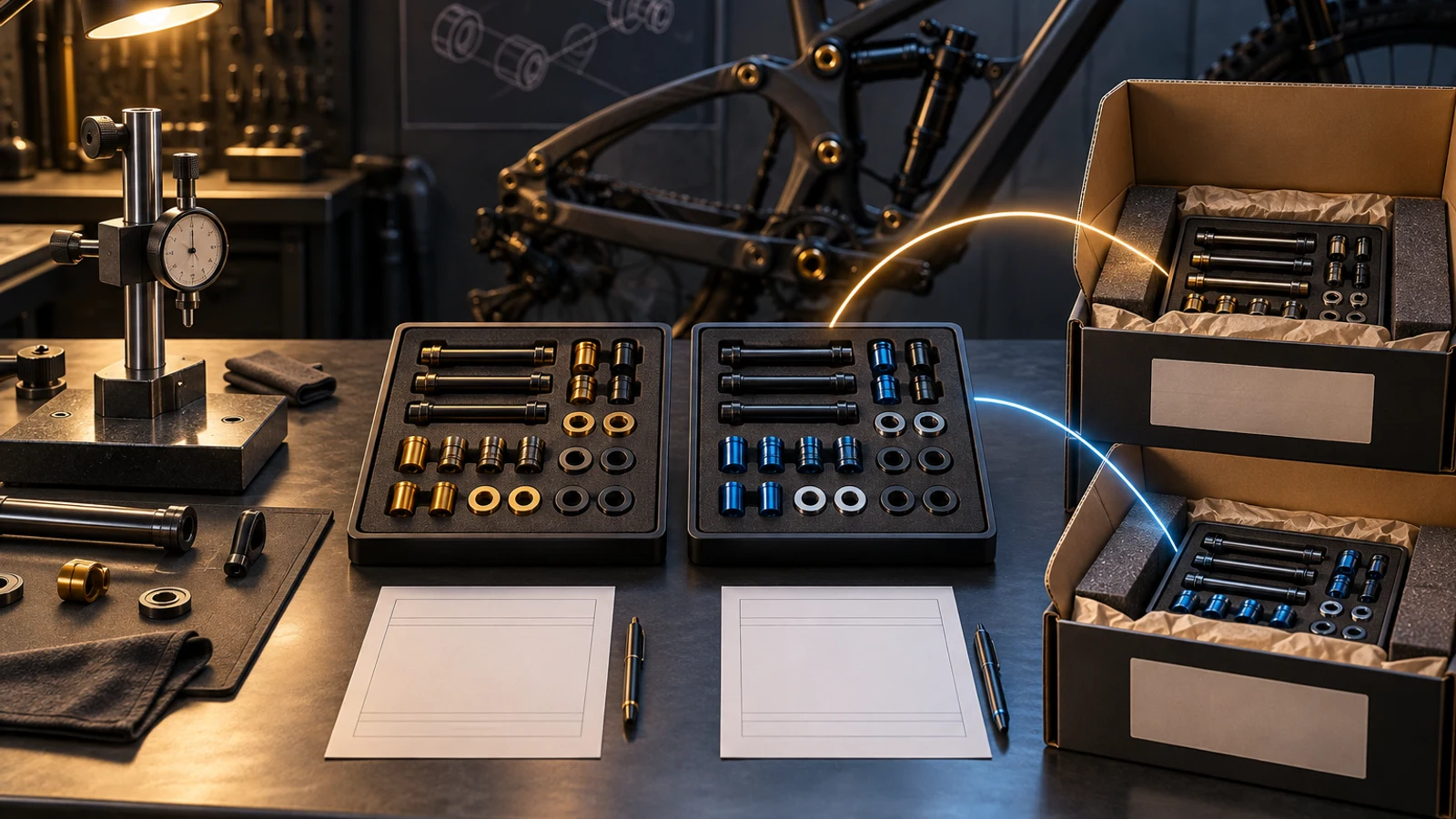
Before custom pivot hardware ships, outgoing inspection should confirm that the agreed product checks and dispositions apply to the parts actually packed. Reconcile component and kit identities, drawing revisions, quantities, lot relationships, protection and required documents with the authorized shipment. Sampling must follow its defined population and plan; there is no universal AQL value for every pivot feature. A correct packing list does not replace product release, and a favorable report for another population cannot release the current cartons. This distinction matters when an order is split, stock is regrouped or replacement parts are added after inspection: the evidence must still describe what the customer will receive.
Hero: concept illustration of example hardware and its application. It is not a factory photograph, tested component or approved production geometry.
Separate final inspection from outgoing reconciliation
Final inspection addresses named component characteristics and coverage. Outgoing reconciliation asks whether those accepted items are the ones prepared for dispatch, whether kit contents are complete and whether remaining order conditions are satisfied. The final-inspection scope guide explains why a percentage alone cannot describe every feature checked.
Do not use OQC as a vague promise of all tests. Identify the characteristics that need a dispatch-stage examination, such as visible transit-protection concerns or kit completeness, separately from results collected earlier. Repeating a measurement adds value only when it addresses a defined changed condition or required check.
Set the population before applying a sampling plan
NIST describes acceptance sampling as a decision about a defined lot, not an estimate that every unit is conforming. The public ISO 2859-1 catalog identifies an attributes-sampling scheme indexed by AQL. Neither statement supplies a universal project acceptance limit for custom pivot hardware.
Use the pivot AQL plan guide to define population, unit, classifications and the applicable plan. Agree the relevant standard edition and customer requirements. Do not choose a convenient AQL after seeing defects, or rename selected cartons as a new lot simply to obtain a favorable release decision.
| Dispatch condition | What to reconcile | Risk | Appropriate verification |
|---|---|---|---|
| Unchanged accepted lot | Report population and packed identity | Wrong report attached | Lot-to-carton match |
| Split dispatch | Released portion and retained balance | Quantity or identity lost | Allocation and condition review |
| Replacement spacer | New component population | Old axle report borrowed | Applicable spacer evidence |
| Mixed kit contents | BOM and component revisions | Loose-part counts imply complete sets | Configuration count |
| Repacked parts | Identity and affected surfaces | Mix-up or handling damage | Focused recheck of changed conditions |
| Required document pending | Contract evidence condition | Packing completion mistaken for release | Authorized disposition |
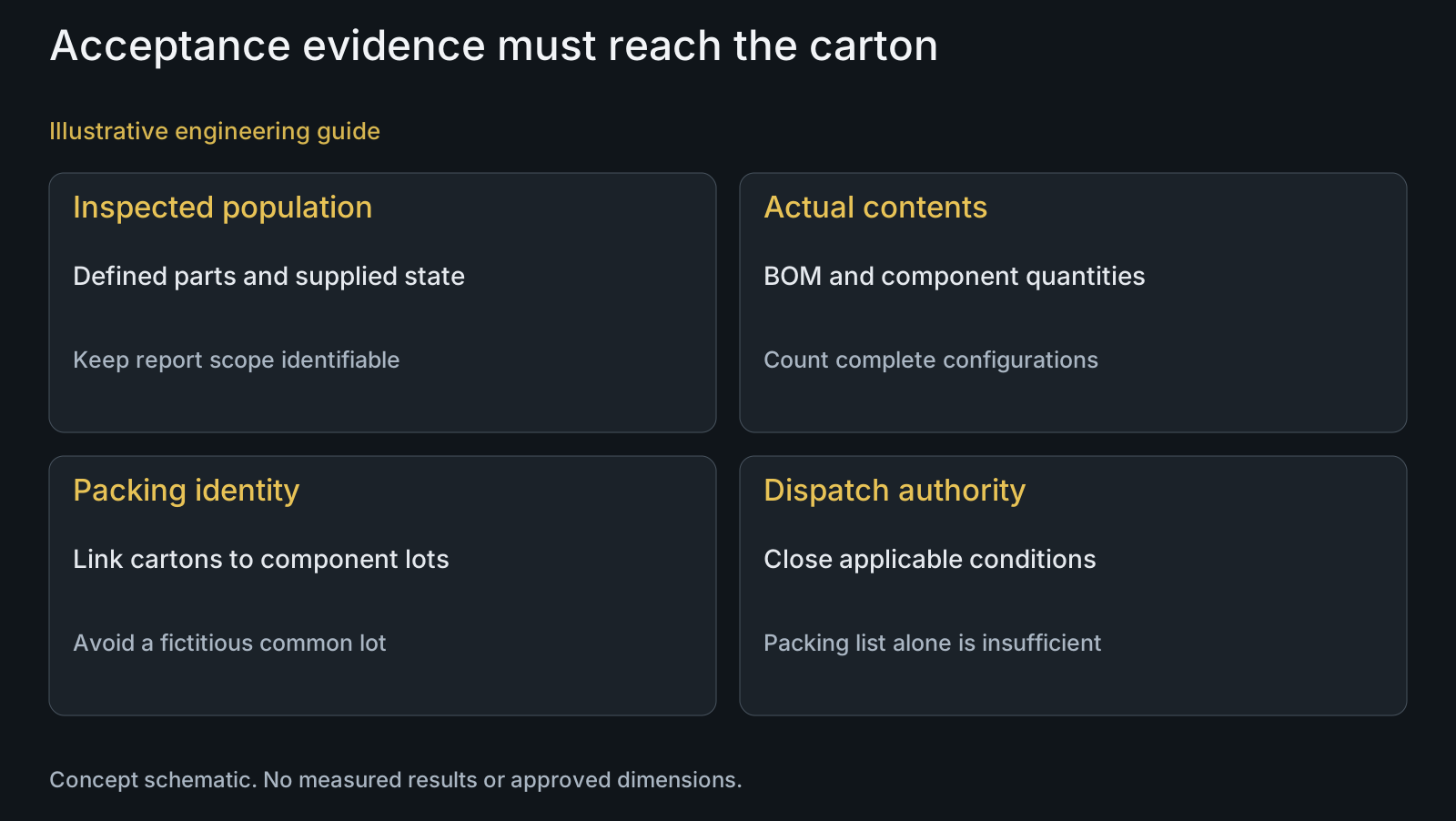
Reconcile the report with the physical carton
Identify the report's represented part, revision, supplied state and lot. Then show which cartons contain those items. A carton can hold components from several manufacturing or finishing lots; describe those relationships rather than implying that one packing number is a common test population.
If the shipment contains kits, check the component relationships against the BOM. Correct axle quantity does not establish complete sets when a required spacer is missing. Count partial kits separately from dispatchable configurations. The manufacturing discussion can establish packaging and evidence requirements before production finishes.
Handle splits and additions without borrowing release
A released lot can be divided among shipments when its identities, quantities and applicable conditions remain controlled. Record the dispatched portion and retained balance. A later split needs the appropriate release and packaging status; it does not become a newly inspected population merely because a new packing list is printed.
Added replacement parts need their own applicable evidence and disposition. If repacking risks mixing revisions or damaging seats, assess those specific concerns before dispatch. Do not assume that an earlier report follows an unrecorded substitution. Equally, do not demand an unrelated destructive test merely because a carton was opened.
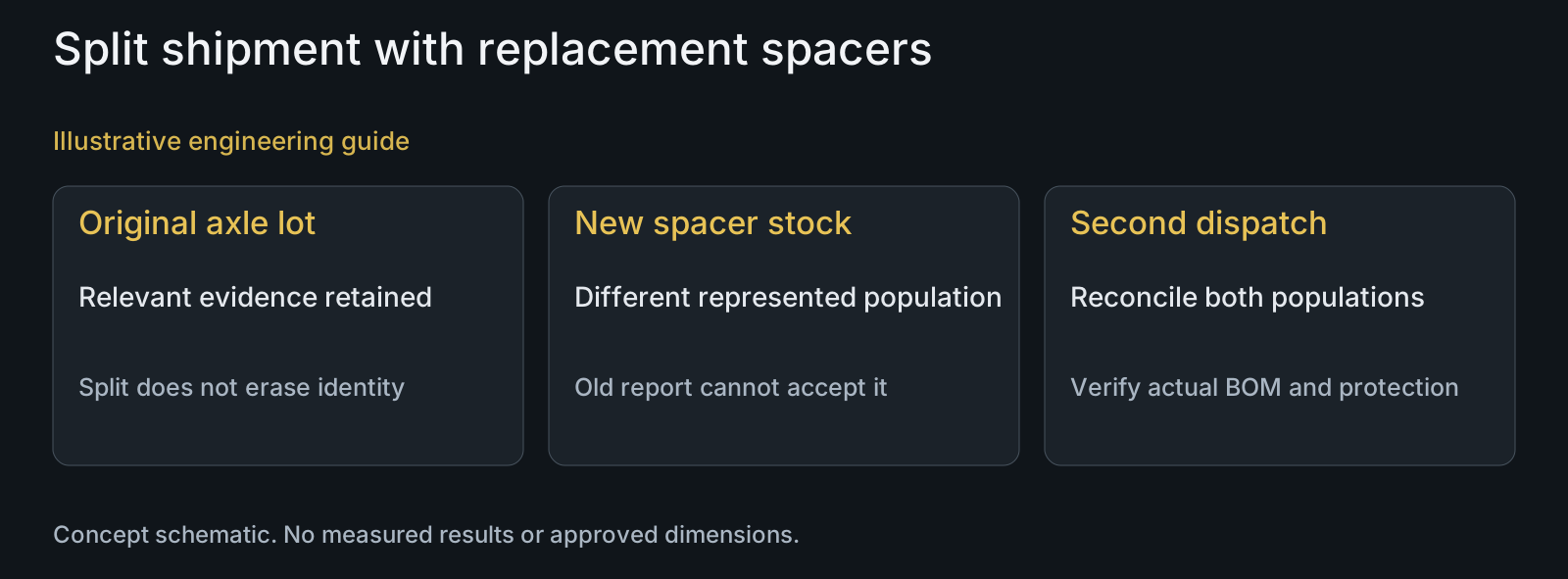
A split order exposes a scope mismatch
Illustrative engineering example: assume one accepted pivot-axle lot is assigned to two dispatch dates. Before the second shipment, a damaged spacer bag is replaced from another stock lot. There are no actual counts, inspection results or customer deliveries in this example.
The axle evidence may remain relevant, but it does not accept the replacement spacers. The team links the second shipment to both component populations, obtains the applicable spacer evidence and verifies the BOM and protection. The decision is about what changed, not whether the first shipment's pass label can be copied onto a later packing document.
Make the release record useful to receiving staff
A useful dispatch record identifies shipped populations, actual quantities, applicable report references, unresolved conditions and authorization. Preserve the relationship in labels and supplied documents so receiving staff can recognize it without opening every packet or interpreting an internal spreadsheet.
Specify which documents accompany the goods and which are delivered through an agreed electronic route. PremFixer's project scope must confirm any promised report timing, partner-test evidence and release responsibilities. This guide does not establish that every order automatically ships with every material or test certificate. The customer's incoming-inspection review remains a separate defined decision.
Questions buyers need to confirm
Is OQC just another name for final dimensional inspection?
Not in this guide. Final checks address named characteristics; outgoing reconciliation connects accepted stock with the actual shipment. State any additional dispatch-stage checks explicitly instead of assuming the acronym covers every test.
Which AQL should we use before shipment?
Choose the agreed plan for the defined population, characteristic classifications and project risk. Specify the applicable edition and scheme. The source topic's example numbers are not universal limits, and AQL does not promise defect-free cartons.
Can a lot be shipped in several portions?
Yes, when identity, allocated quantities and applicable release conditions remain controlled. Identify the dispatched and retained portions. Check later handling or substitution rather than assuming the first packing record describes every later shipment.
Can an earlier report cover replacement parts?
Only if its supported population actually includes them. Supply the replacement identity and applicable evidence. A report for another spacer lot or only the axle cannot accept a new kit member by association.
Must every test be repeated after repacking?
No automatic blanket rule follows. Assess which characteristics or identities could have changed and what the order requires. Repacking may call for a focused surface or configuration check without repeating an unrelated qualification test.
What should an outgoing release record tell the buyer?
It should connect actual shipped identities and quantities with applicable inspection evidence and authorization. Provide component-lot relationships, report references and any agreed conditions so receiving staff can review the same population.
Technical references and scope
NIST, What is acceptance sampling?. Lot-decision purpose of sampling, not a universal pivot release plan.
ISO, ISO 2859-1 public catalog. Public scheme identity and scope; paid sampling tables and contractual editions require separate review.
Explore related component, material and sourcing decisions in the customer decision knowledge center. For a drawing review, use the Drawing/BOM RFQ path.
Agree the evidence for your actual shipment
Send drawings, BOM, dispatch splits, packaging requirements and required report fields through the Drawing/BOM RFQ path. PremFixer can review how manufacturing evidence and kit identities should connect to the parts packed for your order.
Discuss the drawing and BOM