

A credible annual pivot hardware cost-reduction plan needs specific actions, not a guaranteed percentage repeated every year. OEM procurement should agree a comparable baseline, identify the work each proposed action changes and assess implementation effort and quality consequences. Explain changes in quantity, currency or supplied scope separately from process improvement. A lower offer can result from several causes, and a target remains a target until its stated result is supported. The useful annual output is a small portfolio with responsible owners, decision boundaries and measurement rules. No standard yearly reduction, open-book pricing obligation or demonstrated saving is implied for PremFixer or a particular project.
Hero: concept illustration of example hardware and its application. It is not a factory photograph, tested component or approved production geometry.
Choose a baseline that survives the annual comparison
Identify the supplied kit, revision, finished condition, evidence, packing and delivery basis represented by the comparison. Also record quantity and currency. A lower total after removing a required spacer or changing shipment scope is not an improvement to the original delivered unit.
Keep the original baseline visible when a legitimate change occurs. Show the changed boundary rather than quietly replacing the baseline and crediting the difference to efficiency. If the product is no longer functionally comparable, treat the alternative as a new defined option, not a continuation of an unchanged cost trend.
The price negotiation register names commercial exchanges. An annual plan adds a different discipline: determining which actions were implemented, which effects are supported and which explanation belongs outside the improvement result.
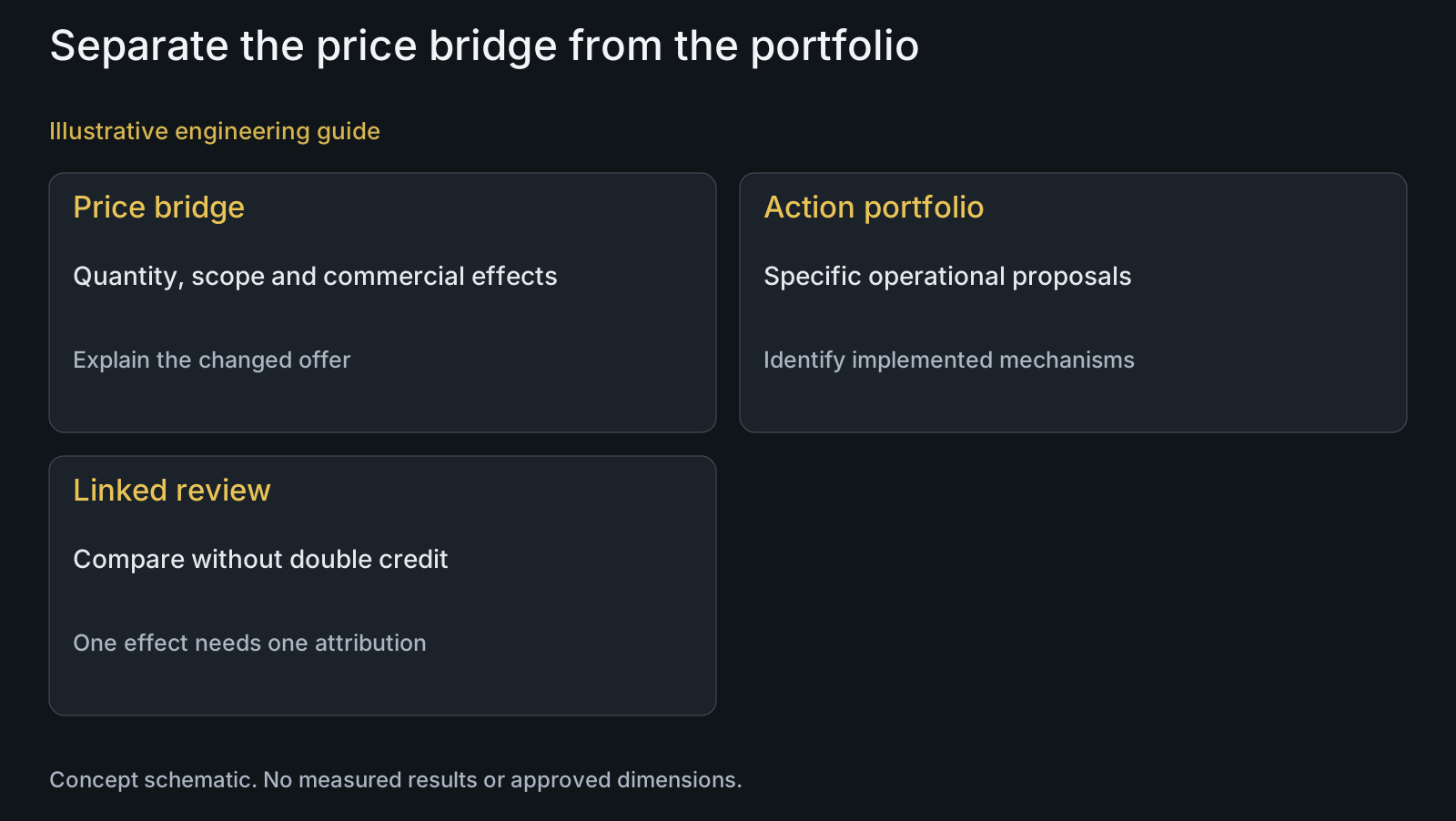
Build a price bridge before attributing an improvement
Separate the changed offer into explainable categories: quantity or production pattern, material purchase basis, delivery scope, currency, negotiated commercial terms and specific operational changes. The categories describe the comparison; they do not require guessing confidential rates or margins.
A currency movement can change a buyer's reported cost while the factory's physical work stays unchanged. A larger run can change charge allocation without demonstrating faster cutting. Name these effects rather than asking the process team to defend a saving it did not create.
When effects overlap, agree an attribution convention before claiming totals. A design simplification that also changes the batch route may not have two independent benefits. Do not add separately discussed estimates if they represent the same eliminated operation. Unexplained differences should remain unexplained, not be assigned to a preferred initiative.
| Candidate action | Potential mechanism | Risk or required investment | Evidence and attribution |
|---|---|---|---|
| Holding-route improvement | Less repositioning or easier access | Fixture work and feature consequences | Represented operation; isolate from volume |
| Kit presentation change | Different grouping and receiving effort | Protection or work transferred to buyer | Both packing and receiving scope |
| Compatible run consolidation | Changed repeated preparation | Stock and revision responsibility | Run basis; not automatic cycle saving |
| Approved feature simplification | Specific operation altered | Engineering evaluation and other features | Separate approved definition and net work |
| Inspection presentation change | Required results delivered more directly | Necessary measurements must remain | Same acceptance scope, reporting effect |
| Commercial or currency change | Offer or reported price changes | Not necessarily a physical improvement | Price bridge, not process achievement |
Select actions with identifiable mechanisms and boundaries
A useful portfolio entry names the actual activity: a holding change, a reduced handling step, improved kit presentation or a different authorized production pattern. Explain why that action could change work. 'Automation' and 'supplier partnership' are not mechanisms until their affected operation is identified.
NIST MEP's public improvement overview describes eliminating non-value-added activity and collaboration along supply chains. That general principle supports examining specific work; it supplies neither a yearly reduction entitlement nor a result for this pivot project. Its listed US services are not PremFixer capabilities.
The continuous-improvement guide addresses testing a selected cause-and-effect proposal. This portfolio instead governs several initiatives over a review period. Include fewer executable entries when authority or evidence is limited rather than a long list of unowned targets.
Include investment and transferred work in the net effect
Identify fixture, programming, evaluation, instruction and receiving changes required to implement each proposal. State who carries them and when they occur. A recurring reduction in handling cannot be called a net benefit while the necessary implementation work is omitted.
Keep physical work, capacity availability and an offered price change distinguishable. An operation becoming easier may release capacity without automatically changing the complete kit price. The buyer and supplier can discuss the commercial treatment, but the engineering observation and negotiated offer remain different evidence.
Review consequences outside the improved station. A proposed bulk pack may reduce packing effort and add receiving work. A holding change may affect other features. Use manufacturing for the defined route and DFM cost review when a feature change transfers rather than removes work.
Report implemented effects without converting targets into results
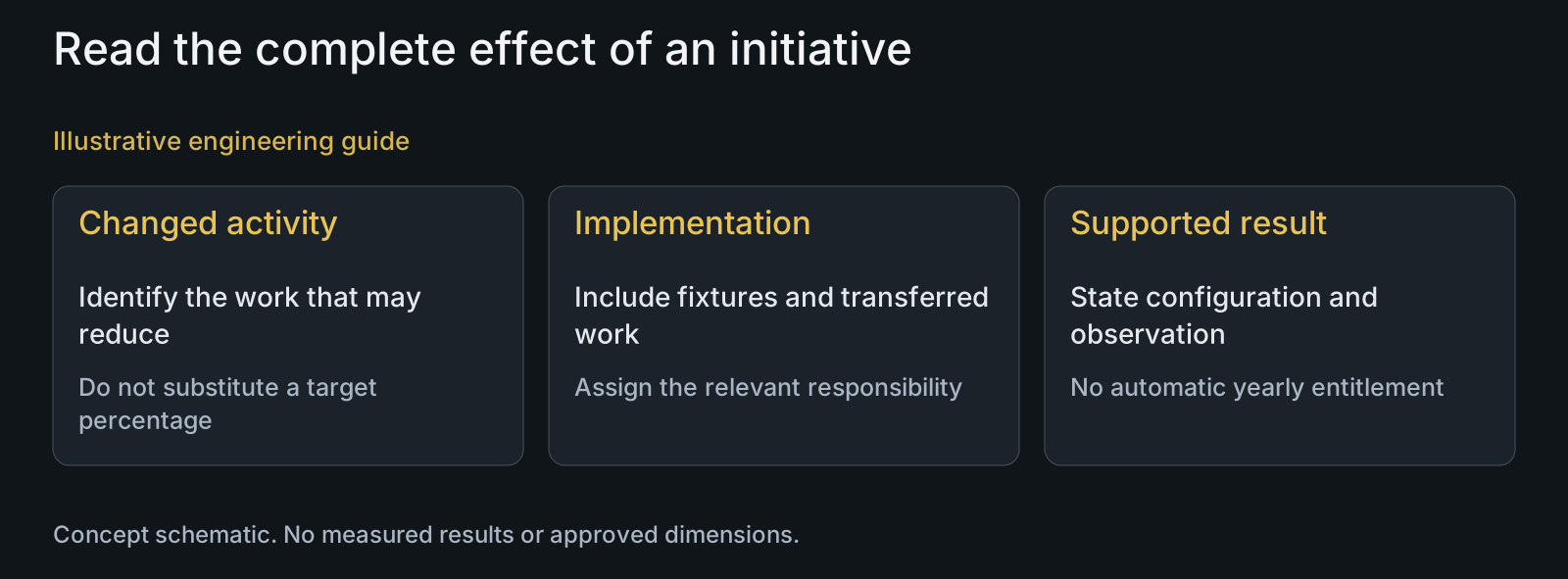
For each initiative distinguish proposed, evaluated, authorized and implemented status. Those labels are not a mandatory production workflow; they explain what the claimed effect represents. A projected quotation alternative is not an observed production outcome, and implementation alone does not establish its magnitude.
State the observation period, represented configuration and comparison basis alongside any supported effect. If quality or assembly scope changed, explain that consequence rather than presenting only the favorable cost line. Keep a separate unresolved-evidence entry when the comparison cannot yet isolate the action.
Avoid accumulating annual percentages on changing denominators. State whether an effect concerns the complete kit, one operation or a defined quantity. The ownership-cost review can examine wider buyer consequences, but speculative service benefits should not be booked as realized annual savings.
Review example: the lower offer has three explanations
Illustrative engineering example: assume an annual comparison contains a larger planned production run, a changed delivery basis and a proposed fixture improvement. The kit definition remains fixed. No actual quotations, currency values, implementation costs or measured savings are supplied.
The reviewer separates the run and delivery explanations from the fixture initiative. The fixture entry records its affected work, required implementation and comparable evaluation. They do not assign the entire offer decrease to the fixture or add its estimate again after already including it in a negotiated price.
The annual review can retain the proposal, request evidence or defer it according to its unresolved boundary. No result or automatic reduction is claimed. The example shows why an explainable price change and an accountable improvement project need linked but separate records.
Questions buyers need to confirm
Can a supplier promise the same reduction every year?
A project offer may contain agreed commercial terms, but a generic repeated percentage is not evidence of an operational plan. Identify executable actions, their conditions and the basis for any actual commitment.
Is every lower annual quotation a process improvement?
No. Quantity, currency, delivery scope or commercial terms may explain it. Use a price bridge to separate those causes from a supported change to physical work.
How should overlapping initiatives be counted?
Identify whether they remove the same activity and agree an attribution convention. Do not add two estimates for one eliminated operation or credit an implemented action again through the entire negotiated price decrease.
Should fixture investment be included?
Yes, when it is necessary for the proposal. Separate one-time implementation from recurring effects and state the represented period. No net benefit is established if required work is omitted.
What does an annual review need to produce?
A small set of defined initiatives with owners, authority, implementation scope and observation rules, alongside an explanation of the offer change. Unresolved evidence should remain visible rather than be assigned an achieved saving.
Can quality improvements be included without a price decrease?
Yes, if their useful effect is stated and supported independently. Do not invent a monetary conversion for improved consistency or capacity; distinguish the observation from its separately negotiated commercial treatment.
Technical references and scope
NIST MEP: Improve. General non-value-added-activity and supply-chain collaboration context only; no program availability, percentage or company-specific results inferred.
Explore related component, material and sourcing decisions in the customer decision knowledge center. For a drawing review, use the Drawing/BOM RFQ path.
Turn an annual target into a bounded manufacturing discussion
Send current drawings, STEP, BOM, comparable quantities and delivered scope, together with the proposed actions and known observations, through the Drawing/BOM RFQ path. PremFixer can review affected manufacturing work, implementation boundaries and the inputs needed for comparable alternatives.
Discuss the drawing and BOM