
Set safety stock for a custom pivot kit from the uncertainty you need to protect, the time needed to replenish usable matching parts and the configuration's expected use horizon. First separate ordinary demand coverage from an additional uncertainty buffer and from purchases made to speculate on price or availability. Average daily consumption multiplied by a period gives a coverage quantity; it does not show whether a shortage target is met. Check the bolt, sleeve and spacer positions together, including holds and commitments. Before increasing finished stock, compare the remaining demand for that approved revision with the quantity you could be left unable to use.
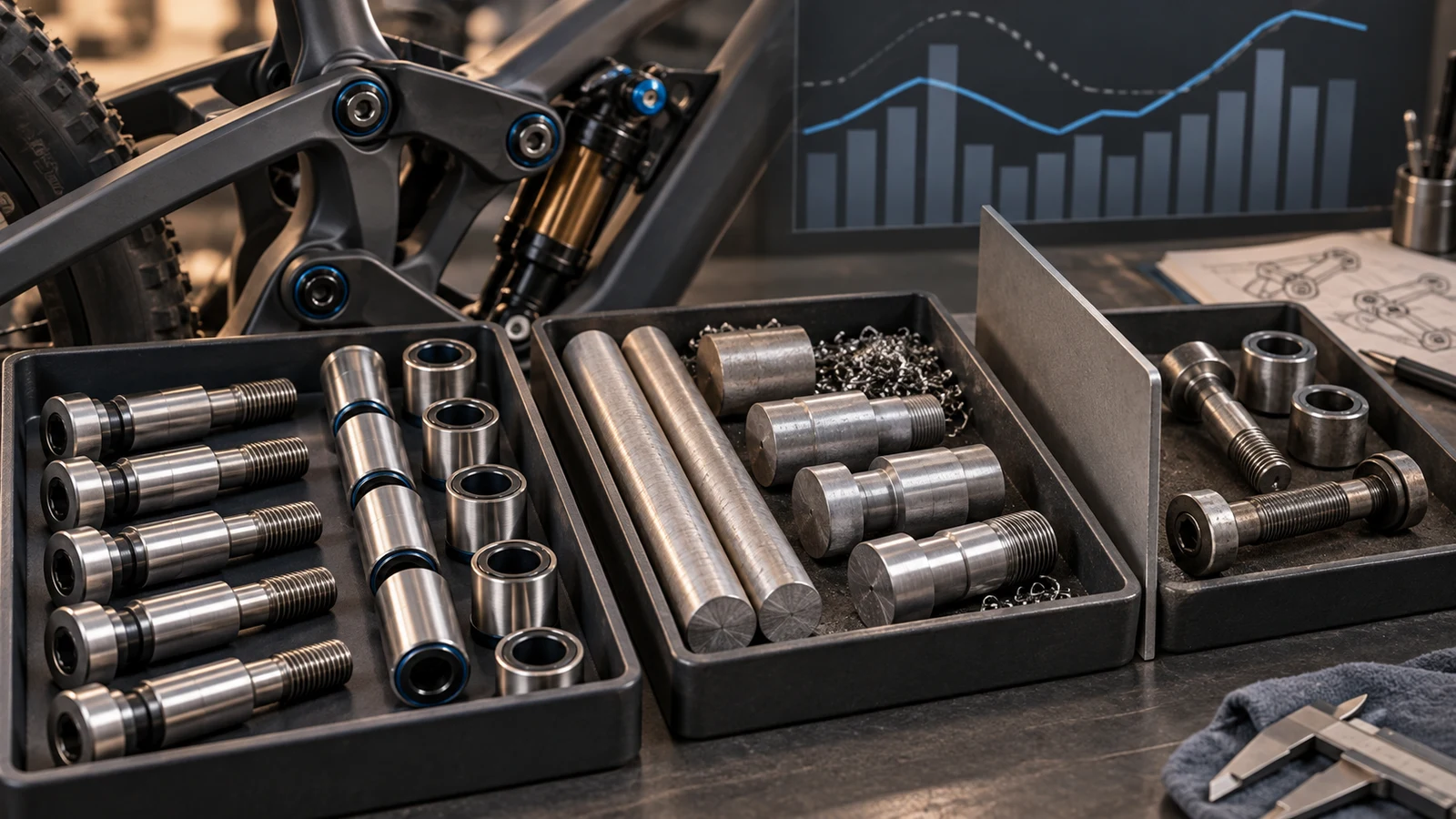
Hero: concept illustration of example hardware and its application. It is not a factory photograph, tested component or approved production geometry.
Separate coverage, uncertainty protection and speculation
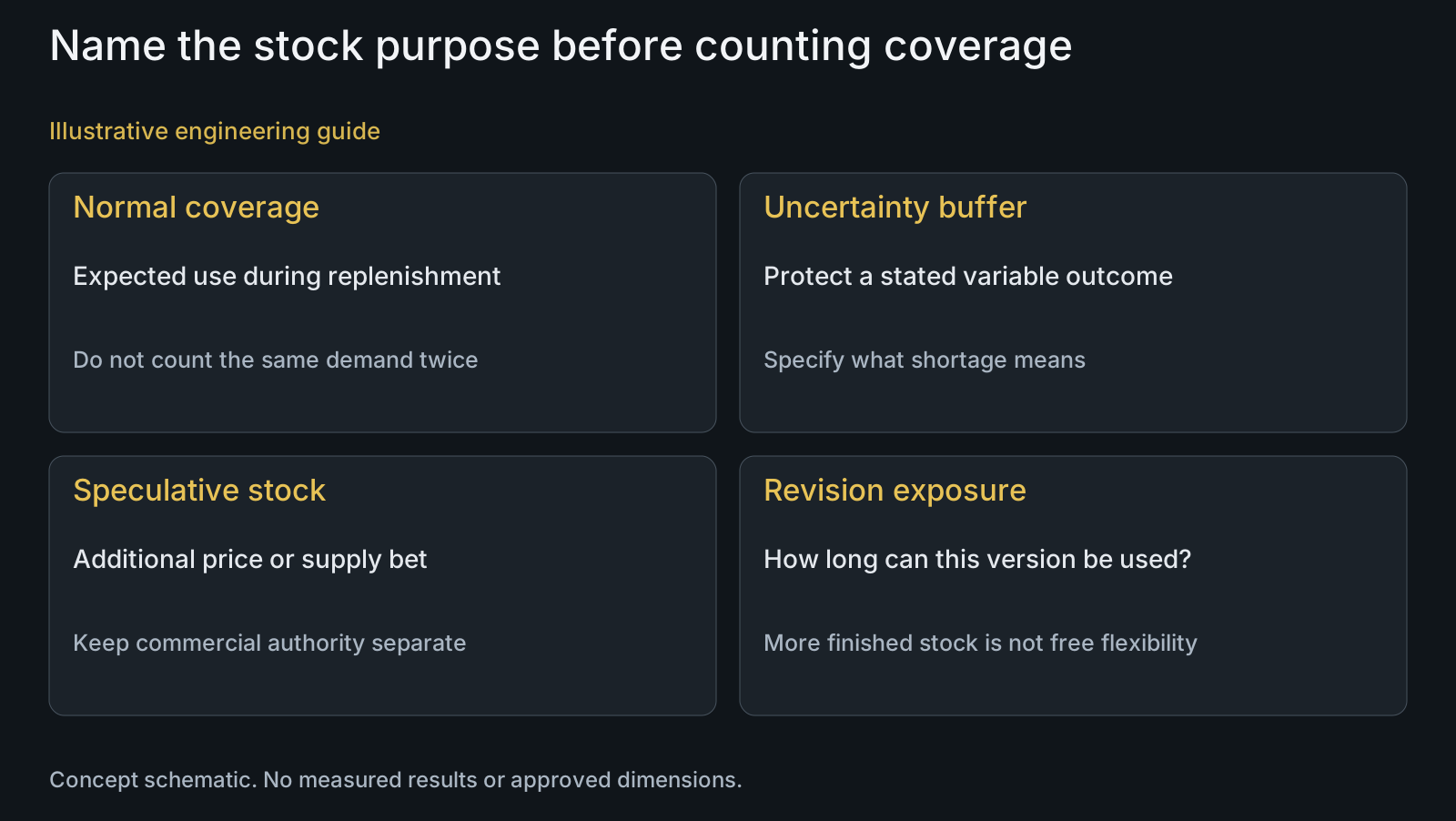
Normal replenishment coverage supports expected consumption while supply is being renewed. Safety stock is intended to protect against a defined uncertainty. Speculative inventory is an additional commitment based on an expectation about future price or availability. Those purposes need not produce the same purchase quantity or authorisation.
Average daily use multiplied by a replenishment period describes the expected demand covered under those assumptions. Calling the entire result safety stock hides whether ordinary demand has already been counted elsewhere. Keep the normal coverage and extra protective quantity explicit to avoid double counting.
Oracle's replenishment-planning documentation distinguishes configurable days-of-cover and service-level-based methods. This illustrates why a chosen policy matters; it does not establish a PremFixer software deployment, an industry-mandated formula or the correct number of days for a bicycle project.
Define the service outcome and usable replenishment period
State what shortage means: a missing component at a particular receiving point, a complete kit unavailable for assembly, or an unmet service-parts request. These are different outcomes. Do not report a general inventory availability percentage as though it proves that every planned bicycle build can proceed.
Measure the time from the relevant replenishment trigger to usable stock, not merely the quoted machining duration. Include applicable input preparation, manufacture, partner operations, transport and required release work. Identify whether the data concern accepted normal orders, urgent proposals or hypothetical alternatives.
Review the JIT delivery-window discussion for usable release timing. A buffer selected against arrival time alone may miss receiving constraints. Where input records are sparse or the route is changing, state the limitation instead of presenting an exact service prediction.
| Stock decision | Useful basis | Risk concealed by a days rule | Validation or review |
|---|---|---|---|
| Expected demand coverage | Represented demand during usable replenishment | Ordinary consumption counted twice as protection | Consistent units, trigger and usable-release boundary |
| Uncertainty buffer | Stated demand and supply variation with service goal | No link between added quantity and intended protection | Scenario or data-based method with explicit assumptions |
| Speculative extra purchase | Explicit price or availability expectation | Commercial exposure labelled as engineering necessity | Separate authorisation, use horizon and residual responsibility |
| Finished kit stock | Near-term configuration demand and complete positions | Earlier revision stranded after interface change | Compatibility, demand horizon and disposition agreement |
| Earlier-stage buffer | Adaptable input and remaining conversion route | Raw material mistaken for assembly-ready coverage | Remaining manufacture, treatment and release time |
| Last-time purchase | Defined final demand and service scope | Forecast treated as unlimited production authority | Committed boundary, permitted use and residual-stock decision |
Compare uncertainty scenarios without forcing a formula
Use a consistent demand unit and planning horizon, then examine normal consumption, demand variation and replenishment variation. Intermittent service orders and regular assembly releases do not necessarily have the same demand shape. A single daily average can conceal a concentrated build release.
For each candidate quantity, ask what happens if demand arrives earlier or usable replenishment takes longer than expected. Identify which assumed scenario the buffer covers and which it does not. A scenario comparison supports a decision but is not a statistically validated probability model.
A numerical method must match the data, service definition and its assumptions. No normal-distribution multiplier, percentile or stocking quantity is prescribed here. Supply actual consumption and replenishment records before claiming that a selected quantity meets a quantified service target. The manufacturing overview helps identify the represented route, not a fixed supply-time distribution.
Apply the configuration horizon before committing finished stock
Identify the expected demand for the approved revision and any planned model or interface change. A forecast horizon is not automatically an authorised production commitment. Stock that protects the current build may become unsuitable for a revised bolt-and-spacer combination.
Compare finished kits with adaptable material or partially processed forms. Finished stock removes more remaining conversion work but embeds more configuration-specific decisions. Earlier-stage stock may preserve options but leaves manufacturing and release time to be covered. The titanium disruption discussion addresses buffer position; here that choice is constrained by demand uncertainty and version exposure.
A last-time purchase needs a defined demand basis, residual-stock responsibility and permitted service configuration. The revision-compatibility guide covers authorised combinations and disposition. It does not make earlier components interchangeable merely because the next revision is not yet in production.
Review a longer sleeve replenishment period before adding every item
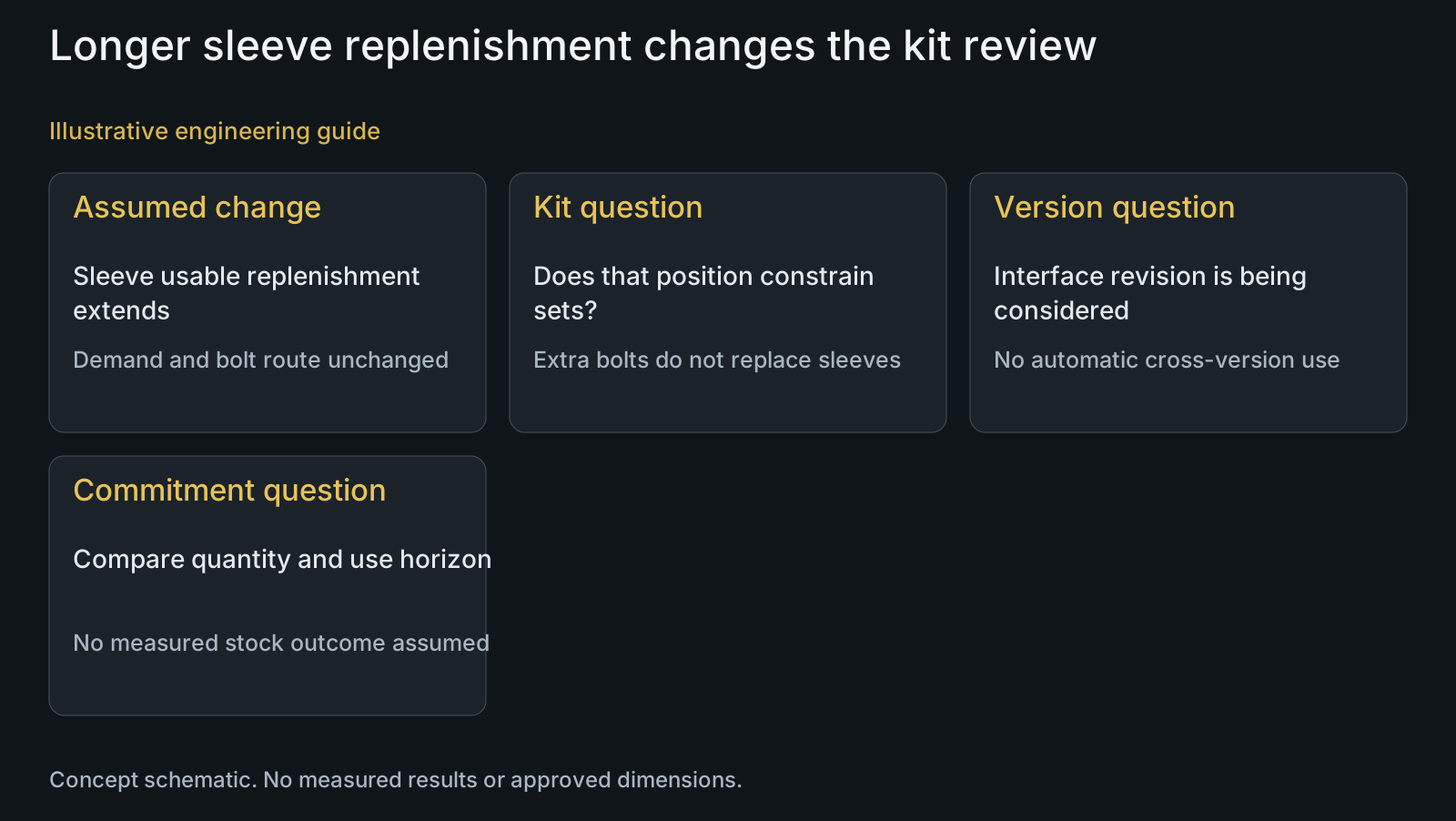
Illustrative engineering example: assume the build demand is unchanged, but the usable replenishment period for one sleeve position becomes longer. Bolt supply is unchanged and an interface revision is under consideration. No real quantities, measured variability or approved revision date are assumed.
The planner compares the sleeve position against the required kit and examines whether its candidate buffer covers the changed replenishment scenario. Increasing finished bolts by the same amount would not remove the sleeve dependency. It could instead commit extra hardware to the earlier configuration.
The reviewer then checks how much demand is expected before a possible configuration change and what earlier-stage material could remain usable. Any production commitment or residual-stock responsibility requires agreement. The example yields a review path, not a calculated stock recommendation, achieved service percentage or demonstrated saving.
Keep the stock policy tied to its original risk
Record the selected buffer's purpose, represented configuration, service outcome and assumptions. When demand, replenishment or the revision horizon changes, reassess the reason for the buffer. Do not preserve a legacy number merely because it was once expressed as an easy-to-remember days-of-stock rule.
Separate usable on-hand parts, held stock, committed supply and conditional incoming quantities. A projected replenishment date is not present accepted inventory. Equally, a price-related extra purchase should remain visible as a commercial risk decision rather than being hidden inside the safety-stock label.
Use the materials overview to define the supply form and the knowledge center for related kit decisions. PremFixer can discuss a scoped replenishment proposal against customer inputs; this article does not establish reserved inventory, free storage, universal replenishment timing or supplier ownership of every residual-stock risk.
Questions buyers need to confirm
Should every pivot program hold 30 to 45 days of stock?
No supported universal rule follows. Define demand, usable replenishment variation, the intended service outcome and configuration lifetime. Compare candidate buffers against those conditions; the same coverage period can expose one program to shortages and another to obsolete stock.
Is average daily demand multiplied by lead time always safety stock?
No. It represents coverage under the selected assumptions and may include ordinary expected consumption. Some planning systems also offer a configured days-of-cover safety policy. State the policy and separate normal coverage from additional uncertainty protection instead of assuming the label proves its adequacy.
What lead time belongs in the review?
Use the relevant trigger-to-usable-stock period. Include applicable preparation, manufacture, partner work, transport and release requirements. A machining quotation alone can omit time that still prevents the matching kit from being available for assembly.
Should bar stock and finished kits use the same buffer quantity?
Not automatically. They remove different amounts of remaining work and embed different configuration decisions. Compare material usability after a revision with conversion and release time. Bar stock cannot be counted as immediate finished-kit coverage.
Does extra bolt stock protect against a sleeve shortage?
Not by itself. Check required component quantities and permitted combinations for the complete kit. More of an unconstrained position does not replace the missing position, and mixed revisions need their own acceptable compatibility basis.
What changes when a new model revision is planned?
Reassess expected use of the current configuration, committed quantities and residual stock before adding finished inventory. A possible revision is not automatically effective, but neither does uncertainty authorise unlimited old-version production. Agree the commitment and disposition boundaries with the responsible owners.
Technical references and scope
Oracle replenishment-planning safety-stock methods. Software-specific distinction between configured days-of-cover and service-level approaches. No deployment, universal formula, statistical output or recommended pivot-stock quantity inferred.
Explore related component, material and sourcing decisions in the customer decision knowledge center. For a drawing review, use the Drawing/BOM RFQ path.
Define a pivot buffer around your demand and revision horizon
Send the drawing, STEP file or sample, BOM revisions, demand pattern, usable and held stock, replenishment records and expected model-change horizon through the Drawing/BOM RFQ path. State the service outcome and who approves inventory commitments. PremFixer can discuss a scoped replenishment proposal without substituting a universal days-of-stock rule for project evidence.
Discuss the drawing and BOM