

Different pivot supplier quotations can be compared fairly only when the worksheet preserves their differences as well as the common requirement. Define one required part or kit, then retain each supplier's actual response, offer reference and assumptions beside the comparison. Separate a baseline offer from a proposed material, geometry or process alternative. An early estimate with unresolved inputs should not be treated as an equivalent production commitment merely because it fits the same price column. The direct task is to identify comparable candidates and the questions blocking comparison before ranking totals. Document length, confident wording and an apparently precise unit price do not establish that equivalence.
Hero: concept illustration of example hardware and its application. It is not a factory photograph, tested component or approved production geometry.
Give the template three layers, not just supplier price columns
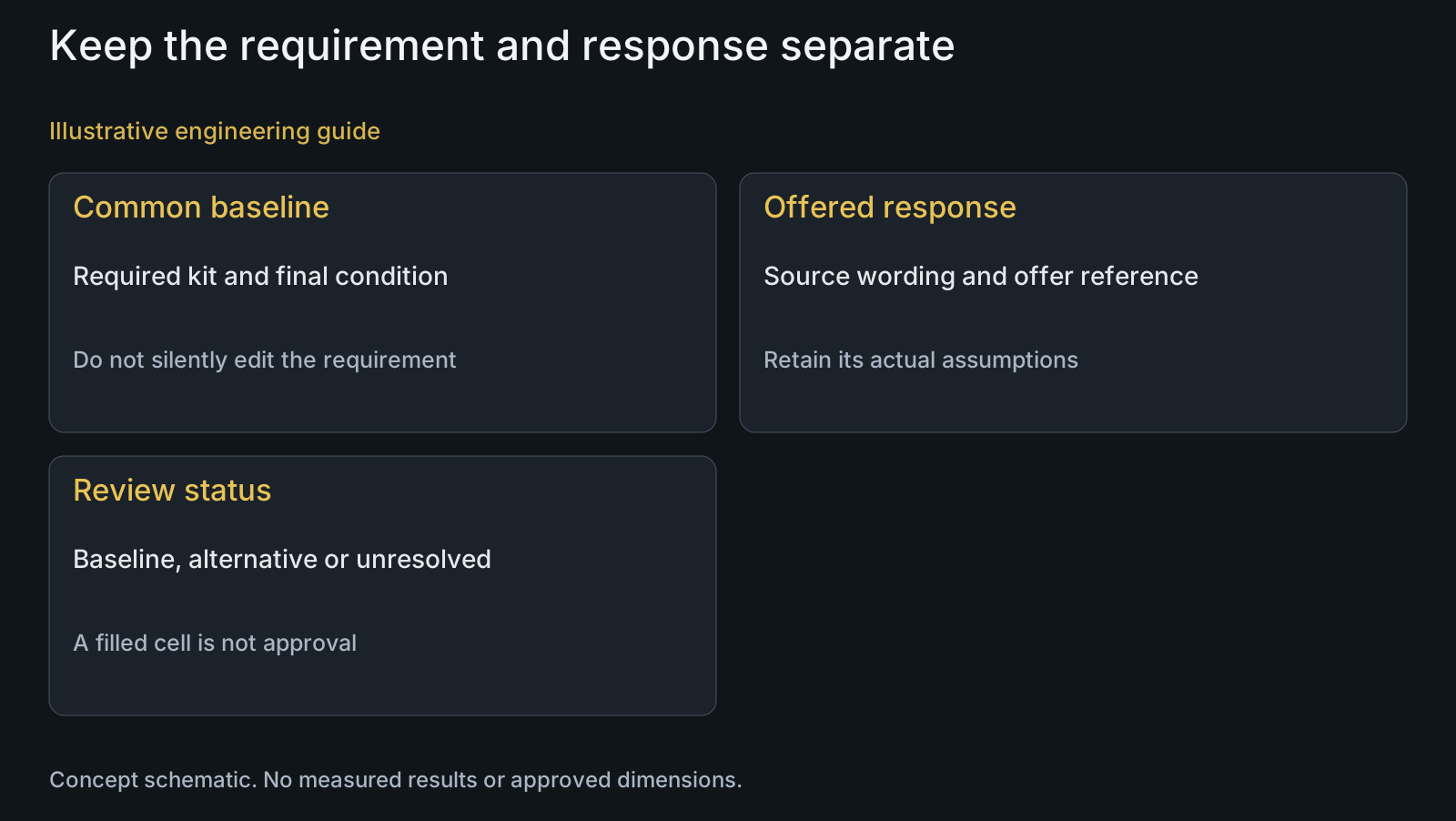
The first layer is the buyer's requirement: component or kit, quantities, revision and finished state. The second is the actual offered response, including its reference and date. The third is the review status: matches the stated baseline, alternative proposed or unresolved. These describe comparison readiness, not automatic design approval.
Keep the source wording available when summarizing a response. Converting 'material to be confirmed' into a grade name chosen by the buyer creates false agreement. Similarly, a supplier's proposed different packing unit should not disappear because the template accepts only one unit label.
The custom-versus-catalog cost guide explains complete supplied scope. This template adds a traceable interpretation boundary: the reviewer can show why an offer is comparable and where clarification is still required.
Make the common technical baseline specific enough to answer
Identify the controlling drawing and BOM members, not only an attachment date. List material grade and condition, relevant final treatment and required acceptance evidence. Include the supplied quantity per complete kit so that one component price cannot be mistaken for a set price.
Describe required outcomes separately from any mandatory production route. A proposed route may be acceptable if the project permits it and its required results remain satisfied. Where the specification mandates a method, the supplier must address that condition explicitly rather than substitute another route in a price cell.
An unresolved receiver or spacer interface can prevent a complete production definition while still allowing a bounded planning estimate. State which information is missing and what decision the estimate can support. Do not require a fabricated complete answer merely to make every row appear filled.
| Required field | Supplier response to retain | Comparison risk | Review or verification |
|---|---|---|---|
| Supplier and offer reference | Actual dated offer version | Clarification from another version mixed in | Link response to its offer |
| Drawing and BOM baseline | Quoted revision and kit members | Different product compared | Required identity and quantities |
| Material condition | Stated grade or proposed alternative | Template silently substitutes grade | Baseline or separate branch |
| Process requirement | Mandatory method or proposed route | Outcome and method confused | Applicable requirement boundary |
| Final finish | Treated and excluded zones | Appearance label accepted as scope | Final condition and interfaces |
| Inspection evidence | Results and coverage actually offered | Generic inspection label overread | Acceptance and document mapping |
| Packing unit | Kit grouping, identity and protection | Receiving tasks disappear | Same operational supplied unit |
| Schedule basis | Represented quantity and starting event | Estimate treated as delivery promise | Actual offer conditions |
| Commercial terms | Currency, payment and delivery basis | Different responsibility ranked as price | Transparent comparison method |
| Exclusions and open inputs | Actual gaps and alternative status | Blank cells called acceptance | Clarification or conditional comparison |
Keep proposed alternatives on their own comparison branch
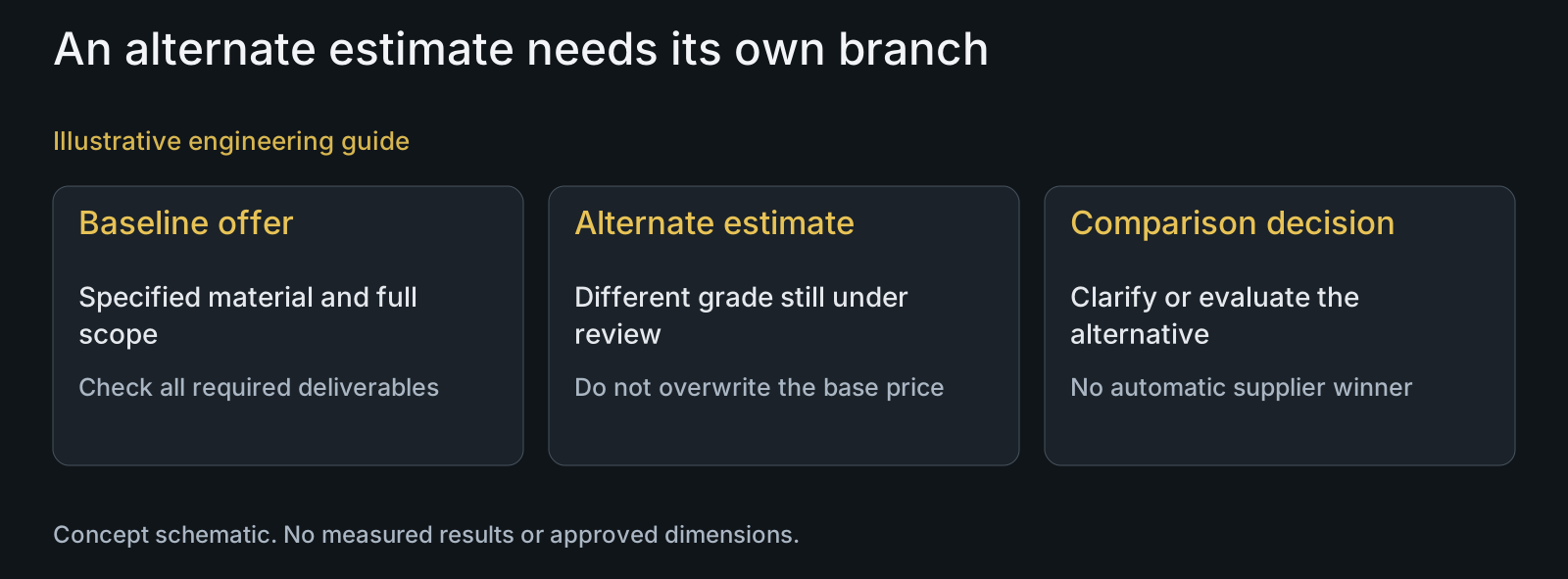
Record the changed feature and the reason for the proposal. A different grade, shoulder arrangement or treatment is not merely a quotation formatting difference. Engineering should be able to evaluate that branch without losing the original baseline offer.
Compare an authorized alternative only on its stated required function and delivered scope. Do not copy the cheaper alternative price into the baseline total while retaining the original specification heading. That produces a worksheet for an item nobody actually offered.
Use material comparison and manufacturing review for the affected engineering questions. The quotation template identifies the branch and its status; it cannot establish complete bicycle compatibility or substitute for design authority.
Separate estimate confidence from the detail of its presentation
Ask what the price represents: an indicative estimate, a sample scope, a production offer or a separately stated alternative. Record outstanding inputs and the offer's own conditions. More decimal places do not make a provisional total a confirmed manufactured scope.
Clarify what a stated schedule starts from and which quantity it covers. A machining-duration estimate and a complete delivery offer are different subjects. Record the supplier's actual basis instead of using the same generic lead-time heading to imply equal obligations.
The International Trade Administration's export-sale overview connects quotations with terms of sale, payment and total delivery-related pricing. That general context supports keeping commercial fields beside technical scope; it does not establish legal acceptance or a particular PremFixer offer policy.
Normalize only what can be normalized transparently
Convert a component price to a kit comparison only when the required quantities and compatible members are established. Add separately offered required work without counting it twice. If the missing work has no applicable price, retain an unresolved subtotal rather than create an invented full total.
Keep currency basis, packing, delivery and payment assumptions explicit. A buyer can use its agreed comparison method, but the original offer should remain identifiable. The currency alternatives guide distinguishes a reference conversion from an actual offered settlement option.
After clarification, state which candidates can be compared on the selected basis and which remain conditional. The scope omissions map helps distinguish included, excluded and unstated work. A completed spreadsheet should expose unresolved choices, not conceal them beneath a numeric ranking.
Review example: the template must not approve an alternate material
Illustrative engineering example: assume an OEM sends one pivot-kit definition to two suppliers. One offers the specified material and another provides an estimate based on a proposed substitute while noting that evaluation remains open. No actual prices, suppliers or performance results are supplied.
The buyer records the second response as an alternative estimate, retaining its material assumption and unresolved authority. They do not insert its price into the baseline column under the specified grade. The first offer is checked for complete scope rather than selected automatically because it matches that one field.
The team can request the baseline offer, separately evaluate the substitute or defer the comparison. No winner is claimed. The useful output is a worksheet that still represents what was actually offered and what engineering must decide before a comparable purchase choice exists.
Questions buyers need to confirm
Does a common template make quotations comparable?
No. It organizes responses, but equivalence still needs the same required kit and scope. Retain the supplier's actual wording and classify matches, alternatives and unresolved conditions separately.
Should an alternate material price sit in the baseline total?
Not while it represents a different definition. Keep the alternative separate with its grade, condition and approval status. Engineering can evaluate it without disguising it as the specified part.
Can an early estimate be useful?
Yes, for a stated planning question with visible assumptions. Identify the missing inputs and represented scope; do not treat it as a complete production offer simply because it contains a detailed total.
What makes schedule figures comparable?
The stated quantity, delivered scope, starting event and conditions must be understood. Machining duration, sample preparation and complete delivery are different subjects, even when all use the word lead time.
Is the longest quotation necessarily better?
No. Each offered activity should address a real requirement. Evaluate defined scope, relevant capability and terms; document length does not prove completeness or create a supplier ranking.
What should happen to an unresolved comparison row?
Keep the original response and name the clarification that changes the decision. Do not fill it with an assumed acceptance or price. The candidate can remain conditional while other comparable offers continue to be reviewed.
Technical references and scope
International Trade Administration: Negotiate an Export Sale. General relationship of quotations, terms, payment and delivery-related total price; no legal acceptance, tariff rate or company policy inferred.
Explore related component, material and sourcing decisions in the customer decision knowledge center. For a drawing review, use the Drawing/BOM RFQ path.
Request an offer that answers the same baseline
Send the controlling drawings, STEP, kit BOM and quantities, material and finish, required evidence, packing and proposed delivery scope through the Drawing/BOM RFQ path. PremFixer can review the baseline and show any proposed alternative or unresolved input separately.
Discuss the drawing and BOM