

Buyers comparing pivot hardware prices should clarify the work outside the visible unit line before ranking offers. Tooling, finishing, evidence, protection, freight, import handling and receiving tasks may be included, explicitly excluded or simply unstated. Those are three different conditions. Ask who performs each required task and which offer or estimate represents it. Keep ordinary required work separate from contingent rework, urgent transport or other possible events. An explicit exclusion can be reasonable and useful; the risk is treating an unresolved responsibility as free. No universal surcharge, duty rate or certain quality failure is assumed in this procurement review.
Hero: concept illustration of example hardware and its application. It is not a factory photograph, tested component or approved production geometry.
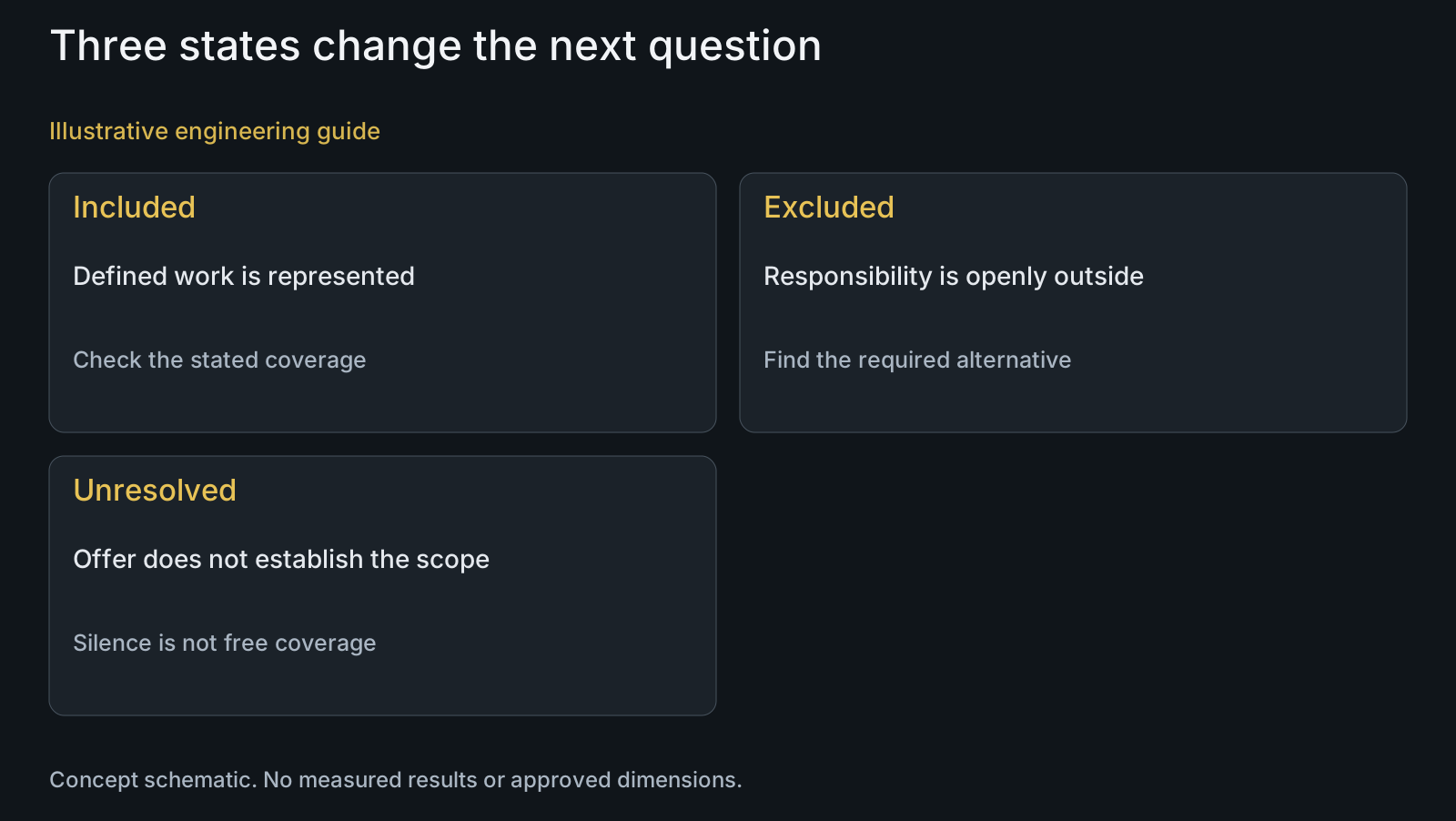
Use three scope states instead of a yes-or-no checklist
Mark an item included only when the offer establishes its scope. 'Inspection included' does not by itself describe every required characteristic or document. Connect the line to the actual acceptance requirements without assuming that broader evidence has been supplied.
Mark an explicit exclusion as excluded, then identify how the required task will be covered elsewhere. If the offer is silent, mark it unresolved and ask for clarification. Do not convert silence into an automatic extra charge or an assumption that the work is free.
The manufacturing cost breakdown explains what can trigger work. Here, the buyer's task is different: determining where required work sits between offers and receiving operations before constructing the comparison total.
Find the missing physical member or delivered condition first
Compare the required BOM with the offered unit. A bolt, axle, receiver, spacer and complete kit are not interchangeable quotation units. If a necessary mate is absent, determine whether it is supplied by another source or omitted from the comparison; do not resolve the gap with a guessed price.
Check the final material condition, treatment zones, cleaning or protection requirements actually applicable to the part. A raw-machined piece and a finished component are different outputs when treatment is required. Colour in an illustration cannot establish that treatment or its evidence.
Use the finishing scope review for included and excluded functional areas. PremFixer's manufacturing scope should be understood from the defined project route, not from an assumption that every listed activity is performed in-house.
| Required item | Possible offer state | Risk | Verification basis |
|---|---|---|---|
| Matching BOM members | Included, excluded or unstated | Bare axle compared with complete kit | Offered unit and member quantities |
| Final treatment | Named route and zones or gap | Appearance mistaken for finished scope | Treatment and protected areas |
| Required evidence | Specified results or broad label | Inspection label assumed comprehensive | Characteristics, coverage and documents |
| Packing and receiving | Grouped kit or transferred task | Buyer work omitted from total | Protection, identity and pack unit |
| Delivery and import | Defined boundary or unresolved provider | Unknown charges treated as zero | Named rule/place and applicable offer |
| Inventory responsibility | Committed quantity and release scope | Surplus counted as certain use or loss | Demand and revision arrangement |
| Contingent events | Applicable event or labelled scenario | Every possible failure added as routine | Event, affected scope and estimate |
Separate supplier evidence from the buyer's receiving tasks
Identify the measurements and documents requested from the supplier, then the receiving operation the buyer still intends to perform. One does not automatically cancel the other. A supplier report may support defined acceptance evidence without removing the buyer's identification, condition or project-specific checks.
Ask whether receiving effort is a routine requirement, a special new-part activity or a response to an identified discrepancy. These have different triggers. Avoid adding repeated sorting or remeasurement to every offer merely because it could happen; there is no evidence that every supplier will create that expense.
If a packing proposal transfers grouping to the buyer, name that task. Include its represented basis where available, but do not claim an actual labor saving or cost without an applicable observation or explicit estimate. The supplied packing unit should match the comparison's operational assumptions.
Read freight and import responsibilities with their actual boundary
ICC's public Incoterms overview explains allocation of delivery-related obligations, costs and risks. It supports reading the named rule and place in an offer, not assuming that a shorthand delivery label includes every expense or changes manufacturing conformity requirements.
Identify the agreed transport and import responsibilities for the actual destination and route. Ask the relevant provider or qualified import specialist for applicable classification and charges. No tariff code, tax rate or universal landed-cost percentage is established by this article.
Keep separate charges from included charges so that neither disappears nor is counted twice. If a carrier or other provider offer is missing, label that part of the comparison unresolved rather than fill it with a generic benchmark. A lower known subtotal is not necessarily a lower complete total.
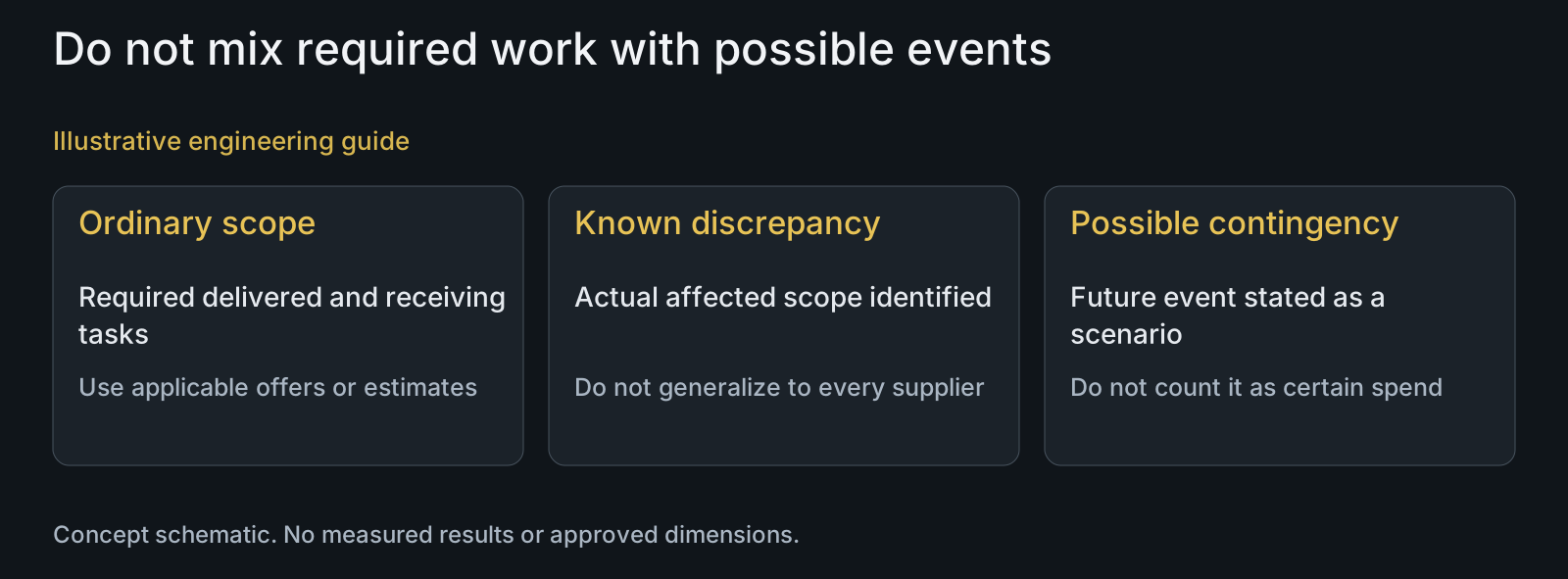
Keep inventories and contingencies out of the routine subtotal
Stock responsibility depends on committed quantity, release timing, storage and revision applicability. An order's surplus is not automatically a loss, but it also is not automatically useful future demand. Identify the actual responsibility instead of attaching a standard inventory surcharge to every part.
Rework, emergency transport and quality-related disruption need an identified event or a labelled scenario. If an applicable discrepancy already exists, its affected scope belongs in the review; if it is only possible, do not charge it to the baseline as though it occurred.
The ownership-cost guide addresses longer-period scenarios and their sensitivity. This offer-normalization map should remain narrower: required supplied and receiving work, known exclusions and unresolved boundaries. Avoid folding an unsupported lifetime forecast into the current quotation comparison.
Review example: an explicit exclusion is clearer than an unstated promise
Illustrative engineering example: assume two offers describe the same pivot kit. One explicitly excludes a particular customer-requested evidence document; the other states only that inspection is included. The buyer needs the document, but no actual prices or report contents are supplied.
The reviewer asks the first supplier for a defined additional offer and the second to confirm whether its inspection scope includes the document and required underlying results. They do not judge the first supplier as inferior simply because its exclusion is visible, nor accept the second supplier's silence as coverage.
The comparison remains unresolved until the required evidence and its cost treatment are established. It may then compare complete scope or retain a separately sourced responsibility where appropriate. No supplier ranking or added fee is claimed; the example shows why transparency is more useful than an unsupported all-inclusive assumption.
Questions buyers need to confirm
What should we check beyond the pivot unit price?
Check required BOM members, final treatment, evidence, packing, receiving and delivery responsibilities. For each item distinguish included, excluded and unresolved scope before estimating a complete total.
Is an explicit exclusion a bad quotation?
Not necessarily. It can make the boundary transparent. Determine whether the excluded work is required and how it will be supplied, then compare the complete defined scope rather than penalize disclosure.
Does inspection included cover our full evidence request?
Only when the offer establishes that coverage. Name the characteristics, represented quantity or lot and required documents; a broad inspection label does not automatically include every customer-requested report.
Should unknown freight or import charges be entered as zero?
No. Keep them unresolved until the relevant boundary and applicable offer or specialist input are available. Do not use a generic duty percentage or presume manufacturing scope includes all destination charges.
Should emergency freight be included in every comparison?
Not as a certain routine expense without a basis. If an actual affected event exists, define its scope; otherwise use a separate labelled scenario rather than assume every supplier creates an emergency.
How should inventory holding be treated?
Identify the actual committed quantity, releases, ownership and revision horizon. Surplus can have useful demand or exposure, but neither conclusion follows automatically; use the specific arrangement instead of a universal surcharge.
Technical references and scope
ICC public Incoterms 2020 overview. General delivery-related cost, risk and obligation allocation; no proprietary clauses, tariff classification or tax rate applied.
Explore related component, material and sourcing decisions in the customer decision knowledge center. For a drawing review, use the Drawing/BOM RFQ path.
Clarify the missing scope before comparing totals
Send drawings, STEP, required BOM members, final condition, evidence and packing requirements, quantities and destination scope through the Drawing/BOM RFQ path. PremFixer can review the manufacturing offer's inclusions and exclusions and identify the responsibilities that still need separate clarification.
Discuss the drawing and BOM