
A more expensive pivot bolt does not automatically have a lower total cost of ownership. An OEM comparing alternatives should first require the same usable hardware function, then examine purchase, receiving, assembly, inventory and relevant service costs over one stated period. Keep observed costs separate from assumed replacement or disruption events. A material label cannot establish a service-life multiplier, and a possible failure cost is not an achieved saving. Test the uncertain input that could change the preferred option. This gives procurement and engineering a useful evidence question instead of a confident total built on unverified durability or future demand.
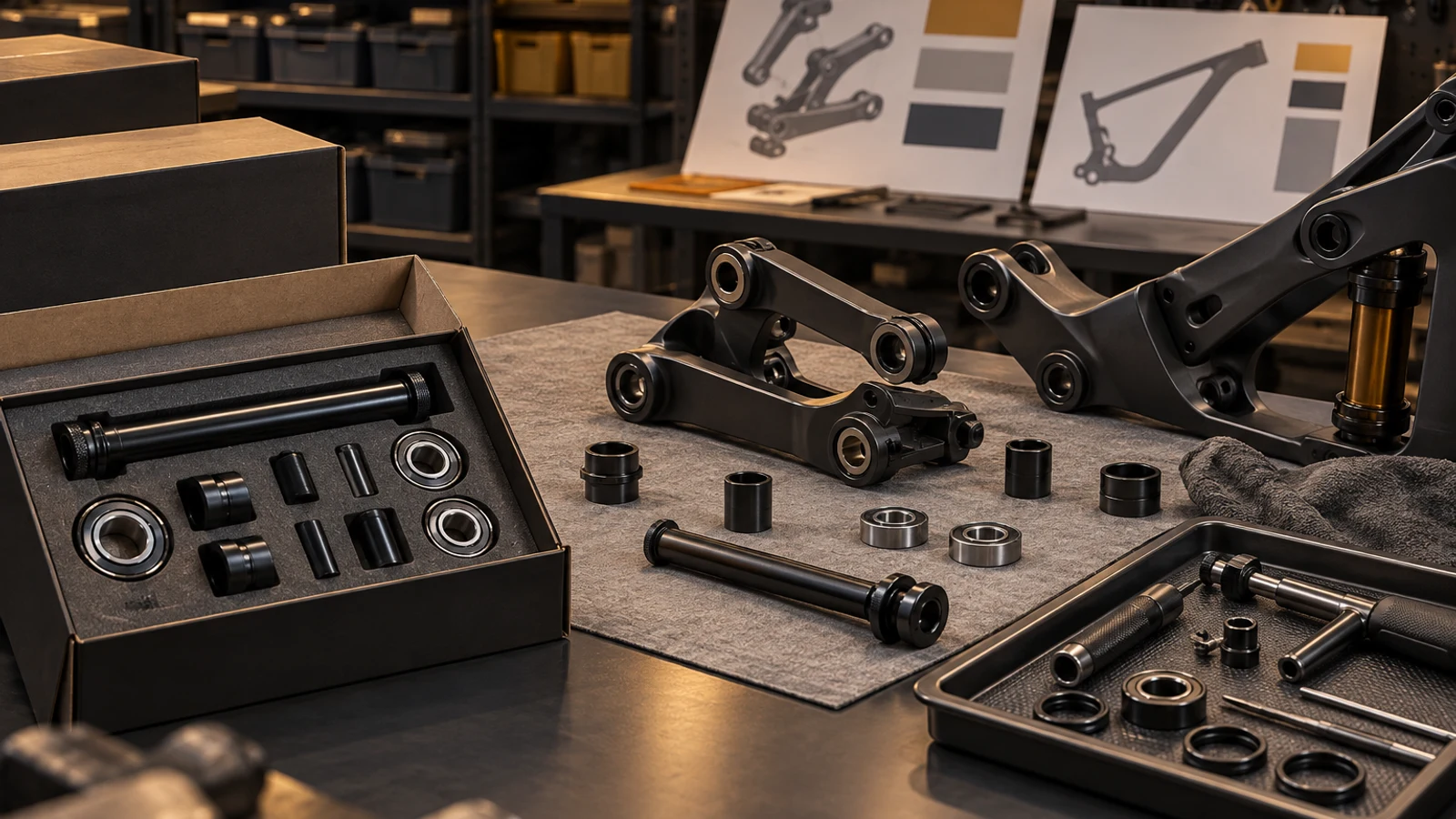
Hero: concept illustration of example hardware and its application. It is not a factory photograph, tested component or approved production geometry.
Fix the unit of comparison and the ownership boundary
Compare complete usable kits or another explicitly defined delivered unit, not one supplier's bare axle with another supplier's assembled set. Identify compatible mates, delivered condition, required evidence and the service task. An apparently economical component may leave necessary work outside its visible purchase price.
Name whose costs are included: the OEM's receiving and assembly operations, its inventory, an authorized service operation or another stated boundary. Do not add a rider's inconvenience as a measured OEM expense without a basis. Keep nonfinancial risks visible without inventing a monetary conversion.
The cost breakdown explains manufacturing charge triggers. This ownership comparison begins after those offers have been made comparable; it does not reconstruct factory margins or claim that price alone represents the buyer's whole cost.
Use one period and separate recurring work from events
State when the comparison starts, how long it runs and the use represented by it. The same calendar period can contain different riding exposure or production use. Do not derive equivalent service from calendar time alone, and do not prescribe a universal pivot replacement interval.
Separate one-time implementation work from repeat handling and assembly. A dedicated receiving check, a new assembly tool and repeated labor have different timing. Ask whether an included quotation charge already covers an activity before adding it as a separate ownership line.
For costs arising at different dates, use the organization's approved consistent financial basis if one is required. This article does not supply discount rates, tax treatment or an accounting policy. A simple undiscounted scenario should be labelled as such, not presented as a fully validated investment valuation.
| Cost or assumption | Comparable basis | Risk | Useful verification |
|---|---|---|---|
| Purchase | Same usable kit and included work | Unlike offers compared | Offer scope and component list |
| Receiving and assembly | Represented station and configuration | Estimated labor called observed | Applicable study or explicit estimate |
| Inventory | Quantity, timing and responsibility | Surplus assumed immediately useful | Demand and revision horizon |
| Service event frequency | Exposure and defined failure criterion | Material label used as lifespan | Applicable evidence or labelled scenario |
| Event consequence | Parts, labor and disruption boundary | One expense counted twice | Included event-cost scope |
| Sensitivity result | Same period and changing input | Possible benefit called likely saving | Ranking and reversal assumption |
Give each cost an evidence type before giving it a value
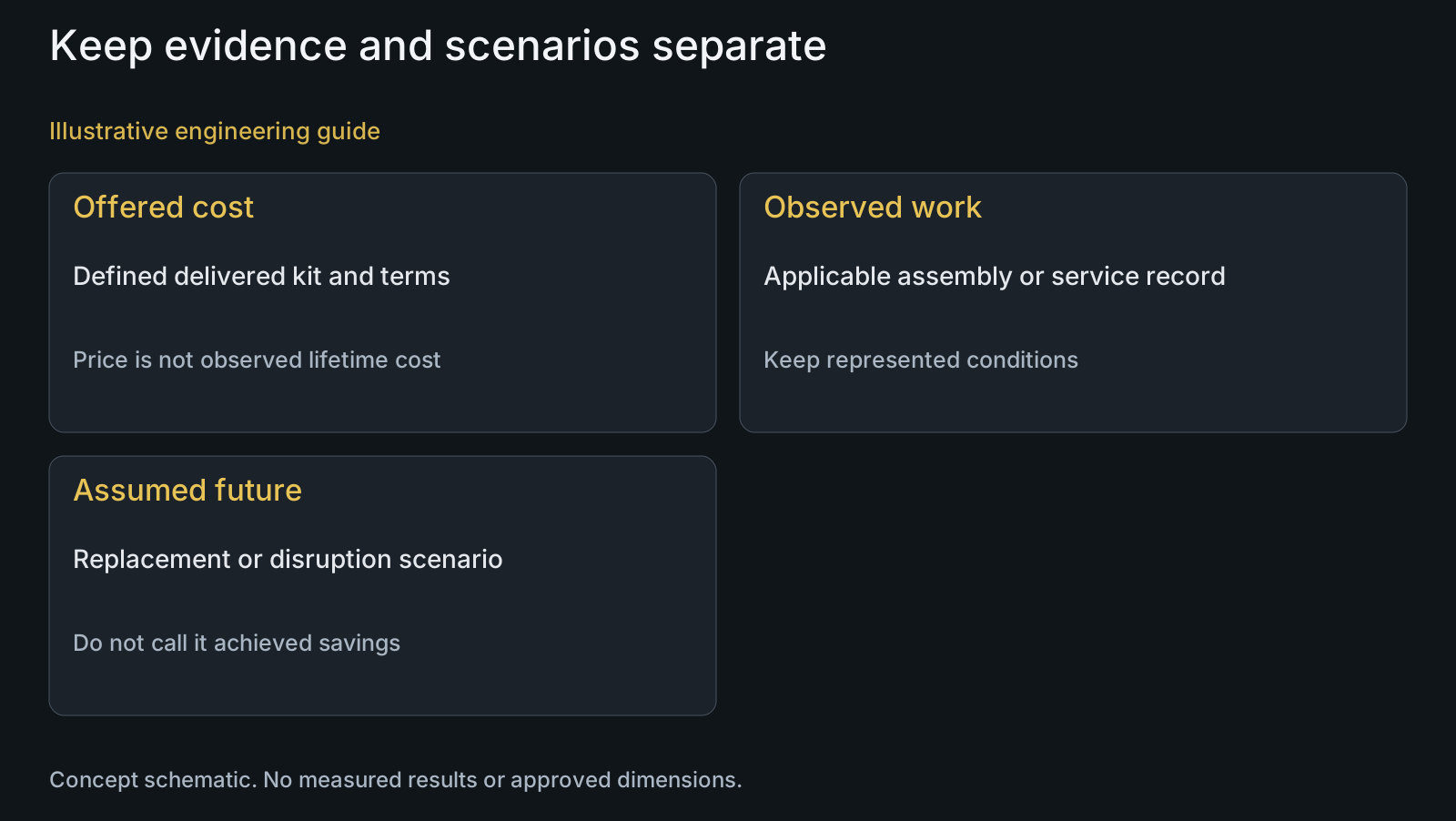
A supplier offer is evidence of offered scope and price under its terms. A timed assembly study can support a labor input for its represented station and process. A past service record can support the recorded configuration and exposure, but not automatically a new material or joint design.
Label estimated storage, future replacement and disruption inputs as assumptions where no applicable record exists. Keep the assumed event, its frequency and its consequence distinct. A replacement part price does not establish how often replacement happens, and a service instruction does not establish an observed failure rate.
Avoid overlapping losses. If a recorded service invoice includes parts and labor, adding the same parts again double counts them. If two disruption scenarios describe the same event, do not automatically sum them as simultaneous losses. Define the event boundary before comparing totals.
Test the variable that could reverse the selection
NIST's life-cycle costing handbook discusses changing uncertain inputs and examining the resulting decision. It also notes that sensitivity analysis does not directly establish outcome probabilities. Its federal-building application and prescribed financial inputs are not pivot-hardware requirements; only that general uncertainty method is used here.
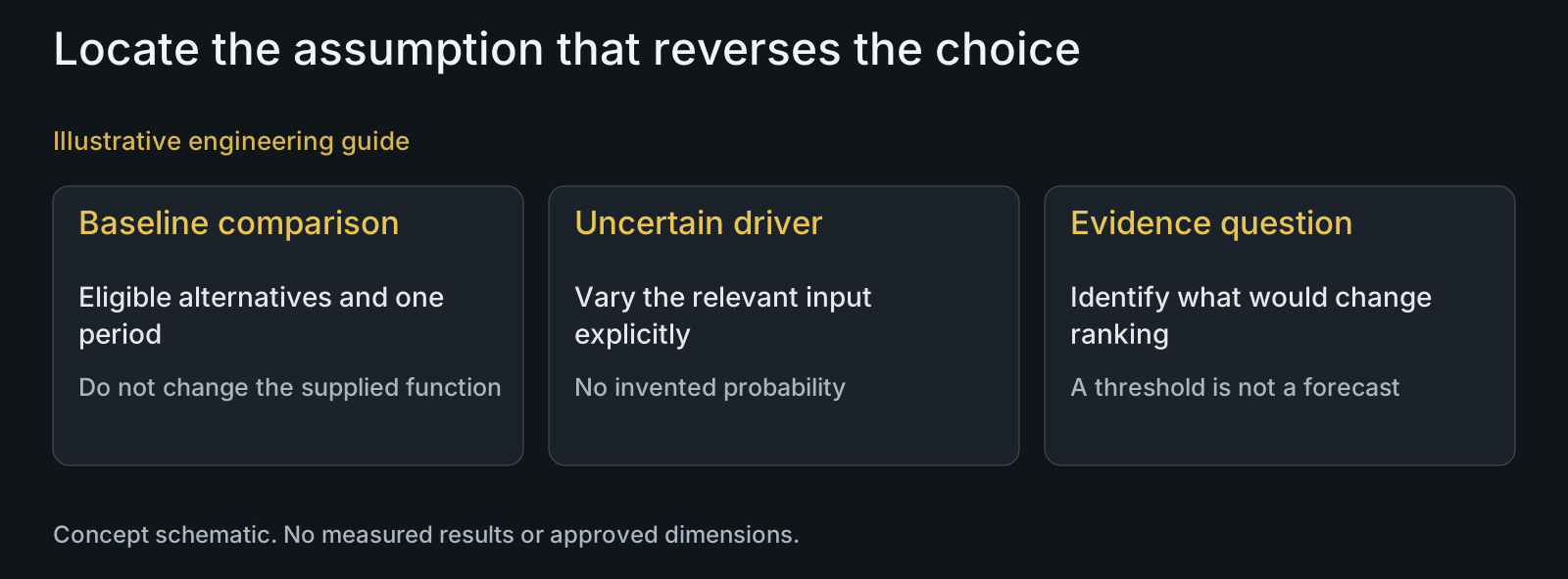
Start with one unresolved driver, such as the difference in assembly handling or the assumed number of service events. Hold the comparison's other inputs steady and examine whether changing that driver reverses the preference. Where related inputs move together, identify the combined scenario and its rationale.
Do not combine every favorable assumption for one option and every unfavorable assumption for the other without explaining why that combination is plausible. The point is to expose dependence on evidence, not to produce the most persuasive sales number. No fivefold price or tenfold lifespan claim is established by this method.
Ask for evidence that matters to the ranking
If the selection barely changes when an uncertain input varies within the project's supported range, further precision on that input may not resolve the decision. If one assumption reverses it, identify the relevant verification rather than collecting unrelated measurements or asking for a generic certificate.
For a service-life claim, define the assembled interface, use exposure, maintenance and failure criterion. Comparing material names alone cannot isolate the effect of the hardware. The material comparison separates equal geometry from equivalent function before any ownership claim is considered.
Keep safety and compatibility requirements outside a tradeoff that treats noncompliance as a cheaper accepted option. Compare only eligible alternatives, or explicitly state that qualification remains unresolved. Manufacturing can clarify the supplied scope; it cannot supply an unobserved project service result.
Review example: an assembly difference is known, service benefit is not
Illustrative engineering example: assume two eligible pivot-kit options have comparable finished scope. The buyer has applicable assembly observations for both, but a proposed future service advantage for one option has no corresponding record. No prices, event counts or measured outcome are supplied.
The worksheet keeps offered purchase and represented assembly inputs apart from the service scenario. The reviewer examines the ranking without the proposed service advantage, then asks what magnitude of that advantage would change the preference. They label that threshold as an evidence question, not a forecast.
If the selection requires a service benefit that has not been demonstrated, the decision remains conditional. If supported purchase and assembly differences already explain the choice, the speculative benefit is not needed to justify it. Neither result proves a material lifespan or a realized financial saving.
Questions buyers need to confirm
Is titanium always cheaper over the service life?
No. Grade, geometry, joint conditions, purchase scope and applicable service evidence are needed. A higher material price and a claimed lifespan multiplier do not establish a lower ownership cost.
Should possible failures count as definite savings?
No. Identify them as scenarios unless applicable observations support the input. Distinguish the assumed event rate from its consequence, and do not treat the avoided scenario total as a realized benefit.
What period should the comparison use?
Use the project's stated decision horizon and represented exposure. Record the start condition and service task. Calendar time alone does not establish equivalent riding use or a universal replacement interval.
How do we avoid counting service expenses twice?
Map what each recorded or assumed expense includes. An invoice containing parts and labor should not be supplemented with those same parts again; overlapping disruption descriptions also require a defined event boundary.
Does sensitivity analysis tell us the most likely outcome?
Not by itself. It shows how results change with stated inputs. A probability claim needs additional evidence and a suitable method; a decision-reversal threshold is an information need, not a forecast.
What can a supplier contribute to the TCO review?
The supplier can clarify the offered hardware definition, delivered condition and included manufacturing work. Applicable assembly and service inputs need their own project evidence; an offer cannot establish unobserved lifetime performance.
Technical references and scope
NIST Handbook 135e2025, sensitivity analysis. Sections 8.2 through 8.2.4: general input and scenario sensitivity and the limitation on probability inference; federal-building parameters not applied to bicycle hardware.
Explore related component, material and sourcing decisions in the customer decision knowledge center. For a drawing review, use the Drawing/BOM RFQ path.
Define the supplied hardware before modelling ownership cost
Send drawings, STEP, compatible BOM, delivered condition, quantities and evidence requirements, together with the ownership-cost assumptions you want to compare, through the Drawing/BOM RFQ path. PremFixer can clarify manufacturing scope and identify where the decision still needs assembly or service evidence.
Discuss the drawing and BOM