
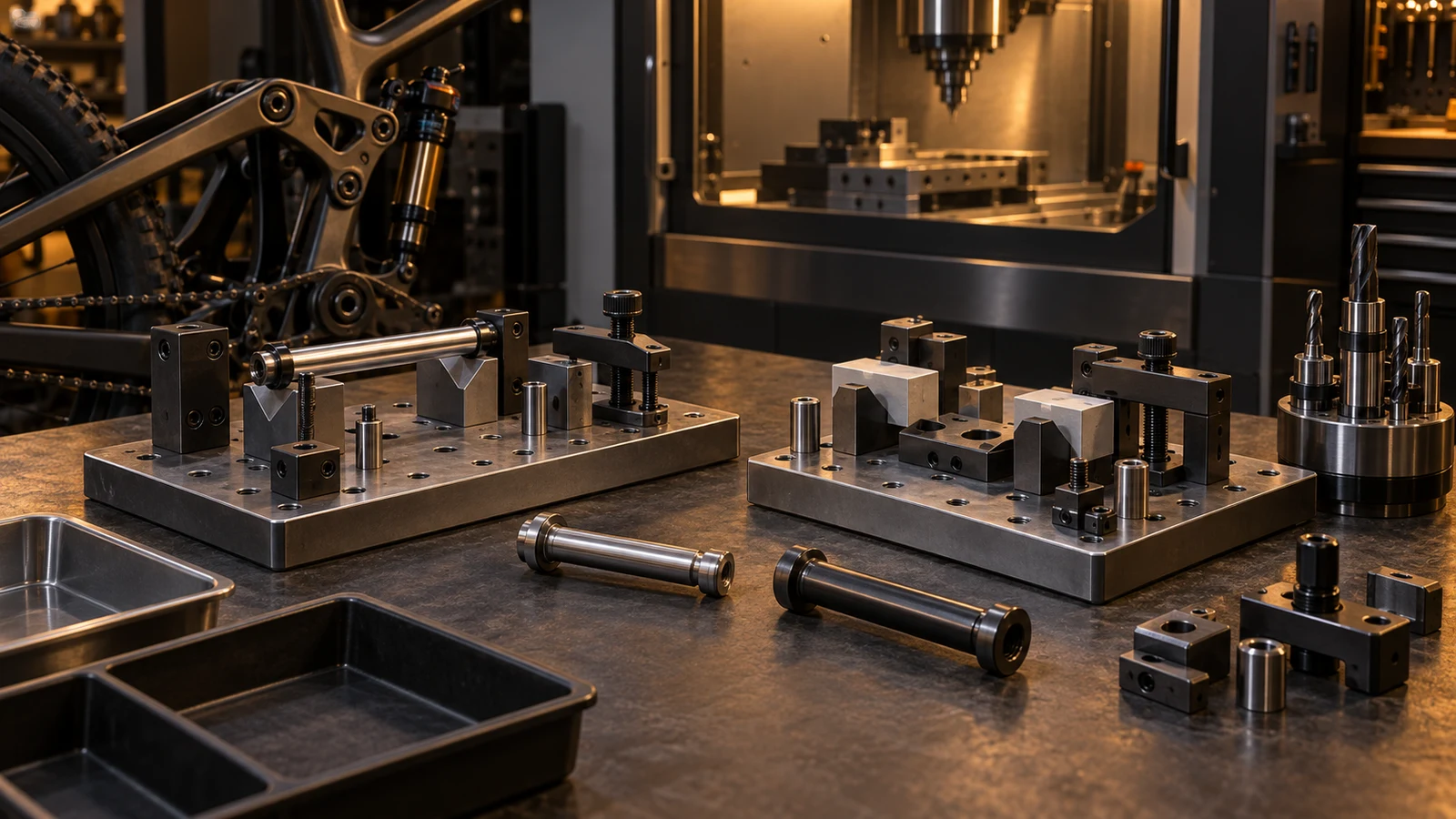
Faster fixture exchange does not guarantee a shorter complete changeover for every custom pivot part. The next axle or shoulder bolt still needs the correct workpiece location, support and clamping, suitable tools, the intended program and agreed first-part confirmation. For a buyer ordering a mixed small batch, compare the same interval to the next accepted production start, not only the time spent replacing a plate. A repeatable mounting interface can help that transition, but it does not prove a different part seats correctly in its jaws. Separate work prepared off the machine from the work that actually interrupts production.
Hero: concept illustration of example hardware and its application. It is not a factory photograph, tested component or approved production geometry.
Give the changeover comparison a common endpoint
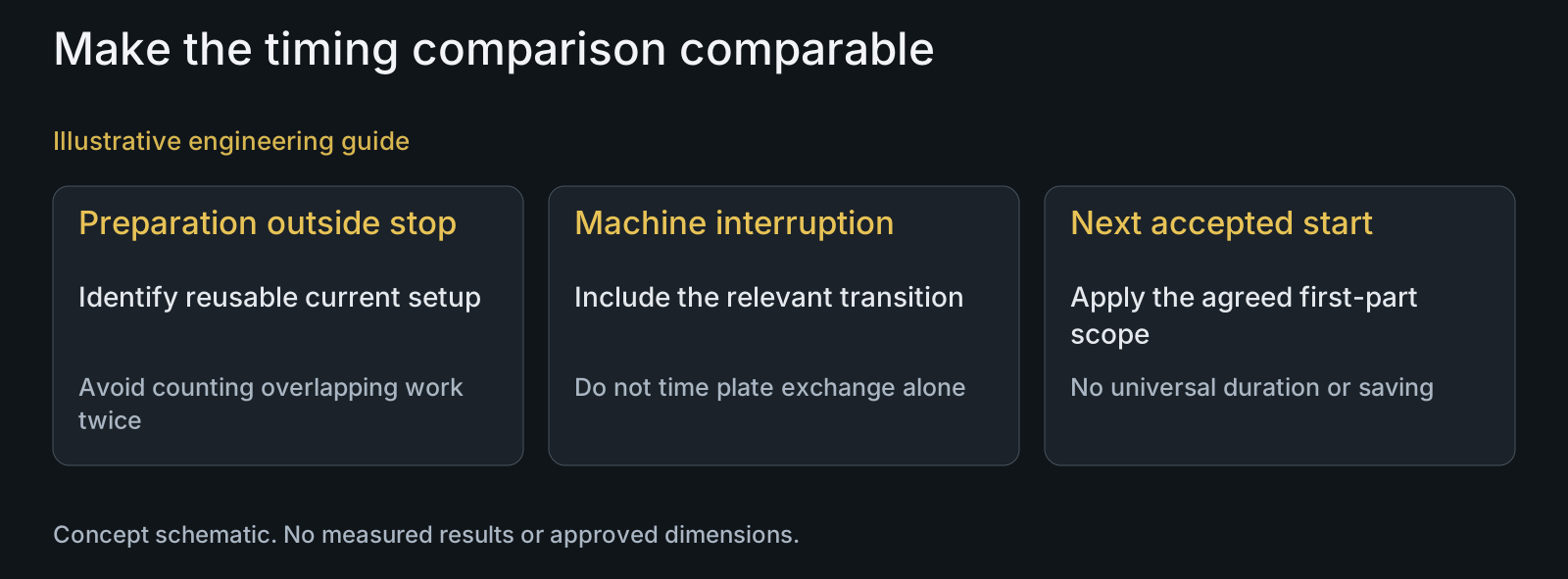
Define where the comparison starts and ends. A fixture-unlocked-to-fixture-locked interval is not the same as the interval from the previous accepted run to the next accepted start. Both can be useful, but they answer different planning questions.
Include the relevant exchange, tool preparation, program and offset confirmation, trial cutting and first-part assessment in the transition scope. Some activities can occur outside machine stoppage; others cannot. Do not add overlapping durations as if all preparation were sequential downtime.
The buyer's useful output is a realistic transition basis for the proposed part mix. A faster hardware exchange alone does not establish the complete batch schedule, external finishing availability or shipment date. Keep those later route constraints visible without turning a setup claim into a delivery guarantee.
Preparing a second plate can move work out of downtime
Jergens' quick-change kit description illustrates preparing parts on one fixture plate while another is on the machine. That explains the potential to move preparation outside the exchange interval; it does not measure a PremFixer changeover.
Check what can actually be prepared in advance for the proposed pivot family. A known part revision, compatible locating hardware and available tools support a different preparation scope from a newly revised shoulder geometry with unresolved contact surfaces.
Separate the reusable mounting base from part-specific jaws, stops or supports. A second plate is useful only if its setup is correct for the intended member. Preparing an obsolete configuration early does not create usable capacity. Retain the relevant part and fixture identities rather than relying on similar appearance.
| Measure or interface | Useful subject | What it does not establish | What to confirm |
|---|---|---|---|
| Fixture exchange interval | Removing and mounting hardware | Complete accepted-start time | Defined start/end and included actions |
| Off-machine preparation | Work moved outside stoppage | Correct current part configuration | Revision, contacts and required tooling |
| Plate mounting repeatability | Plate against its mounting base | Every workpiece datum relationship | Part-specific location and support chain |
| First-part confirmation | Defined output of the new setup | Every subsequent part or property | Changed features and acceptance scope |
| Batch schedule | Complete route for the requested mix | Guaranteed dispatch from fast exchange | Setup, output, finishing and inspection constraints |
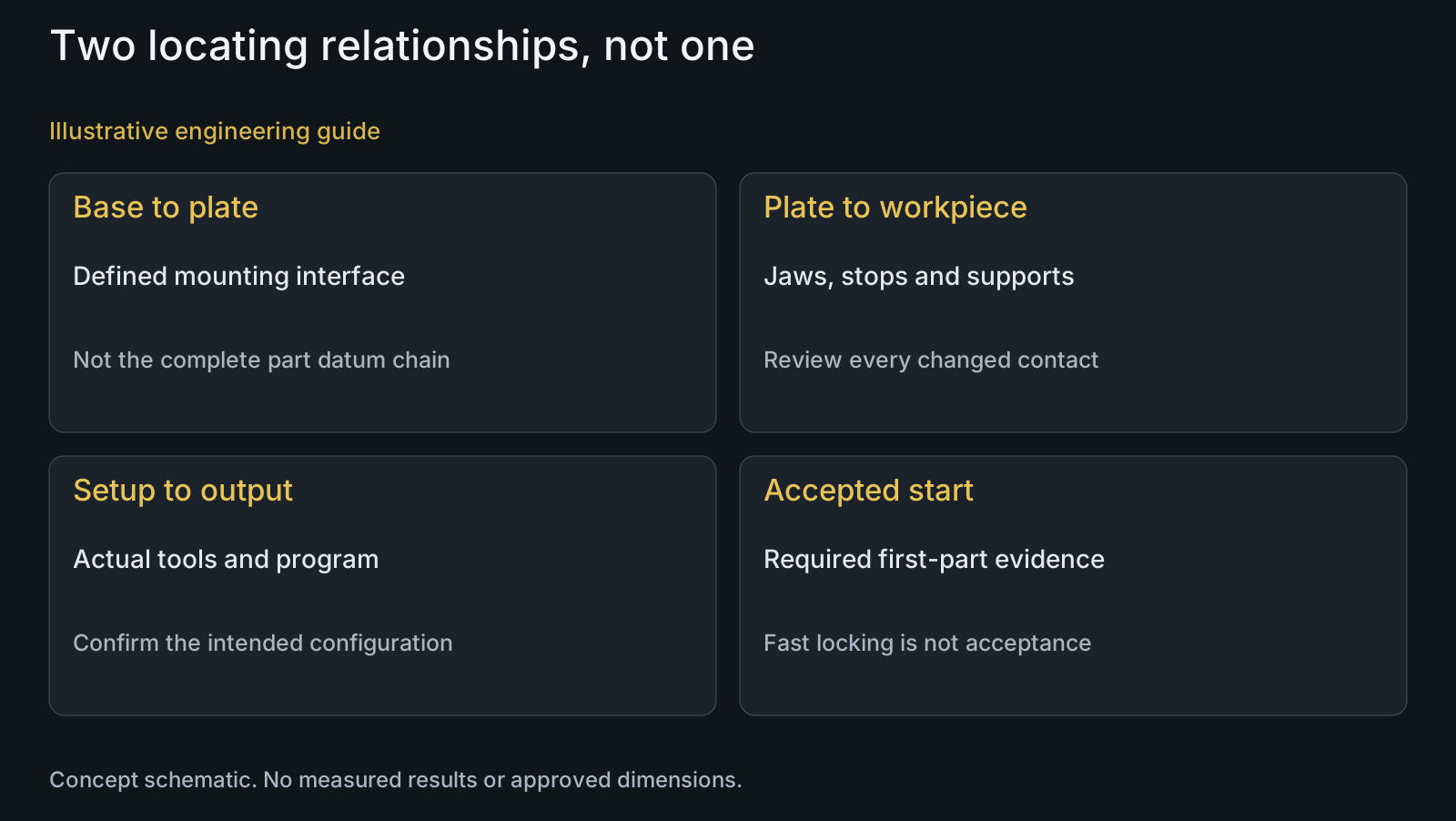
The mounting interface is not the entire datum chain
Carr Lane's Carr Lock description distinguishes the clamp, liner bushing in the top plate and receiver bushing in the subplate. It demonstrates a defined plate-locating interface, not the accuracy of every workpiece placed above it.
Follow the actual relationship from the machine setup through the plate and part-specific contacts to the controlled feature. Identify where the pivot is located axially and radially, where it is supported and which surfaces receive clamp load. A repeated plate position does not correct a changed part stop.
As a workholding-review implication, inspect the relevant contacts and seating condition before transferring an earlier setup conclusion. Chips or damaged contacts can matter even when the mounting hardware closes normally. Do not interpret easy locking as evidence that every locating relationship is preserved.
Part families need more than a shared outside diameter
Two shoulder axles can share a holding diameter while differing in length, axial reference, hollow section, exposed thread or feature requiring tool access. Those differences may change support, clamp contact or the position represented by the setup.
Review whether common tooling can preserve each member's specified datum relationship and protect its finished surfaces. The workholding-mark guide develops contact damage and held-versus-released conditions. Quick exchange cannot be justified by sacrificing the bearing-seat surface or deforming the component.
A proposed common fixture should state the range of part configurations it covers and which components must change between them. Do not group parts solely to reduce the number of setups when their locating or support requirements are materially different.
Tool and program confirmation remain part-specific
A mounted fixture does not establish the intended tool assembly, work offset or current program revision. Review the relevant holder and tool access against the new part and fixture. Moving one plate can leave a different clamp or support in the tool's approach.
The CNC optimization guide separates program visualization from complete verification. For the changeover, identify what the setup confirmation must establish for the actual machining configuration rather than treating a familiar part family as permission to skip it.
Define the first-part checks by the changed features and agreed requirements. Their purpose is not to prove every later piece or complete bicycle durability, but to establish the accepted start within their scope. The SPC guide explains why subsequent process monitoring remains a separate task.
An unchanged plate can still contain a changed setup
Illustrative engineering example: assume a second pivot axle uses the same mounting plate and holding diameter as the first, but its locating shoulder changes. The plate is exchanged without difficulty. No actual exchange time, dimensional readings or savings are supplied.
The review asks whether the existing stop represents the new drawing's axial relationship. If not, the part-specific setup needs adjustment and confirmation even though the plate interface is unchanged. The first accepted part, not the successful locking action, completes the defined transition.
Provide both drawings, material conditions, quantities and required delivery mix to CNC turning review. Connect proposed fixture reuse to the manufacturing process, identifying preparation scope and acceptance needs. PremFixer will review the manufacturing proposal without a universal changeover duration, equipment-brand claim or capacity promise.
Questions buyers need to confirm
Can modular fixtures guarantee a fixed changeover time?
No. Identify the actual part mix, required exchanges, tools, program confirmation and first-part checks. State the measured interval before comparing proposals; no universal duration is established here.
Does a repeatable plate position prove part accuracy?
No. The workpiece's jaw, stop and support relationships are separate links. A changed shoulder or contact can alter that relationship even when the plate returns to its intended position.
Can preparation on a second plate reduce stoppage?
It can move suitable preparation off the machine. Confirm the current revision, compatible fixture components and readiness; preparation outside stoppage does not automatically shorten every other transition task.
Is one holding diameter enough to define a fixture family?
No. Review axial references, length, hollow sections, access and surfaces receiving clamp load. Shared diameter does not prove that the same support and stops suit every member.
Can first-part confirmation be skipped after a quick exchange?
Do not assume so. Define the applicable confirmation for the new setup and changed features. Mechanical locking alone does not establish correct tools, offsets, program or delivered geometry.
What should a mixed-batch fixture RFQ contain?
Send the part drawings and STEP, quantities and mix, material conditions, protected features, acceptance requirements and proposed repeat-order schedule. Identify which members are new or revised so reuse can be reviewed accurately.
Technical references and scope
Jergens: Quick Change Kit. Relevant description136–150 fully read. Second-plate off-machine preparation mechanism only; product ranges, savings, ownership and claimed accuracy not transferred.
Carr Lane: Carr Lock System. Relevant description66–68 fully read. Top plate/subplate mounting components only; numerical repeatability and brand/equipment ownership not adopted.
Explore related component, material and sourcing decisions in the customer decision knowledge center. For a drawing review, use the Drawing/BOM RFQ path.
Review fixture reuse for your mixed pivot batch
Send the current drawings and STEP for each member, quantities, material conditions, key datums and protected surfaces. PremFixer will review part-family compatibility, preparation that can occur outside stoppage and the checks needed for the next accepted production start.
Discuss the drawing and BOM