

Evaluate a custom pivot supplier against the work your drawing and BOM require, not the size of an equipment list or the speed of a sales reply. Before ordering samples, compare manufacturing route, documents, inspection, relevant applications, sample state, technical communication, quantity basis, price scope, change handling and kit identity. Use the same project definition for each candidate and identify exclusions or proposed alternatives. This ten-question checklist supports initial selection; it is not a completed factory audit or proof of production approval. A critical unresolved interface or acceptance requirement remains open even when the supplier answers the other questions convincingly.
Hero: concept illustration of example hardware and its application. It is not a factory photograph, tested component or approved production geometry.
Start with a common component and purchasing baseline
Issue the same drawing revision, material condition, finish, quantity and delivery definition to the candidates being compared. Include the mating interface and BOM where kit function matters. Keep firm requirements separate from areas where a supplier may propose an alternative.
Without that baseline, answers can describe different products. One candidate may include finished bearing-contact surfaces and inspection records while another prices unfinished blanks. A seemingly simpler quotation is not evidence of better efficiency until its supplied state is understood.
Use the pivot RFQ input guide to assemble the package. This checklist then evaluates the response before sample ordering; it does not replace a later supplier audit or the customer's application approval.
Questions one to three: route, documents and inspection
Ask how the manufacturing route addresses the actual geometry and material condition. Identify producing responsibilities for machining, threads, treatment and inspection. An equipment name alone does not show access to a recessed feature, control of a treated seat or inspection of a datum relationship.
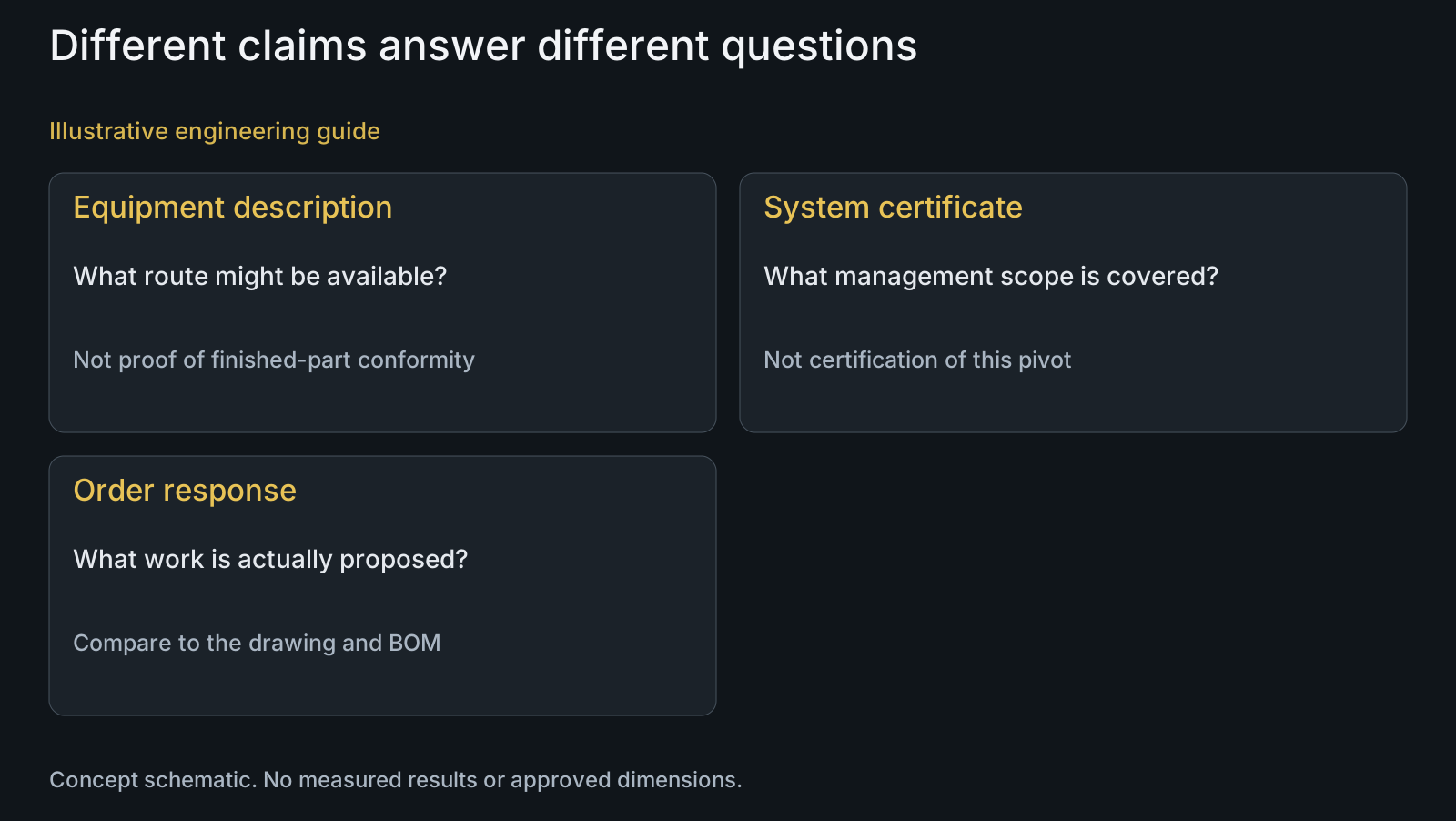
Ask what each requested document covers. ISO CASCO distinguishes management-system certification from product conformity: a system certification mark does not certify the individual product. Review the issuer, scope and applicable identity rather than treat a certificate logo as a dimensional report.
Ask which methods evaluate the critical finished features and what the submitted record will contain. A general statement that the supplier has a CMM does not establish a workable measurement approach for your shoulder, internal passage or thread. The inspection-capability guide connects characteristic, method and provider.
| Question | Order-specific response | Risk behind a vague answer | Check |
|---|---|---|---|
| 1. Manufacturing route? | Operations and producing responsibilities | Equipment list mistaken for feature feasibility | Relevant geometry and final-state route |
| 2. Document coverage? | Issuer, scope and identified object | System certificate treated as part certification | Document purpose and applicable identity |
| 3. Inspection method? | Critical feature, method and report scope | Generic inspection misses the required relationship | Final condition and accessible measurement |
| 4. Relevant applications? | Permitted examples with explained similarities | Appearance treated as model compatibility | Interface differences and disclosure permission |
| 5. Sample and date? | Purpose, delivered state and milestone | Unfinished sample mistaken for released hardware | Included operations and evidence |
| 6. Technical ownership? | Responsible contact and discrepancy response | Fast acknowledgment mistaken for issue closure | Answer reflected in the controlling scope |
| 7. Quantity basis? | Pieces, part numbers or complete kits | Unlike quantities compared | BOM quantities and order structure |
| 8. Price inclusions? | Finished scope and separate one-time charges | Low unit price omits required work | Like-for-like quotation |
| 9. Change handling? | Affected items and implementation boundaries | Revised file silently changes existing supply | Approved scope and stock actions |
| 10. Kit identity? | Part, revision and pack quantities | Valid components delivered as an incorrect kit | Contents tied to the BOM |
Questions four to six: relevance, samples and communication
Ask how public examples relate to the proposed interface. Similar-looking bicycle hardware can have different bearing contact, engagement and clamped-stack functions. Permitted application examples support a discussion of experience; they do not prove universal model fit or allow disclosure of another customer's drawing.
Ask what the sample will represent and which operations remain temporary or excluded. The sample should have a named purpose, finished state and accompanying evidence. A visual machining sample, dimensional first article and application-validation assembly are different commitments.
Ask who resolves technical discrepancies and how answers reach the quotation and manufacturing definition. Response speed is useful only alongside an accurate answer. A prompt acknowledgment can coexist with an unresolved tolerance conflict; purchasing needs to know which response actually closes the issue.
Questions seven to ten: quantities and supply controls
Ask whether quantities refer to individual parts, part numbers or complete kits, and how sample and production quantities are quoted. Do not compare one candidate's kit price with another's single-bolt price. Identify one-time work and order structure rather than impose an assumed universal MOQ.
Ask whether price includes the required material, processing, finished-state checks, packing and delivery basis. An unexplained higher price is not automatically evidence of better quality. The custom-fastener cost breakdown helps distinguish actual scope from a preferred commercial offer.
Ask how proposed changes and existing items remain identifiable, then how finished kit contents will be checked. These final questions connect revision handling to physical supply. A single coordinating supplier can simplify contact without removing item-level part numbers, quantities and acceptance requirements.
Judge gaps by consequence rather than a blended score
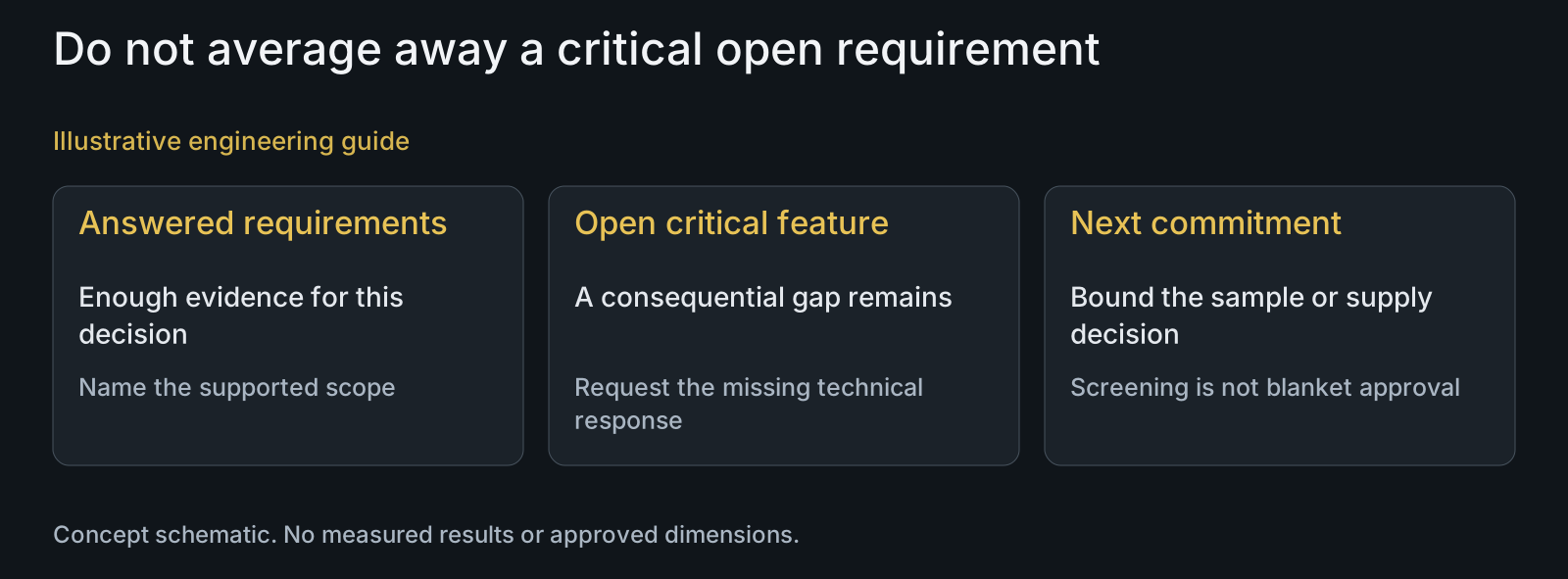
Classify each answer as sufficiently defined for the present decision, requiring clarification or unable to meet a stated requirement. Explain the reason. A noncritical packaging preference and an unresolved bearing-seat acceptance method should not receive equal weight merely because both occupy one checklist row.
Follow up on contradictions between public descriptions and the specific offer. PremFixer combines in-house cold heading, CNC machining, thread rolling and tool/die manufacture with qualified partner testing, heat treatment and surface treatment. Coordination does not mean every operation is owned or performed under one roof; order-specific scope remains necessary.
Keep initial screening, sample conformity and approved production scope distinct. A satisfactory questionnaire can justify the next bounded evaluation, not a blanket endorsement of future components. Record which part, revision, producing scope and decision the current evidence supports.
Review example: a strong questionnaire still has one blocking gap
Illustrative engineering example: assume a pivot drawing requires inspection of a bearing-contact feature after treatment. A candidate gives clear commercial answers and lists relevant machining equipment, but its proposed measurement report covers only the untreated component. No actual supplier or test result is represented.
The buyer asks how the final feature will be measured and priced. Until that scope is resolved, the candidate's other satisfactory responses do not establish conformance to the finished-state requirement. Another candidate's higher offer may include that work, but it still needs a technically suitable method rather than acceptance based on price.
The comparison therefore highlights one requirement-specific gap instead of declaring a winner from an average score. The next decision is whether a candidate can support an appropriately defined sample order. The checklist has improved selection clarity without claiming that an audit or qualification has already passed.
Questions buyers need to confirm
Is a large machine list enough to select a pivot supplier?
No. Ask how the proposed operations produce and check the features on your drawing. Access, material condition, treatment effects and final-state inspection can change the route. A machine category alone does not resolve those requirements.
Does an ISO 9001 certificate certify our pivot bolts?
No. Management-system scope and product conformity are different objects of assessment. Review the certificate's applicable identity and scope, then request the part-specific evidence your order requires. Do not infer a product result from a system certification mark.
Must every operation be performed in-house?
Not automatically. Determine who performs and controls each required operation and how the delivered result is established. A coordinated partner route can be assessed against the same drawing and supply requirements; neither outsourcing nor complete ownership alone establishes conformity.
Should the lowest-priced candidate be rejected?
No automatic conclusion follows. Normalize quantities, finished state, inspections, packing and delivery, then identify exclusions and one-time charges. A lower comparable price can be legitimate, while a higher offer still needs relevant scope and evidence.
Can good answers elsewhere offset an unresolved critical requirement?
No. Identify the requirement and consequence of the gap. A fast reply or attractive delivery proposal cannot establish an unmeasured finished bearing seat. Resolve the missing scope before treating the candidate as able to satisfy that requirement.
Does passing this questionnaire approve production?
No. It supports a defined screening or sample decision. Production approval needs the applicable evidence and responsible acceptance for the identified component, revision and producing scope. Do not extend a satisfactory early response to all later products.
Technical references and scope
ISO CASCO: attestations of conformity. Distinguishes the object of conformity assessment and management-system versus product certification marks. No claim of a completed supplier audit or application approval.
Explore related component, material and sourcing decisions in the customer decision knowledge center. For a drawing review, use the Drawing/BOM RFQ path.
Compare your pivot order against an explicit supply scope
Send the controlled drawing and BOM, material and finish requirements, critical acceptance features, sample purpose, quantities and receiving milestone. Identify any mandatory document or source requirement. PremFixer can respond with the relevant manufacturing responsibilities, proposed scope and open questions for a bounded sample or quotation decision.
Discuss the drawing and BOM